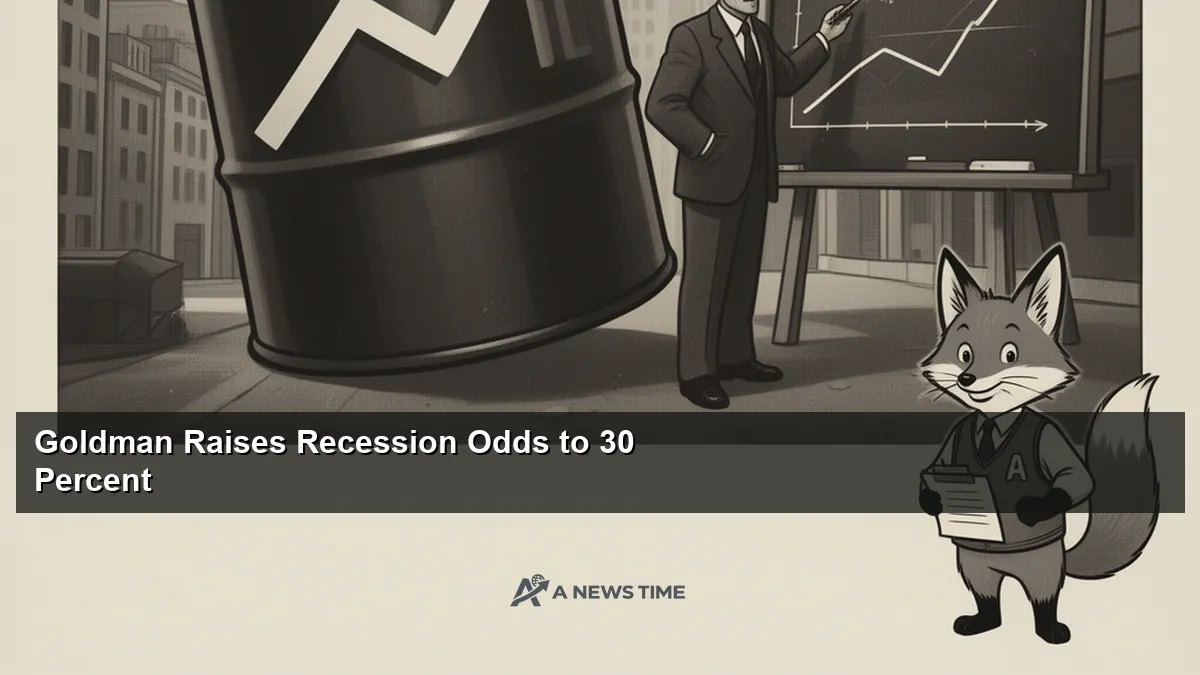
Goldman Sachs raised its estimate of the probability of a U.S. recession within the next 12 months to 30%, up from 15% in January, citing the escalating economic fallout from the U.S.-Iran military conflict and the oil price shock it has triggered. The revision, contained in a research note distributed to clients on Wednesday, represents the most significant upward adjustment to Goldman's recession forecast since the firm raised its estimate to 35% during the regional banking crisis of March 2023. It also places Goldman at the more pessimistic end of the Wall Street consensus, where the median recession probability estimate among major investment banks sits at approximately 22%.
The central driver of the revision is oil. Goldman's commodities research team, led by Jeff Currie, now expects Brent crude to average $115 per barrel in April, up from a previous forecast of $92, reflecting an assumption that disruptions to shipping through the Strait of Hormuz will persist for at least six weeks. The Strait handles approximately 17 million barrels per day of crude oil transit, roughly 20% of global supply. Even partial disruption of that flow, on the order of 2 to 3 million barrels per day, is sufficient to push prices well above the threshold at which energy costs begin to meaningfully erode consumer purchasing power and corporate profit margins.
The Goldman Framework: How Oil Becomes Recession
Goldman's recession probability model relies on a combination of leading economic indicators, financial conditions, and commodity prices. The note walks through the transmission mechanism in detail that is worth understanding, because it explains not just the forecast but the economic logic behind it.
The first channel is the consumer spending channel. The average American household consumed approximately 1,100 gallons of motor gasoline in 2025, according to EIA data. At the December 2025 national average price of $3.42 per gallon, that represented roughly $3,760 in annual gasoline spending. At the current national average of $4.15 per gallon (and Goldman's projection of $4.50 or higher by May if crude reaches $115), annual gasoline spending rises to approximately $4,950, an increase of $1,190 per household. That $1,190 comes directly out of the disposable income that households would otherwise spend on goods, services, and savings.
The second channel is the corporate margin channel. For the S&P 500 as a whole, Goldman estimates that a sustained $30 per barrel increase in crude oil reduces aggregate earnings by approximately 3 to 4 percentage points through higher input costs, transportation expenses, and energy bills. For energy-intensive industries (airlines, chemicals, cement, agriculture), the impact is several times larger. Delta Air Lines, as one example, has disclosed that every $1 increase in jet fuel prices reduces its annual pre-tax income by approximately $150 million.
The third channel is the financial conditions channel. Higher oil prices feed into inflation expectations, which constrain the Federal Reserve's ability to cut interest rates, which keeps borrowing costs elevated for businesses and consumers. Goldman's financial conditions index, a composite measure of interest rates, credit spreads, equity prices, and the dollar, has tightened by approximately 75 basis points since the conflict began, a degree of tightening that, if sustained, typically reduces GDP growth by 0.5 to 0.75 percentage points over the following four quarters.
The Six-Week Hormuz Assumption
The most consequential assumption in Goldman's analysis is the timeline: the firm expects Hormuz disruptions to persist for approximately six weeks from their current level. That assumption places the expected normalization somewhere in the second half of April, contingent on either a diplomatic resolution, a decisive military outcome that secures the waterway, or a combination of both.
The six-week estimate is notably shorter than what some military analysts consider realistic. Anthony Cordesman of the CSIS wrote this month that Iran's ability to threaten Hormuz shipping with mines, fast-attack craft, and anti-ship missiles could persist for "months rather than weeks" even under sustained U.S. military pressure, because Iran has had decades to prepare its asymmetric naval capabilities for exactly this scenario. The key installations, many of them mobile or underground, are designed to survive air strikes and continue operating.
If the disruption lasts longer than six weeks, Goldman's own model implies that recession odds would rise further. The note includes a sensitivity analysis showing that an eight-week disruption would push the recession probability to 38%, a 12-week disruption to 45%, and a scenario in which Hormuz is effectively closed for an entire quarter to 55%. Those are not predictions. They are conditional estimates. But they illustrate how the relationship between conflict duration and economic damage is not linear; it accelerates.
"The key variable is not whether oil prices spike. They already have. The key variable is duration. A six-week supply disruption is a manageable shock for strategic petroleum reserves and alternative shipping routes. A six-month disruption would be a structural break that alters the global energy map."
Jeff Currie, Chief Commodity Strategist, Goldman Sachs
What Brent at $105 Means in Historical Context
Brent crude has averaged approximately $105 per barrel through March, according to ICE futures data. That figure requires historical context to interpret properly. Adjusted for inflation, $105 in 2026 dollars is roughly equivalent to $85 in 2014 dollars, the level at which oil prices sat during the period of relative stability between the 2011-2014 Libyan crisis and the 2014-2016 OPEC price war. In other words, the current price is elevated but not at the inflation-adjusted extremes seen during the 2008 oil spike ($147 nominal, approximately $215 in 2026 dollars) or the 2022 Russia-Ukraine surge ($130 nominal, approximately $155 in 2026 dollars).
What makes the current price more economically significant than its nominal level might suggest is the velocity of the increase. Oil prices rose from $82 to $105 in approximately eight weeks, a 28% increase that businesses and consumers had no time to adjust to. When oil rises gradually over a period of months or years, businesses can adjust pricing, renegotiate contracts, and invest in efficiency. When it jumps 28% in two months, the cost increase hits margins immediately, with no time for adaptation.
Fortune reported that Goldman's projection of $115 in April, if realized, would represent a 40% increase from December, a pace of increase that has been associated with recession in three of the four previous instances when it occurred (1973, 1979, and 2008). The one exception was 1990, when the Gulf War oil spike was brief enough that it produced a shallow, short recession rather than a deep one.
Higher Inflation, Lower GDP: The Stagflation Shadow
Goldman's updated economic forecasts paint a picture that resembles, in outline if not in severity, the stagflation episodes that defined the 1970s. The firm now expects headline PCE inflation to reach 3.4% by June 2026, up from its previous forecast of 2.6%, driven primarily by energy costs feeding through to transportation, food production, and housing. Core PCE, which excludes food and energy, is expected to remain elevated at 3.0% or above through the third quarter, reflecting the "stickiness" of inflation once it becomes embedded in wage expectations and corporate pricing decisions.
On the growth side, Goldman revised its 2026 full-year GDP growth forecast down to 1.1%, from 2.0% previously. That is not a recession forecast (a recession is technically defined as two consecutive quarters of negative GDP growth), but it is close enough to the zero line that any additional negative shock, a further oil spike, a financial market disruption, a spike in unemployment, could tip the economy into contraction. Goldman's Jan Hatzius, the firm's chief economist, described the outlook as "a narrow path between stagnation and contraction, with the width of that path determined primarily by the duration of the Hormuz disruption."
The combination of slowing growth and rising inflation is precisely the scenario that gives central bankers nightmares. The Federal Reserve's standard policy tools work by trading one problem for the other: higher rates fight inflation at the cost of growth, while lower rates support growth at the risk of inflation. When both problems exist simultaneously, there is no rate level that solves both. The Fed's current posture, holding the federal funds rate at 5.25% to 5.50%, is an implicit acknowledgment that it cannot help the economy without risking further inflation, and it cannot fight inflation without risking further economic weakness.
The Strategic Petroleum Reserve Factor
One tool that could partially offset the oil supply disruption is the U.S. Strategic Petroleum Reserve (SPR), currently holding approximately 370 million barrels of crude oil. The Biden administration drew the SPR down to 347 million barrels in 2022 during the Russia-Ukraine energy crisis, the lowest level since the 1980s. The Trump administration partially refilled it through 2024 and 2025, bringing it to its current level, which represents roughly 18 days of total U.S. consumption.
The White House has authorized "coordinated releases" from the SPR in consultation with IEA member nations, but the scale of the releases so far, approximately 500,000 barrels per day, is insufficient to fully offset the estimated 2 to 3 million barrel per day reduction in Hormuz transit volume. Goldman's note characterizes the SPR releases as "a painkiller, not a cure," effective at taking the edge off short-term price spikes but unable to solve a sustained supply disruption of this magnitude.
The IEA's emergency reserves, held collectively by its 31 member countries, amount to approximately 1.2 billion barrels. A coordinated release of 4 to 5 million barrels per day, the maximum logistically feasible under the IEA's emergency sharing system, could bridge a gap of approximately six to eight weeks. Beyond that timeline, the world would need to find alternative supply sources (which take months to bring online) or accept a structurally higher oil price.
What Other Banks Are Saying
Goldman's revised recession probability did not emerge in isolation. Other major investment banks have been adjusting their forecasts in the same direction, though with varying degrees of alarm.
JPMorgan Chase raised its recession probability to 25% from 20%, with chief economist Bruce Kasman noting that "the conflict has introduced a supply-side shock to an economy that was already navigating the lagged effects of the 2022-2023 rate hike cycle." Morgan Stanley moved its estimate to 28%, just below Goldman's, and lowered its GDP growth forecast to 1.3%. Citigroup, which has historically been among the more cautious forecasters, raised its estimate to 30%, matching Goldman's, and warned that "the tail risk of a Hormuz closure is significantly underpriced by financial markets."
Bank of America took a somewhat more optimistic view, keeping its recession probability at 20% and arguing that "the U.S. consumer's balance sheet, while under pressure from energy costs, remains fundamentally healthier than in any previous oil shock, with elevated savings balances, low debt-to-income ratios, and a strong labor market providing a buffer." That assessment may prove correct. It may also prove to be an underestimation of how quickly consumer confidence can deteriorate when gas prices rise and stock portfolios shrink simultaneously.
Deutsche Bank, in a separate research note, highlighted a factor that other banks have mentioned but not emphasized: the OECD's recent downgrade of global growth forecasts. Because the U.S. economy does not operate in isolation, a global slowdown driven by the same oil shock would reduce demand for American exports, weaken multinational corporate earnings, and potentially trigger capital outflows from emerging markets that could destabilize the global financial system.
Market Implications
Goldman's note concludes with an assessment of what a 30% recession probability means for asset prices. In previous periods when Goldman's recession estimate has been in the 25-35% range, the S&P 500 has typically traded at a forward P/E multiple of 15 to 16, compared with the current level of approximately 17.8. That implies further downside of 6 to 10% from current levels if the recession probability estimate is accurate and the market fully prices it in.
For the bond market, a 30% recession probability typically supports lower long-term yields, as investors seek safety in Treasuries. However, the inflationary component of the current shock complicates that relationship: bond investors are reluctant to buy duration (long-maturity bonds) when inflation is rising, because inflation erodes the real value of the fixed payments that bonds provide. The result has been a relatively flat Treasury yield curve, with the 10-year yield hovering around 4.58%, providing neither the "flight to safety" rally that equity bears might expect nor the "inflation panic" selloff that bond bears have feared.
The dollar has strengthened modestly, reflecting its traditional role as a safe-haven currency during geopolitical crises. Goldman expects that strength to persist as long as the conflict continues, which has negative implications for U.S. exporters and for emerging market economies that borrow in dollars.
The So What
Goldman's revised recession estimate matters not because Goldman's forecasts are infallible (they are not), but because Goldman is the most influential voice in the institutional investor ecosystem. When Goldman raises its recession probability, pension funds reassess their equity allocations, credit committees tighten lending standards, and corporate boards ask tougher questions about capital expenditure plans. The forecast, in other words, has the potential to become partially self-fulfilling: by signaling increased economic risk, it prompts behavioral changes that themselves reduce economic activity.
The 30% figure is not a prediction that a recession will occur. It is a statement that the probability is high enough to warrant serious preparation. For businesses, that means stress-testing budgets against a scenario of sustained $100-plus oil and 1% GDP growth. For the Federal Reserve, it means navigating a policy environment where the risks of doing too much and doing too little are roughly balanced. For investors, it means the risk-reward profile of U.S. equities has shifted materially since January, and the market may not yet fully reflect that shift.
The number to watch is not Goldman's recession probability. It is the price of oil. If Brent crude stabilizes below $100, the recession probability drops. If it pushes above $120, the probability rises. Everything else, the Fed's response, the corporate earnings impact, the consumer spending trajectory, follows from that single variable. And that variable, in turn, depends on a military conflict whose outcome no economic model can predict.