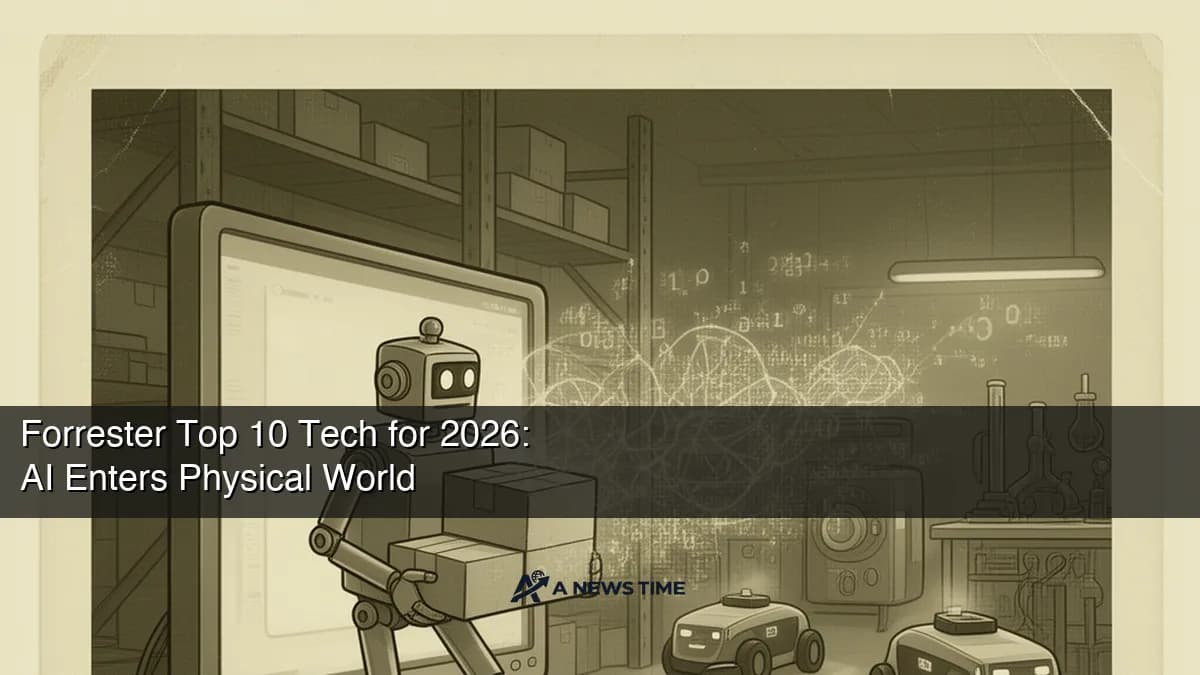
Forrester released its annual "Top 10 Emerging Technologies" report on , and the headline finding represents a fundamental shift in how the research firm frames artificial intelligence. For the first time, the dominant theme is not what AI can do inside software, but what it can do in the physical world. Robots, vehicles, and ambient environments now sit alongside chatbots and code generators as the defining applications of the technology. The report categorizes each technology by its expected benefit horizon, giving enterprise leaders a framework for deciding where to invest now versus where to place longer-term bets.
AI Moves Beyond Software Into Physical Environments
The central thesis of Forrester's 2026 report is that AI has crossed a threshold. It is no longer confined to digital workflows, screen-based interactions, and software automation. The technology is now powering robots that operate in warehouses, vehicles that navigate streets, and ambient experiences that change how consumers interact with physical spaces.
This is a meaningful shift from previous editions of the report, which focused primarily on AI's impact on knowledge work, content generation, and enterprise software. The 2026 version acknowledges that the technology's reach has expanded beyond what any single category can contain, and it structures the list accordingly.
"While AI continues to dominate the top emerging technologies list for 2026, AI technologies vary widely in capability and impact. Our research is designed to help business and technology leaders spread their investments out by identifying shorter-term technologies that can deliver quick returns and longer-term bets that require more effort, more foundational investment, and the capacity to manage more risk."Sharyn Leaver, Chief Research Officer, Forrester
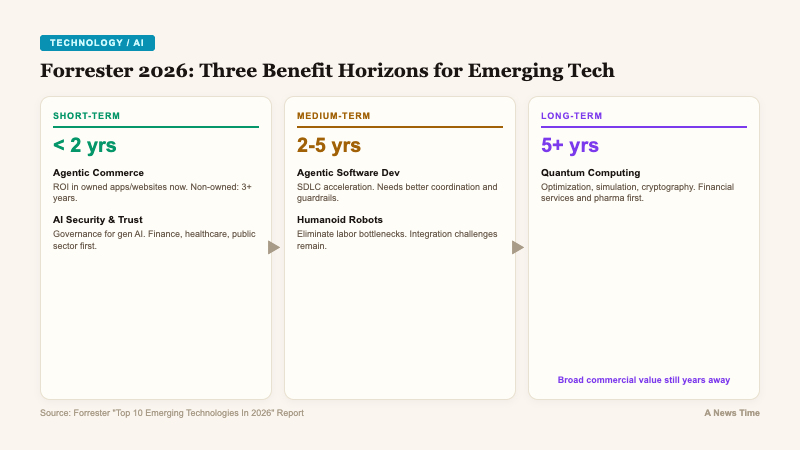
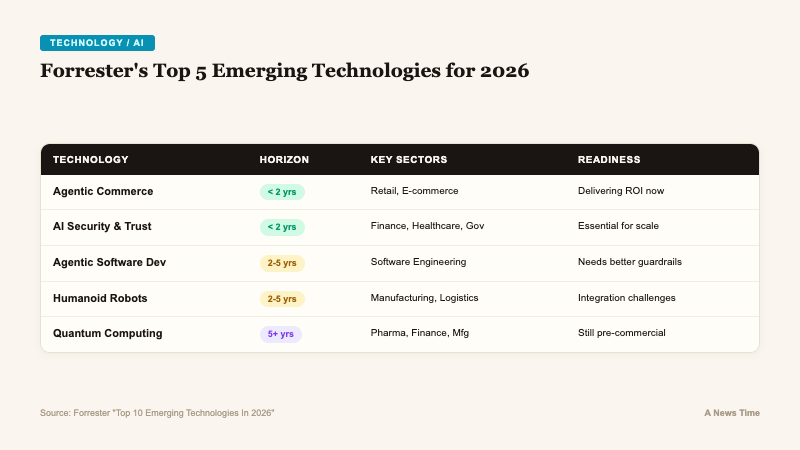
The report organizes its top 10 into three time horizons, each with different risk-reward profiles for enterprises considering adoption.
The Three Benefit Horizons at a Glance
| Horizon | Timeline | Technologies | Key Sectors |
|---|---|---|---|
| Short-Term | Within 2 years | Agentic Commerce, AI Security & Trust | Retail, Financial Services, Healthcare, Public Sector |
| Medium-Term | 2-5 years | Agentic Software Dev, Humanoid Robots | Software Engineering, Manufacturing, Logistics |
| Long-Term | 5+ years | Quantum Computing | Financial Services, Pharma, Manufacturing |
The three-tier structure is designed to help executives avoid the common trap of treating all emerging technologies as equally imminent. A retailer evaluating agentic commerce faces a fundamentally different investment decision than a manufacturer weighing humanoid robots, even though both fall under the broad AI umbrella.
Short-Term: Agentic Commerce Delivers ROI Now
The short-term category includes technologies that are already moving from trial to real use and delivering measurable benefits to early adopters. Agentic commerce tops this tier, with Forrester predicting that businesses will see return on investment in owned digital environments such as apps and websites within the next two years.
The concept is straightforward: AI agents that can complete transactions, personalize recommendations, and lower purchase friction on behalf of consumers. Think of it as the logical next step from recommendation engines and chatbots, where the AI does not just suggest a product but handles the entire purchase flow.
Forrester notes an important limitation, however. While agentic commerce will deliver quickly in environments that brands control, broader adoption in non-owned environments (third-party marketplaces, social platforms, voice assistants) will take an additional three years or more as the underlying ecosystems and interoperability standards mature.
The second short-term technology, AI security and trust, reflects the inevitable consequence of scaling generative and agentic AI across enterprises. As these systems handle more data, make more decisions, and interact with more external services, the attack surface expands. Forrester identifies integrated security, governance, and trust controls as essential infrastructure, with financial services, healthcare, and the public sector leading adoption because of their regulatory requirements and high-stakes decision environments.
Medium-Term: Humanoid Robots and Agentic Software Development
The medium-term category requires what Forrester describes as "discipline, vision, and a substantial tolerance for risk." These technologies promise larger rewards but need two to five more years of development before they deliver significant enterprise value.
Agentic software development (ASD) represents the next phase of AI-driven engineering tools. Current AI coding assistants suggest code and complete functions. ASD goes further: agents that generate, test, and refine software artifacts across the entire development lifecycle. The acceleration potential is enormous, but Forrester cautions that the technology needs better agent coordination protocols and stronger guardrails before it can operate reliably at enterprise scale.
This tracks with what the industry has been seeing. OpenAI's GPT-5.4 enterprise launch and similar releases from Anthropic and Google have pushed AI coding capabilities forward dramatically, but the gap between "generates code that works in isolation" and "reliably coordinates across a complex codebase" remains substantial. Forrester's two-to-five-year timeline for significant ASD benefits implicitly acknowledges that gap.
Humanoid robots make the list for the first time as a standalone category, reflecting both the hardware advances from companies like NVIDIA (whose robotics platform was a major focus at GTC 2026) and the AI improvements that allow robots to adapt to unstructured environments. Forrester frames them as labor bottleneck eliminators across every industry, but flags a substantial list of challenges: integration complexity, scaling difficulties, safety requirements, data needs, and workforce transition issues.
The report's characterization is notably measured. Humanoid robots will "deliver limited near-term value" until these challenges are addressed, a frank assessment that contrasts with the hype cycle surrounding companies like Figure AI and Tesla's Optimus program. The technology is real and improving rapidly, but the operational barriers to deployment at scale are equally real.
Long-Term: Quantum Computing Remains Years Away
Quantum computing sits alone in Forrester's long-term category, a position it has occupied for several consecutive years. The report acknowledges meaningful advances in quantum hardware, algorithms, and hybrid architectures that "point toward future breakthroughs in optimization, simulation, cryptography, and materials science." But broad commercial value remains years away.
The sectors Forrester identifies as early quantum beneficiaries are familiar: financial services (portfolio optimization, risk modeling), pharmaceuticals (molecular simulation, drug discovery), and manufacturing (materials science, supply chain optimization). These are the same sectors that have led quantum experimentation since the field's early commercial days, suggesting that while the technology is advancing, the use case landscape has not fundamentally changed.
The investment from companies like defense tech firms and hyperscale cloud providers continues to accelerate, but the gap between quantum research demonstrations and production-ready enterprise applications remains wide. Forrester's placement of quantum in the 5+ year horizon is a reality check for executives who may be over-indexing on the technology's long-term potential at the expense of nearer-term AI investments.
What the Report Means for Enterprise Investment Decisions
The practical value of Forrester's framework lies in its ability to help technology leaders allocate budgets across time horizons. The temptation for many enterprises is to concentrate spending on whatever is generating the most headlines, which currently means generative AI and large language models. The report argues for a more diversified approach.
Short-term technologies like agentic commerce and AI security deserve aggressive investment because the payoff window is near and the competitive advantage of early adoption is significant. Medium-term technologies like ASD and humanoid robots warrant active experimentation and pilot programs but should not consume the bulk of current budgets. Long-term bets on quantum computing should be maintained at a research and partnership level without expectations of near-term returns.
Leaver's framing cuts through the noise: "Business and technology leaders need to plan their tech investments based on value, risk, and potential payout timelines." The report's classification system provides the structure for that planning, even if individual enterprises will need to calibrate the framework to their specific industry position and risk tolerance.
The Bigger Shift: From Digital Experimentation to Physical Deployment
The most significant takeaway from the 2026 report is not any individual technology but the directional shift it documents. AI's movement from screens to physical environments changes the nature of the technology's impact on the economy and society. Software automation displaces tasks. Physical AI displaces roles and reshapes entire operational models.
When a warehouse deploys humanoid robots, the change is not incremental. When a vehicle navigates autonomously, the insurance, liability, and workforce implications extend far beyond the technology itself. And when agentic commerce systems can complete transactions without human intervention, the relationship between consumers and brands changes in ways that current regulatory frameworks are not equipped to address.
Forrester's report does not shy away from these implications, but it frames them as challenges to manage rather than reasons to retreat. The technologies on the list are coming regardless of enterprise readiness. The question Leaver poses is whether organizations will be positioned to capture value from them or will be disrupted by competitors who moved earlier. That framing is likely to resonate with the C-suite audience the report targets, and it sets the terms for technology strategy conversations through the rest of 2026.