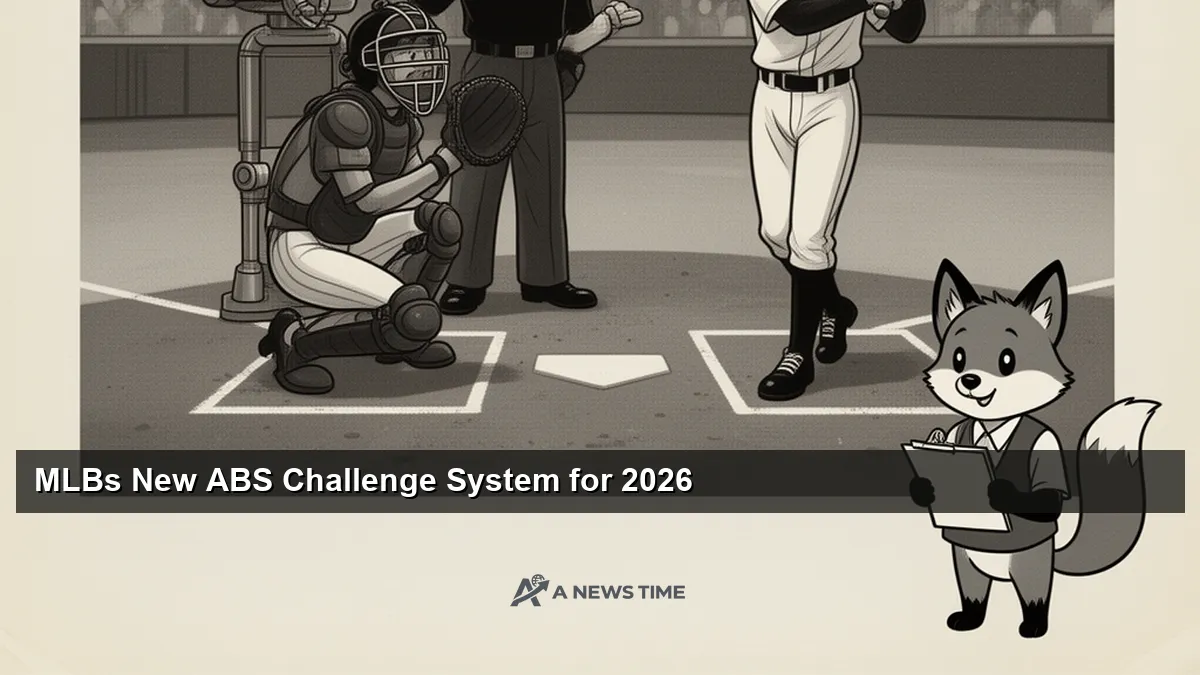
Major League Baseball has introduced the most significant change to the ball-strike calling system in the sport's history. Beginning with the , players can now challenge ball and strike calls using the Automated Ball-Strike (ABS) challenge system, a technology-assisted review process that has been tested in the minor leagues since 2022 and is now making its debut at the highest level. The system does not replace human umpires. Instead, it gives players a limited number of opportunities per game to appeal a call to the ABS technology, which uses pitch-tracking data to determine whether a pitch was, in fact, a ball or a strike.
How the ABS Challenge System Works
The core mechanics are straightforward. Each team receives a set number of challenges per game (three, under the current rules). When a batter or catcher disagrees with a ball-strike call, they can signal for a challenge. The home plate umpire then consults the ABS system, which uses Hawk-Eye pitch-tracking technology (the same system used for replay review in tennis and cricket) to determine whether the pitch crossed the strike zone. If the ABS system overturns the call, the challenge is successful and the team retains it. If the ABS system confirms the umpire's original call, the challenge is unsuccessful and the team loses it.
The strike zone used by the ABS system is calibrated to each individual batter's height. Before the season, MLB established a standardized strike zone definition: the area above home plate between the midpoint of the batter's torso and the hollow beneath the kneecap, with the horizontal boundaries defined by the 17-inch width of home plate. The ABS system uses the batter's pre-registered height to calculate the top and bottom of their individual zone, then tracks the pitch's trajectory to determine whether any part of the ball crossed any part of the zone.
"This is not about replacing umpires. This is about giving players a tool to correct calls that technology shows were incorrect. The umpire is still calling the game. The challenge system is a safety net, not a replacement."
MLB Commissioner's Office, ABS Challenge System Announcement
The technology behind the system is precise. Hawk-Eye's pitch-tracking cameras, which are installed in all 30 MLB stadiums, track the ball's position with an accuracy of approximately 0.25 inches. That level of precision is more than sufficient to determine whether a borderline pitch caught the edge of the strike zone or missed it. The system processes the challenge in approximately 5 to 8 seconds, meaning that the game is not significantly delayed by the review process.
Number of Challenges: The Strategic Dimension
Each team receives three challenges per game, regardless of how many are successful. This is a departure from the minor league testing phase, which experimented with both two and three challenges per team. MLB settled on three after analyzing data from the minor league trials, which showed that teams averaged 1.8 challenges per game when given two and 2.4 when given three. The additional challenge gives teams more flexibility without significantly increasing game time.
The strategic implications are significant. Managers and batters must decide which calls are worth challenging and which are not, knowing that a failed challenge reduces their remaining inventory. In the minor league trials, teams were more likely to challenge calls in high-leverage situations (runners in scoring position, two-strike counts, full counts) and less likely to challenge in low-leverage early-game situations. This pattern is expected to carry over to the major leagues, where the strategic calculus is, if anything, more intense.
The challenge decision rests with the player directly involved (the batter or the catcher), not the manager. This is a deliberate design choice. MLB wanted the challenge to be an immediate, in-the-moment response to a call, not a dugout-driven strategic decision that requires signaling and delay. The player must signal the challenge before the next pitch is thrown (or, in the case of a called third strike, before leaving the batter's box). If the moment passes, the challenge opportunity is lost. The speed requirement mirrors the kind of real-time decision-making systems that are transforming data-driven fields.
Teams cannot carry over unused challenges to extra innings. However, if a game goes to extra innings, each team receives one additional challenge. This provision was added after minor league data showed that challenge usage increased in extra innings, reflecting the higher stakes and the greater importance of each individual pitch.
Impact on Game Pace and Flow
One of the primary concerns about any new review system is its impact on game pace. MLB has invested heavily in pace-of-play initiatives in recent years, including the pitch clock (introduced in 2023) and rule changes designed to reduce dead time between pitches. Adding a challenge system that interrupts the flow of play would be counterproductive if it significantly increased game duration.
The data from the minor league trials is encouraging. The average challenge took 8.7 seconds from signal to resolution, a delay that is barely noticeable in the context of a baseball game. Across a full game, the cumulative time added by challenges averaged 22 seconds (for games with an average of 2.3 challenges). That figure is well within MLB's acceptable range and is offset, in part, by the reduction in extended arguments between players and umpires that the challenge system is designed to prevent.
The argument-reduction effect is significant. In the minor league trials, the number of prolonged ball-strike arguments (defined as interactions between a player and an umpire lasting more than 15 seconds) decreased by 47 percent after the challenge system was introduced. Players who disagreed with a call had a constructive outlet (the challenge) rather than a confrontational one (arguing with the umpire), and the result was fewer ejections, fewer delays, and a more professional atmosphere on the field.
"The challenge system actually speeds up the game in some ways. Instead of a hitter stepping out of the box to argue, or a catcher turning around to say something, they just signal the challenge and we move on. It is cleaner, faster, and more respectful of everyone's time."
Minor League Umpire, during ABS trial period
The pitch clock interaction is also worth noting. The challenge signal pauses the pitch clock. Once the challenge is resolved, the clock resets and play resumes. This prevents any penalty (an automatic ball or strike) from being assessed during the brief review period. The integration between the two systems was tested extensively in the minors and has been refined to ensure seamless operation.
Accuracy Data: How Often Are Umpires Wrong?
The ABS challenge system is built on a premise that can be empirically verified: umpires make mistakes on ball-strike calls, and technology can identify those mistakes. The data overwhelmingly supports both halves of that premise.
According to MLB's internal tracking (which uses the same Hawk-Eye technology that powers the ABS system), home plate umpires correctly called approximately 92.4 percent of ball-strike pitches in the 2025 season. That figure represents a slight improvement over the 2024 rate of 91.8 percent, reflecting ongoing training and accountability measures. However, a 92.4 percent accuracy rate still means that approximately 7.6 percent of ball-strike calls are incorrect, which translates to roughly 14 missed calls per game (based on an average of 185 called pitches per game).
The errors are not evenly distributed. Umpires are significantly more accurate on pitches over the heart of the plate (accuracy above 99 percent) and significantly less accurate on borderline pitches that clip the edges of the zone (accuracy around 78 to 82 percent). Since borderline pitches are the ones most likely to be challenged, the ABS system is expected to overturn calls at a rate of approximately 18 to 22 percent, based on minor league data. This means that roughly one in five challenges will result in a changed call, a rate high enough to justify the system's existence but not so high that it undermines confidence in the umpires' overall competence.
The distribution of errors also varies by count. Umpires are slightly less accurate on 3-2 counts (91.1 percent) and 0-2 counts (90.8 percent) compared to other counts, a finding that aligns with research on decision-making under pressure. The ABS challenge system provides a corrective mechanism that is most valuable in exactly the situations where umpire accuracy is lowest, which is a well-designed feature of the system.
Player and Coach Reactions
Reactions from players and coaches have been broadly positive, though not unanimous. Position players, particularly batters, have been the most enthusiastic advocates of the challenge system. For batters, the strike zone is the most consequential area of the game, a called strike three on a pitch that was actually a ball can end an at-bat, strand runners, and change the outcome of a game. The ability to appeal a call that a batter believes was wrong is a meaningful addition to the game's competitive framework.
Pitchers have been more cautious in their endorsement. Several starting pitchers have expressed concern that the challenge system could erode the "pitcher's strike zone," the tendency of umpires to give elite pitchers slightly more generous strike zone boundaries based on their reputation and the quality of their stuff. If the ABS system enforces a uniform zone regardless of pitcher identity, the advantage that elite pitchers have historically enjoyed on borderline pitches could diminish. This is an intentional feature of the system (uniform enforcement is the point), but it represents a real competitive adjustment for pitchers who have benefited from subjective umpiring.
Catchers, particularly elite pitch framers, are in a complex position. Pitch framing, the art of receiving a pitch in a way that makes a borderline ball look like a strike, has been a valued skill for the past decade. The ABS challenge system does not eliminate framing (umpires still make the initial call, and good framing can influence that call), but it does reduce the long-term value of the skill by introducing a correction mechanism for the calls that framing influences. Catchers who have built their value proposition around elite framing will need to demonstrate other skills to maintain their roster spots and their salaries. The shift is similar to how technology disrupts established business models, forcing adaptation and new sources of value creation.
The Umpire Perspective
MLB's umpires, represented by the Major League Baseball Umpires Association, have been cautiously supportive of the challenge system. The union negotiated several provisions during the implementation process, including a commitment from MLB that the challenge system would not be used as a performance evaluation tool for umpires (challenge overturn rates will not factor into umpire assignments or discipline) and a guarantee that the system would not lead to a reduction in the number of umpires assigned to games.
Individual umpires have offered mixed perspectives. Some view the challenge system as a welcome safeguard that protects them from the consequences of honest mistakes. Others see it as an implicit criticism of their competence, a public acknowledgment that their calls cannot always be trusted. The psychological dimension of the change should not be underestimated. Home plate umpires have been the sole arbiters of the strike zone for the entire history of professional baseball. Sharing that authority with a machine, even in a limited challenge-based format, represents a fundamental shift in the umpire's role.
"We are going to make the right call the vast majority of the time. That has always been true, and it is still true. The challenge system catches the small percentage of calls that we miss, and I am fine with that. Getting the call right is what matters."
Veteran MLB Umpire, Spring Training 2026
Looking Ahead: The Path to a Fully Automated Zone
The ABS challenge system is widely viewed as a transitional step toward a fully automated strike zone, in which every ball-strike call is made by technology rather than a human umpire. MLB has not committed to a timeline for that transition, and Commissioner Rob Manfred has emphasized that the challenge system is the current plan, not a bridge to something else. However, the infrastructure is now in place, and the question of whether to eliminate human ball-strike calling entirely will be driven by public and player reaction to the challenge system over the coming seasons.
The minor league data suggests that a fully automated zone is operationally feasible. In Triple-A, where a fully automated zone was tested alongside the challenge system, games proceeded smoothly, player satisfaction was high, and the average game time was actually 3 minutes shorter than games using the challenge format (because challenges were unnecessary when every call was made by the machine). The technology works. The question is whether MLB wants to take the step of removing human judgment from ball-strike calling entirely, a decision that involves tradition, aesthetics, and the umpire union's interests in addition to operational efficiency.
For the 2026 season, the challenge system is the reality, and it is a significant improvement over the status quo. Players have a tool to correct incorrect calls. The game's pace is not meaningfully affected. And the umpires, who remain central to the game's operation, have a safety net that protects both them and the players from the inevitable human errors that occur over the course of a 162-game season. It is a sensible, well-tested change that deserves a fair evaluation based on its performance, not on abstract debates about tradition versus technology.
Byline: Aisha Mbeki, Senior Sports Reporter