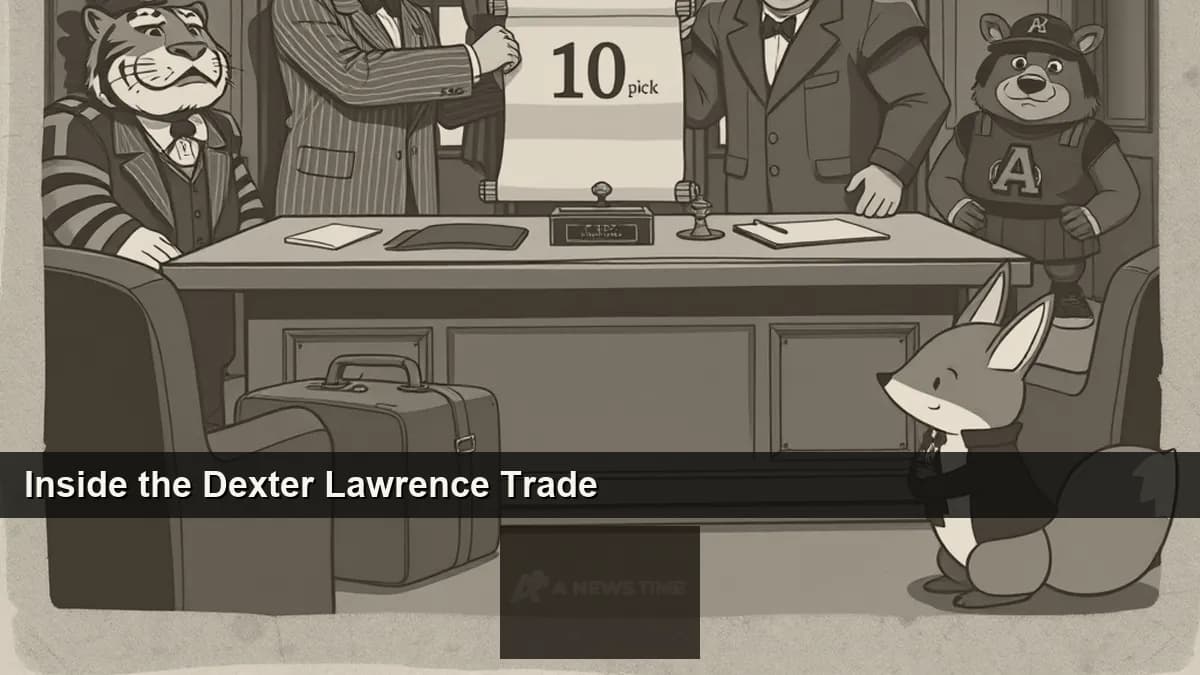
The Dexter Lawrence II trade from the New York Giants to the Cincinnati Bengals looked like an instant blockbuster when Adam Schefter broke the news . Behind-the-scenes reporting published Sunday by ESPN's Jordan Raanan, Jeremy Fowler, and Ben Baby shows the deal actually took nearly two weeks of quiet conversations to build, required a surprise offer that caught the Giants off guard, and was completed in one of the fastest post-agreement physicals in recent NFL memory. The negotiation timeline, contract structure, and cross-team dynamics that produced the trade reshape how both franchises enter draft week and set a template for future in-season stars requesting exits.
Lawrence, 28, requested a trade on . He signed a one-year, $28 million extension with the Bengals after arriving, converting his existing contract into an effective three-year, $70 million deal at roughly $23.3 million in annual average value. The Giants walk away with a second top-10 pick (at No. 10, alongside their own at No. 5) heading into in Pittsburgh. Cincinnati lands the defensive interior centerpiece the organization has openly said it needed to capitalize on Joe Burrow's prime.
Talks Started Two Weeks Ago
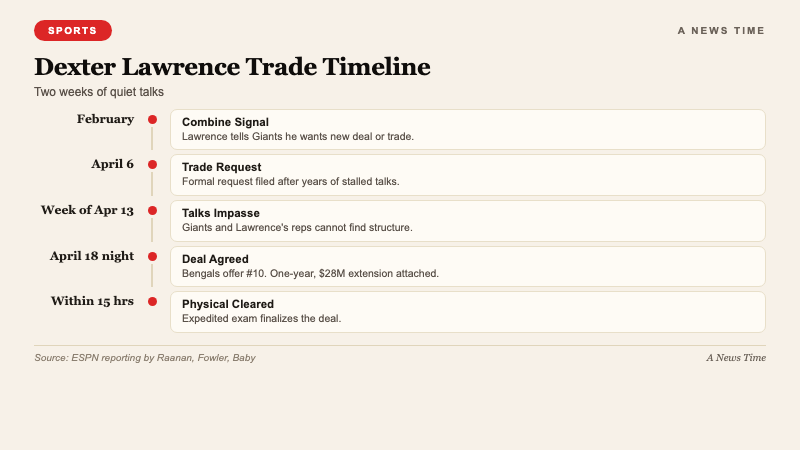
Conversations between Cincinnati and New York opened roughly two weeks before the trade was announced, according to sources with knowledge of the negotiations. The Giants at that point were still attempting to find a contract structure that would keep Lawrence, who requested the trade on April 6 after contract talks that had "been happening for two years" without real progress, in the words of a source close to the defensive tackle.
Multiple league sources told ESPN that New York was seeking a significant return for Lawrence. The consensus inside the market was that any deal would open with a first-round pick, with the expected final value landing at a late first-rounder or a second-rounder plus additional assets. "Nobody was going to beat the 10th pick," a Giants source told ESPN after the deal was done.
| Date | Event |
|---|---|
| February 2026 (combine) | Lawrence informs Giants he wants new deal or trade |
| Early April 2026 | Bengals and Giants open informal trade talks |
| April 6, 2026 | Lawrence formally requests trade |
| Week of April 13 | Contract talks between Giants and Lawrence reach impasse |
| April 18, 2026 | Trade agreed; one-year, $28M extension negotiated |
| Within 15 hours | Lawrence passes Bengals physical; trade finalized |
The Giants Thought They Could Keep Him
The Giants tried to make the relationship work even as they acknowledged the trade market was developing. New York offered to increase the $20 million Lawrence is due in 2026 but wanted a contract structure the organization considered favorable. Lawrence was not interested in those offers, per league sources. A person close to the defensive tackle said "he really wanted out" after watching friend Saquon Barkley depart for Philadelphia and win Super Bowl LIX while the Giants went 7-27 over two seasons.
First-year coach John Harbaugh communicated directly with Lawrence's agent Joel Segal for parts of the negotiation. A conversation between Harbaugh and Lawrence shortly after Harbaugh's hiring did not touch on contract matters and was described as "great." By the time business entered the picture, roughly two months after the NFL combine, the two sides had already run out of runway.
"I don't know where that came from."Joe Schoen, Giants general manager, at the NFL combine when asked about Lawrence's future
The Schoen comment is notable in retrospect. League sources indicated that by the combine, Lawrence had already informed the Giants that he wanted a new deal or a trade. Schoen's public posture of confusion reflected either an organizational preference for keeping the leverage private, or a genuine belief that the relationship could still be repaired. Either way, the public distance between the stated position and the reality shortened once April arrived.
Why Cincinnati Broke Its Own Rules
The Bengals had not traded a top-10 pick for an active player at any point since the NFL-AFL common-draft era began in 1966. That is six decades of organizational discipline, and it reflects a front-office culture that prefers to build through the draft and mitigate risk. The Lawrence trade reverses that posture in a single stroke.
"We don't want to throw away chances at finding guys in the draft who can be long-term real guys for us. We've found guys in about every round who have changed our team and been exceptional players."Duke Tobin, Bengals director of player personnel, at the NFL combine
The internal logic was urgency. Cincinnati has gone 24-37 over three seasons, missing the playoffs each year. Joe Burrow said publicly at the end of the 2025 season that "what we've been doing hasn't worked the last couple of years. We have to think outside the box and get creative about where we go from here." Burrow players openly referenced big-name trade candidates throughout the offseason, a signal unusual for a franchise that keeps its board tight.
Lawrence has commanded the highest double-team rate on pass rushes in the NFL over the past three years at 72.7%, according to ESPN's film tracking. A defensive tackle who attracts that much attention reshapes what the rest of the defense can do, and Cincinnati's pass rush over the past three years has lacked exactly that gravitational pull. Pairing Lawrence with BJ Hill gives defensive coordinator Lou Anarumo a two-down rotation that Cincinnati has not had since the 2021 AFC Championship run.
The 15-Hour Physical and the Crosby Precedent
The trade was announced late Saturday. Lawrence passed his physical in under 15 hours. That speed is unusual for a defensive lineman changing teams. A Giants source acknowledged to ESPN that both sides wanted the physical completed urgently because the draft was days away. The most recent high-profile trade to fall apart over a physical was the Ravens' deal for Raiders edge rusher Maxx Crosby, which collapsed after Baltimore raised concerns during its medical evaluation.
Multiple sources told ESPN that several NFL teams now expect expedited physicals to become standard in high-stakes pre-draft trades. The Crosby snafu changed the operational calculus. A deal can fall apart between the handshake and the finalized paperwork, which means compressed evaluation windows are a risk both sides accept in exchange for certainty.
Lawrence's contract structure is part of why the medical clearance mattered. The new extension adds one year and $28 million to the two years he already had remaining, creating a three-year, $70 million effective package. Seven defensive tackles in the NFL currently play on deals worth $24 million or more annually. The Lawrence contract slots at the high end of that tier but below the absolute peak for the position.
What the Giants Actually Bought
The Giants now hold picks No. 5 and No. 10 entering the first round. That is two top-10 selections, an asset profile no team has carried into a draft since the 2016 Tennessee Titans. For first-year coach John Harbaugh, the capital is both opportunity and pressure. A rebuilding roster does not normally get this kind of starting point, and the 2026 class is regarded around the league as a mid-tier group, which raises the importance of landing the right two players from the set available.
Schefter's intel report identified several candidates the Giants are considering at those two slots. The consensus inside the building, per league sources, is that Notre Dame running back Jeremiyah Love is in play at No. 5 if he slides from No. 3 after Arizona. At No. 10, the Giants have broader flexibility, with a quarterback, an offensive tackle, or a second high-impact defensive player as the likely categories.
Frequently Asked Questions
When did Dexter Lawrence request a trade?
Lawrence formally requested a trade from the Giants on April 6, 2026, after informing the organization at the February NFL combine that he wanted either a new contract or a trade. Contract discussions between his representation and the Giants had been ongoing for approximately two years without meaningful progress.
What was Lawrence's new contract with the Bengals?
Lawrence signed a one-year, $28 million extension with Cincinnati after the trade, converting his existing deal into an effective three-year, $70 million package at approximately $23.3 million in annual average value.
Is this the first time the Bengals have traded a top-10 pick for a player?
Yes. The Lawrence trade is the first time the Cincinnati Bengals have traded a top-10 pick for an active player since the NFL-AFL common draft began in 1966, a six-decade organizational departure from the franchise's traditionally draft-focused approach.
What picks do the Giants now hold in Round 1?
The Giants hold the No. 5 and No. 10 overall picks in the 2026 NFL Draft, which begins Thursday, April 23. The No. 10 selection was acquired from Cincinnati as part of the Lawrence trade, alongside the Giants' own No. 5 pick.
How quickly did Lawrence pass his physical?
Lawrence passed his Bengals physical in under 15 hours from the time the trade news broke. Sources told ESPN the expedited medical clearance was important because of the nearing draft and because of concerns raised by the recently failed Maxx Crosby deal between the Raiders and Ravens, which collapsed after Baltimore's physical evaluation.
What Changes Thursday Night
The Lawrence trade is now a reference point for how a franchise motivated by a Super Bowl window can be persuaded to break with organizational convention. The Bengals bought an All-Pro interior rusher six days before a draft they now enter with one of the narrower first-round boards in the league. The Giants walked into the week with two of the top 10 picks and a new coach who has five days to figure out which two players he wants. The 2026 draft was always going to be consequential for both teams. The Saturday night trade just made it the single most consequential pre-draft transaction either franchise has executed in the past decade.