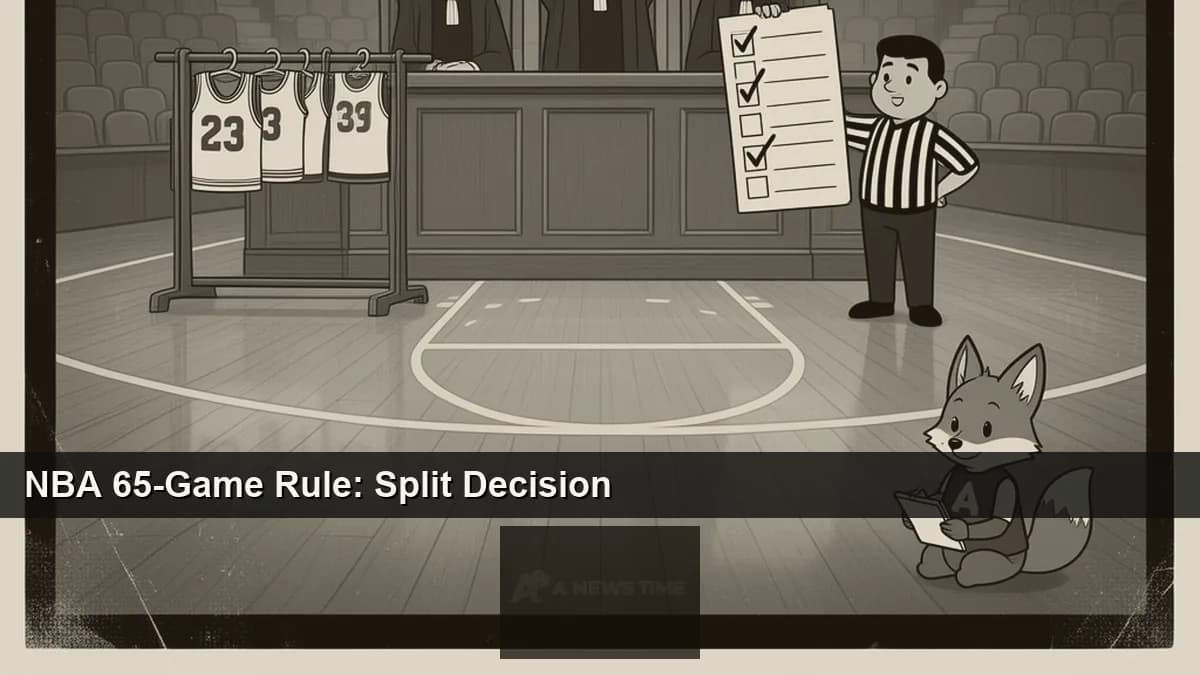
The NBA and the NBPA jointly announced on that Los Angeles Lakers guard Luka Doncic and Detroit Pistons guard Cade Cunningham will be eligible for major postseason honors despite falling short of the 65-game minimum, after both players' extraordinary-circumstances appeals were approved. Minnesota Timberwolves guard Anthony Edwards, who also filed, had his appeal denied by an independent arbitrator and will not be eligible for awards including MVP or All-NBA. The ruling preserves MVP-tier candidacies for two All-Star guards whose seasons were interrupted by injuries and a family event, while closing the door on Edwards in a way that is already drawing heat from player agents and media.
What the Rule Says and What Just Happened
The 65-game threshold was negotiated into the 2023 collective bargaining agreement as a check on regular-season load management. The league wanted star players on the floor more often, and the rule tied eligibility for major awards to a concrete attendance standard. To qualify, a player has to appear in at least 65 regular-season games and log a minimum of 20 minutes in at least 63 of those games, with exceptions up to two games where a player can play fewer minutes and still get credit.
Doncic appeared in 64 games. He missed the last five games of the regular season with a hamstring strain and sat two games in December when he flew home to Slovenia for the birth of his daughter. Cunningham also appeared in 64 games, though only 63 counted: he left a March 17 game against the Pacers after five minutes because of a collapsed lung, which forced him to miss 11 games down the stretch. Edwards appeared in 61 games, with only 60 counting toward the threshold. All three teams filed extraordinary-circumstances challenges on their players' behalf.
"The NBA and NBPA agreed that, taking into account the totality of the circumstances for Cunningham and Doncic, each player qualified for awards under the extraordinary circumstances provision in the CBA."NBA and NBPA joint statement, April 16, 2026
The word that is doing the work in that statement is "totality." The CBA language is deliberately imprecise about what qualifies as extraordinary circumstances, leaving the league and union to negotiate case by case. A collapsed lung is obviously medical and unusual. A hamstring strain happens to hundreds of players every season, but the combination of that with a paternity trip the Lakers formally supported apparently tipped the balance for Doncic. Edwards's argument, whatever it was, did not land.
The Statistical Case and the Appeal Math
| Player | Games played | Games counted | Reason(s) for absence | Appeal outcome |
|---|---|---|---|---|
| Luka Doncic (LAL) | 64 | 64 | Hamstring strain (5 games); daughter's birth in Slovenia (2 games) | Approved |
| Cade Cunningham (DET) | 64 | 63 | Collapsed lung (11 games); left March 17 game after 5 minutes | Approved |
| Anthony Edwards (MIN) | 61 | 60 | Undisclosed in public ruling | Denied by independent arbitrator |
On pure basketball merit, all three are All-NBA-caliber guards this season. Doncic, playing his first full year with the Lakers alongside LeBron James, is chasing a sixth All-NBA First Team nod in eight seasons. Cunningham, anchoring a Pistons team that won 60 games for the first time since 2006 and locked up the East's No. 1 seed, has never been All-NBA and is expected to make a team now that his eligibility is restored. Edwards carried the Timberwolves through yet another competitive Western Conference with elite scoring and defensive metrics, and his exclusion from All-NBA consideration will be hard to justify on the stat line alone.
The awards calculus actually matters for the two approved players. Doncic is unlikely to win MVP (that race involves Nikola Jokic, Victor Wembanyama, and Giannis Antetokounmpo among others), but finishing in the top five has historical significance for the career narrative. Cunningham gains a legitimate shot at his first All-NBA selection, which affects max contract supermax eligibility under the CBA's Designated Veteran Extension framework.
The Edwards Problem and What It Signals
The Edwards ruling is where the rule's inconsistency becomes awkward. His 60-count total is only three games short of eligibility, and absent specific medical documentation that neither the league nor the arbitrator has shared publicly, the cultural optics look like this: two stars with high-profile, sympathy-inducing reasons got through, while Edwards, whose reasons have not been disclosed with the same specificity, did not. That may turn out to be defensible once more detail emerges. For now, it reads as selective enforcement.
The broader issue is that the rule has never functioned cleanly as a load-management enforcement tool. Players who are truly trying to manage their bodies across an 82-game regular season have found that the threshold is reachable with discipline, so the rule mostly catches legitimate injury cases. In 2024, Joel Embiid and Tyrese Haliburton were among the high-profile names affected. In 2025, Kawhi Leonard and Paul George sat out of awards consideration under it. The 2026 list is shaping up to be similar.
Doncic acknowledged the NBPA's role in his public statement on social media.
"I am grateful to the NBPA for advocating on my behalf and to the NBA for their fair decision. It was so important to me to be present for the birth of my daughter in December and I appreciate Mark, Jeanie, Rob, JJ, and the entire Lakers organization for fully supporting me and allowing me to travel to be there."Luka Doncic, Los Angeles Lakers guard
The Playoff Picture Complicates Everything
The awards ruling is a parallel track to the actual postseason. Doncic's availability for the Lakers' first-round series against the Houston Rockets, which begins Saturday, is still in question. Lakers coach JJ Redick told reporters Tuesday that both Doncic and Austin Reaves (oblique) remain "out indefinitely." Doncic traveled to Spain recently for hamstring treatment in an attempt to accelerate recovery, a trip the Lakers authorized in part because of the scheduling breaks between Games 2 and 3 (April 21 to April 24) and Games 4 and 5 (April 26 to April 29) that could allow a later return if the series extends.
Cunningham's situation is cleaner. He returned to the Pistons' lineup on April 8 and played in the final three regular-season games, meaning he will be ready for Detroit's playoff opener on Sunday. The Pistons held onto the No. 1 seed in the East despite his absence and are waiting to face the winner of Thursday's Play-In Tournament finale between the Orlando Magic and Charlotte Hornets.
The Timberwolves and Edwards have their own first-round matchup to focus on, but the awards ruling adds a layer of internal motivation that will carry over into the offseason's media cycle and next season's contract negotiations. Edwards is already on his max extension, so the financial impact is limited, but All-NBA selections feed into the NBA's broader market-making for endorsements, media opportunities, and the informal hierarchy of where a player sits relative to his peers. Missing an All-NBA selection in a year he likely would have earned one is a tangible absence from his resume.
The Rule, the Union, and What Comes Next
The 65-game rule is up for renegotiation in the next CBA cycle, and the outcomes from 2024 through 2026 will form most of the evidence base. The league's argument for the rule was always that it disincentivized strategic rest. The NBPA's counterargument has been that it punishes legitimate injuries, creates selective enforcement through the appeals process, and injects awards committees into medical decisions that properly belong to teams and players.
Thursday's outcome sharpens both sides of that fight. The NBPA will point to Doncic and Cunningham's successful appeals as proof that extraordinary-circumstances provisions work and should be expanded. The league will point to the same outcomes as evidence that the rule produces reasonable results with the appeals process as a safety valve. Edwards will become a case study in whatever position each side wants to argue.
What this will not do is change any of the outcomes fans will see over the next six weeks. Doncic and Cunningham will make at least one All-NBA team apiece. Edwards will not. One or both of the guards who got through will probably finish top-five in MVP voting. The Finals will happen. And next October, when training camps open, the rule will still be there, the appeals process will still be there, and the same cycle will start again. At some point, the league and the union will have to decide whether the rule is serving its original purpose or whether the appeals process has effectively replaced it as the real eligibility standard.
What to Watch Next
The immediate questions are two. First, will Doncic return for the Lakers before their season ends. Redick's "out indefinitely" language leaves real uncertainty, and the Rockets will take the series seriously enough that a Lakers exit in five or six games is plausible regardless of Doncic's status. Second, how All-NBA voters will actually rank the reinstated players. First-Team nods for Doncic and Cunningham are the most likely outcome given their production, but voting ballots close quickly after the regular season ends and the ruling gives voters only a short window to recalibrate.
The longer arc is the 2027-28 CBA negotiation, which will shape every rule governing awards eligibility, revenue sharing, and the salary cap for the rest of the decade. The 65-game rule as currently written is unlikely to survive intact. Whether it gets softened, strengthened, or replaced by a fundamentally different eligibility framework will depend on how both sides read the evidence from seasons like this one.