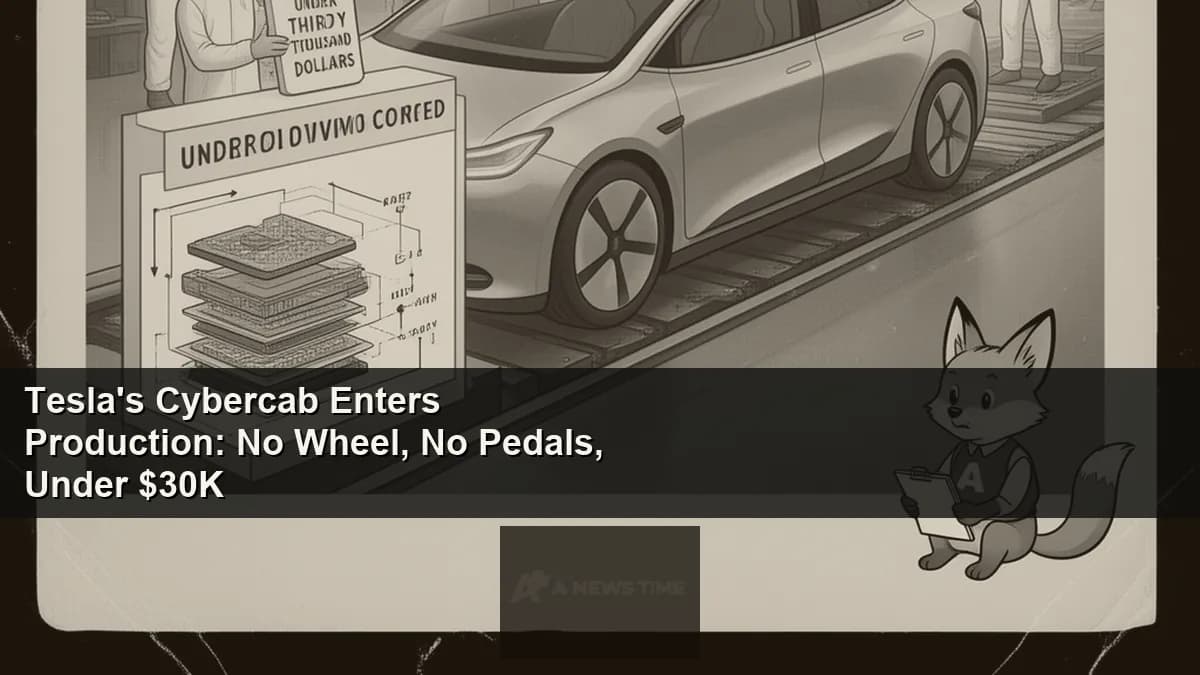
Tesla began production of the Cybercab in April 2026, a vehicle that represents the clearest expression of the company's strategic shift from selling electric cars to selling autonomous transportation services. Unlike any Tesla model that preceded it, the Cybercab has no steering wheel, no brake pedal, and no manual controls of any kind. It is designed from the ground up to be operated by software, not humans. The production start, confirmed by Elon Musk in recent communications, follows months of regulatory groundwork and manufacturing preparation at Tesla's Gigafactory Texas facility.
The Cybercab is targeted at a price under $30,000, a figure that positions it substantially below any other Tesla model in the lineup and reflects the vehicle's architecture: the elimination of the driver's control hardware, the seat configuration optimized for passengers rather than a driver, and the design decisions that flow from building a car for a specific commercial use case rather than for individual consumer ownership. The $30,000 target also reflects Tesla's manufacturing ambitions. CEO Elon Musk has described the Cybercab as the most efficiently producible vehicle Tesla has built, with a simplified manufacturing process that relies on large single-piece castings and a reduced parts count compared to the Model 3 platform.
What Makes the Cybercab Different From Tesla's Existing Vehicles
Every Tesla currently sold to consumers, including the Model 3, Model Y, Model S, and Model X, includes full manual driving controls and operates under regulations that require a licensed human driver behind the wheel even when Autopilot or FSD is engaged. The driver is legally responsible for the vehicle's operation; Tesla's systems are driver-assistance technology, not autonomous vehicles in the regulatory sense.
The Cybercab is categorically different. It operates as a SAE Level 5 autonomous vehicle, meaning it is designed for full vehicle autonomy without any human fallback driver. That regulatory classification requires a completely different approval pathway than the driver-assistance systems in consumer Tesla vehicles. The Cybercab's production launch follows the completion of regulatory approvals in specific operating jurisdictions, with initial deployment planned in defined geographic areas where Tesla has obtained the necessary permits for fully driverless commercial operation.
| Feature | Current Tesla Consumer Vehicles | Cybercab |
|---|---|---|
| Steering wheel | Yes (required) | None |
| Brake/accelerator pedals | Yes (required) | None |
| Human driver required | Yes, legally | No |
| SAE automation level | Level 2 (driver assistance) | Level 4/5 (autonomous in ODD) |
| Primary use case | Personal ownership | Commercial robotaxi fleet |
| Target price | $35,000-$110,000 | Under $30,000 |
The operational design domain (ODD) concept is central to understanding what "fully autonomous" means in practice for the Cybercab. An autonomous vehicle's ODD specifies the environmental conditions and geographic areas in which the autonomy system is designed to operate safely: specific weather conditions, road types, geographic boundaries, speed limits, and other parameters. The Cybercab will initially operate within defined ODDs in cities where Tesla has regulatory approval, with the ODD expanding over time as the system's performance data justifies the expansion.
The Tesla Network Business Model
The Cybercab is the vehicle, but the business model is the Tesla Network, a planned ridesharing service where Cybercab vehicles operate as a fleet earning revenue per trip, similar to Uber or Lyft but without human drivers taking a share of the fare. Tesla's model involves the company deploying Cybercab vehicles as a managed fleet, using its own charging and maintenance infrastructure, and capturing the per-trip economics directly rather than through hardware sales alone.
Musk has also described a future in which Tesla owners can add their personal Cybercabs to the Tesla Network when not in personal use, similar to how Airbnb hosts list their properties on the platform. The economics of that model depend on the vehicle's utilization rate when owner-operated versus the rate achievable through a professionally managed fleet, and the specific revenue sharing structure between Tesla and vehicle owners, which has not been publicly detailed.
The per-mile economics of autonomous ridesharing, when the driver cost is eliminated, are substantially different from current human-driven ridesharing. The driver's share of a rideshare fare typically represents 70-80% of the gross fare, with the platform taking 20-30%. Fully autonomous operation eliminates the driver cost entirely, allowing either much lower fares (to compete aggressively on price), much higher margins, or some combination of the two. Tesla's pricing strategy for the Tesla Network service has not been announced, but the unit economics available when driver costs are zero represent a significant structural advantage over human-driven competition.
The Regulatory Path and Initial Markets
The production start in April 2026 reflects the completion of the regulatory process in the initial operating markets. Fully driverless commercial vehicle operation is regulated at both the state and federal level in the United States, with states having primary authority over licensing and operation while the National Highway Traffic Safety Administration (NHTSA) oversees vehicle safety standards. Tesla has been working through permit processes in California, Texas, and Arizona, the three states where it has sought initial Cybercab operating approval.
The competitive landscape for robotaxi approvals is well established. Waymo has been operating fully driverless robotaxi service commercially in San Francisco and Phoenix since 2023, accumulating millions of miles of real-world operational data. Waymo's operational experience, regulatory relationships, and demonstrated safety record represent a meaningful competitive advantage that Tesla is entering the market against rather than pioneering. The comparison between Waymo's sensor-rich approach, which uses lidar, radar, and cameras in combination, and Tesla's vision-only approach will be a recurring analytical question as the Cybercab accumulates its own operational data.
"Production starting in April means we're not talking about a concept anymore. The Cybercab is being manufactured. The question is now deployment velocity and regulatory expansion pace, not whether the vehicle exists."
Elon Musk, Tesla announcement communications, April 2026
Consumer Availability and What the $30K Price Actually Means
Consumer availability of the Cybercab for personal purchase is planned for 2027, after the initial commercial fleet deployment phase. The commercial-first rollout makes regulatory and operational sense: fleet vehicles operating in defined geographic areas generate the data and regulatory track record that supports expanding approval for broader consumer operation. A consumer who purchases a Cybercab and uses it primarily as a personal vehicle in their specific location will be operating it under different conditions than the initial commercial deployment.
The under-$30,000 target price, if maintained, would make the Cybercab the most affordable new autonomous vehicle ever sold to consumers. For context, Waymo does not sell vehicles; it operates its own managed fleet. The only mass-market autonomous vehicles currently available for consumer purchase, which is to say no consumer-purchasable fully autonomous vehicle, means the Cybercab would be entering genuinely new market territory if the consumer offering reaches the market at its planned price in 2027.
The connection between the Cybercab's production launch and Tesla's overall financial position is worth noting. The company's China sales have been strong (as we report in our separate coverage of Tesla's March China numbers), but domestic sales have faced headwinds from both competition and the brand controversies surrounding Elon Musk's political activities. The Cybercab represents a new revenue stream and a new market category that is distinct from the competitive pressures in the conventional EV market.
What Comes Next
The production launch in April 2026 is the beginning of what will be an extended deployment and validation process. The initial commercial fleet will generate the operational data, regulatory feedback, and safety performance record that determines how quickly the ODD can expand and how broadly the Tesla Network can be deployed. The first 12 months of commercial Cybercab operation will be scrutinized by regulators, competitors, safety advocates, and investors in ways that no previous Tesla vehicle launch has been, because the stakes of fully driverless commercial operation are qualitatively different from the stakes of an advanced driver-assistance system.
The most important question the production launch does not yet answer is whether Tesla's vision-only approach to autonomy performs at the safety level required for commercial driverless operation across the full range of conditions the Cybercab will encounter. Waymo's sensor-redundant approach has demonstrated a safety record that has satisfied regulators in multiple jurisdictions. Tesla will need to demonstrate an equivalent or better safety record with its different technical approach. That demonstration happens in real operational miles, not in laboratory tests or simulated scenarios, and the production launch is the precondition for accumulating those miles.