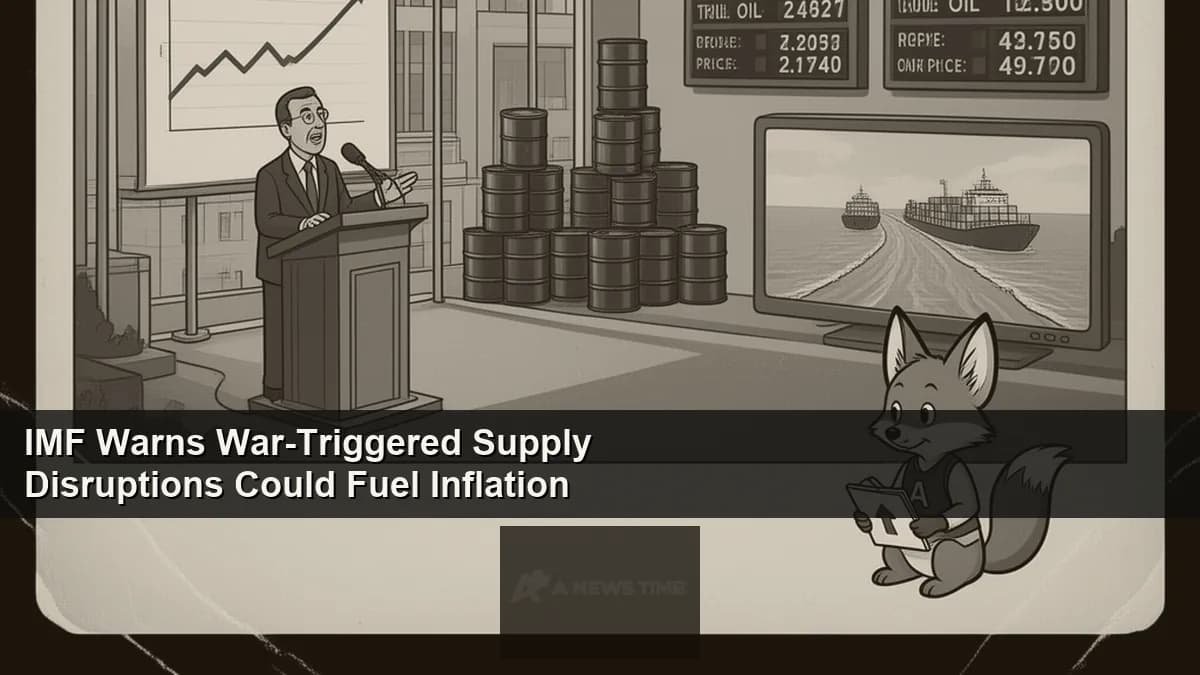
The IMF warned on , that war-triggered supply disruptions are likely to slow global economic growth and push inflation higher, with Managing Director Kristalina Georgieva telling reporters that the fund's upcoming World Economic Outlook will reflect a materially darker picture than the January baseline. Brent crude is trading near $110 per barrel, Iran has effectively blocked the Strait of Hormuz since mid-March, and S&P 500 futures were falling as a White House deadline on Iran ceasefire terms approached. The numbers in the January outlook, including 3.3% global growth in 2026 and 3.2% in 2027, were set before any of this became structural.
The warning lands ahead of the IMF's semi-annual forecast release, scheduled for , which the fund has confirmed will include multiple scenarios tied to the depth and duration of the Hormuz disruption. What began as a geopolitical risk premium on oil has become something more complicated: a sustained supply-side shock that is simultaneously compressing growth and reigniting inflation, the same combination that paralyzed policymakers in the 1970s and that modern central banks have spent decades building credibility to prevent.
The Hormuz Blockade and Its Scale
The Strait of Hormuz, the roughly 21-mile-wide passage between Iran and Oman, is the single most consequential chokepoint in global energy markets. Approximately 20% of global oil and natural gas shipments transit the strait daily, a figure that includes roughly 17 million barrels of crude oil, 3.5 million barrels of refined petroleum products, and a significant share of global LNG exports from Qatar, the world's third-largest natural gas exporter.
Iran's enforcement of what it has described as "navigational security protocols" since late March has, in practice, reduced global oil availability by approximately 13%, according to tanker tracking data cited by Reuters. That reduction has come through a combination of direct confrontations with commercial tankers, mined approaches to export terminals, and insurance-driven route changes that have effectively closed the strait to vessels not specifically cleared by Iranian naval authorities. The result is an energy market operating with a structural deficit for the first time since the Arab oil embargo of 1973.
Even Qatar, a country that has historically maintained careful diplomatic distance from regional conflicts, has seen significant facility damage to LNG loading infrastructure. Repair timelines are measured in years, not months, a fact that has particular relevance for European countries that shifted their LNG import strategy toward Qatar after Russia's gas cutoffs in 2022. Reuters reported that the cargo insurance market has effectively repriced the entire Persian Gulf as a conflict zone, which means higher shipping costs persist even for voyages that successfully complete transit.
The IMF's multiple-scenario approach in the April 14 outlook reflects genuine uncertainty about how long these conditions persist. Scenario one assumes a diplomatic resolution within 60 days; scenario two assumes the status quo for the remainder of 2026; scenario three models a further escalation that extends the blockade into 2027. The difference in projected global GDP between scenario one and scenario three is estimated at more than one full percentage point of output, roughly $1 trillion in economic activity.
The IMF's Pre-Conflict Baseline and What Changes
To understand the scale of the expected downgrade, the January 2026 baseline deserves a closer look. The IMF entered the year projecting 3.3% global growth in 2026 and 3.2% in 2027, both figures that reflected an economy finally settling into what the fund described as a "soft landing" after two years of aggressive monetary tightening across advanced economies. Inflation was expected to continue its descent toward central bank targets. The Federal Reserve was forecast to make two rate cuts. The ECB was on track for three. Oil was priced around $75 per barrel on the assumption that Middle East tensions would remain contained.
None of those assumptions survived March intact.
| Indicator | January 2026 Forecast | Post-Disruption Direction |
|---|---|---|
| Global GDP growth (2026) | 3.3% | Expected downgrade |
| Global GDP growth (2027) | 3.2% | Expected downgrade |
| Brent crude oil | ~$75/barrel | ~$110/barrel (actual) |
| Global oil supply reduction | 0% | ~13% (Hormuz disruption) |
| IMF member countries (energy importers) | ~85% of membership | |
| Fed rate cut expectation (2026) | 2 cuts | Significantly reduced probability |
The revisions will not be uniform across countries. Economies with domestic energy production, sovereign wealth funds, or pre-existing commodity export infrastructure are relatively insulated. The 85% of IMF member countries that are net energy importers, a figure Georgieva specifically cited, face a direct transmission channel from higher oil prices into domestic inflation, slower growth, and, in the most exposed cases, balance-of-payments pressure from deteriorating terms of trade.
Low-income countries sit at the highest-risk tier. Many lack the fiscal buffers to deploy energy subsidies, the foreign currency reserves to absorb import cost increases, or the monetary policy credibility to keep inflation expectations anchored. Sub-Saharan Africa, South Asia, and parts of Central America and the Caribbean are the regions the IMF has identified as most likely to experience debt stress from a prolonged disruption.
Georgieva's Framing and What It Signals
Georgieva's public comments have been notably precise for IMF communications, which typically favor hedged language about "risks" and "scenarios." Her statement that the fund is "likely" to downgrade growth projections while raising the inflation outlook represents a stronger signal than the fund typically issues ahead of a formal forecast release.
"The conflict-driven supply disruptions we are seeing create a challenging environment for global growth. We expect our April World Economic Outlook to reflect lower growth projections and a higher inflation outlook than our January baseline, with the range of outcomes wider than usual given uncertainty about the conflict's trajectory."
Kristalina Georgieva, IMF Managing Director
The significance of that framing is that the IMF is signaling a direction of travel before publishing hard numbers. That is unusual. Typically the fund releases preliminary data and formal forecasts simultaneously at its World Economic Outlook press conference. Telegraphing the direction in advance is a way of managing market expectations and, arguably, of prompting policymakers to begin contingency planning before the formal document lands.
The timing also matters. The April 14 release coincides with IMF and World Bank spring meetings in Washington, where finance ministers and central bank governors from 190 countries gather to coordinate policy responses. The fund is not just releasing a forecast; it is setting the analytical framework for those conversations. When Georgieva says the outlook will include multiple scenarios, she is telling the global policy community to arrive in Washington with contingency plans, not a single baseline path.
Market Reaction: First Winning Week, Then the Deadline
Financial markets have been trading the conflict's evolution in real time, and the pattern has been instructive. Equities posted their first winning week since the Iran war began in the week ending , as ceasefire proposal language briefly circulated and oil pulled back from its highs. The S&P 500 rose approximately 2.4% on the week, with energy sector outperformance partly offsetting technology and consumer discretionary weakness.
That reprieve proved short-lived. Trump called Iran's ceasefire proposal "not good enough" over the weekend, and S&P 500 futures were tumbling by Monday morning as a White House-imposed deadline on Iran negotiations approached. The pattern, rally on ceasefire hopes, sell off on diplomatic failure, has repeated three times since late March, each cycle compressing slightly. Markets are getting less euphoric on the upswings and less panicked on the downswings, which analysts at Goldman Sachs described as the market "pricing in a longer-duration conflict rather than a near-term resolution."
The oil market has been the cleaner read. Brent crude has maintained a floor near $107 per barrel even during the brief diplomatic episodes, suggesting that traders are not yet pricing in a genuine Hormuz reopening. The options market shows elevated implied volatility on oil contracts extending through the third quarter of 2026, which is the market's way of saying it has no idea where crude will be in six months. CNBC reported that several large commodity trading houses have built positions explicitly sized for $130-per-barrel scenarios.
The currency markets have told a parallel story. The dollar has strengthened against most currencies as investors treat U.S. assets as a relative safe haven, but the dollar strength itself creates problems for emerging market economies that have borrowed in dollars and now face higher local-currency costs on that debt at the same moment their import bills are rising. The IMF has historically provided emergency balance-of-payments support in these situations. The fund currently has approximately $1 trillion in available lending capacity, but that figure could face stress if multiple low-income countries request support simultaneously.
The Inflation Arithmetic
The IMF's inflation outlook revision stems from a relatively straightforward transmission channel, one that the fund has analyzed in each of the previous oil shocks since 1973. Higher crude prices flow first into gasoline, diesel, and heating fuel costs, which represent a direct reduction in household purchasing power. The IMF's standard methodology estimates that a sustained $20 increase in oil prices reduces real household income by approximately 0.3% to 0.5% in advanced economies and 0.7% to 1.2% in energy-importing emerging markets.
The current shock is not a $20 increase from a stable baseline. It is a $35 increase from the January baseline, sustained now for six weeks with no clear endpoint. The second-round effects, higher transportation costs feeding into the prices of manufactured goods, food distribution costs, and business input costs broadly, are already showing up in producer price indexes across the US, eurozone, and UK. The OECD, which released its own analysis in late March, estimated that the shipping disruption from Hormuz rerouting alone could add 0.2 to 0.3 percentage points to consumer inflation globally.
This creates the policy bind that the IMF has been warning about for weeks. Central banks facing demand-driven inflation cut rates to cool the economy. Central banks facing supply-driven inflation have no good response: cutting rates risks entrenching the price level increase; raising rates compounds the growth damage without fixing the supply problem. James Calloway's earlier analysis of the Federal Reserve's position laid out exactly this dilemma, which has only sharpened as oil prices held above $100 for a second consecutive month.
The specific scenario the IMF is most focused on preventing is a wage-price spiral. If workers in energy-importing countries begin demanding higher wages to compensate for rising living costs, and if companies comply and pass those costs through to prices, the second-order inflation can become self-sustaining even after oil prices eventually stabilize. The fund's research on the 2022 inflation episode found that labor markets in advanced economies were closer to a wage-price spiral than was publicly acknowledged at the time. The current shock starts from an already-elevated inflation baseline in many countries.
Energy Exporters Are Not Insulated Either
The intuitive assumption is that energy exporters are winners in this environment. The data is more complicated. Saudi Arabia, the UAE, and Iraq are collecting substantially higher revenues on each barrel exported, but their ability to benefit depends on physical export infrastructure that the conflict has disrupted. The Strait of Hormuz does not only carry Iranian energy; it carries the majority of Gulf state energy exports as well.
Qatar's case is the clearest illustration. As one of the world's largest LNG exporters, Qatar should theoretically be benefiting from sky-high natural gas prices in European markets. In practice, facility damage from conflict-related strikes has reduced Qatar's export capacity by an estimated 15% to 20%, according to tanker tracking firms cited by the Economic Times. The repair timeline for Ras Laffan port infrastructure, where Qatar's LNG terminals are concentrated, is measured in years. Qatar cannot capture the windfall because it cannot move the product.
The broader regional disruption extends to non-energy sectors. Tourism, aviation, construction, and financial services across the Gulf have all been affected by investor caution, insurance cost increases, and the practical difficulties of operating businesses near an active conflict zone. The OECD had estimated Gulf Cooperation Council growth at 3.4% for 2026 before the conflict. Current projections have been revised to 2.1% or lower.
What the April 14 Outlook Is Expected to Show
Based on the IMF's preview language and the analytical framework the fund uses for supply shocks, the April 14 World Economic Outlook is expected to include the following elements, though the precise numbers will not be confirmed until the formal release.
- Global growth downgrade: The January 3.3% forecast for 2026 is expected to be revised down by at least 0.4 to 0.6 percentage points in the baseline scenario, with the "extended disruption" scenario showing a reduction of more than one percentage point.
- Inflation upward revision: Global headline inflation, which was expected to average 4.1% in 2026 under the January baseline, is expected to be revised upward, with the specific magnitude depending on which oil price assumption the fund embeds in its central forecast.
- Country-specific vulnerabilities: The IMF is expected to identify a cohort of 15 to 20 low-income countries at elevated debt stress risk and to recommend that its Emergency Financing Instrument be made available without the usual access limits for the most exposed members.
- Policy recommendations: The fund is expected to recommend that advanced economy central banks maintain current rate settings rather than cutting, while urging targeted fiscal support for low-income households to prevent the distributional consequences of higher energy costs from triggering political instability.
The scenario analysis itself carries a signal. When the IMF presents three scenarios rather than a single forecast, it is telling markets and policymakers that the range of outcomes is wider than its standard forecasting tools can resolve. That is an acknowledgment of genuine uncertainty about the conflict's trajectory, not a failure of the fund's modeling. The economic literature on conflict-driven supply shocks consistently finds that duration is the most important variable, and duration is the one thing no economic model can reliably predict.
The Bigger Picture
The IMF's April 14 release will be the most consequential macroeconomic document published since the conflict began. Not because it will tell markets something they do not already know, but because it will put an authoritative, multilateral set of numbers behind a deterioration that individual countries have been managing in isolation.
The fund's institutional role is partly diagnostic and partly convening. When Georgieva says the outlook will be worse than January, she is not just updating a spreadsheet. She is telling 190 finance ministers to arrive in Washington the same week prepared for a harder conversation than the one they had budgeted for. The Goldman Sachs recession probability analysis and the OECD's March revision both pointed in this direction. The IMF is the largest of the three and speaks with the most formal authority in sovereign debt and balance-of-payments management.
The question the April 14 outlook will not answer, because no forecast can, is whether the diplomatic situation changes before economic conditions fully reflect the current disruption. The White House deadline on Iran, the Trump administration's rejection of the ceasefire proposal, and the next round of S&P 500 futures pricing will all move before the ink dries on the fund's projections. What the IMF can do is set the cost-benefit context for the diplomats and policymakers who are the only people who can actually close the Strait of Hormuz back open. The economics say the cost of continued disruption is rising by the week. Whether that arithmetic changes the political calculation is a question that no economic model answers.
Frequently Asked Questions
What is the IMF World Economic Outlook?
The IMF World Economic Outlook is a semi-annual publication that provides the International Monetary Fund's official growth, inflation, and economic projections for all 190 member countries. It is released twice yearly, in April and October, and serves as a key reference for governments, central banks, and international investors setting policy and strategy. The fund also publishes interim updates when conditions change materially between the main releases.
How does the Strait of Hormuz affect global oil prices?
The Strait of Hormuz handles approximately 20% of global oil and gas shipments, including exports from Saudi Arabia, Iraq, Kuwait, the UAE, and Qatar. When transit through the strait is disrupted, oil must either be rerouted around longer maritime paths (adding cost and time) or the supply simply does not reach markets. Either outcome tightens global supply, which pushes prices higher. Because oil is priced globally and most major economies use petroleum in transportation and manufacturing, a sustained price increase at this scale propagates into broader inflation within weeks.
Why does higher oil cause both slower growth and higher inflation simultaneously?
Oil is both a consumer cost and a production input. When oil prices rise sharply, households pay more for fuel and heating, which reduces the money available for other spending (slower growth). At the same time, higher oil costs flow into the prices of manufactured goods, food distribution, and transportation services (higher inflation). Central banks can address demand-driven inflation by raising interest rates, but a supply-side shock like an oil price spike caused by a conflict is not driven by excess demand, so rate hikes reduce growth further without fixing the underlying supply problem. This combination is called stagflation.
Which countries are most at risk from the IMF's expected downgrade?
The IMF has specifically flagged low-income, energy-importing countries as facing the highest risk from the current disruption. These countries typically lack fiscal buffers for energy subsidies, hold limited foreign exchange reserves to absorb rising import costs, and have less monetary policy credibility to contain inflation expectations. Sub-Saharan African nations, South Asian importers, and several smaller Caribbean and Central American economies are in this cohort. Even among advanced economies, energy-intensive industrial exporters like Germany and Japan face materially higher downgrades than commodity-producing nations.
What policy tools does the IMF recommend for affected countries?
For advanced economies, the IMF has generally recommended holding monetary policy steady rather than cutting rates prematurely, while deploying targeted fiscal support to cushion lower-income households from higher energy costs. For low-income and emerging market economies, the fund has expanded access to its emergency financing instruments and is expected to formally recommend eased access limits for the most exposed members in the April 14 report. Internationally coordinated releases from strategic petroleum reserves are also on the table, though the US Strategic Petroleum Reserve release authorization that the White House issued in March has so far had limited price impact.