Something shifted in the data that Booking.com published in its 2026 travel trends report. The category it labeled "immersive travel" topped the priority rankings among travelers who had booked three or more trips in the previous two years, surpassing beach vacations, city breaks, and even culinary tourism for the first time in the report's history. Immersive travel, defined by Booking.com as experiencing a destination through its working culture rather than its tourist attractions, covering farm stays, craft apprenticeships, wilderness expeditions, and festival-anchored journeys, has been growing steadily as a booking category since the post-pandemic reopen. In 2026, it arrived as the dominant aspiration of the most active travelers. The adventure travel industry, which sits at the intersection of physical challenge, ecological encounter, and cultural depth, is the direct beneficiary.
The numbers from adjacent markets confirm the direction. The global wellness travel sector is projected to reach $1.35 trillion by 2028, according to data tracked by Statista and reported across the Forbes Travel vertical. Wellness travel, once synonymous with spa resorts and detox retreats, has expanded its definition to include physically demanding activities, wildlife encounters, and remote immersions that share wellness travel's core premise: that how you travel should affect your physical and mental state in positive and lasting ways, not just provide a backdrop for passive relaxation. The overlap between wellness travel and adventure travel has become the sector's most dynamic growth area.
Rail: The Adventure Itinerary That Changes How You See Distance
The rail renaissance in adventure travel is one of the more unexpected developments in a travel category that has traditionally emphasized getting to remote places as fast as possible. Three rail experiences are generating disproportionate attention in 2026, each offering a distinctly different reason why the train is the point rather than the transport.
Switzerland's Glacier Express, the eight-hour journey from Zermatt to St. Moritz through the Swiss Alps, has been a bucket-list fixture for decades. What distinguishes it in 2026 is the opening of several new premium observation cars with full-length panoramic glass roofs that replace the original viewing windows. The experience of watching the Landwasser Viaduct pass beneath you, or the Furka Pass summit surrounded by glacial moraine, through a glass ceiling that eliminates the frame separating you from the landscape, is genuinely different from the previous experience. Swiss Federal Railways has released an app integration that provides GPS-triggered commentary at each significant viewpoint, meaning the journey now functions as a guided alpine education as much as a scenic ride. Peak summer reservation dates are already limited; spring and autumn shoulder season windows are more available and produce a landscape with its own distinct character.
China's Qinghai-Tibet Railway, which the Chinese tourism industry has been rebranding as the "Sky Train," reaches altitudes above 5,000 meters on its run between Xining in Qinghai Province and Lhasa in Tibet. The train itself is pressurized to manage altitude effects, and carriages are fitted with supplemental oxygen outlets at each seat. The journey takes approximately 22 hours from Xining to Lhasa, traversing the Tibetan Plateau through a landscape that has no close equivalent: braided rivers across grassland valleys, yak herds visible from the windows, and the Tanggula Mountain range with its glaciated peaks. Access to Tibet requires a Tibet Travel Permit in addition to a Chinese visa, with additional permits required for travel to sensitive border areas. The permitting process takes one to two weeks through an authorized Tibet travel agency, making advance planning mandatory.
Norway's Flåm Railway, the 20-kilometer descent from Myrdal to the Sognefjord at Flåm, is the world's steepest adhered railway (meaning it uses no rack-and-pinion system). The 55-minute descent drops 866 meters through waterfalls, mountain farms, and the dramatic V-shaped valley of the Flåmsdalen. The railway has operated since 1940 and is now integrated into a broader Flåm tourism ecosystem that includes fjord kayaking, e-bike routes through the surrounding valley, and boat connections to the Nærøyfjord, a UNESCO World Heritage arm of the Sognefjord that may be the most scenically perfect fjord in Norway. Combining the train with a boat journey and a night in Flåm village before a morning kayak creates an adventure day that costs far less than Norwegian adventure travel is generally assumed to cost.
Wildlife: Single-Species Focus Changes the Safari Model
The traditional multi-species African safari model, see the Big Five across as many game drives as possible, remains popular and legitimate. But 2026 is seeing a significant growth in single-species-focused wildlife expeditions, where the itinerary is organized around the deep observation of one species in its habitat, with expert naturalist guides who specialize in that animal's behavior, ecology, and conservation status.
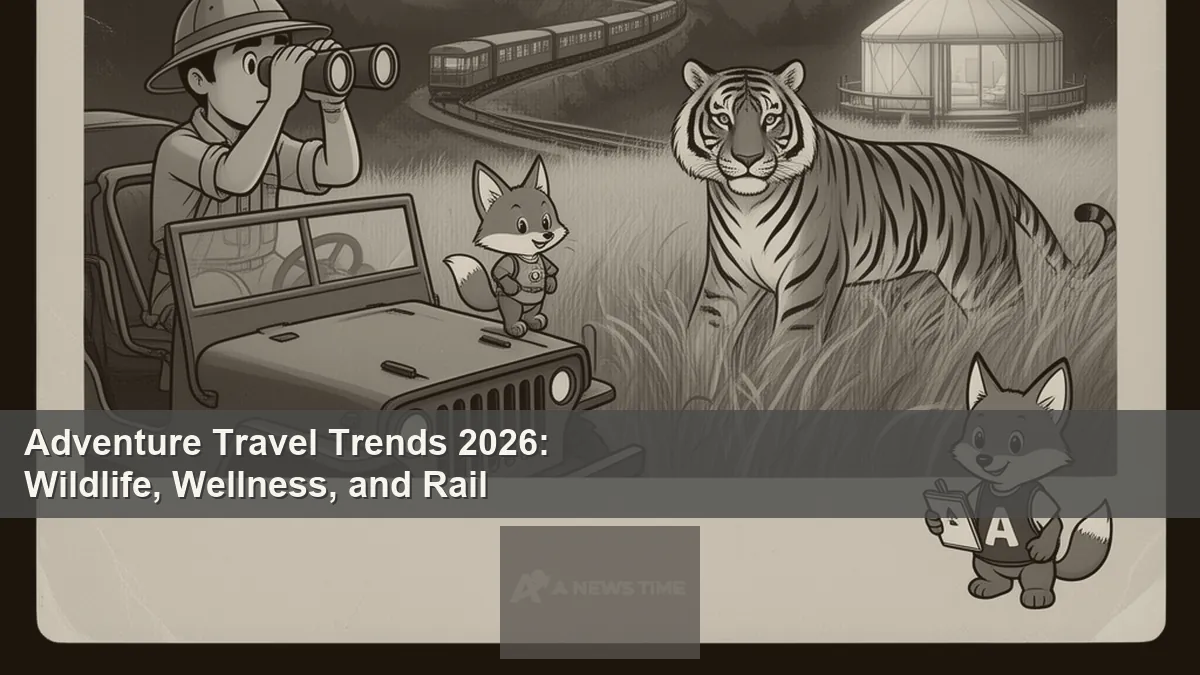
India's tiger reserves, particularly Kanha and Bandhavgarh in Madhya Pradesh and Jim Corbett in Uttarakhand, have become the primary destination for this model. India now has the world's largest wild tiger population, having increased from fewer than 1,500 individuals in 2010 to approximately 3,800 by 2025 following three decades of Project Tiger conservation. Safari vehicles enter the core zones of these reserves at dawn and dusk under strict capacity caps, guided by naturalists who know individual tigers by their stripe patterns and behavioral histories. The experience of watching a single Bengal tiger move through teak forest in early morning light, tracked by guides who know its territory intimately, produces an encounter of a different depth from a general game drive where tigers are one of many possible sightings.
In South America, the Pantanal in Brazil and Bolivia has replaced the Amazon as the preferred destination for serious wildlife observers. The Pantanal is the world's largest tropical wetland, covering approximately 150,000 to 195,000 square kilometers across parts of Brazil, Bolivia, and Paraguay. Its open grassland and shallow water habitat, in contrast to the closed canopy of the Amazon, makes wildlife visible in ways that the rainforest rarely allows. The primary draw is the jaguar, which the Pantanal supports in the highest density of any habitat on earth. The Porto Jofre region, accessible by boat on the Cuiabá River, has become the global standard for jaguar observation, with specialist operators offering multi-day floating lodge programs during which jaguar sightings are, while never guaranteed, remarkably common by any historical standard of big cat observation in the wild.
"The single-species model changes the psychology of the expedition. You are not trying to see everything. You are trying to understand one thing deeply. That requires patience, and patience produces a completely different travel experience."
Will Bolsover, Wildlife Director, Exodus Travels
Aurora Borealis: A Solar Maximum Opportunity
coincides with the peak of Solar Cycle 25, the roughly 11-year cycle of solar magnetic activity that reaches maximum intensity in the year when sunspot numbers and solar flare frequency are at their highest. At solar maximum, the aurora borealis, and its Southern Hemisphere counterpart the aurora australis, is more frequent, more intense, and visible at lower latitudes than it is during the quiet periods of the solar cycle. This means that 2026 offers an aurora opportunity that will not recur at comparable intensity until approximately 2037.
The traditional aurora destinations, northern Norway's Tromsø, Iceland, Finnish Lapland, and northern Canada's Yukon, remain the most reliable viewing locations because they sit within the auroral oval year-round. But solar maximum extends the aurora's southern reach significantly. Reports from winter 2025 to 2026 documented strong aurora displays visible as far south as the northern United States, central Europe, and New Zealand's South Island. For travelers who cannot easily reach the Arctic, the expanded visibility window during solar maximum creates viable viewing opportunities from locations that are simply easier to get to.
The adventure travel operators who specialize in aurora expeditions, including those offering dog-sled journeys in Norwegian Svalbard, snowshoe aurora walks in Finnish Lapland, and ice hotel stays in northern Sweden, are reporting significantly advanced bookings for the to aurora season. The intersection of solar maximum and the post-Thanksgiving booking surge has produced a competitive reservation environment for the best dark-sky lodges. Travelers who want a guided aurora expedition for the 2026 to 2027 winter should be booking now, not waiting for autumn.
For the Southern Hemisphere version, New Zealand's South Island in June through August and Argentina's Patagonia during the same period are reporting growing interest from travelers who want to experience the aurora australis during the solar maximum without the logistical challenge of reaching the Arctic. Ushuaia, Argentina, near the southern tip of South America, is the most practical southern aurora base, accessible by regular flights from Buenos Aires and positioned within reasonable distance of the auroral oval at a latitude where solar maximum frequency provides meaningful viewing probability.
Festival-Led Travel: Culture as the Expedition Core
Festival-led travel, organizing a multi-week journey around a specific cultural event as the anchor and building the itinerary around it, is one of the adventure travel trends Booking.com's report identified as growing fastest among travelers aged 35 to 60. The model combines the immersive travel aspiration with a concrete planning anchor: you know the festival date, you build the journey around it, and the surrounding days or weeks extend the cultural encounter into its full context.
Four festivals stand out in 2026 for the depth of encounter they offer and the adventure context surrounding them.
Peru's Inti Raymi, the Festival of the Sun, takes place on in Cusco, at the ancient fortress of Saqsaywamán above the city. It is a re-enactment of the Inca ceremony honoring the sun god Inti, conducted in Quechua, involving hundreds of participants in traditional dress, and drawing audiences of Peruvians and visitors from across the Andean world. The festival is not a tourist production, despite its significant foreign audience. It is a serious cultural expression of Andean identity that exists primarily for the Peruvian communities who participate in it and attend it. Building a two-week Andean itinerary, including the Sacred Valley, Machu Picchu, and Lake Titicaca, around the Inti Raymi date produces a journey that holds together thematically and culturally in a way that a generic Peru tour does not.
Bhutan's tshechu festivals, held throughout the country at different monasteries and dzongs on dates determined by the Bhutanese lunar calendar, are the country's primary cultural and religious celebrations. They feature masked dance performances (cham) depicting episodes from Tibetan Buddhist mythology, performed by monks and lay participants in elaborate traditional costumes. The most internationally accessible tshechus are the Paro Tshechu in late March or April and the Thimphu Tshechu in September or October, both in cities with international airport connections. Bhutan requires all visitors to book through a licensed Bhutanese tour operator and pay a Sustainable Development Fee of $100 per person per night, a policy that keeps visitor numbers low and culturally compatible with the country's deliberate approach to tourism development.
Mexico's Day of the Dead celebrations in Oaxaca and Pátzcuaro, though not a single-date event but rather a two-to-three-day cultural practice across and , have become one of the most sought-after immersive cultural encounters in the Western Hemisphere. The Oaxacan version involves candlelit cemetery vigils, elaborate ofrendas (offerings) at household altars, and the kind of street-level cultural expression that reflects deep religious and familial traditions. For travelers who approach it with genuine respect and appropriate guidance, including staying with local families rather than in tourist hotels, the encounter offers something far from the Halloween-adjacent spectacle that Day of the Dead tourism has become in some contexts. Several specialist operators offer small-group experiences hosted by Oaxacan families during which the festival is accessed from the inside rather than observed from the outside.
Mongolia's Eagle Festival, held in Ölgii in the Bayan-Ölgii Province in , celebrates the ancient Kazakh tradition of hunting with trained golden eagles. Kazakhs who maintain this tradition bring their birds and compete in events that demonstrate the eagle's speed, accuracy, and responsiveness to commands. The setting, a high-altitude steppe valley backed by snow-capped Altai peaks, and the culture, Kazakh nomadic life maintained largely intact into the 21st century, produce an encounter that has no parallel anywhere on the adventure travel calendar. Access to Ölgii requires flights via Ulaanbaatar or Almaty, and the logistics of the final journey through mountain terrain reward travelers who book through operators with established local relationships. The broader rise of active and experiential travel has made festivals like the Eagle Festival, where participation and proximity are the point, one of the sector's fastest-growing booking categories.
Planning for Adventure in a Disrupted Market
The context for all adventure travel in 2026 is a disrupted aviation market that has made some destinations more expensive to reach and others more accessible by comparison. Adventure travel destinations in the Americas, South Africa, and Western Europe are relatively well positioned relative to the most disrupted Asia-Pacific and Middle East corridors. Destinations that require connections through affected Gulf hubs face increased booking complexity and higher prices. The festivals and wildlife experiences in India require routing that avoids the worst-disrupted airspace. For travelers concerned about the aviation disruption environment, the current airfare landscape analysis provides specific context for planning.
The adventure travel operators with the most relevant expertise are responding to the disrupted environment by building greater flexibility into their itineraries, offering more generous rebooking terms, and in some cases designing alternative routing options into their programs so that travelers whose primary flight options are disrupted have backup paths to reach the journey's starting point. Booking with operators who specialize in a specific region, rather than generalist tour operators who cover the whole world, has always been the quality-of-experience argument for specialist travel. In 2026, it is also the logistical resilience argument.
The 2026 adventure travel landscape, for all the disruptions that frame it, offers an extraordinary range of genuinely transformative experiences. Solar maximum auroras, once-in-a-decade intensities. Tiger reserves with the largest wild population in history. Ancient festivals preserved in their original cultural context. Rail journeys through landscapes that planes fly over too fast to see. The traveler who engages with the year on its own terms, rather than mourning the disruption of the familiar travel order, will find that 2026 is one of the more remarkable years to be in motion.