
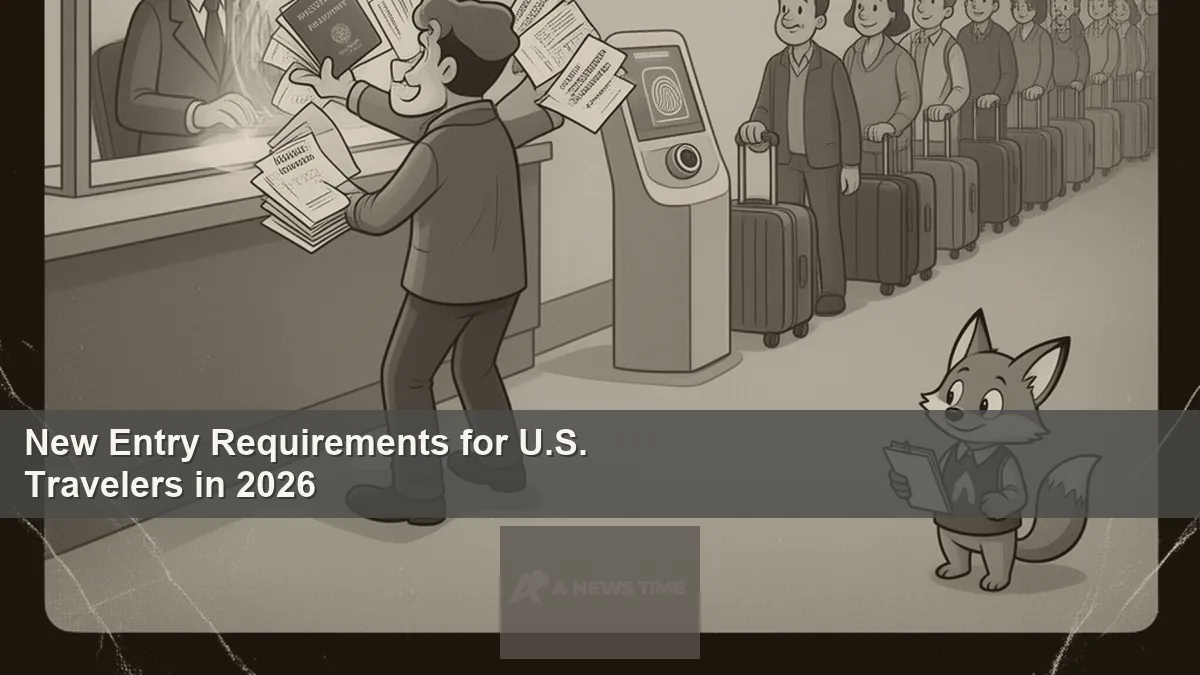
The checklist a U.S. traveler needed to board an international flight used to be simple: valid passport, any required visa, and the knowledge that most Western European countries required neither. In 2026, that checklist has expanded considerably, and the changes are not evenly distributed or widely understood by the traveling public. The European Union's two-part digital border control overhaul, new biometric requirements, expanded digital arrival systems in Asia and the Pacific, and a wave of eVisa launches across multiple regions have created a landscape where an up-to-date understanding of entry requirements is a practical travel necessity rather than an optional pre-departure detail. Missing one of these requirements does not produce a waived entry; it produces a denied boarding at the gate or, in some cases, a turned-away arrival at the border.
Travel journalist and consumer advocate Wendy Perrin, who has tracked entry requirement changes for over a decade, published a comprehensive 2026 update noting that the number of countries with new or significantly modified entry requirements for U.S. passport holders has reached its highest point since the post-pandemic reopening wave of 2022. The difference, Perrin notes, is that the 2022 changes were primarily about COVID health requirements that have since been lifted. The 2026 changes are permanent structural modifications to how countries manage international visitor flows, from biometric data collection to revenue generation through pre-travel authorization fees.
Europe's Two-Part Entry Overhaul: EES and ETIAS
The most significant change for U.S. travelers visiting Europe is the implementation of the EES, the European Union's new biometric border management system. EES replaces the existing practice of stamping passports at Schengen border crossings with a digital record that captures a traveler's fingerprints, a facial photograph, and travel document data at each entry and exit. The system has been in technical preparation for several years and is now entering phased rollout at Schengen member state borders.
For U.S. travelers, EES does not require any pre-travel application or fee. It happens at the border, as part of the entry process. The practical implication is additional time at border control: the first registration on EES, when a traveler has no existing profile in the system, takes approximately three to five minutes per person for biometric enrollment. Subsequent visits draw on the existing profile and process more quickly. The concern raised by European airports and travel industry groups is that the initial enrollment period, across the tens of millions of first-time EES registrants, could produce significant queuing at major international airports including Amsterdam Schiphol, Paris Charles de Gaulle, and Frankfurt. Travelers arriving at Schengen borders for the first time after EES implementation should add buffer time for border processing.
The second component is the ETIAS, which operates as Europe's equivalent to the U.S. ESTA or Australia's ETA: an online pre-travel authorization that travelers from visa-exempt countries, including the United States, must obtain before boarding a flight to the Schengen zone. ETIAS is expected to launch in late 2026, with the current projection placing implementation in the October to December window. The authorization costs approximately $23 for applicants aged 18 to 70 and is valid for three years or until the applicant's passport expires, whichever comes first. Applications are submitted online and are expected to be processed within minutes in the vast majority of cases, with a small percentage requiring manual review of up to 96 hours.
"EES and ETIAS together represent the most significant structural change to U.S.-Europe travel since the Schengen Agreement itself. Travelers who do not know about ETIAS before they book will find out about it at check-in, and that is not where you want to learn that you need to apply."
Wendy Perrin, Travel Consumer Advocate
The key practical point is sequencing. EES begins rolling out at borders during 2026. ETIAS is expected later in the year. U.S. travelers planning European trips through 2026 should verify the current implementation status of both systems against their specific travel dates, as the rollout is phased and some border crossings will implement EES before others.
The United Kingdom: ETA Now Required
The United Kingdom, which left the European Union in 2020, implemented its own pre-travel authorization requirement for U.S. visitors in January 2025. The ETA is required for U.S. citizens traveling to the UK for stays of up to six months, regardless of purpose. The ETA costs £10 (approximately $21 at current exchange rates), is linked digitally to the traveler's passport, and is valid for multiple trips over two years or until passport expiry.
Applications are made through the UK Home Office's UK ETA app or website, and processing typically takes minutes to hours. Travelers who apply at least 48 to 72 hours before departure have reliable time for processing without risk of delays affecting their trip. Airlines check ETA status at check-in for flights to the UK; boarding is denied if no valid ETA is linked to the passport being presented. The UK government reports that the vast majority of applications are approved automatically, with a small percentage requiring additional review for security or immigration history reasons.
Travelers who hold existing U.S. visas for the UK, or who have existing biometric residence permits, are not required to separately obtain an ETA. Transit passengers passing through UK airports without clearing immigration are similarly exempt. For the majority of U.S. leisure and business travelers making short visits, the ETA is the correct and required document, and its absence will prevent boarding regardless of how carefully other preparations are made.
Asia-Pacific: Digital Arrival Systems Expanding
Thailand launched its Digital Arrival Card system in early 2026, replacing the paper TM6 form that had been a fixture of Thai immigration for decades. All arriving international visitors, including U.S. citizens, must complete the digital form before arrival through the Thailand Digital Arrival Card portal. The form captures the same information as the paper version but is linked to the traveler's passport digitally and processed at electronic immigration kiosks at major international airports including Suvarnabhumi and Don Mueang in Bangkok and Phuket International. The system is free, requires only internet access to complete, and can be filled in at any point during the 72 hours before arrival.
Thailand remains visa-free for U.S. passport holders for stays of up to 30 days. The Digital Arrival Card does not change the entry permission structure; it changes the processing mechanism. Travelers who arrive without a completed digital form will be directed to complete it on airport tablets before clearing immigration, a process that is reportedly adding five to ten minutes per traveler during peak hours at Suvarnabhumi. Completing the form in advance avoids this delay entirely.
Israel has implemented its own ETA-IL requirement for U.S. citizens, with a fee of approximately $7 and validity of two years for multiple entries. Applications are submitted online through the Israeli government portal and are typically processed within 72 hours. Israel remains a security-conscious entry environment where border officers conduct in-person interviews regardless of pre-travel authorization status, but holding a valid ETA-IL before arrival is a requirement rather than an option, and travelers who arrive without one will face complications at Tel Aviv's Ben Gurion Airport.
China has expanded its transit visa-free policy for 2026, allowing passport holders from a list of countries, which now includes the United States, to transit through major Chinese cities including Beijing, Shanghai, Guangzhou, and several others for up to 10 days without a formal visa. The transit policy requires that travelers have a confirmed onward flight or travel document showing departure from China within the permitted period, and that they remain within the designated areas of the transit city. For travelers connecting through Chinese hubs on Asia-Pacific itineraries, this expansion meaningfully increases the possibility of a multi-day China layover without the complexity of obtaining a full tourist visa.
New Visa-Free and eVisa Destinations
Not all 2026 entry changes represent added friction. Several destinations have reduced barriers for U.S. travelers, either by launching eVisa systems that replace in-person consular applications or by extending visa-free access to new countries.
Uzbekistan introduced 30-day visa-free access for U.S. citizens in , representing a significant opening of one of Central Asia's most historically and architecturally rich countries. Samarkand, Bukhara, and Tashkent, cities that defined the Silk Road for millennia, are now accessible to U.S. passport holders without the visa application process that previously required advance planning and documentary submission. The change reflects Uzbekistan's aggressive push to develop its tourism sector, which has been underinvested relative to the country's significant cultural and natural assets.
Brazil has reinstated its eVisa requirement for U.S. citizens following a period of temporary reciprocal waiver. The Brazilian eVisa costs approximately $80 and is valid for multiple entries over 10 years, with stays of up to 90 days per visit and a maximum of 180 days in any 12-month period. Applications are submitted online through the Brazilian government portal, with processing typically taking three to five business days. The eVisa is electronic and linked to the traveler's passport; no physical visa sticker is issued.
Bolivia has been visa-free for U.S. citizens since 2012 and remains so in 2026. For travelers considering South American itineraries, Bolivia's access ease is worth factoring against Brazil's new eVisa cost and processing time. Bolivia's geographic position, landlocked but adjacent to Peru, Chile, and Argentina, makes it a natural addition to circuit itineraries across the continent's most compelling destinations.
Building Your Pre-Departure Checklist
The practical synthesis of the 2026 entry requirement landscape produces a checklist that U.S. travelers should run through at least four weeks before any international departure.
Passport validity: Most countries require that a U.S. passport be valid for at least six months beyond the intended return date. A passport that expires in September 2026 may be functionally invalid for international travel from late February 2026 onward if the destination enforces the six-month rule. Passport processing times for renewal currently run four to six weeks through standard channels and one to three weeks through expedited processing. Factor this timeline in if there is any doubt about passport expiry.
Pre-travel authorizations: The UK ETA, Israel's ETA-IL, and Thailand's Digital Arrival Card are all required before boarding for those destinations. ETIAS for Europe is coming and should be tracked by anyone with European travel planned for late 2026. Check the official government portal for each destination; unofficial third-party sites charge fees for applications that are free or low-cost directly from government sources.
Visa requirements: Brazil's eVisa is a formal requirement with a processing period; apply no later than two weeks before departure to ensure processing completion. Uzbekistan's new visa-free access is a genuine simplification that opens itinerary possibilities for Central Asia. China's transit policy requires a confirmed onward booking, not just the intent to transit.
Japan, another perennial favorite for U.S. travelers, announced its own forthcoming electronic travel authorization system called JESTA in early 2026, though its implementation date is set for 2028 and does not affect current travel. For travelers planning Japan visits in 2026, existing visa-free access remains in place. The broader shift across Asia toward pre-travel digital authorization systems means that the manual-free, show-up-and-stamp era of travel to the region is clearly approaching its end, even if it has not yet fully arrived for U.S. passport holders.