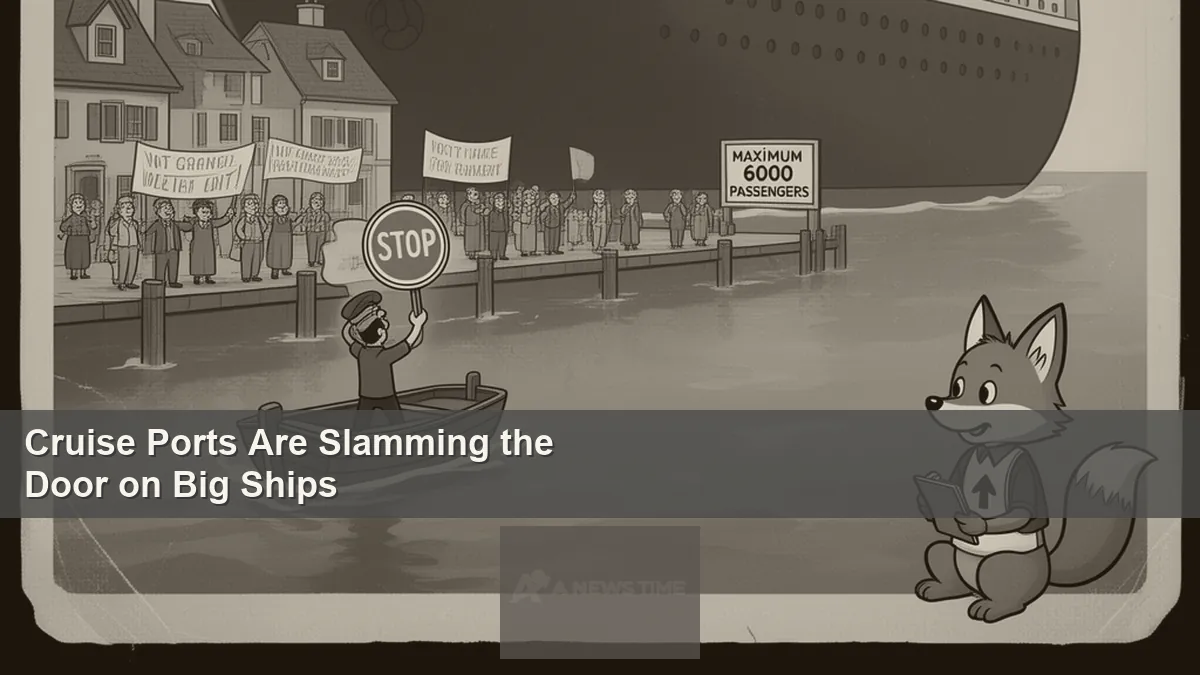
A 90,000-ton cruise ship anchored off the coast of Cannes, France holds roughly the population of a small American city. For about eight hours, those passengers pour into the waterfront restaurants and boutiques of one of the Riviera's most carefully maintained towns. Then they reboard, and the ship moves on to its next port. Cannes keeps the foot traffic, the queues, and the noise. It keeps very little of the money. Starting in 2026, Cannes is no longer accepting that bargain unconditionally. The city has implemented a cap of 6,000 cruise passengers per port call and expressed a clear preference for smaller vessels, those under 1,000 passengers, which the municipal government considers more compatible with the character and capacity of the destination.
Cannes is not alone. In the past twelve months, a collection of cities spanning from Juneau, Alaska to Barcelona, Spain to Amsterdam, Netherlands have implemented or accelerated measures to restrict, cap, or fundamentally restructure the relationship between their communities and the cruise industry. AAA reported that 21.7 million Americans cruised in 2025, a figure that reflects the sustained growth of an industry that has expanded its passenger volume by 50 percent since 2015. That growth has not been evenly distributed in its benefits. The destinations that bear the physical and social costs of hosting these passengers are pushing back in concrete and enforceable ways.
Barcelona: The Capacity Cut
Barcelona's relationship with cruise tourism has been one of the most publicly contested in European travel for a decade. The city's response in 2026 is the most concrete it has produced. The municipal government has committed to reducing cruise passenger capacity at its port by 16 percent by 2030, a reduction it intends to achieve by declining to renew long-term port usage agreements with the largest vessels and by capping the number of passengers allowed to disembark simultaneously from any single call.
Barcelona's port currently handles approximately 3.4 million cruise passengers annually, making it one of the busiest cruise ports in Europe. The 16 percent reduction target would bring passenger volume to approximately 2.9 million per year. The city has also halted discussion of any expansion of cruise pier capacity, a position that represents a significant reversal from the port authority's development plans of five years ago, when pier expansion was viewed as necessary to meet projected demand growth.
The economic argument used to justify cruise expansion, that it generates local spending, has been increasingly challenged by independent analysis. A study by the Barcelona Institute for Regional and Metropolitan Studies found that cruise passengers spend an average of €58 per person during a port call, compared to €197 per day for hotel guests and €234 per day for apartment guests. When those spending figures are compared against the infrastructure costs, police deployment requirements, and resident quality-of-life impacts of peak cruise days, the net economic contribution of cruise tourism is considerably less favorable than the headline passenger numbers suggest.
Amsterdam: 100 Calls Per Year
Amsterdam's approach is the most blunt of the European interventions: a hard cap of 100 cruise ship calls per year effective from 2026 onward. The cap represents a significant reduction from the approximately 175 to 180 annual calls Amsterdam received in 2024 and 2025. The city's position is that the canal-side city center, already under enormous pedestrian pressure from independent tourism, cannot absorb the density of visitors that cruise calls generate on top of the existing baseline.
The cap applies to Amsterdam's cruise terminal at Passenger Terminal Amsterdam, the main facility for ocean cruise vessels. River cruise ships, which are substantially smaller and bring far fewer passengers per vessel, are subject to separate oversight and are not included in the 100-call limit. For ocean cruise operators, the practical implication is a competition for available call slots that did not exist under the previous unconstrained access model. MSC Cruises, Royal Caribbean, and Norwegian Cruise Line all have existing itineraries that route through Amsterdam, and all will need to negotiate their allocation of the 100 available annual slots with port authorities.
"Amsterdam is for people who live here first, and for visitors second. The cruise terminal serves visitors exclusively, and we're no longer willing to let visitor infrastructure crowd out resident livability."
Amsterdam Port Authority spokesperson, March 2026
The 100-call cap also reflects a longer-term planning ambition. City planners have discussed relocating the cruise terminal from its current central location to an outer port area where the passenger volume would not directly intersect with the historic canal district. That relocation, if it proceeds, would likely come with bus or ferry connections to the historic center but would meaningfully reduce the congestion impact of cruise arrivals in the city's most sensitive neighborhoods. No formal timeline for the relocation has been announced, and the 100-call cap is the near-term operational measure in place while longer-term plans are developed.
Valencia: No Mega Ships
Valencia, Spain's third-largest city, took the most categorical position of the European group: a ban on mega-cruise ships, defined as vessels exceeding approximately 100,000 gross tons, from calling at its port for tourism purposes. The ban, which came into effect in early 2026, affects vessels in the largest categories of ocean cruise ship, the class typified by Royal Caribbean's Oasis-class and MSC Cruises' World-class ships, each capable of carrying 5,000 to 6,700 passengers.
Valencia's ban is framed around environmental impact as much as social carrying capacity. The largest cruise ships generate air pollution during port calls that rivals or exceeds the emissions of all vehicle traffic in the surrounding urban area during the same period. The city's air quality monitoring data, which showed consistent spikes on days with large cruise ships in port, provided the environmental justification for a measure that also had strong political support from resident neighborhood associations in the historic center near the port.
The ban does not prohibit all cruise tourism in Valencia. Smaller vessels, those below the mega-ship threshold, remain welcome. Port officials have indicated they see an opportunity to reposition Valencia as a destination for expedition and small-ship cruise programs, a growing segment of the market that generates a very different visitor profile from the mega-ship passenger: typically older, higher-spending, and more interested in cultural exploration than beach or entertainment experiences.
Juneau: The Alaska Template
Alaska's capital city of Juneau is, in geographic and demographic terms, about as different from Cannes or Barcelona as a city can be. It has no road connections to the rest of Alaska or the continental United States, and is accessible only by air or sea. Its year-round population is approximately 32,000. It also receives more than 1.4 million cruise passengers per summer season, concentrated into a roughly 90-day window from May through August. On peak days, ships disgorging simultaneously produce more than 16,000 visitors in a downtown that was built for a fraction of that footfall.
Juneau voters approved a ballot measure in 2022 limiting daily cruise passenger arrivals to 16,000 per day, with a secondary cap of 12,000 on days when specific local events are scheduled. Implementation has been gradual, with port authorities working with cruise lines to adjust itineraries over multiple seasons. The 2026 season is the first year in which the cap is being enforced with real operational consequence: ships that would previously have called on the same day have been separated into different days, and some port calls have been reassigned to alternative Alaska destinations including Skagway, Sitka, and Ketchikan.
The Juneau model is notable because it emerged from a democratic process rather than administrative decree. Residents voted for the cap after years of debate about the trade-off between cruise revenue, which is significant for the city's economy, and the resident experience of living in a city that becomes functionally inaccessible on the most congested days. The model is being watched by other Alaska communities and by U.S. coastal cities considering whether a ballot initiative approach could produce durable limits on cruise volume in their own markets.
The Cruise Industry's Response
The cruise industry has not been passive in the face of the 2026 wave of restrictions. The Cruise Lines International Association, the industry's primary lobbying and standards body, has published responses to several of the specific restrictions arguing that the economic contribution of cruise tourism is being systematically undercounted and that restrictions will reduce employment at ports and in local tourism-adjacent businesses without achieving meaningful environmental or social benefits.
The industry has also made genuine investments in environmental performance that complicate the straightforward environmental arguments against cruise tourism. Newer ships are incorporating LNG propulsion, shore power connections that allow ships to cut engines while in port and draw electricity from land-based sources, and advanced wastewater treatment systems. Several major lines have committed to net-zero carbon operation by 2050, with interim targets in the 2030s. These investments are real, though their pace is slower than environmental advocates consider necessary, and they do not address the social carrying capacity arguments about pedestrian overcrowding and housing market impacts.
The practical response has been itinerary adjustment. Cruise lines have begun routing more heavily toward destinations that actively compete for ship calls, including Trieste, Marseille, and Civitavecchia (Rome's port), which have been expanding capacity. For passengers, this means that itineraries marketed as calling at Barcelona or Amsterdam may increasingly substitute alternative ports in the same region, particularly for large ships that cannot meet the new access requirements.
What Cruise Travelers Should Know Before Booking
For the 21.7 million Americans who cruised last year, and the millions more considering a cruise booking for 2026 or 2027, the port restriction landscape changes the itinerary research process in meaningful ways.
Verify current port call status: Itineraries published by cruise lines at the time of booking may not reflect subsequent port access changes. Barcelona, Amsterdam, Valencia, and Cannes restrictions affect which ships can call and how many passengers can disembark simultaneously. Before booking a cruise marketed as including these ports, contact the cruise line directly to confirm the operational status of those specific calls for your travel dates, and ask whether any port substitutions are possible in the event of access restrictions.
Smaller ships are gaining advantages: The preference for smaller vessels at Cannes, the explicit ban on mega ships in Valencia, and the per-call caps in multiple cities all advantage ships carrying fewer passengers. If European port access is a significant priority in your cruise booking decision, smaller-ship lines, including Viking Ocean, Silversea, Azamara, and Windstar, are currently facing fewer operational restrictions at the affected destinations than their larger-ship competitors. The experience on these vessels also differs markedly from mega-ship cruising, with more intensive port access and less shipboard amenity emphasis.
Alaska planning for Juneau: For Alaska cruisers specifically, the Juneau daily cap means that peak-season sailings are now being managed with greater attention to the specific days on which ships arrive. Booking with a travel agent who specializes in Alaska cruises and can advise on the least-congested arrival windows is worth considering. Alternative Alaska ports including Sitka and Wrangell offer compelling experiences with significantly less crowding than Juneau at peak.
The 2026 port restriction wave represents a structural shift in how cruise tourism is managed at the world's most popular destinations. The broader overtourism crackdown across multiple travel categories is creating a landscape where advance planning and flexibility are prerequisites for the kind of access that was once available on demand. Cruise travelers who engage with this new reality rather than assuming that their ship's arrival schedule guarantees access to the marketed destinations will be better positioned to plan itineraries that actually deliver the experiences they are booking for.