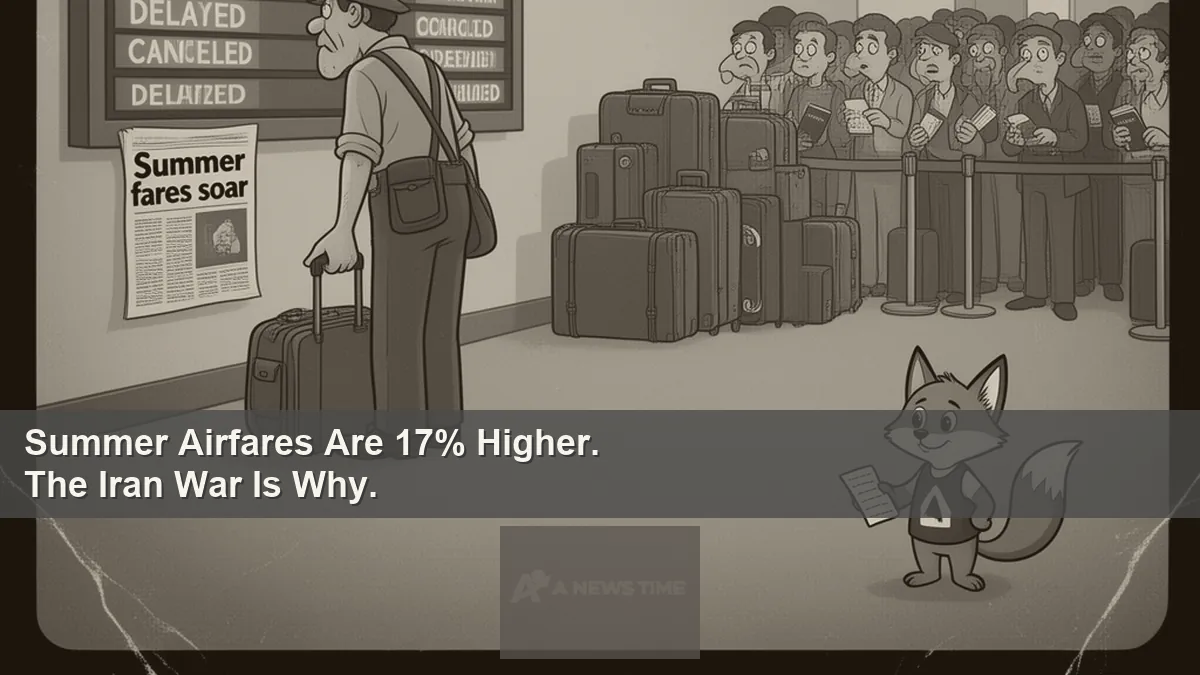
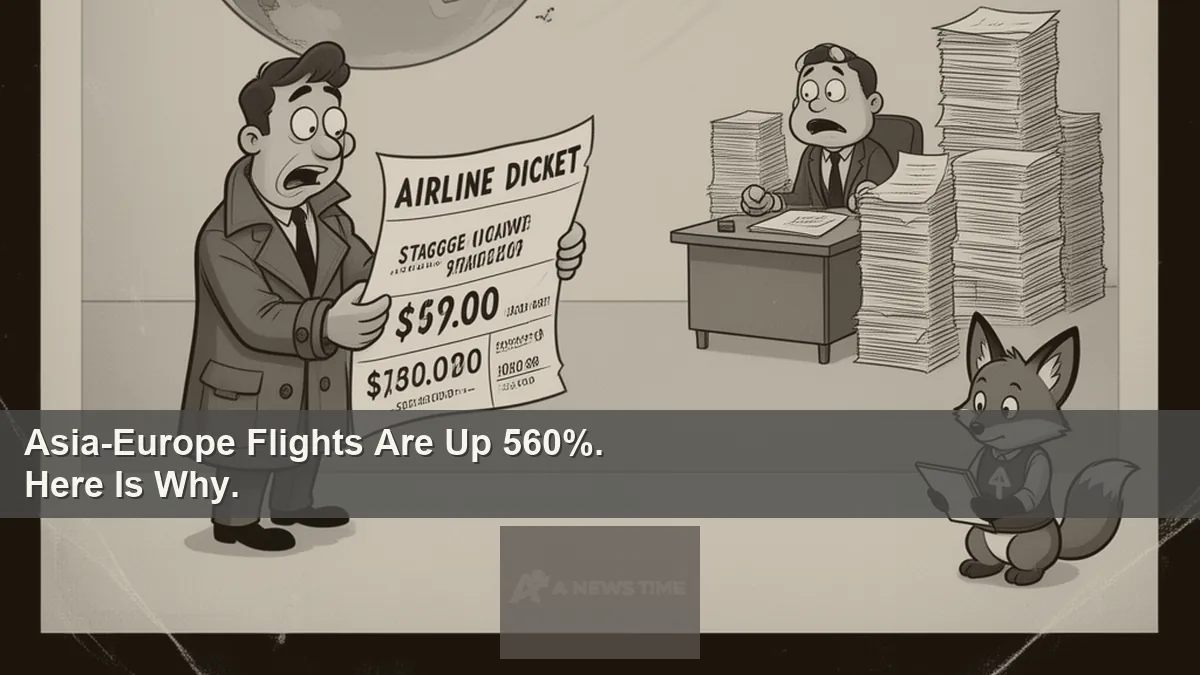
On the morning of , a one-way economy seat from Hong Kong to London was listed at $3,318. Three months earlier, before the Iran War began, the same route in the same cabin ran between $450 and $600. The numbers from Bangkok to Frankfurt tell a similar story: $2,870 for a one-way economy ticket, compared to roughly $475 in December 2025. The increases, documented by Bloomberg and confirmed across multiple fare tracking platforms, represent a surge of 560 percent and 505 percent respectively. This is not a pricing anomaly. It is the logical arithmetic of airspace closures, rerouted flight paths, and a global fuel market that has reset to a new and higher baseline.
For travelers attempting to book or rebook Asia-Europe travel in the weeks following the conflict's escalation, the fare environment is unlike anything the industry has experienced outside of the immediate post-pandemic rebound in 2022. Even that comparison understates the specific nature of this disruption. The 2022 surge was driven by a mismatch between surging demand and reduced fleet capacity. This surge is driven by supply chain costs increasing simultaneously with route-level supply falling, as airlines reduce frequencies on their most expensive-to-operate long-haul routes. The combination is, for budget travelers, devastating.
Why These Routes Specifically
Asia-Europe routes are uniquely exposed to the Iran War's aviation consequences because of geography. The FAA and the EASA have barred their respective carriers from operating in Iranian airspace (FIR Tehran), Iraqi airspace (FIR Baghdad), and portions of adjacent airspace. The traditional routing for flights between East and Southeast Asia and European capitals tracked either through the Gulf region and across the Middle East, or through Iranian airspace on southern great circle routes. Both paths are now closed to Western carriers.
The alternatives are costly. Flights now route north through Turkish airspace and across Central Asia, or in some cases take transpolar routes that add even more time. A Cathay Pacific flight from Hong Kong to London that previously took 12 to 13 hours now takes 14 to 16 hours depending on the alternate routing. Singapore Airlines' London service, which normally routes through the Middle East, is now adding up to 90 minutes per flight. Each additional flight hour on a long-haul widebody aircraft burns approximately 2,500 to 3,000 gallons of fuel. At the current IATA-tracked jet fuel price of $3.98 per gallon, that is between $9,950 and $11,940 in additional fuel cost per flight, per hour added. On a round-trip basis, the math of rerouting produces thousands of dollars in additional cost per departure, costs that flow directly into fare structures.
The problem extends beyond fuel. Crew hour regulations create secondary constraints. Aviation rules limit the total hours a crew can work within defined rest windows. When a flight adds two hours of flying time, it either requires additional crew (with positioning and accommodation costs) or reduces the number of return flights the same crew can operate within their legal limits. Airlines facing this math often reduce frequency rather than add crew to maintain full schedules, which tightens the supply of seats precisely when the remaining passengers most need them.
The Cancellation Count
By late March 2026, Eurocontrol, the organization that coordinates European airspace, estimated that the conflict had produced more than 70,000 flight cancellations across affected routes since the conflict's escalation. This is not 70,000 flights removed from schedules entirely; some of those cancellations reflect frequency reductions, where daily service becomes four-times-weekly service. But for passengers holding tickets on cancelled departures, the distinction is cold comfort when rebooking options on the remaining flights carry prices five to six times higher than their original fares.
The rebooking situation itself has created secondary market distortions. When a carrier cancels a flight, passengers with flexible tickets can rebook on the next available departure. But when available departures are running at drastically higher fares, airlines face the awkward situation of rebooking displaced passengers at current market rates or absorbing the cost of rebooking them at their original fare basis. Most major carriers have issued fare waiver policies for conflict-affected routes, allowing passengers to rebook within defined windows at their original fare basis or receive refunds. The practical application of those waivers has been inconsistent, with passengers reporting extended hold times and varied outcomes depending on which agent handled their call.
"Up to three months for the supply chain reductions to fully work through to market prices. This isn't going to turn around in two weeks just because people want it to."
Bryan Terry, Aviation Analyst, Alton Aviation Consultancy
Bryan Terry of Alton Aviation Consultancy explained the timeline dynamic to Bloomberg in late March. His "three months" estimate for fare normalization assumes that the conflict situation stabilizes and airspace reopens on a reasonable timeline. If airspace remains closed through the summer, the period of elevated fares extends accordingly. Terry's analysis reflects the industry's own modeling: airlines do not immediately reprice downward when cost pressures ease; they watch booking trends, competitive moves, and fuel markets before adjusting fare structures, which adds lag on both the upward and downward sides of the cycle.
What Travelers With Booked Tickets Should Know
The first practical question for anyone holding an Asia-Europe ticket is whether their flight is actually operating. The answer requires checking directly with the airline, because what shows on a booking confirmation is not necessarily what will operate on the travel date. Airlines are updating schedules on rolling bases, sometimes with three to five days notice for frequency reductions. Setting up schedule change notifications through the airline's app or website is essential for anyone traveling in the next 60 days on an affected route.
For passengers on flights that are operating but with extended flight times due to rerouting, the practical implications depend on connections. A traveler flying Hong Kong-to-London with a connection at Heathrow onto a domestic UK flight faces the risk that the extended flight time eliminates their connection buffer. Airlines have typically been issuing mass schedule change notifications on affected routes, which trigger rebooking rights. If your arrival time has shifted significantly, review whether your airline has issued a schedule change notification and whether that notification entitles you to rebooking on a different flight at your original fare basis.
For travelers who have not yet booked but need to travel between Asia and Europe in the next 90 days, Hanming Li, an independent aviation analyst who tracks Asia-Pacific routing changes, offered measured guidance in commentary published in late March: "Booking flexibility has never mattered more on these routes than it does right now. A fully flexible ticket that can be changed without fee is worth the premium in this environment, because the situation is genuinely dynamic."
The premium Li refers to is real. Fully refundable economy and business class fares on Asia-Europe routes are running 40 to 60 percent above non-refundable fares on the same flights. In a normal environment, that premium is rarely worth paying. In a situation where schedules are being revised weekly and the conflict trajectory is uncertain, the calculation changes materially.
Alternatives: What Routing Options Exist
For travelers whose Asia-Europe itineraries are flexible enough to consider alternatives, a few routing strategies can reduce exposure to the most severely repriced segments.
Trans-Pacific then Atlantic: Flying from Asia to the United States and then connecting to Europe on a separate transatlantic leg avoids the most disrupted routes entirely. The trans-Pacific corridor is not subject to Iranian airspace constraints, and transatlantic fares, while elevated by fuel costs, are not experiencing the 500-plus percent spikes of Asia-Europe direct routes. The tradeoff is additional flying time, typically adding 12 to 18 hours over the Asia-Europe equivalent, and the complexity of managing two separately ticketed segments. For travelers for whom the price gap justifies the time cost, this routing is worth pricing out explicitly.
Trans-Siberian and northern routings: Some carriers have increased use of polar or northern routes that traverse Siberian airspace, which remains open to most international carriers. Aeroflot and other carriers comfortable with Siberian routing have not been subject to the same constraints as Western and Gulf carriers. For travelers who prioritize cost over complexity and hold citizenship that allows these routings without restriction, exploring carriers that maintain Siberian corridor options is worth considering.
Overland in Asia: For certain Asia-Europe itineraries where the final European destination is Central or Eastern Europe, rail and road connections through Central Asia represent an extreme but historically significant alternative. This is not a practical suggestion for most business travelers or those with tight timelines, but the conflict has generated renewed interest in trans-Asian overland routes among a subset of budget-oriented travelers and those with significant scheduling flexibility.
The most practical advice for the majority of travelers is narrower: if your Asia-Europe trip is not essential in the next 60 to 90 days, and you booked on a refundable or changeable ticket, consider delaying until the airspace situation clarifies. The analysis of Middle East flight disruptions published earlier in the month remains relevant for understanding the likely timeline of airspace reopening.
The Impact on Australian and Oceania Travelers
Australia and New Zealand face a specific version of this problem. Sydney-to-London routes, one of the world's longest commercial flights, previously used either Middle Eastern hubs for connections or Indian Ocean routing that passed through or adjacent to Gulf airspace. With both options constrained, fares on Australia-Europe routes have climbed significantly, though the increase is less severe than on the Hong Kong or Bangkok corridors because Australian routes had more pre-existing routing alternatives via southern Indian Ocean paths.
Sydney-to-London economy fares, which ran $1,200 to $1,400 in December 2025, were listing at $1,800 to $2,200 in late March 2026. The increase is roughly 50 to 60 percent, painful but substantially below the 500-plus percent increases on shorter Asia-Europe routes that relied more heavily on the now-closed airspace. Qantas and Singapore Airlines, the dominant carriers on this corridor, have both maintained service with rerouting adjustments rather than cancellations, which has supported seat supply and moderated the fare impact.
For Australians considering alternatives, the trans-Pacific via Los Angeles routing has emerged as a practical option for those with flexible schedules. Adding a stopover in Los Angeles or Dallas on the way to Europe adds travel time but accesses transatlantic fares that are currently more stable than Asia-Pacific-to-Europe direct pricing.
Looking Ahead: When Might Fares Normalize?
The 560 percent surge on Hong Kong-to-London and the 505 percent jump on Bangkok-to-Frankfurt represent a market in shock, repricing in real time to reflect costs that no airline modeled as a planning scenario at the start of 2026. These levels are not sustainable as a long-term fare structure; they reflect the acute disruption of the first weeks of a conflict that the market is still pricing through.
Terry's three-month normalization timeline assumes airspace reopening. Without that reopening, the structural cost of rerouting remains embedded in every flight, and fares remain elevated regardless of what happens to demand. The travelers best positioned in this environment are those who can delay, reroute, or who purchased flexible tickets before the crisis escalated. Strategies for managing the broader summer fare surge are relevant context for anyone navigating the next booking decision.
For the longer-term record: the last time Asia-Europe fares experienced anything approaching this disruption was the post-pandemic rebound in mid-2022, when seats on these routes were genuinely scarce and fares ran 80 to 120 percent above 2019 levels. Those fares normalized within 18 months. The current surge is sharper in magnitude but driven by different structural causes, and the normalization timeline will depend on factors that no airline CEO or aviation analyst can determine: when the conflict ends and when the airspace reopens.