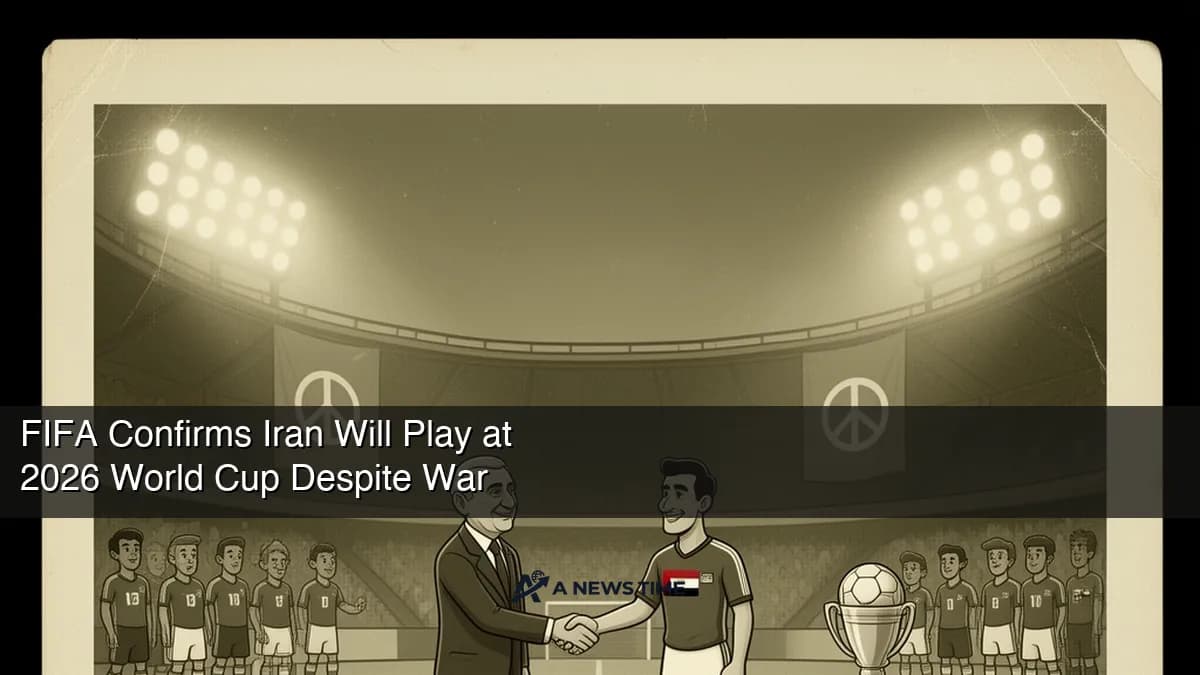
FIFA president Gianni Infantino confirmed on that Iran will participate in the World Cup despite the ongoing military conflict between Tehran and a US-Israeli coalition that has overshadowed preparations for the sport's biggest event. Speaking on CNBC at the Semafor World Economy 2026 summit in Washington, Infantino was unequivocal: "Iran is coming for sure."
Infantino Makes the Case for Sports Over Politics
Iran's participation had been thrown into serious doubt following the outbreak of war on , when the United States and Israel launched strikes against Iranian targets. The conflict created an unprecedented situation: a World Cup participant actively at war with one of the tournament's three host nations.
Infantino addressed the tension directly but framed it as a question with only one acceptable answer.
"Iran is coming for sure. We hope that by then the situation will be a peaceful situation, that would definitely help. But Iran has to come, they represent their people, they have qualified, the players want to play."Gianni Infantino, President, FIFA
The FIFA president repeatedly returned to the principle of political neutrality. "Sports should be outside of politics," he said. "If there's nobody else that believes in building bridges and keeping them intact and together, we are doing the job."
The statement carried diplomatic weight beyond football. With US-Iran peace talks stalling and a naval blockade intensifying tensions, FIFA positioning itself as a bridge-builder, however symbolic, adds another dimension to the geopolitical dynamics surrounding the conflict.
Iran's Long Road to the 2026 World Cup
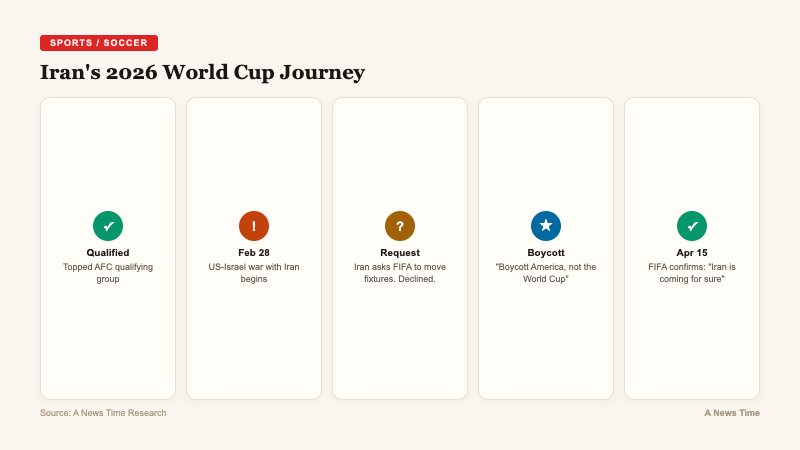
Iran qualified for the 2026 World Cup through the Asian Football Confederation's qualification pathway, securing their place as one of the continent's six automatic qualifiers. The team, coached by Amir Ghalenoei, topped their qualifying group and arrived at the tournament as one of Asia's strongest sides on current form.
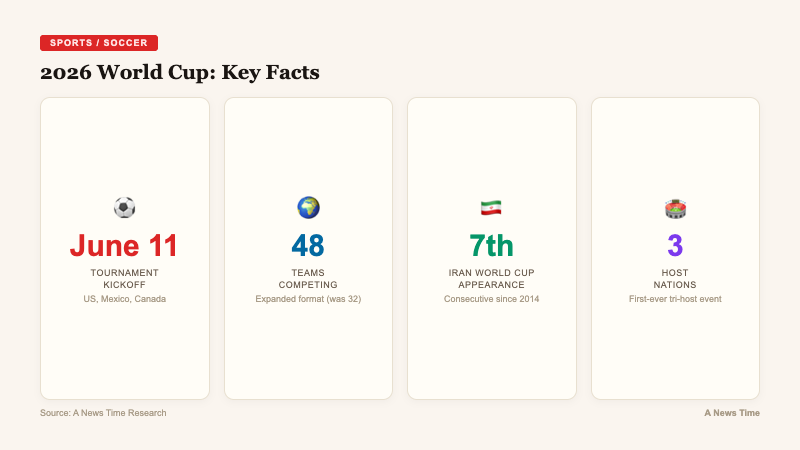
| Tournament Detail | Information |
|---|---|
| Host Nations | United States, Mexico, Canada |
| Tournament Start | |
| Total Teams | 48 (expanded format) |
| Iran's Group Stage Venues | To be confirmed (matches in US) |
| Iran's World Cup Appearances | 7th total (consecutive since 2014) |
| War Outbreak | |
| FIFA Decision on Venue Relocation | Declined Iran's request |
Iran's journey to the tournament was not without controversy even before the war. The team had previously asked FIFA to relocate their group stage fixtures away from US soil, citing security concerns for players and fans traveling to a country whose government was actively engaged in military operations against their homeland. FIFA declined the request, stating that all participating nations were expected to play at the designated venues.
Iran's football federation subsequently declared that the team would "boycott America but not the World Cup," a carefully worded position that left open the possibility of traveling to the US for matches while maintaining a political stance. That formulation now appears to have been a precursor to full participation, with Infantino's confirmation removing the remaining ambiguity.
Security and Logistics Present Real Challenges
Infantino's confirmation that Iran will play does not resolve the practical challenges of hosting a team from a country at war with the tournament's primary host nation. The security requirements for Iran's delegation, including players, coaching staff, officials, media, and fans, will be significantly more complex than for any other participating team.
Iranian fans traveling to the United States face potential visa restrictions, heightened screening, and the general uncertainty of entering a country whose government is conducting military operations against their own. The US State Department's travel advisories and the status of diplomatic relations between the two countries at the time of the tournament will directly affect fan attendance.
For the players themselves, the situation creates psychological pressure that extends far beyond normal tournament stress. Representing a nation at war on the soil of the enemy adds a dimension to the World Cup that no previous edition has confronted. The 1998 US-Iran match in Lyon, France, occurred against the backdrop of diplomatic tensions but nothing approaching the current military conflict.
FIFA's security protocols for the tournament will need to account for scenarios ranging from protests at matches to cybersecurity threats targeting team communications. The organization has experience managing politically charged fixtures, but the US-Iran war elevates the complexity to a level that will test its operational capacity.
Historical Precedent: Sports and Conflict
FIFA's decision to keep Iran in the tournament follows a long and contentious history of sports organizations navigating participation during active conflicts. The most relevant precedents offer mixed guidance:
- 1980 Moscow Olympics: The US-led boycott over the Soviet invasion of Afghanistan removed 66 nations from the Games, but the Olympics proceeded with the remaining participants
- 1984 Los Angeles Olympics: The Soviet bloc's retaliatory boycott demonstrated that exclusion based on geopolitics creates its own problems
- 2022 Russia suspension: FIFA banned Russia from all competitions following the invasion of Ukraine, but the circumstances differed because Russia was the aggressor in a conflict within its own region
- Yugoslavia in the 1990s: The country was excluded from European Championship and World Cup competitions during the Balkan wars
The Iran case is distinct from all of these because Iran is not the aggressor in the conflict (from its own perspective and that of many international observers), it qualified through legitimate sporting channels, and the war involves one of the host nations rather than a third party. Excluding Iran would set a precedent that could be used to remove any nation involved in a military conflict with a host country, a standard that would have made historical tournament participation impossible for multiple nations.
The Ceasefire and What It Means for June
The timing of Infantino's announcement coincides with renewed diplomatic activity between the US and Iran. A fragile two-week ceasefire is in place, and both sides are reportedly considering returning to Pakistan for further talks. If a lasting peace agreement is reached before the tournament begins on , much of the tension around Iran's participation would dissipate.
If the ceasefire collapses, however, FIFA faces a scenario with no modern precedent: hosting a team whose country is in active military conflict with the host nation while matches are being played. The economic fallout from the war has already affected global markets, energy prices, and international relations. The World Cup adds a cultural and sporting dimension that amplifies the stakes.
Infantino's message was clear: FIFA will not be the organization that excludes a nation from the world's biggest sporting event over a conflict it did not start. Whether that principled stance can be maintained through the operational realities of hosting Iran in American stadiums will be one of the defining stories of what is already shaping up to be the most geopolitically complex World Cup in the tournament's 96-year history.
What Comes Next Before Kickoff
With fewer than two months until the tournament begins, several developments will determine how Iran's participation unfolds:
- Ceasefire negotiations: The Pakistan-mediated talks between US and Iranian officials are the most immediate variable
- Visa and travel logistics: The US government's willingness to facilitate entry for Iranian players, staff, and fans
- FIFA security protocols: Specific measures for Iran's matches, including venue selection and fan zone management
- Team preparation: Iran's ability to conduct pre-tournament training camps and friendly matches despite the war's disruption to domestic football infrastructure
- Fan movement: Whether Iranian supporters can realistically travel to the US, and whether diaspora communities organize support
The 2026 World Cup was always going to be historic as the first 48-team tournament and the first hosted across three countries. Iran's participation ensures it will also be remembered as the tournament that tested FIFA's principle that sports and politics can be separated, even when the pitch is 3,000 miles from the front lines.