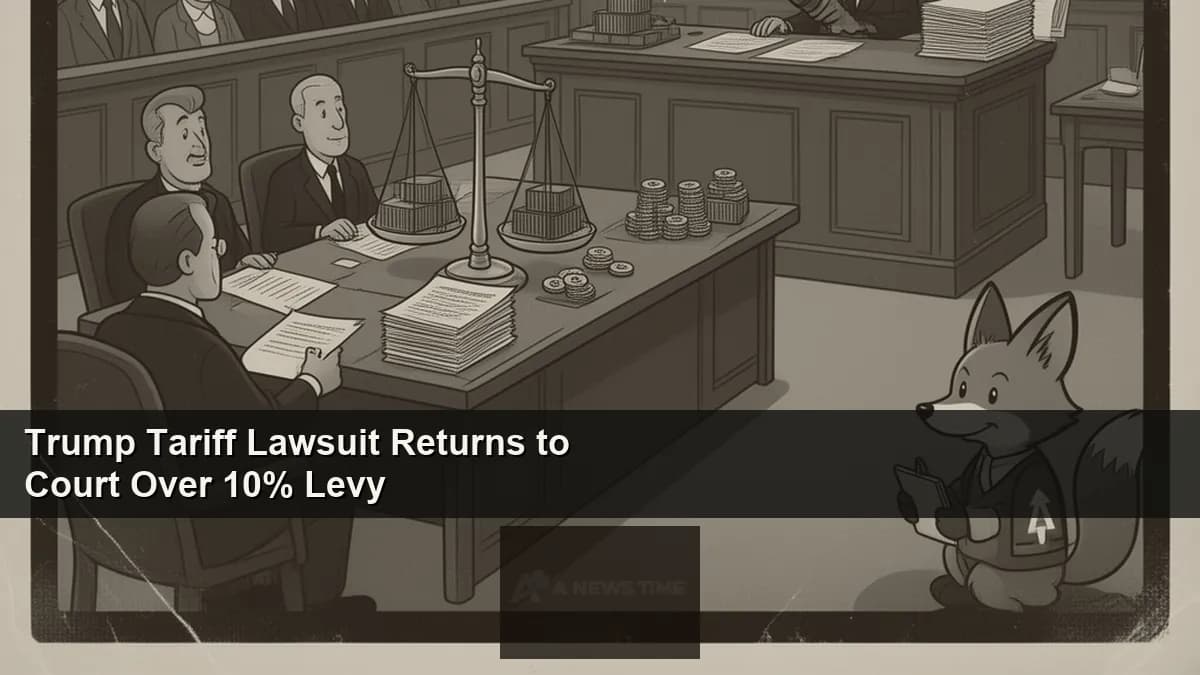
The U.S. Court of International Trade convened a three-judge panel on , to weigh the legality of President Trump's 10 percent global import tariff -- a levy that went into effect on and now sits at the center of a constitutional fight over how much tariff authority the executive branch can claim without an act of Congress. The plaintiffs: 24 mostly Democratic-led states and two small businesses who argue the administration has again exceeded its legal mandate, this time under a narrow provision of a law written to protect the dollar from gold-era monetary emergencies.
The hearing is the second major legal test of Trump's tariff program in less than two months. On -- the same day the president signed the executive order imposing this new levy -- the Supreme Court handed the administration a significant defeat, ruling that the IEEPA did not grant the president authority to impose broad-based tariffs. That ruling wiped out the bulk of the administration's earlier tariff architecture. What remained standing were tariffs imposed under more conventional statutory authority -- steel, aluminum, copper duties -- plus this new global rate built on a separate and largely untested statute: Section 122 of the Trade Act of 1974.
What Section 122 Actually Says -- and What the Administration Claims It Means
Section 122 of the Trade Act of 1974 grants the president authority to impose import duties of up to 15 percent for up to 150 days when the United States faces "large and serious United States balance-of-payments deficits" or when the dollar faces imminent depreciation. The provision was written during the Nixon era, when the Bretton Woods system was collapsing and the dollar could still technically be exchanged for gold held at Fort Knox. The law was designed as a short-term monetary emergency tool, not a standing mechanism for broad trade rebalancing.
The Trump administration's position is straightforward: the United States has run a persistent goods trade deficit for decades, that deficit constitutes a "balance-of-payments deficit" within the meaning of Section 122, and the statute therefore gives the president legal authority to impose the 10 percent global levy. Under that reading, the tariff expires after 150 days unless renewed -- a structural feature that distinguishes it from the open-ended IEEPA authorities the Supreme Court struck down.
Oregon lawyer Brian Marshall, arguing on behalf of the plaintiff states before the USCIT panel, rejected that reading directly. "They have a different meaning of what 'balance of payments deficits' means," Marshall told the judges, arguing that the administration is conflating the narrow, technical economic concept -- which refers to the net flows of currency, capital, and goods across borders in a way that threatens reserve adequacy or currency stability -- with the everyday trade deficit figure the government reports monthly. The merchandise trade deficit has run between roughly $800 billion and $1.2 trillion annually in recent years. That is a different animal from the acute monetary crisis Section 122 was designed to address, the plaintiffs argue.
| Statute | Max Tariff Rate | Duration | Trigger Condition | Current Status |
|---|---|---|---|---|
| IEEPA | No statutory cap | Indefinite while emergency declared | National emergency (broadly defined) | Struck down by Supreme Court, |
| Section 122, Trade Act of 1974 | 15% | 150 days (renewable) | "Large and serious" balance-of-payments deficit or imminent dollar depreciation | Under challenge at USCIT, hearing |
| Section 232 (Steel/Aluminum) | No statutory cap | Indefinite while national security finding stands | National security threat from imports | Active, not challenged in current litigation |
No U.S. president before Trump has used either IEEPA or Section 122 to impose tariffs. That track record matters in administrative law: courts are more skeptical of novel executive interpretations of statutory authority, particularly when the claimed power is sweeping and the historical record of non-use is long. The Supreme Court's February ruling leaned heavily on this logic.
Who Filed and What They Are Actually Asking For
The lawsuit was brought by a coalition of 24 states -- predominantly Democratic-led -- along with two small businesses who can demonstrate direct economic harm from the 10 percent levy. The state coalition is led by Oregon, whose attorney argued the opening position before the three-judge panel. The coalition's legal strategy draws a sharp line: they are not challenging the traditional tariffs on steel, aluminum, and copper imports that the Trump administration has imposed under Section 232 national security authority. Those tariffs rest on firmer precedent. This lawsuit is specifically and narrowly targeted at the 10 percent global rate and the statutory interpretation the administration is using to justify it.
For the small business plaintiffs, the stakes are concrete and immediate. A 10 percent blanket tariff applied to all goods imports adds cost at every stage of supply chains that domestic businesses cannot easily reroute. As A News Time reported in its Liberation Day one-year analysis, the Peterson Institute for International Economics estimated that 94 percent of tariff costs in the broader Trump trade program have been absorbed by U.S. importers and consumers, not passed back to foreign exporters. For a small importer operating on thin margins, a 10 percent across-the-board input cost increase is not an abstraction -- it is a cash flow problem that compounds quarter over quarter.
The states' argument includes a procedural dimension as well. Congress has not authorized this use of Section 122 for what is, in effect, a permanent trade rebalancing policy. The administration announced the Feb. 24 tariffs on Feb. 20, the same day the Supreme Court ruled against it on IEEPA -- a timing that plaintiffs characterize as a deliberate pivot to a backup statute rather than a good-faith reading of the law.
The Supreme Court Backstory: How IEEPA Fell
To understand what is at stake at the Court of International Trade, it helps to understand what fell before it. The Trump administration's initial tariff strategy rested primarily on IEEPA, a 1977 law that gives presidents broad authority to regulate economic transactions with foreign nations during declared national emergencies. The administration declared a national economic emergency in early 2025 and used IEEPA to impose a sweeping tariff structure on imports from more than 60 trading partners -- the so-called Liberation Day tariffs that went into effect on .
Courts moved quickly. The challenge worked its way up to the Supreme Court within months. On , the Court ruled that IEEPA did not grant tariff-imposing authority -- that the statute's language authorizing the president to "regulate" or "prohibit" transactions did not encompass the power to levy tariffs, which is constitutionally a congressional function. The practical effect, as analyzed in A News Time's Liberation Day retrospective, was that the effective U.S. tariff rate had already climbed from 2.4% to between 12% and 13.6% during the year the IEEPA tariffs were in force -- with most of that cost absorbed by American businesses and households.
"Trump announced the new tariffs on Feb. 20, the same day the Supreme Court handed him a stinging defeat when it struck down a broad swath of tariffs he had imposed under the International Emergency Economic Powers Act, ruling that the law did not give him the power he claimed."
Reuters, via BNN Bloomberg,
The pivot to Section 122 was announced the same day as the IEEPA ruling, which legal observers noted at the time was either remarkably fast contingency planning or a signal that the administration had been preparing this fallback position for months. The 10 percent rate is lower than the IEEPA-era peak -- the original Liberation Day structure included country-specific rates as high as 54 percent on Chinese goods -- but it applies globally and remains above the pre-2025 average effective tariff rate of 2.4 percent.
The Legal Crux: What "Balance of Payments" Actually Means
The phrase "balance of payments" has a specific meaning in economics and international finance that is materially different from "trade deficit." The balance of payments is a comprehensive accounting of all economic transactions between a country's residents and the rest of the world over a given period. It encompasses the current account (goods and services trade, income flows, and transfer payments), the capital account (transfers of assets), and the financial account (investments, loans, reserve changes). A "balance-of-payments deficit," in the technical sense Section 122 was written to address, refers to a situation where a country is running down its foreign exchange reserves or facing downward pressure on its currency because outflows exceed inflows across all three accounts.
The United States runs a current account deficit, driven primarily by its goods trade deficit. But the dollar is the world's reserve currency, and the U.S. financial account consistently runs a large surplus -- foreign investors buy U.S. Treasuries, equities, and real estate at a pace that more than offsets goods trade outflows. The dollar has not faced the kind of depreciation pressure or reserve-adequacy crisis that Section 122 was designed to address. The IMF's most recent global outlook flagged supply chain disruptions from the Iran conflict as a growth and inflation risk but did not flag a U.S. balance-of-payments crisis as a near-term concern.
| Indicator | Value | Direction |
|---|---|---|
| Annual goods trade deficit (2025) | ~$1.1 trillion | Persistent, structurally stable |
| U.S. Dollar Index (DXY) | ~103 at time of announcement | Moderately elevated, no acute depreciation pressure |
| Foreign holdings of U.S. Treasuries | ~$7.9 trillion | Near record, rising financial account surplus |
| Federal Reserve foreign exchange reserves | Not being drawn down | No reserve adequacy crisis |
This is the core of the plaintiffs' argument: whatever problem the 10 percent tariff is solving, it is not the problem Section 122 was designed to fix. The statute's 150-day limit and 15 percent cap, the states argue, are also evidence that Congress intended a narrow emergency tool, not a framework for structural trade rebalancing that the administration intends to maintain indefinitely.
Market and Business Implications: What a Ruling Either Way Means
The USCIT panel is not expected to issue an immediate ruling from the bench. Legal observers anticipate a written decision within weeks, with an almost certain appeal to the U.S. Court of Appeals for the Federal Circuit, and likely a subsequent petition to the Supreme Court from whichever side loses. That appellate timeline means the 10 percent tariff could remain in force for months regardless of the April 10 hearing outcome.
For importers and businesses that depend on global supply chains, that uncertainty compounds the cost of the tariff itself. Companies cannot easily restructure sourcing arrangements on the assumption that a tariff will be struck down, because if it is upheld, they will have made expensive adjustments for nothing. The rational response is to absorb costs, raise prices where possible, and wait -- a dynamic that the March jobs report's 178,000-job gain suggests the labor market has so far absorbed without catastrophic damage, though the long-run effects of sustained elevated input costs tend to show up in capex cuts and margin compression before they appear in payrolls.
There is also a 150-day clock problem. Section 122 tariffs can only run for 150 days before requiring renewal. The tariff went into effect on February 24. That means it expires around late June 2026 absent a renewal action. If the USCIT panel strikes down the tariff but the Federal Circuit stays that ruling pending appeal, the administration may simply let the first 150-day period expire and issue a renewal -- resetting the legal clock and complicating the litigation. That procedural maneuver is not hypothetical; it is the kind of iterative executive action that has characterized the administration's tariff strategy throughout.
For financial markets, the hearing introduces a specific category of risk: a ruling against the tariff would remove a layer of import costs that is currently priced into supply chains, which could ease near-term inflation pressure but also create reallocation noise as businesses adjust. The Federal Reserve has noted tariff pass-through as a contributing factor to above-target inflation; a tariff removal could modestly loosen the inflation picture and, at the margin, shift the rate hike probability calculus that CME FedWatch data currently prices at 52 percent for at least one 2026 increase.
Broader Stakes: Congressional Authority Over Tariffs
The deeper question animating both this lawsuit and the IEEPA case that preceded it is constitutional: the Taxing Clause of the U.S. Constitution grants Congress, not the president, the power to lay and collect taxes and duties. Congress has delegated significant tariff authority to the executive over the decades -- through Section 232, Section 301, and the trade remedy statutes -- but those delegations are bounded by specific triggers and procedural requirements. What the Trump administration has attempted, across both the IEEPA and Section 122 theories, is to claim authority broad enough to function as a de facto standing tariff policy set by executive order alone.
The Supreme Court's February ruling on IEEPA drew a clear line: statutory delegations of authority that touch core congressional powers require specific, clear authorization. That reasoning applies with equal force to Section 122, which was written for monetary emergencies, not trade deficits. "No U.S. president before Trump had used the IEEPA or Section 122 to impose tariffs," Reuters noted in its April 10 coverage of the hearing -- a historical observation that carries legal weight under the major questions doctrine the Supreme Court has applied to executive overreach claims.
For businesses, the long-run implication is not just about the 10 percent rate. It is about whether the next administration -- or this one in a second phase -- can use executive authority to impose tariffs at will without the kind of statutory specificity that creates predictability for investment and sourcing decisions. Trade policy uncertainty has real costs: it raises the hurdle rate for long-lived capital investments, compresses international business planning horizons, and fragments global supply chains in ways that tend to be durable even after the policy that caused them is reversed.
What Happens Next
The USCIT three-judge panel will issue a written ruling. If it strikes down the tariff, the administration will almost certainly seek an emergency stay from the Federal Circuit to keep the tariff in force pending appeal. The Federal Circuit, which has jurisdiction over international trade cases, would then face its own decision on the merits. Either way, the case is almost certainly destined for the Supreme Court -- the same body that struck down the IEEPA tariffs in February and will now be asked to rule on the administration's backup theory.
On the legislative side, the ongoing litigation creates pressure for Congress to act. If neither IEEPA nor Section 122 survives judicial scrutiny as a basis for broad tariffs, the administration's remaining options narrow to the traditional Section 232 and Section 301 pathways -- which require specific findings, procedural steps, and product-level specificity that make them blunt instruments for a president who wants to impose a universal baseline rate. Congress could, theoretically, pass new legislation granting explicit tariff authority. Whether the current Congress has the appetite for that fight, given that the tariff program is broadly popular with the Republican base, is a political calculation that will unfold in parallel with the legal one.
For the 24 states and two small businesses that filed this lawsuit, the April 10 hearing is the opening argument in what is likely an 18-to-24-month legal process. The 150-day clock provides a procedural complication, but neither side is treating this as a narrow technical dispute. It is a contest over the shape of executive power over trade -- a question the Supreme Court began answering in February and has not finished.