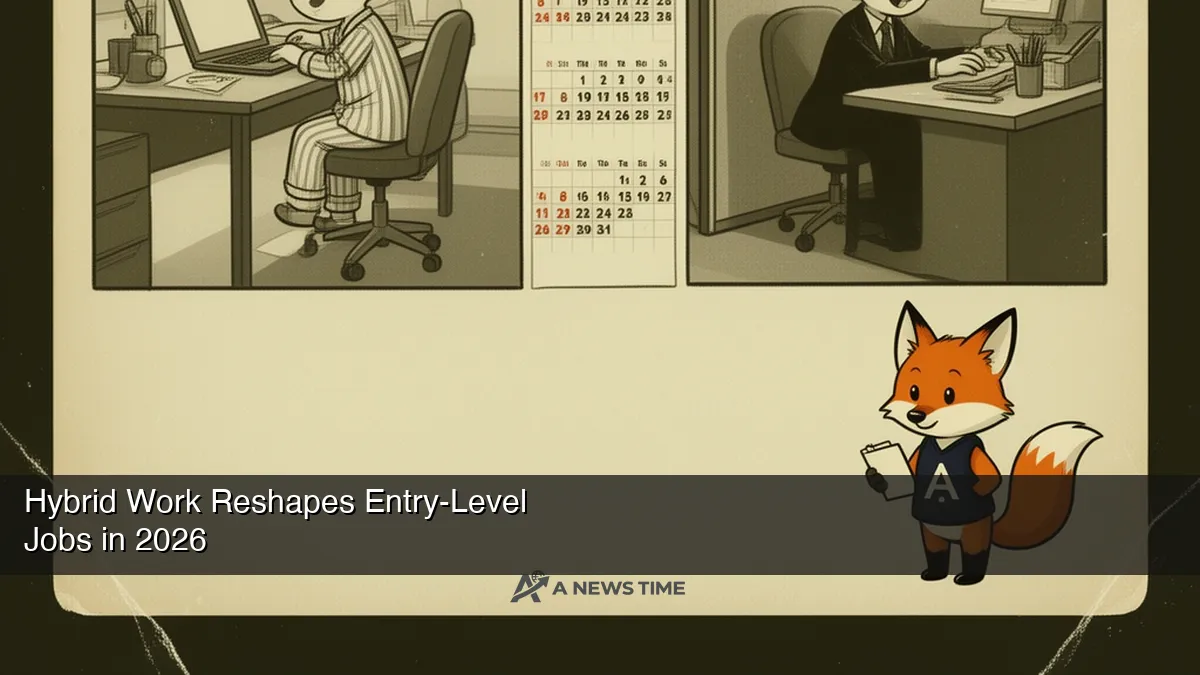
The post-pandemic remote work settlement has arrived at something close to a stable state. The dramatic swings of 2020 through 2022 and the subsequent return-to-office campaigns of 2023 have produced a labor market in which approximately one-third of professional job postings feature some form of flexible work arrangement, a ratio that has held relatively steady since late 2023 and shows no sign of unwinding despite high-profile office mandates at several large employers. Robert Half's analysis of more than 423,000 new U.S. job positions through the fourth quarter of 2025 found that 24 percent of new postings were hybrid and 11 percent were fully remote, with fully on-site at 65 percent. FlexJobs, tracking the narrower category of fully remote professional roles, found that 15 career fields each showed at least 19 percent growth in fully remote job postings during 2025 compared to the prior year. The map of where remote work is growing, who is getting it, and what it takes to be competitive for it tells a more granular story than either the "remote work is over" or "remote work won" narratives that continue to circulate.
The 15 Fields Where Fully Remote Work Grew Fastest
FlexJobs' Remote Work Index, published on , analyzed more than 60 career categories to identify fields where fully remote job postings grew at the highest rates between January and December 2025. The methodology excluded long-established remote-friendly categories like information technology, customer service, and project management to highlight where remote work is newly expanding rather than simply persisting in its traditional strongholds.
The 15 fields that made the list, each with at least 19 percent growth in fully remote postings, were: engineering, administrative, sales, client services, banking, social media, mental health, insurance, operations, nursing, legal, account management, education and training, communications, and HR and recruiting. The breadth of that list is significant. It spans technical and non-technical roles, credentialed and non-credentialed fields, and sectors as different as mental health, banking, and engineering. The common thread is not occupational category but employer behavior: companies in all of these fields are discovering that the functions can be performed effectively at a distance, and are adjusting their hiring posture accordingly.
The inclusion of nursing in the fully remote growth list is worth specific attention. Remote nursing, primarily in the form of telephonic triage, telehealth consultation, case management, and utilization review, has been growing since the pandemic accelerated telehealth adoption, and the growth continued through 2025 as health systems that built remote nursing capacity found it operationally effective and cost-efficient. The category does not represent bedside nursing, which remains inherently on-site, but it represents a growing and well-compensated subset of nursing roles that has opened a path to remote work for a profession that has historically required in-person presence.
"Workers want to work remotely. Companies know that it makes sense to offer work flexibility like remote work to help them attract and retain talent. For remote roles, candidates need to show they can work really effectively as independently as possible with less manager oversight."
Toni Frana, Career Expert Manager, FlexJobs
What Workers Are Saying: Flexibility Drives Job Search Behavior
The demand side of the remote work equation is equally clear in the survey data. FlexJobs' Remote Work Index found that 85 percent of professionals identified remote work as the biggest factor that would make them apply to a job, ranking above competitive pay and benefits. That figure suggests a preference intensity that goes beyond convenience: for most professionals, remote work availability is a primary filter applied before salary, not an enhancement considered after it.
Robert Half's survey of more than 500 HR managers, with a companion survey of job seekers, found that 38 percent of professionals were already looking or planning to look for a new role in the first half of 2026. Of those, only 16 percent said their top choice was an in-office job. Only 25 percent were even considering pursuing a role that required five days per week in the office. Hybrid was the dominant preference, with 55 percent of workers ranking it as their top choice. The split between workers preferring 1-2 days versus 3-4 days in the office was nearly even: 28 percent preferred 1-2 days, and 27 percent preferred 3-4 days.
The retention implications are as significant as the recruitment implications. Among professionals who were not actively job searching, 47 percent cited not wanting to lose their current level of flexibility as a key reason for staying. Flexibility retention is functioning as a compensation substitute for a large segment of the professional workforce: workers who would otherwise be open to job changes are staying in roles that offer remote or hybrid arrangements even when those roles might not be the highest-compensated options available to them.
For employers, this dynamic creates a specific competitive calculus. Offering hybrid or remote options is not simply a quality-of-life benefit; it is a retention mechanism that is keeping workers from going to market, reducing turnover costs, and maintaining institutional knowledge. Robert Half's data found that 88 percent of employers are now providing some hybrid work options, though availability varies significantly by seniority level and role type.
The Seniority and Field Gaps in Remote Availability
The availability of remote and hybrid work is not evenly distributed across the workforce, and the distribution pattern has important implications for career development, equity, and the long-term career trajectories of workers at different experience levels. Robert Half's seniority analysis of new job postings through the fourth quarter of 2025 found a clear gradient: senior-level roles offered hybrid arrangements at a rate of 30 percent and fully remote at 13 percent, while entry-level roles offered hybrid at 18 percent and fully remote at 9 percent. The gap between entry-level and senior-level remote availability is not trivial. Entry-level workers, who are most likely to benefit from the financial flexibility that remote work offers, are least likely to have access to it.
The field variation adds another layer. Marketing and creative roles showed the highest rate of fully remote availability at 14 percent of new postings, followed by technology at 13 percent. Legal and finance and accounting each showed fully remote availability of 9 percent. Healthcare support, which includes clinical roles that are inherently on-site, came in at 8 percent fully remote. The most striking finding from the field data is that even in sectors where remote work is most common, it represents a minority of total postings. The majority of professional jobs are still on-site or hybrid, and fully remote roles remain a competitive segment with high demand from job seekers and relatively limited supply from employers.
The geographic distribution of hybrid work further complicates the access picture. Robert Half's geographic analysis found that Boston, Massachusetts led all major metro areas in hybrid job posting share at 33 percent, followed by New York at 31 percent and Minneapolis at 31 percent. San Francisco came in at 30 percent, Austin at 29 percent. Major metros show higher hybrid availability in part because the density of employer competition for talent in those markets creates stronger incentives to offer flexibility as a recruitment tool. Workers in smaller markets face a different choice set: they may find that remote work is the mechanism through which they can access major-market employers and salaries without relocating, making the ability to compete for remote roles an economic mobility question as much as a lifestyle preference.
The Stabilization That Policy Headlines Are Obscuring
The narrative about remote work since 2023 has been dominated by return-to-office announcements from high-profile employers: Amazon's five-day in-office mandate, major financial institutions requiring full-time office presence for their banking staff, technology companies rolling back pandemic-era remote policies. Those announcements are real, and they have affected workers at the specific employers involved. But the aggregate data that Robert Half and FlexJobs have been tracking tells a different story at the market level.
Fully on-site job postings declined from 83 percent of new postings in early 2023 to 66 percent by end of 2023, a drop of 17 percentage points in a single year. Through 2024 and 2025, the rate stabilized. Fully on-site postings fluctuated between 61 and 65 percent across the quarters Robert Half tracked, showing no material movement in either direction. The hybrid rate held steady at 22 to 24 percent throughout the same period. Fully remote fluctuated between 11 and 15 percent, peaking in late 2024 before declining slightly through 2025.
The stabilization pattern suggests that the labor market has settled into an equilibrium. The return-to-office announcements at individual companies have not produced a broad shift in how the overall market is structured. Employers who want to mandate full-time office presence are doing so and accepting the recruitment and retention costs that come with that decision. The majority of employers are maintaining hybrid options, which the data suggests is the arrangement that best balances operational preferences with labor market competitiveness. Neither the fully-remote advocates nor the full-time office mandators appear to have won the argument in aggregate terms; the outcome looks more like a negotiated coexistence.
What It Takes to Be Competitive for Remote Roles
The competition for remote roles is considerably more intense than the competition for comparable on-site roles. FlexJobs noted that the ratio of job seekers to remote openings is substantially higher than for on-site positions, creating a screening environment where employers can be highly selective. Frana's characterization of what differentiates successful remote candidates is specific: the ability to demonstrate that you can work effectively with minimal manager oversight, produce consistent output independently, and communicate clearly without the in-person cues and casual check-ins that office environments provide as scaffolding.
The skills that employers use to screen for remote viability are not always legible on a standard resume. Prior experience in remote roles is the strongest signal, because it demonstrates that the candidate has already demonstrated the relevant behaviors rather than just claiming they can. Project management tool proficiency, including experience with Slack, Notion, Asana, Jira, or similar collaboration platforms, signals that the candidate has worked in the documentation-heavy, asynchronous-first environment that remote work requires. Written communication quality matters more for remote roles than for comparable on-site roles because written output is the primary evidence of a remote worker's thinking and work product.
The entry-level gap in remote availability creates a specific challenge for workers early in their careers who want remote access. Entry-level roles in fully remote fields, including customer success, content writing, data annotation, and some categories of software quality assurance, are among the most effective entry points into remote work for workers without prior remote experience. Building a track record in those roles, even if the roles themselves are not the long-term career destination, provides the prior remote experience signal that is the most effective way to compete for higher-level remote roles later.
The remote work landscape of 2026 is stable enough that workers can plan around it, differentiated enough that specific choices about field and employer still matter substantially, and competitive enough that the workers who succeed in it are those who prepare for it deliberately rather than assuming that remote availability will come automatically with seniority or credentials. The FlexJobs and Robert Half data together describe a market where flexibility is available but not free: it has to be earned through demonstrated capability in the specific mode that remote work requires.