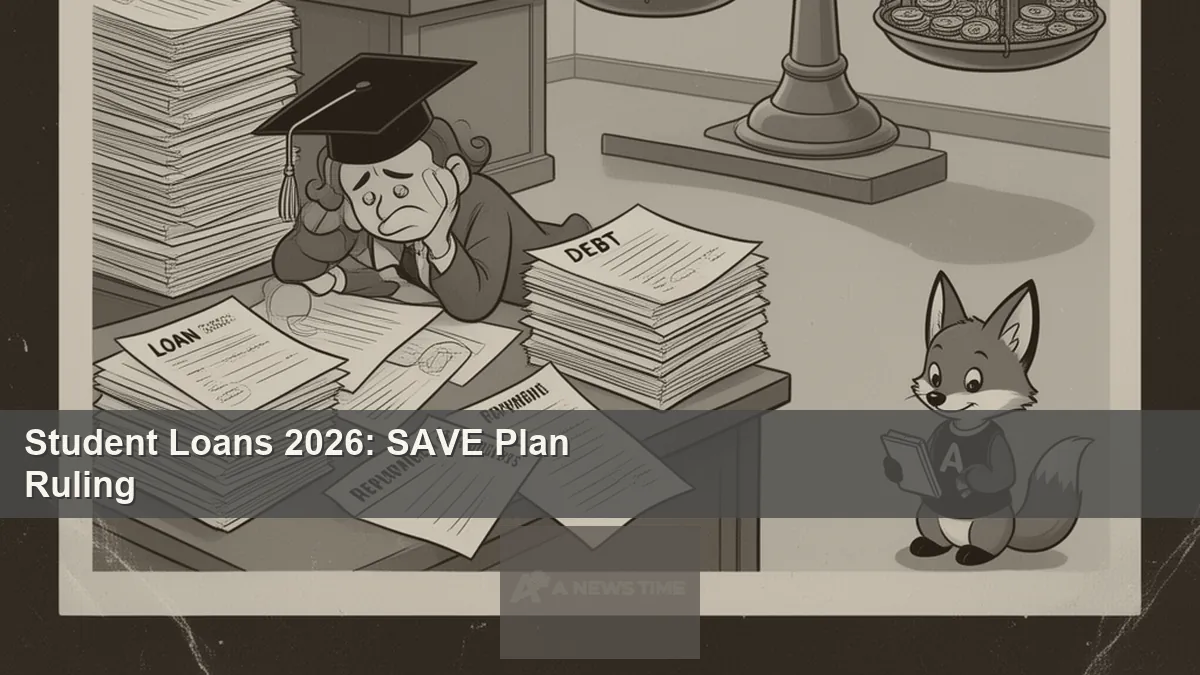
The federal student loan system entered in a state of legal and regulatory flux that has no recent precedent, and the practical implications for the roughly 43 million Americans carrying federal student loan debt are both significant and genuinely uncertain. The OBBBA, signed into law on July 4, 2025, restructured the income-driven repayment landscape in ways that are still working through the courts and the Education Department's administrative systems. A federal court ruling on dissolved the injunction blocking the SAVE plan, setting off a chain of legal maneuvers by Republican-led states seeking to re-block it. And the Education Department began processing a backlog of student loan forgiveness approvals in January and February 2026 that has sent thousands of borrowers to discharge, while simultaneously acknowledging uncertainty about whether additional approvals can proceed. For borrowers navigating this environment, understanding what has actually changed and what remains contested is the prerequisite for making sound decisions about repayment, consolidation, and planning.
The One Big Beautiful Bill Act: What Actually Changed
The OBBBA signed by President Trump in July 2025 made the most comprehensive structural changes to the federal student loan system since the repayment plan expansions of the early 2010s. Some of those changes took immediate effect; others are staged for implementation through 2026 and beyond.
The most consequential immediate change was to the IBR plan. Previously, borrowers were required to demonstrate partial financial hardship to enroll in IBR. The OBBBA removed that requirement, making IBR accessible to a broader population of borrowers including those whose income levels would not have qualified them under the prior rules. Parent PLUS borrowers who have consolidated their loans into Direct Consolidation Loans and enrolled in the ICR plan can also now access IBR. The Education Department updated its systems to implement this change on December 22, 2025, making it operational at the start of the new year.
The OBBBA also set a sunset timeline for two of the four major income-driven repayment plans: ICR and PAYE are slated to be eliminated by 2028. Borrowers who have eligible loans taken out before are permitted to access IBR, ICR, and PAYE. Borrowers who receive disbursements on new loans on or after that date will not have access to those plans, making the consolidation and enrollment deadline a significant decision point for borrowers who currently need to consolidate to access these plans. The Education Department's official guidance recommends applying for consolidation at least three months before the July 1 deadline to ensure timely processing.
The OBBBA also extended Pell Grant eligibility to short-term nondegree credential programs, a change that opens federal grant funding to workforce training programs that were previously outside the federal student aid system. This expansion has implications for the broader skills-and-credentialing market that institutions, employers, and workers are still working through.
The SAVE Plan: From Injunction to Limbo
The SAVE plan, the income-driven repayment program launched by the Biden administration in 2023, has been in legal limbo since a federal court issued an injunction blocking it in 2024. The injunction was expanded in April 2025 to include all regulations underlying the program, some of which affect all IDR plans, not just SAVE, creating a cascading complication for forgiveness processing across the entire income-driven repayment system.
The Education Department had settled with the state of Missouri and other state challengers in December 2025, agreeing to eliminate the SAVE plan entirely in exchange for dissolving the injunction. That settlement would have been bad news for the approximately seven million borrowers enrolled in SAVE, who would have been forced into less favorable repayment plans. But before the settlement could be finalized, the district court rejected the joint motion and instead dismissed Missouri's legal challenge altogether on February 27, 2026, concluding that there was no longer a live dispute for the court to resolve since all parties, the Trump administration, Congress, and Missouri, were aligned on eliminating the SAVE plan.
The court's dismissal had an immediate legal consequence: the injunction blocking the SAVE plan was no longer in effect. By the Education Department's own legal reasoning, the dissolution of the SAVE injunction should have removed the barrier to processing loan forgiveness for the broader population of IDR borrowers who reached discharge eligibility after April 2025. Within days of the February 27 ruling, the state of Missouri and other state challengers filed a new motion to re-block the SAVE plan, seeking to restore the injunction that the court had just dissolved.
"As a result of the case being dismissed, the injunction keeping millions of student loan borrowers from making payments in the SAVE plan is no longer in effect, and enrolled borrowers are entitled to its benefits."
Protect Borrowers, student loan borrower advocacy group, statement issued February 28, 2026
The legal situation as of early April 2026 is genuinely unsettled. Whether the re-blocking motion succeeds, whether the Education Department moves independently to advance forgiveness processing, and whether SAVE plan borrowers can resume making payments under the program's more favorable terms are all questions that courts have not yet resolved. Adam Minsky, a student loan attorney and writer who has tracked this litigation closely for Forbes, characterized the situation as one where forgiveness processing could either stall out or accelerate dramatically, depending on which legal development comes next.
The Forgiveness Backlog: Thousands Approved, More Waiting
Even amid the legal uncertainty, the Education Department processed a significant surge in student loan forgiveness approvals in January and February 2026. The department had previously suspended forgiveness processing for all IDR plans, arguing that the SAVE injunction prevented it from properly processing any plan's forgiveness. After successfully challenging that position in court, the American Federation of Teachers secured an agreement under which the department began resuming approvals.
Processing expanded in stages. The department first processed IBR forgiveness for borrowers who reached discharge eligibility before April 2025. It then expanded to ICR and PAYE under the same pre-April 2025 eligibility window. According to court filings from January 2026, the department identified 10,873 IBR borrowers, 10,729 original ICR borrowers, and 820 PAYE borrowers as eligible for discharges. Those discharges began processing in March 2026.
The outstanding question is what happens to borrowers who reached forgiveness eligibility during or after April 2025. The Education Department argued that those borrowers could not receive forgiveness until the SAVE injunction was lifted, because its systems could not account for the qualifying months that the injunction had frozen in place. With the injunction now dissolved (at least temporarily), the legal rationale for that limitation is gone. Whether the department will begin processing that cohort of borrowers, and how quickly, depends on administrative decisions and the outcome of Missouri's new re-blocking motion that are still unfolding.
Public Service Loan Forgiveness: Stable Amid the Turbulence
PSLF, the program that forgives remaining federal student loan balances for borrowers who work in qualifying public service or nonprofit employment for ten years while making 120 qualifying payments, has remained relatively insulated from the SAVE plan litigation. PSLF forgiveness is not subject to the same injunction issues as IDR forgiveness and has continued processing throughout the legal turbulence affecting the IDR plans.
The OBBBA made one significant change to the PSLF context: the legislation extended the period during which student loan forgiveness under PSLF is not subject to federal income tax, a provision that had been set to expire. Borrowers who receive forgiveness through PSLF do not pay federal taxes on the cancelled loan balance, and that treatment continues under the new legislation. State tax treatment varies.
For borrowers in qualifying public service employment, the PSLF stability is a meaningful contrast with the IDR turbulence. Continuing to make qualifying payments and maintain employment in a qualifying organization while the IDR landscape shifts remains the most straightforward path for PSLF-eligible borrowers, whose forgiveness is governed by a separate legal framework that has not been directly affected by the SAVE plan litigation.
What Borrowers Should Know and Do Now
The complexity of the current student loan environment rewards borrowers who take the time to understand their specific situation rather than relying on general accounts of what is happening across the system. A few specific items are actionable regardless of how the ongoing litigation resolves.
The July 1, 2026 consolidation deadline is a hard date for borrowers who need to consolidate their loans to access IBR, ICR, or PAYE. The Education Department's recommendation to apply at least three months in advance means the practical deadline for initiating consolidation is late March or April 2026, a window that is currently open but closing. Borrowers who need to consolidate and have not started the process should do so promptly through the official studentaid.gov portal rather than through third-party services that charge fees for processes that are free through official channels.
Borrowers currently enrolled in the SAVE plan are in a legally uncertain position. The plan technically exists and the injunction blocking it has been dissolved, but a new re-blocking motion is pending and the plan is slated for elimination by Congress. The Education Department has not provided clear guidance about whether SAVE borrowers can immediately take advantage of the plan's benefits given the current legal ambiguity. Monitoring official updates from studentaid.gov and consulting with a student loan attorney if a significant financial decision depends on SAVE's status is the most prudent approach.
Borrowers who received notification that they qualify for IDR forgiveness should respond promptly to any department requests for additional information and should verify that their contact information on file with their loan servicer is current. Processing delays in the current environment are common, and borrowers who are reachable when the department initiates contact are less likely to experience additional delays in receiving their discharge.
The broader student loan landscape is in the midst of the most significant structural transformation it has experienced since the program's expansion in the early 2000s. The OBBBA's changes, the SAVE plan litigation, and the IDR plan sunset schedule will reshape the repayment options available to current and future borrowers over the next several years. Staying informed through official sources rather than relying on secondhand summaries is the clearest advantage available to borrowers trying to navigate a genuinely complex environment.
Sources
- Federal Student Aid — One Big Beautiful Bill Act Updates (Official)
- Forbes / Adam S. Minsky — Student Loan Forgiveness May Be About To Accelerate, March 2026
- NPR — Federal Student Loans Are Changing: What to Expect in 2026
- U.S. Department of the Treasury — Interagency Agreement on Defaulted Student Loan Collections