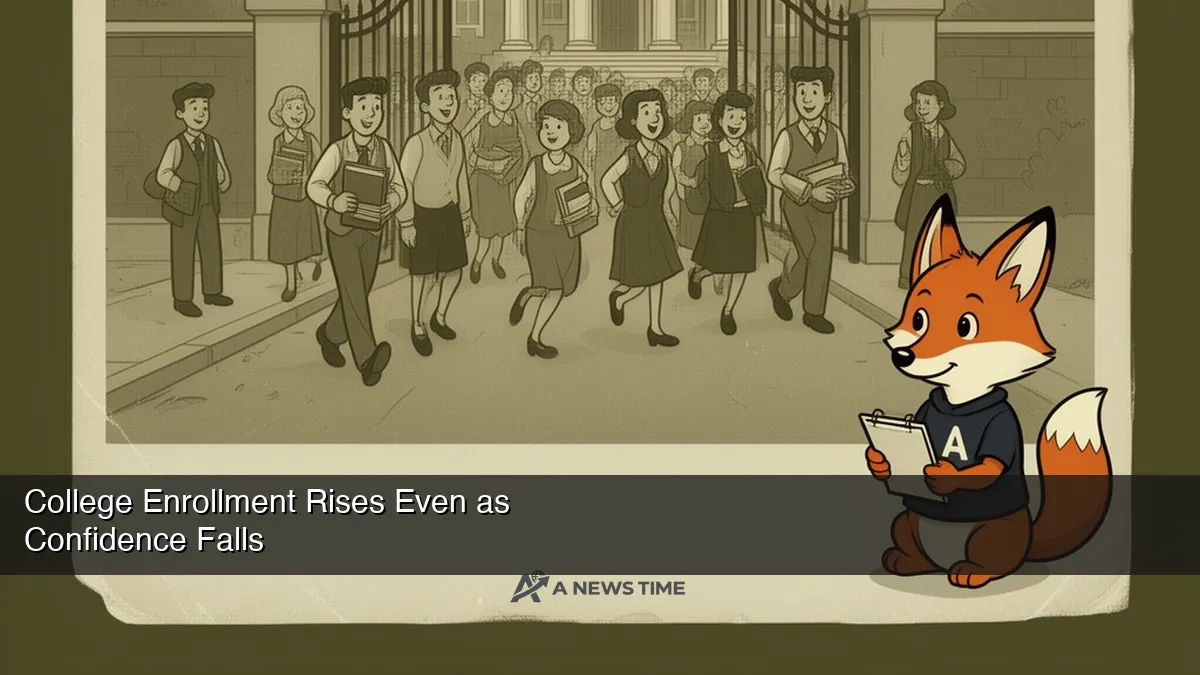
American colleges and universities recorded enrollment growth for the third consecutive year in 2025-26, surpassing pre-pandemic levels for the first time since the COVID-19 disruptions that sent undergraduate enrollment into a steep decline starting in 2020. The recovery is real, it is measurable, and it arrives at a moment of extraordinary cultural and political antagonism toward higher education that makes the continued enrollment growth more analytically interesting than a simple rebound story. An analysis by Chalkbeat's Matt Barnum, published March 24, 2026, documents the paradox carefully: Americans say they have less confidence in higher education than at any point in recent polling history, elite schools have far more qualified applicants than they can accommodate, and students are enrolling in record numbers anyway.
Understanding this paradox requires separating the sentiment about higher education from the economic reality of the credential. Those are two different things. People can believe that universities are too expensive, too politically charged, and too slow to adapt to a changing economy, and still rationally choose to attend because the alternative, entering the workforce without a degree, costs more in forgone earnings over a career than the cost of attending. The data supporting that calculus has not meaningfully weakened, even as the cultural conversation about higher education has shifted sharply.
What the Enrollment Numbers Show
Undergraduate enrollment declined significantly between 2019 and 2022, with the National Student Clearinghouse tracking losses of roughly one million students over that period. Community colleges bore a disproportionate share of those losses, as did regional public universities in states with declining 18-to-24-year-old populations. The recovery since 2022 has been broad but uneven: highly selective institutions saw relatively modest enrollment declines and have recovered quickly. Less selective regional schools and community colleges face a more difficult trajectory, constrained by demographics in states with falling birth rates and competition from online credentials and workforce training programs.
The aggregate numbers that crossed pre-pandemic levels in 2025-26 mask significant institutional variation. Some colleges are genuinely thriving, running waitlists and turning away qualified applicants. Others are managing enrollment shortfalls, running deficit budgets, and in some cases contemplating mergers or closures. The headline "enrollment rises" is accurate at the system level while being actively misleading for a subset of institutions facing genuine existential pressure.
The most selective institutions sit in a category of their own. Demand for seats at the 50 or so universities that are consistently regarded as elite has continued to vastly outstrip supply, with acceptance rates at the most selective schools falling to levels that were unimaginable a generation ago. This is partly because the college-educated share of the American population has grown, meaning the absolute number of academically competitive applicants has increased even as the number of seats has stayed roughly constant. It is also because the credential from a selective institution carries labor market and social signaling value that appears to have increased rather than decreased as confidence in higher education overall has fallen.
The Confidence Gap: Why People Enroll Where They Don't Trust
Gallup's annual polling on confidence in American institutions has consistently shown higher education near the bottom of recent rankings, a dramatic reversal from the mid-20th century when universities enjoyed some of the highest institutional confidence ratings in American life. The sources of skepticism are well-documented: concerns about cost, about political bias in curricula and campus culture, about the labor market relevance of certain degrees, and about whether universities are delivering on their core promise of upward economic mobility for students from lower-income backgrounds.
But as Barnum's analysis notes, low confidence in an institution does not necessarily translate into reduced engagement with it when the alternatives are less attractive. Americans have low confidence in Congress but continue to vote. They have low confidence in banks but continue to use them. The relevant question is not whether people trust higher education in the abstract but whether they believe the specific benefits of a credential outweigh the specific costs of obtaining it.
On that narrower question, the data remains clear. College-educated workers substantially out-earn those without degrees across virtually every occupational category, a premium that has not meaningfully compressed even as the number of college graduates has grown. The New York Federal Reserve's analysis of the college wage premium finds it persistently strong, particularly for workers in their 30s and 40s whose earnings trajectories have had time to diverge from their non-college-educated peers. The premium is not uniform: it is strongest in occupations that directly require or value the credential, and weaker in fields where alternative credentialing paths, skilled trades certifications and coding bootcamps most prominently, have developed genuine market recognition.
"Unambiguously, you see large returns to college-going. The data on this is quite consistent across different methodological approaches and different time periods."
Zachary Bleemer, economist, Princeton University
Bleemer's research, which uses quasi-experimental methods to separate the causal effect of college attendance from the selection effects that make college graduates look better on paper partly because they were already more likely to succeed, finds robust returns even after controlling for prior academic achievement and family background. That finding, consistent across multiple research approaches and datasets, is a meaningful counterpoint to the skeptical narrative about college value that has dominated popular discourse.
The Cost Reality: Tuition Is Not What People Think It Is
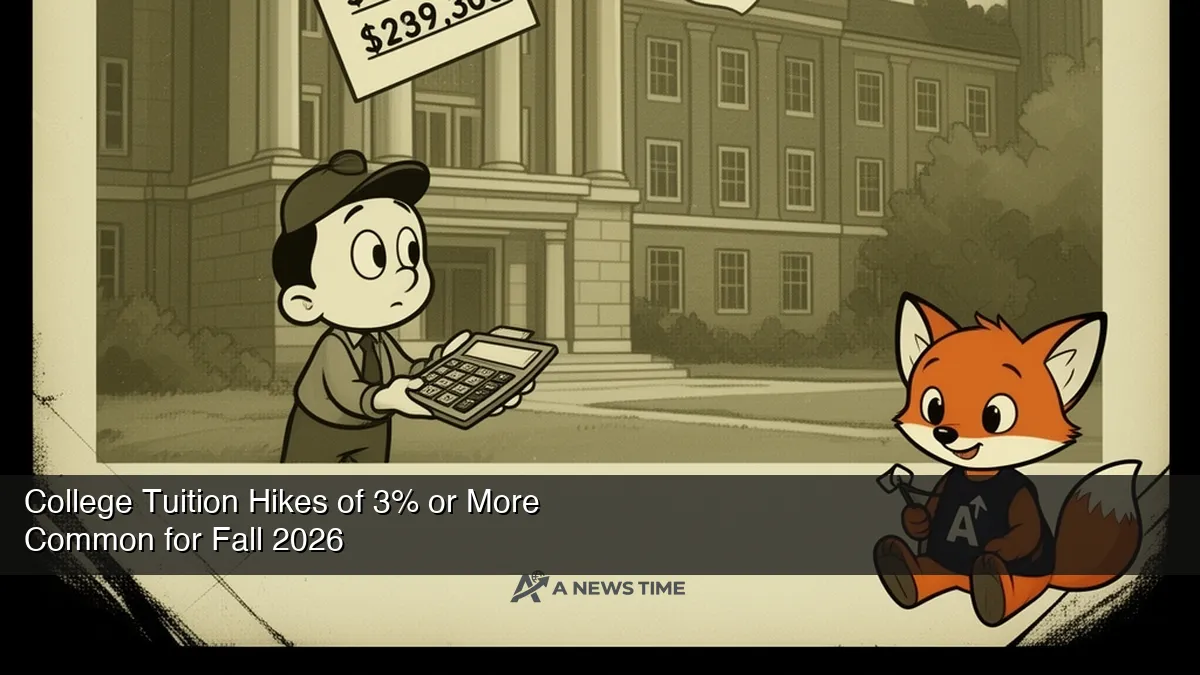
The most significant gap between public perception and economic reality in the higher education conversation involves tuition costs. Most Americans substantially overestimate what students actually pay for college, in part because the sticker prices that generate headlines (and genuine sticker shock) are not what the majority of students pay after grants, scholarships, and institutional aid are applied.
College Board data, analyzed in detail by Barnum, shows that real net tuition at public four-year institutions has fallen dramatically over the past two decades. Net tuition at public four-year schools, meaning the average price paid after grant aid and scholarship deductions, inflation-adjusted to 2025 dollars, was approximately $4,450 in the 2012-13 academic year. By 2025-26, that figure had fallen to $2,300. Not a slight reduction. A halving, in real terms, of what the average student actually pays.
The story at private nonprofit universities is similar, though at a higher absolute level. Net tuition at private nonprofits fell from approximately $18,930 in 2012-13 to $16,910 in 2025-26, both figures inflation-adjusted. Again, the sticker prices at those schools have risen, in some cases substantially. But the net price has come down as institutions have competed more aggressively for students through merit aid and need-based grants.
This reality coexists with genuine cost pressures on students at institutions that do not offer substantial aid, and for students whose family circumstances place them just above the thresholds for need-based grants while making genuine independent payment difficult. The higher education cost story is not one story. It is several, differentiated by institutional type, student financial circumstances, and what costs are counted (tuition alone versus total cost of attendance including housing, food, and supplies).
The recent round of tuition increases at some high-profile institutions adds complexity. Forbes coverage by Michael Nietzel documented increases including Penn at 3.9%, Brown at 4.25%, and Baylor at 6.5% for 2026-27. Those numbers generate headlines. What receives less attention are the institutions holding or freezing tuition: Stanford froze tuition for 2026-27, as did the University of Connecticut and the University of Arizona. Yale announced that students from families earning below $200,000 annually would pay no tuition, joining more than 100 colleges nationwide that now offer free tuition based on income thresholds.
The Equity Divide in Higher Education Conversations
One of the most revealing observations in Barnum's analysis concerns who is having which conversations about college value. Shavar Jeffries, CEO of KIPP, the national network of college-preparatory charter schools serving primarily low-income students of color, made the point directly and pointedly:
"Wealthy families are not having conversations with their kids about whether to go to trades instead of college. That conversation is happening primarily in working-class and lower-income communities, and the people having it are often not the ones who would bear the consequences of the advice."
Shavar Jeffries, CEO, KIPP
Jeffries' observation identifies a structural inequity in the current conversation about college value. When prominent voices advocate for trades over college, or frame college as overrated, they are disproportionately influential with communities that are already underrepresented in higher education and would have the most to gain from the credential's wage premium. Meanwhile, the families with the most access to information about college returns continue sending their children to four-year universities at very high rates.
This is not to say that skilled trades are bad career choices. Monster's 2026 job market data, discussed in our recent coverage of where hiring is actually happening, shows strong demand for automotive technicians, HVAC workers, and electronics technicians. Those are economically valuable careers with genuine upward wage trajectories. The concern is not trades versus college as a binary. It is that the advice being given to students in under-resourced communities often reflects ideological skepticism about higher education rather than a careful analysis of that individual student's specific options, financial circumstances, and labor market trajectory.
Genuine Threats to the Enrollment Recovery
Three structural threats to the higher education enrollment recovery are worth taking seriously, because they differ from the rhetorical critiques that dominate headlines without much affecting actual enrollment decisions.
The first is demographic. The number of 18-year-olds in the United States will begin declining in the late 2020s as the relatively small cohorts born during the 2007-2012 fertility decline reach college age. This "enrollment cliff," anticipated by demographers for more than a decade, will disproportionately affect institutions in regions with the steepest population declines: rural areas, Rust Belt states, and New England. Schools that are already operating with thin margins will face structural enrollment declines driven entirely by the size of the available student population, regardless of their quality or value proposition. Some will not survive it.
The second is the AI uncertainty that has affected how employers and students think about the future value of specific degrees. If AI tools continue to displace white-collar knowledge work at the rate that the most pessimistic projections suggest, the returns to degrees in fields like accounting, paralegal work, and certain engineering specializations could erode. That uncertainty is real even if its ultimate magnitude is not yet knowable. Students choosing degree programs today are making a bet on the labor market conditions that will exist in four to seven years, a period over which AI capabilities could change substantially.
The third, and perhaps most politically complex, is the ongoing conflict between federal and state governments and universities over issues including DEI programs, speech policies, research funding, and student visa policies. The research university sector's dependence on federal grants, particularly from the NIH and NSF, creates significant financial exposure to federal policy shifts. Several research universities have seen federal grants frozen or threatened since late 2025, creating uncertainty about lab staffing, graduate student funding, and the research enterprise more broadly. International student enrollment, a significant revenue source for many universities, is sensitive to visa policy and political climate in ways that are difficult to predict and manage.
What Enrollment Growth Tells Us, and What It Does Not
The three-year enrollment recovery tells us that, in aggregate, students and families are making a rational economic calculation that the college credential continues to justify its cost. It does not tell us that higher education is well-managed, appropriately priced, equitably distributed, or optimally structured for the labor market it is preparing students to enter. Both things can be true simultaneously.
The institutions best positioned for the next decade are those that have reduced net cost through expanded aid, maintained strong labor market connections, developed genuine competencies in online and hybrid delivery, and built enough financial resilience to weather demographic headwinds and federal funding uncertainty. The institutions worst positioned are those that have relied on enrollment growth from a declining demographic pool, maintained high net prices without commensurate labor market outcomes, and built cost structures that leave little room for adjustment.
For students navigating the decision today, the College Board data and the wage premium research suggest a framework that is less about college versus no college and more about which college, for what credential, at what net cost, in what field. The average net tuition figures cited above are precisely that: averages. Individual students who qualify for substantial need-based aid at selective institutions may be able to attend for costs well below the average. Students considering institutions that offer minimal aid and have weak employment placement rates in their field of interest are facing a genuinely different risk-reward calculation.
The broader economic context matters too. With recession odds rising amid energy price pressures, the historical pattern that education enrollment increases during economic downturns is relevant. When the labor market is soft, the opportunity cost of attending college, the wages you give up by being a student rather than a worker, falls. That dynamic has historically supported enrollment even when confidence in higher education is low, and it may be part of what is driving the current recovery alongside the structural wage premium.
What the data most clearly shows is that the cultural conversation about higher education and the economic behavior of students and families are operating on different tracks. The conversation has turned sharply skeptical. The behavior remains largely consistent with the rational calculation that the credential is worth having. Until the labor market premium erodes, or until genuine affordable alternatives at scale emerge, that gap between sentiment and enrollment is likely to persist.