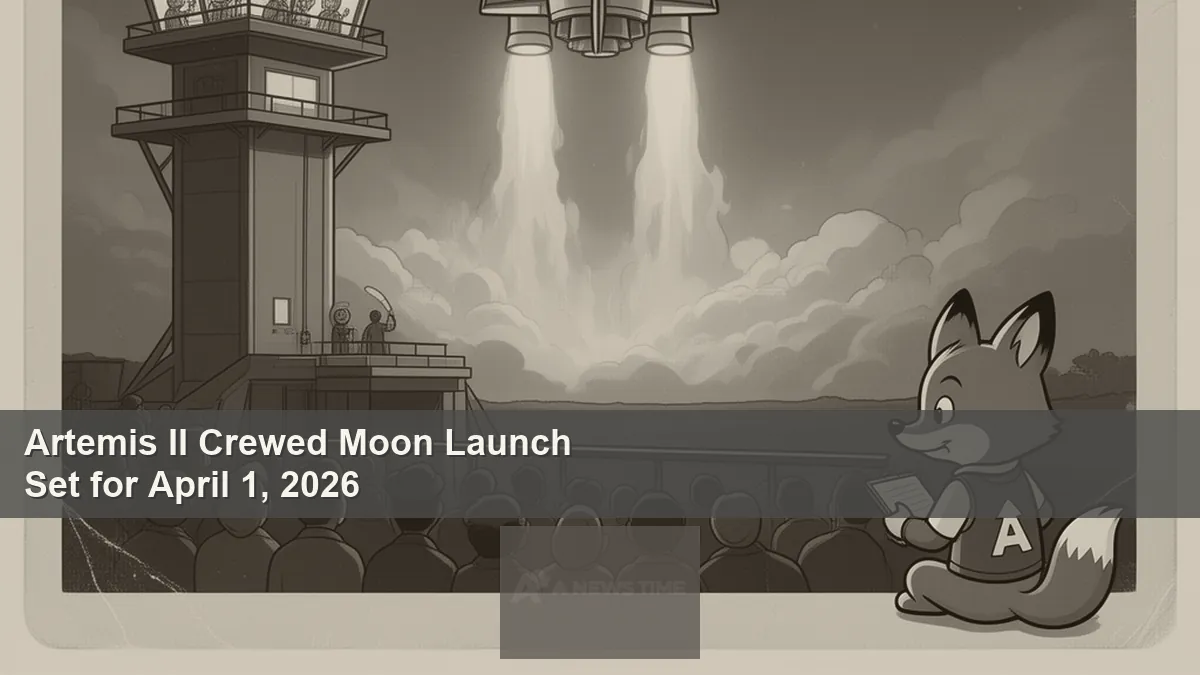
NASA's Artemis II mission is on the launch pad at Kennedy Space Center in Florida, with a two-hour launch window opening at 6:24 p.m. ET on . If the mission launches on schedule, it will mark the first time human beings have traveled to the vicinity of the Moon since Apollo 17 in . Four crew members will fly aboard NASA's Orion spacecraft, mounted atop the SLS rocket at Pad 39B, the same launch complex used by the Apollo program more than five decades ago.
The road to this launch window has been longer than anyone at NASA anticipated. Multiple technical issues and weather delays have pushed the mission from its original February window through March and into April. The rocket is now ready, and NASA officials say that this window represents the earliest achievable date given the work completed since the program's last major setback in late February.
The Mission: Around the Moon and Back
Artemis II is not a lunar landing. That mission, Artemis III, will follow if this one succeeds. Artemis II's objective is to test the full integrated system — crew, spacecraft, rocket, communications, life support — in a real operational environment that extends beyond Earth orbit. The four-person crew will travel around the Moon on a free-return trajectory before coming back to Earth, covering a total journey of roughly 10 days.
The crew consists of three NASA astronauts and one from the CSA. Commander Reid Wiseman and pilot Victor Glover are joined by mission specialists Christina Koch and Jeremy Hansen, who will become the first Canadian to travel beyond low-Earth orbit. Koch, who previously set the record for the longest single spaceflight by a female astronaut, is making her second trip to space.
| Crew Member | Role | Agency |
|---|---|---|
| Reid Wiseman | Commander | NASA |
| Victor Glover | Pilot | NASA |
| Christina Koch | Mission Specialist | NASA |
| Jeremy Hansen | Mission Specialist | Canadian Space Agency |
The mission follows the uncrewed Artemis I test flight, which sent an uncrewed Orion spacecraft around the Moon and back to validate the basic performance of the SLS rocket and spacecraft systems. Artemis II will perform the same trajectory with crew aboard, validating life support, crew interfaces, and the communication and navigation systems in conditions that cannot be fully replicated in Earth-based testing.
A Delayed Path to the Pad
The Artemis II rocket was first rolled out to Pad 39B on . The original target launch windows of February 6 and 7 were moved after cold weather and winds at Kennedy Space Center pushed the wet dress rehearsal back. A wet dress rehearsal on ran into multiple issues: a delay in fueling due to cold weather, a liquid hydrogen leak, and a valve retorquing problem related to the Orion crew module capsule. Teams also worked through intermittent audio communication dropouts that had been affecting ground teams.
Engineers scrubbed a March launch window after identifying a problem with helium flow to the rocket's upper stage. NASA rolled the vehicle back to the Vehicle Assembly Building on to preserve an April launch date, then rolled it back to the pad on . The current April window reflects the time required to complete that work and finalize all pre-launch checkouts.
- Original launch window: February 6-7, 2026 (cold weather delay)
- Wet dress rehearsal: February 2, 2026 (liquid hydrogen leak, valve issues)
- March window scrubbed: helium flow problem in upper stage
- Rollback to VAB: February 25, 2026
- Re-rollout to pad: March 20, 2026
- Current window: April 1, 3, 4, 5, 6, 2026 (within the 27 March to 10 April launch period)
The Technology Being Tested
The SLS is NASA's heavy-lift rocket, designed from the outset for missions beyond low-Earth orbit. Its core stage burns liquid hydrogen and liquid oxygen through four RS-25 engines, the same engine design that powered the Space Shuttle main engines, modified for expendable use. The rocket generates more thrust at liftoff than the Saturn V that carried Apollo astronauts to the Moon, making it the most powerful rocket NASA has ever operated.
Orion is the crew vehicle riding atop the SLS. It is built around a pressurized crew module capable of sustaining four astronauts for up to 21 days, paired with a European Service Module that provides propulsion, power, thermal control, and consumables. On Artemis II, the service module will handle the burn needed to put Orion on a translunar trajectory and the burns needed to return the crew safely to Earth.
The heat shield is one of the most closely watched components of the mission. On Artemis I, the heat shield performed as expected but post-flight inspection found some areas of char material that behaved differently than models predicted. NASA engineers assessed the findings and determined the vehicle is safe to fly with crew, but the Artemis II re-entry will generate additional data that will directly inform the design of the heat shield for Artemis III and beyond.
What Happens After
The primary objective after Artemis II is to execute Artemis III, the crewed lunar landing. That mission is currently targeted for no earlier than 2027, though the specific date remains subject to the readiness of the commercial Human Landing System being developed by SpaceX, which will carry astronauts from Orion to the lunar surface and back. NASA is also developing a lunar spacesuit, the Exploration Extravehicular Mobility Unit, that crew members will need for surface operations.
NASA Administrator Jared Isaacman, who announced a shift in the agency's lunar architecture in March, described the longer-term goal as establishing a permanent surface presence on the Moon rather than the earlier concept of a Gateway space station in lunar orbit. Under that revised roadmap, each crewed Artemis mission is intended to incrementally extend the duration and capability of lunar surface operations, building toward a base that supports extended human presence. The scientific questions that motivate sustained lunar exploration connect directly to broader questions about the solar system's history and the conditions that shaped Earth and its neighbors.
The Artemis II launch is also the context against which the rest of Florida's Space Coast is operating this week. SpaceX Falcon 9 missions continue at high frequency from Cape Canaveral Space Force Station, with Starlink satellite missions scheduled in the days immediately before and after the Artemis II window, demonstrating how thoroughly routine high-frequency orbital launch has become against the backdrop of a historic crewed mission. The broader activity in Earth-Moon space has rarely been as dense or as consequential as it is in early April 2026. Whether the launch proceeds on April 1 or slips to a later date in the window, Artemis II represents the most significant human spaceflight event since the retirement of the Space Shuttle in 2011.