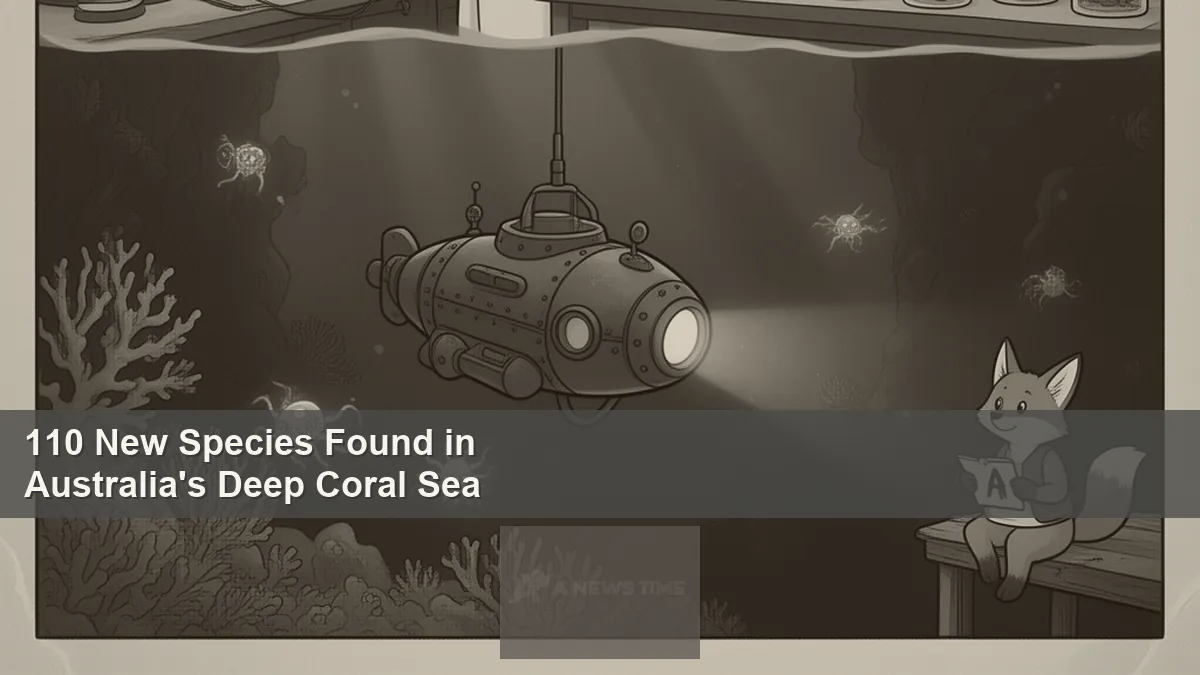
A joint scientific expedition to the deep waters of Australia's Coral Sea Marine Park has produced one of the largest marine biodiversity discoveries in the country's research history. Marine taxonomists confirmed more than 110 fish and invertebrate species new to science on , with that number expected to climb past 200 once DNA analysis of cryptic species is completed. The findings came from specimens collected during a late-2025 voyage aboard CSIRO's research vessel RV Investigator, operating at depths most marine science programs never reach.
The Coral Sea Marine Park covers nearly a million square kilometres of Australian waters northeast of Queensland. Despite its size and its designation as a protected marine area, the deeper portions of the park had never been the subject of a systematic biological survey. The expedition, led by CSIRO in partnership with the Nippon Foundation-Nekton Ocean Census, was specifically designed to change that — sending researchers into habitats between 200 and 3,000 meters where scientific documentation is sparse and species inventories are essentially blank pages.
What the Expedition Found
Dr. Will White, the expedition's Chief Scientist and a shark biologist at CSIRO, personally identified four new species during a series of taxonomic workshops held across Australia after the voyage concluded. Those four species span a range of cartilaginous fish groups: two rays from the genera Dipturus and Urolophus, a deepwater catshark from the genus Apristurus, and a chimaera from the genus Chimaera. Beyond White's direct identifications, taxonomists at the workshops worked through hundreds of specimens drawn from multiple invertebrate groups, producing new species records across brittlestars, crabs, sea anemones, sponges, and polychaete worms.
"During the voyage it was incredible to observe plenty of unique, deep-sea creatures in locations from seamounts and atolls to unexplored deep reefs."
Dr. Will White, CSIRO Voyage Chief Scientist
Among the striking footage captured during the expedition was an encounter with the rare sand tiger shark (Odontaspis ferox), a deepwater relative of the grey nurse shark, filmed at the Mellish Seamount. That sighting alone illustrates how little is documented about life in the deeper reaches of the park: the sand tiger shark is known to science, but confirmed observations at Mellish are rare enough that the footage represents meaningful new distributional data.
| Species Group | Known New Species | Survey Depth |
|---|---|---|
| Rays | 2 (Dipturus and Urolophus genera) | 200–3,000 m |
| Catsharks | 1 deepwater catshark (Apristurus genus) | Deep reef habitats |
| Chimaeras | 1 (Chimaera genus) | Deep water |
| Brittlestars | Multiple, pending description | Deep-water sediment |
| Crabs | Multiple, pending description | Seamount habitats |
| Sea anemones | Multiple, pending description | Various depths |
| Sponges | Multiple, pending description | Atolls and deep reefs |
| Jellyfish | Under active DNA analysis | Mixed depths |
The Method Behind the Discovery
Finding species at these depths is not a matter of lowering a net and waiting. RV Investigator, Australia's dedicated national ocean research vessel, carries a deep-towed camera system capable of imaging and documenting life at 3,000 meters, providing a visual record that supplements physical specimen collection. The vessel also allows scientists to take tissue samples from delicate organisms like jellyfish before preservation, a step that is technically straightforward at the surface but logistically demanding on a deep-sea research platform.
After the voyage, the real taxonomic work began. The workshops assembled local and international specialists who applied two complementary methods to every specimen: morphological examination, which involves physically measuring and describing structural features in detail, and DNA sequencing, which provides a genetic identity that can be compared against global databases. For groups where external appearance varies little between species, genetics is not a supplement to morphology but a prerequisite for accurate identification.
"Voyages like the Coral Sea Frontiers expedition are essential for uncovering biodiversity in our marine parks — but collecting specimens is just the first step; turning them into knowledge depends on taxonomic expertise. Through Ocean Census-supported workshops, local and international taxonomists came together to work through hundreds of specimens, combining detailed morphological analysis with DNA sequencing to identify species new to science."
Dr. Candice Untiedt, Marine Ecologist, CSIRO
Dr. Claire Rowe, Collection Manager for Marine Invertebrates at the Australian Museum, highlighted the specific challenges jellyfish present. Because those specimens are fixed in formalin for preservation, extracting usable DNA requires fresh tissue taken before fixation — exactly the protocol the Investigator team followed. The practical significance is that many of the jellyfish species collected have never been genetically sequenced at all, let alone from Australian waters. Building those comparison records from scratch adds time to the analysis but also produces data that will serve future researchers working on entirely different questions.
Making the Data Public in Real Time
One deliberate design choice in this expedition's workflow was immediate open-access publication of species data. Rather than routing findings through the typical lag of journal peer review before any public visibility, taxonomists at the workshops entered confirmed species data directly into the Ocean Census Biodiversity Data Platform, an open-access digital gateway specifically built for newly discovered marine species.
"To ensure high-quality data is visible to the global community in real-time, the taxonomists at the workshops input the species data directly into the Ocean Census Biodiversity Data Platform, the world's first open-access digital gateway for newly discovered marine species."
Dr. Michelle Taylor, Head of Science, Nippon Foundation-Nekton Ocean Census
Physical specimens from the voyage are being preserved in permanent national collections, including CSIRO's Australian National Fish Collection and museums in several Australian states. That institutional preservation matters beyond archival tidiness: a specimen deposited today may be re-examined decades from now using analytical methods that do not yet exist. Several new species described from older museum collections were identified not in the field but by a researcher revisiting a jar on a shelf with a different set of tools. The Coral Sea specimens will be available for exactly that kind of future reanalysis.
The combination of real-time digital data access and long-term physical preservation represents a model for how large-scale biodiversity expeditions can maximise their scientific return. It also connects to the ongoing work of recovering legacy biodiversity records that had been filed away in archives and recordings rather than actively studied.
Conservation Implications for a Park That Has Outgrown Its Documentation
The Coral Sea Marine Park has been a designated protected area since 2012, progressively expanded to its current boundaries over the following years. The legal and administrative architecture for its protection existed long before the scientific baseline that should underpin that protection. A marine park without a species inventory is managed on inference rather than evidence: rangers and policymakers make decisions about permitted activities, buffer zones, and threat assessments based on incomplete information about what is actually living in the area they are protecting.
Shaun Barclay, Branch Head of Parks Australia's Marine and Islands Branch, connected the expedition findings directly to management decisions, describing the research as "strengthening our understanding of the Coral Sea Marine Park and improving how we protect it." That framing points toward a practical downstream use for the species data: formal species descriptions once published in peer-reviewed literature will be able to be incorporated into updated park management plans, informing which zones receive the strictest access controls and which ecosystems are considered priority habitats for future monitoring.
The broader context is concerning. Deep-ocean environments face a growing list of pressures, from rising water temperatures and changing circulation patterns connected to accelerating planetary warming to the expanding reach of deep-sea fishing and the early-stage development of seabed mining interests. Several of the newly discovered species from this expedition have ranges that overlap with areas under consideration for commercial extraction activities in other jurisdictions, a pattern that has made rapid documentation increasingly urgent across multiple ocean basins. Scientists cannot protect what they have not yet identified.
- The Coral Sea Marine Park covers nearly 1 million km² of Australian waters
- The expedition surveyed depths of 200 to 3,000 meters, mostly unexplored before this voyage
- More than 110 new species confirmed, with the count expected to exceed 200
- Rare sand tiger shark (Odontaspis ferox) footage captured at Mellish Seamount
- Specimens are preserved in Australian national fish and museum collections
- Species data entered directly into the Ocean Census Biodiversity Data Platform
What Comes Next
The 110-plus species identified so far are not yet officially described in the scientific record. A confirmed new species requires a formal description published in a peer-reviewed journal: a document that names the species, designates a type specimen, and describes the anatomical and genetic features that distinguish it from known relatives. That process takes months per species when done rigorously, and the Coral Sea workshops are working through a backlog measured in the hundreds.
Further voyages to the deeper zones of the park not reached by this expedition are under consideration, as is follow-up work on the seamounts and atolls that generated some of the richest specimen hauls from the first trip. The partnership structure between CSIRO, the Ocean Census, Parks Australia, and international museum networks has proven capable of the large-scale taxonomic workshops this work requires, and the expedition's outputs will likely form the basis for funding proposals for expanded surveys.
The question of how many species remain undescribed in the deep ocean is genuinely unanswerable with current data. Estimates suggest hundreds of thousands of marine species have not yet been given a scientific name, with deep-water environments contributing disproportionately to that gap. The Coral Sea findings suggest that even in a relatively well-studied oceanic region, close to one of the world's best-resourced scientific communities, the inventory of deep-water life is far from complete. The work coming out of these workshops is essential, but it is also, by all current projections, just a beginning. The challenge of documenting and protecting marine environments against accelerating pressures is one that will define ocean science for decades.