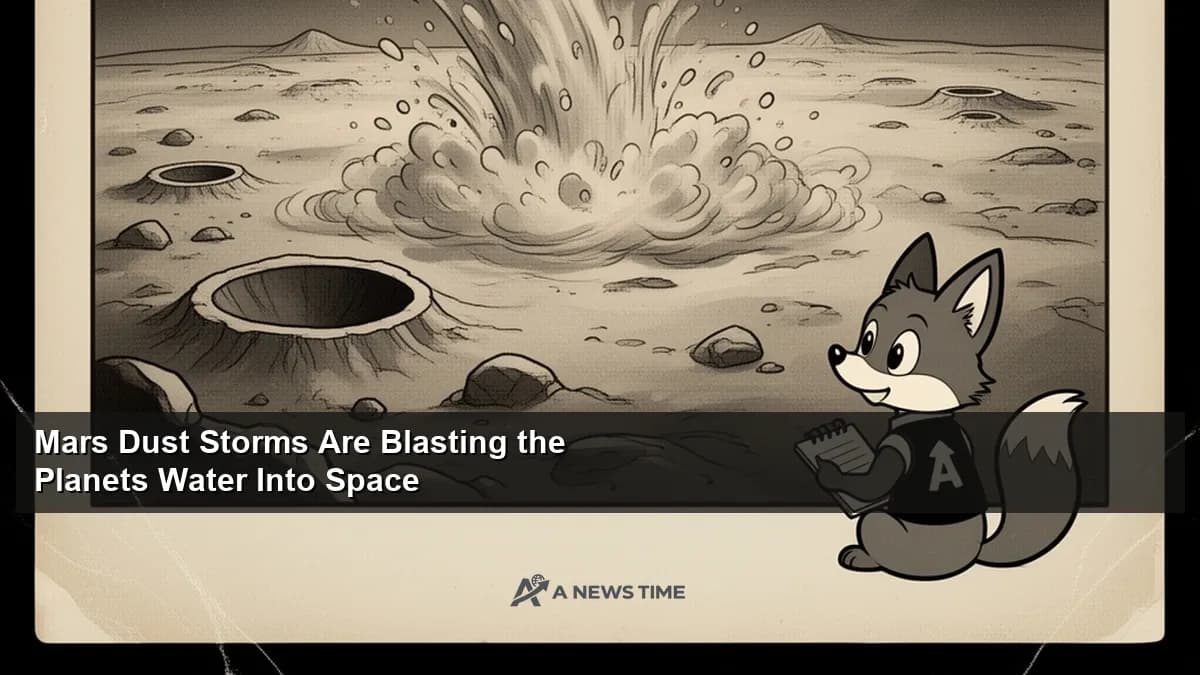
Mars is losing its water, and the culprit is not what scientists expected. A new study published in Communications: Earth & Environment in reveals that localized dust storms, previously dismissed as minor players in the planet's atmospheric water cycle, are actually pumping water vapor high into the Martian middle atmosphere at rates up to ten times normal levels. From there, ultraviolet radiation splits the water molecules apart, and the resulting hydrogen escapes into space. The finding reshapes our understanding of how Mars transformed from a world with rivers and lakes into the desiccated landscape we see today.
The Mystery of Mars's Missing Water
Three and a half billion years ago, Mars had enough liquid water to cover its entire surface to a depth of roughly 100 to 1,500 meters, depending on which estimates you use. Today, the planet retains water primarily as ice locked in its polar caps and subsurface deposits, with only trace amounts of vapor in its thin atmosphere. The question of where all that water went has been one of planetary science's most persistent puzzles.
The basic mechanism has been understood for decades. Water vapor in the Martian atmosphere drifts upward, where solar ultraviolet radiation breaks it into hydrogen and oxygen atoms through a process called photodissociation. The hydrogen, being lightweight, can reach escape velocity and leave Mars's weak gravitational field entirely. Over billions of years, this slow leak could account for a substantial fraction of the planet's original water inventory.
What has been less clear is the rate at which this process operates and, critically, what controls that rate. If water vapor stays confined to the lower atmosphere (below roughly 40 kilometers altitude), it is relatively protected from the most intense ultraviolet radiation. The water cycle remains slow, and the leak to space proceeds at a measured pace. But if something lofts water vapor higher, into the middle atmosphere between 40 and 80 kilometers, the escape process accelerates dramatically.
Until recently, scientists believed that only planet-encircling dust storms, the massive events that can shroud Mars entirely for weeks at a time, were capable of pushing significant water into the middle atmosphere. The 2018 global dust storm observed by multiple spacecraft confirmed this: water vapor levels at altitude surged during the event. The assumption was that smaller, regional dust storms lacked the energy to produce the same effect.
That assumption has now been overturned.
How Localized Storms Change the Equation
The new research, led by scientists at Tohoku University in Japan and the Institute of Astrophysics of Andalusia (IAA-CSIC) in Spain, analyzed data from three spacecraft simultaneously orbiting Mars: the ESA's Trace Gas Orbiter (TGO) with its NOMAD instrument, NASA's Mars Reconnaissance Orbiter (MRO), and the Emirates Mars Mission (Hope probe). By combining observations from all three missions, the team could track dust storm activity, water vapor distribution, and hydrogen escape rates simultaneously across different altitudes and locations.
The key discovery: during the northern hemisphere summer on Mars, when regional and localized dust storms are most frequent, water vapor concentrations in the middle atmosphere rose to ten times their normal levels. These were not planet-encircling events. They were storms covering hundreds to thousands of kilometers rather than the entire globe, the Martian equivalent of large terrestrial weather systems rather than apocalyptic planetary events.
Think of the Martian atmosphere like a building with multiple floors. The ground floor (lower atmosphere) is where most of the weather happens: dust gets kicked up, temperatures fluctuate, and water vapor cycles through familiar processes. The upper floors (middle and upper atmosphere) are normally dry and quiet. What the study found is that localized dust storms act like elevators, carrying water vapor from the ground floor to the upper floors far more efficiently than anyone realized. Once the water reaches those upper floors, it is exposed to intense ultraviolet light and quickly broken apart.
The consequence at the very top of the atmosphere was equally striking. Hydrogen concentrations at the exobase (the boundary where the atmosphere thins to the point that atoms can escape to space) were 2.5 times higher than expected during periods of regional dust storm activity. More hydrogen at the exobase means more hydrogen escaping Mars altogether. The connection between surface dust storms and water loss to space is more direct and more powerful than the prior scientific consensus allowed.
Three Spacecraft, One Picture
The strength of this study lies in its use of complementary datasets from three different orbital platforms, each contributing a different piece of the puzzle.
- ESA's TGO/NOMAD: The NOMAD spectrometer aboard the Trace Gas Orbiter measures the chemical composition of the Martian atmosphere at different altitudes using solar occultation, a technique where the instrument watches sunlight pass through the atmosphere as the Sun rises or sets from the spacecraft's perspective. This provides vertical profiles of water vapor, dust, and other trace gases with remarkable precision.
- NASA's MRO: The Mars Reconnaissance Orbiter has been studying Mars since 2006 and carries instruments capable of tracking dust storm formation, evolution, and dissipation across the planet's surface. Its long baseline of observations provides context for how 2026 dust storm activity compares to historical patterns.
- Emirates Mars Mission (Hope): The Hope probe, launched by the UAE's Mohammed Bin Rashid Space Centre, orbits Mars in a high, elliptical path that gives it a global view of the planet's atmosphere. Its ultraviolet spectrometer can measure hydrogen and oxygen emissions in the upper atmosphere, providing a direct window into the escape process.
By correlating dust storm activity tracked by MRO with water vapor profiles from TGO/NOMAD and hydrogen escape measurements from Hope, the research team constructed the most complete picture yet of how individual storms drive water loss. The multi-mission approach also allowed them to rule out alternative explanations. If the elevated water vapor levels were caused by seasonal temperature changes rather than dust storms, the pattern would look different in the TGO data. If the hydrogen escape increase were driven by solar activity rather than atmospheric water, the Hope measurements would show a different correlation. In each case, the dust storm connection held up. Similar multi-instrument approaches have proven critical in tracking anomalous fireball activity near Earth.
Why Northern Summer Matters
Mars's orbit is significantly more eccentric than Earth's, meaning its distance from the Sun varies more over the course of a Martian year. The planet is closest to the Sun (at perihelion) during its northern hemisphere summer, which means this season receives more solar energy than any other period. That extra energy heats the surface more intensely, drives more vigorous atmospheric circulation, and creates conditions favorable for dust storm formation.
The northern summer dust storm season has long been recognized as a period of enhanced atmospheric activity. What the new study reveals is that this season is also a critical window for water loss. The combination of warmer temperatures (which increase the amount of water vapor the atmosphere can hold), more frequent dust storms (which loft that vapor to altitude), and intense ultraviolet radiation (which breaks the water apart) creates what the researchers describe as a "perfect storm" for atmospheric escape, a convergence of conditions that accelerates Mars's drying process far beyond the annual average rate.
Adrián Brines, a researcher at IAA-CSIC and a co-author of the study, emphasized the broader implications:
"These findings reveal the impact that regional dust storms have on Mars's climate evolution. They show that we cannot understand the planet's long-term water loss without accounting for these smaller, more frequent events."
Adrián Brines, Researcher, IAA-CSIC
Shohei Aoki of Tohoku University, another member of the research team, framed the discovery in terms of the larger scientific puzzle:
"Regional dust storms provide a vital new piece to the incomplete puzzle of Mars's water history. We knew that global dust storms mattered. Now we know that localized storms, which occur much more frequently, contribute significantly as well."
Shohei Aoki, Tohoku University
Rewriting the Water Loss Budget
The practical consequence of this discovery is that existing models of Martian water loss likely underestimate the total rate. If you only account for global dust storms (which occur roughly every few Mars years) and ignore the cumulative effect of dozens of regional storms each summer, you are missing a substantial fraction of the water transport to the upper atmosphere.
Consider the arithmetic. A global dust storm might last weeks and drive a massive pulse of water to altitude, but it happens infrequently. Regional storms are individually less powerful but occur far more often: dozens per Martian summer, each lasting days to weeks. The cumulative contribution of these smaller events, integrated over a full Martian year, may rival or even exceed the contribution of the rare global events. The researchers compare it to rainfall on Earth: a few hurricanes produce dramatic flooding, but steady seasonal rains often deliver more total precipitation over the course of a year.
Revising the water loss budget has implications for understanding Mars's past as well as its present. If the escape rate has been higher than previously modeled, then Mars may have lost its surface water faster than current timelines suggest. This could affect estimates of how long the planet remained habitable, a question with direct relevance to the search for evidence of past life. The study parallels how new indicators are reshaping our understanding of Earth's climate balance.
Implications for Future Exploration
The findings also carry practical implications for future Mars missions, both robotic and human. Dust storms are already a primary concern for solar-powered landers and rovers. The discovery that these storms also significantly alter atmospheric water content and chemistry could affect instrument calibration, atmospheric entry calculations, and plans for in-situ resource utilization (ISRU), the technology needed to extract water and oxygen from the Martian environment for human crews.
If regional dust storms can push water vapor ten times higher than normal in the atmosphere, they also redistribute water geographically. This could create temporary zones of enhanced atmospheric humidity that might be relevant for ISRU water harvesting, or it could strip water from areas that would otherwise be stable reservoirs. Understanding these dynamics will be important for selecting landing sites and planning surface operations during the dust storm season.
The multi-spacecraft approach used in this study also demonstrates the value of maintaining a diverse fleet of orbiters around Mars. No single mission could have produced these results. The combination of TGO's vertical profiling, MRO's surface monitoring, and Hope's global upper-atmosphere perspective was essential. As planning continues for future Mars exploration, including eventual human missions, the case for continued orbital science support grows stronger. Researchers studying environmental resilience on Earth have drawn similar conclusions about the need for coordinated monitoring across large networks.
What Remains Unknown
As with any significant finding, the new study raises as many questions as it answers. Among the most pressing:
- Seasonal variation: The study focused on northern hemisphere summer, the peak dust storm season. How much water transport occurs during other seasons, when dust activity is lower but not absent?
- Storm size thresholds: Is there a minimum storm size below which the water-lofting effect becomes negligible? The study examined regional storms, but Mars also produces thousands of smaller, local dust devils each year.
- Long-term trends: Is Mars's current rate of dust storm activity representative of its long-term average, or is the planet going through a particularly active or quiet period? Without a longer observational baseline, it is difficult to extrapolate current rates into the deep past.
- Feedback mechanisms: As Mars loses water and its atmosphere continues to thin, does the efficiency of dust-driven water transport change? A thinner atmosphere might produce weaker storms but also offer less shielding from ultraviolet radiation, creating competing effects.
These questions will drive the next generation of Mars atmospheric research. The current study provides a foundation, establishing that regional dust storms are a major, previously underappreciated driver of water loss. Building on that foundation will require continued observation, improved modeling, and ideally, new missions designed specifically to monitor atmospheric escape processes in real time.
For now, the picture is clearer than it was before. Mars is losing its remaining water through a process that is more active, more complex, and more closely tied to everyday weather than scientists previously understood. The planet's dust storms, long known for their dramatic visual impact, turn out to be agents of planetary transformation, stripping water molecule by molecule from a world that was once wet enough to support rivers, lakes, and perhaps even an ocean.