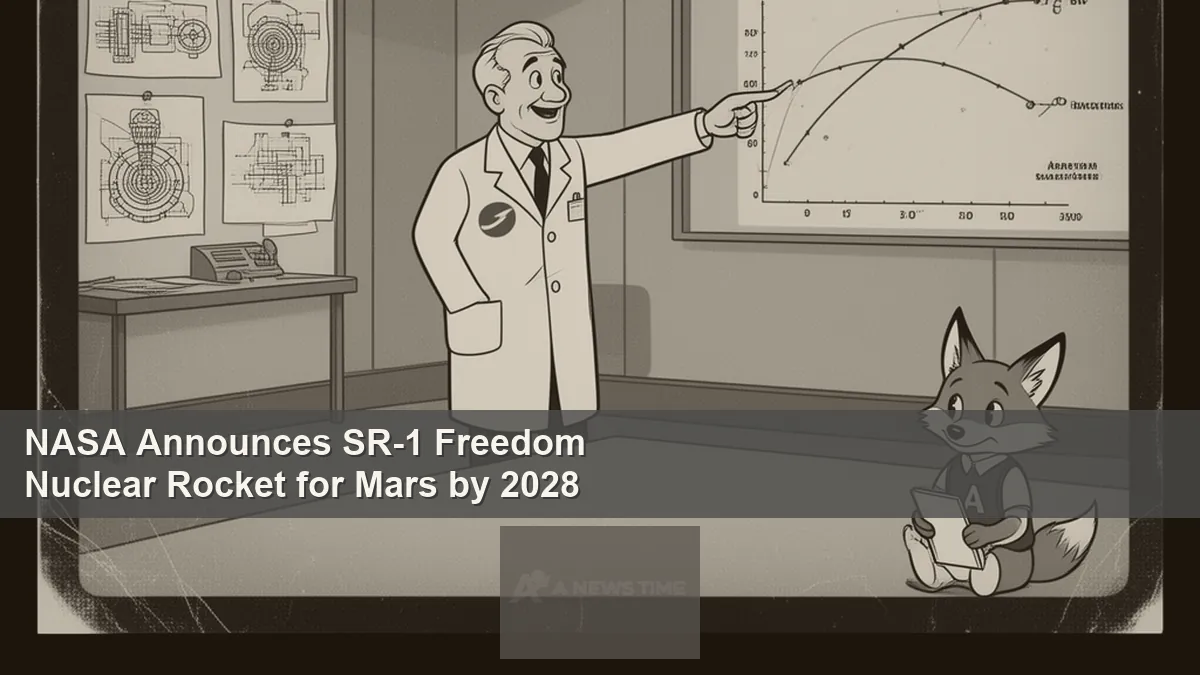
NASA Administrator Jared Isaacman announced on that the agency will launch a nuclear-powered spacecraft to Mars before the end of 2028. The mission, called SR-1 Freedom, will be the first US spacecraft to operate a nuclear fission reactor in deep space. Only one American nuclear reactor has ever flown in space, and that was more than 60 years ago. The announcement came during an all-day event at NASA headquarters in Washington that also revealed a broader restructuring of the agency's lunar and deep-space exploration roadmap.
The mission takes a deliberately constrained approach, repurposing hardware that already exists rather than starting from scratch. NASA has spent close to $4.5 billion on the Gateway lunar space station since the program began in 2019. With the Trump administration now redirecting the agency's lunar strategy toward a surface base rather than an orbital station, the core module of Gateway has been given a new purpose.
What SR-1 Freedom Is and How It Works
SR-1 Freedom is built around the Gateway Power and Propulsion Element (PPE), which is currently under construction at Lanteris Space Systems in Palo Alto, California. The PPE carries the most powerful electric propulsion system ever flown in space: three 12-kilowatt engines and four 6-kilowatt thrusters. In its original Gateway configuration, this hardware would have run entirely on solar power. Under the SR-1 plan, it will be augmented with a uranium-fueled fission reactor generating approximately 20 kilowatts of electricity.
That reactor figure is 20 times more electrical power than the nuclear generators currently operating in deep space, including those aboard NASA's Mars rovers and the Voyager probes now leaving the solar system. Those generators, called RTGs, produce heat from radioactive decay and convert it to electricity. SR-1's fission reactor is a categorically different system: a controlled nuclear chain reaction that can be scaled and modulated in ways that decay-based generators cannot.
"We will launch the first-of-its-kind interplanetary mission called SR-1 Freedom before the end of 2028, demonstrating fission power and the extraordinary capabilities to move mass efficiently in space."
Jared Isaacman, NASA Administrator
| Propulsion Type | Thrust Level | Efficiency (Isp) | Power Source | SR-1 Uses? |
|---|---|---|---|---|
| Chemical rocket | Very high | Low (~450s) | Propellant combustion | No |
| Nuclear-thermal | High | Moderate (~900s) | Reactor heats propellant | No (was DRACO) |
| Nuclear-electric (ion) | Low | Very high (~3,000s+) | Reactor powers electric thrusters | Yes |
| Solar-electric (ion) | Low | Very high (~3,000s+) | Solar panels power electric thrusters | Supplementary |
| RTG (current deep space) | None (power only) | N/A | Radioactive decay heat | No |
Why Nuclear Electric, and Why Now
Nuclear-electric propulsion uses electricity from a reactor to ionize and accelerate xenon gas through plasma thrusters. The approach produces far less thrust than a chemical rocket but is dramatically more fuel-efficient, meaning a spacecraft can accelerate for much longer periods and move more mass over the course of a mission. For the kind of deep-space missions NASA is planning for human Mars exploration, that efficiency advantage is significant: getting people and supplies to Mars and back requires moving large amounts of mass, and chemical propellant requirements for that scale of mission are prohibitive.
Steve Sinacore, NASA's program executive for space reactors, was direct about why the US has not previously flown a nuclear propulsion mission despite decades of programs that aimed to do exactly that. "The lack of an operational space nuclear reactor is not a technology problem, it's an execution problem," he said. Past programs, including Project Prometheus in the early 2000s and the more recent DRACO nuclear-thermal rocket program (canceled by the Trump administration last year), aimed too high in their initial designs and accumulated science objectives and management layers that drove up costs and extended timelines until political support evaporated.
"SR-1 Freedom primarily has that one new system, the reactor, on a spacecraft bus that already exists. The timeline will match the need with the next Mars launch window in December 2028. Orbital mechanics does not negotiate, and the scope must bend around this deadline."
Steve Sinacore, Program Executive for Space Reactors, NASA
Isaacman's announcement reflected that lesson explicitly. "Honestly, we haven't won the right to be able to do that after $20 billion worth of failed programs over time," he said, referring to the accumulated nuclear propulsion investment. SR-1 is designed around one new system, the reactor, on a spacecraft bus that already exists and a timeline pegged to the December 2028 Mars launch window. If the mission misses that window, the next Earth-Mars alignment is not until early 2031.
The Skyfall Payload: Mars Helicopters
SR-1 Freedom will carry a secondary payload called Skyfall: three small flying drones designed after NASA's Ingenuity Mars helicopter, which demonstrated powered flight on Mars in 2021. The Skyfall drones will separate from the SR-1 mothership on approach to Mars, enter the Martian atmosphere in an aeroshell, deploy parachutes to slow down, and then release from the heat shields for mid-air deployment over the Martian surface. Each drone carries cameras and ground-penetrating radar to scan the terrain for subsurface water ice, scouting candidate landing sites for future human missions.
- SR-1 Freedom will carry a ~20 kW uranium-fueled fission reactor
- Reactor generates 20 times more electricity than current deep-space nuclear generators
- Launch target: before end of 2028, matching the December 2028 Mars window
- PPE spacecraft bus already under construction at Lanteris Space Systems, Palo Alto
- Skyfall payload: three Ingenuity-class helicopters to scout Mars landing sites
- SpaceX Falcon Heavy, originally booked for Gateway, is undergoing nuclear certification for the mission
The inclusion of Mars helicopters addresses a gap created by NASA's cancellation of the Mars Sample Return mission last year. No US-led Mars landing missions were on the agency's roadmap until this announcement. Skyfall does not replace sample return, but it re-establishes an active US presence on the Martian surface before potential crewed missions later in the 2030s.
Hurdles That Remain
Readying any large space mission in less than three years is difficult. Readying one that involves a nuclear reactor is harder. Launching radioactive material into space requires clearance from multiple federal agencies beyond NASA, including the Department of Energy, which must certify the reactor design and fuel. The rocket selected to carry the mission must undergo a special nuclear payload certification process; SpaceX's Falcon Heavy, originally contracted for Gateway, is currently undergoing that process in connection with the separate Dragonfly mission to Saturn's moon Titan.
Sinacore laid out a schedule that leaves almost no margin: mission design complete by June 2026, large-scale assembly beginning at the start of 2028. That timeline has to account for the kind of integration and testing challenges that have surprised previous nuclear-capable space programs. "We are not trying to do everything," Sinacore said. "We are trying to do the hard thing, which is operate a coupled nuclear reactor, power conversion, and electric propulsion thruster system beyond Earth orbit for the first time ever."
What SR-1 Freedom proves, or fails to prove, will shape the trajectory of nuclear power and propulsion in space for years. The Artemis program's pivot toward a lunar surface base reflects the same ambition that motivates SR-1: building the capabilities needed for humans to operate sustainably beyond low-Earth orbit. Nuclear power is widely understood by NASA planners as a prerequisite for a viable lunar base during the two-week lunar night, when solar panels generate nothing. Demonstrating a fission reactor in space in 2028 would validate the technology in time to begin designing the surface systems that Artemis missions in the early 2030s are expected to need. The scientific understanding of Mars that informs those longer-term human exploration plans makes the SR-1 Skyfall data especially relevant: knowing where water ice sits near the Martian surface is one of the foundational inputs to any viable Mars landing site selection.