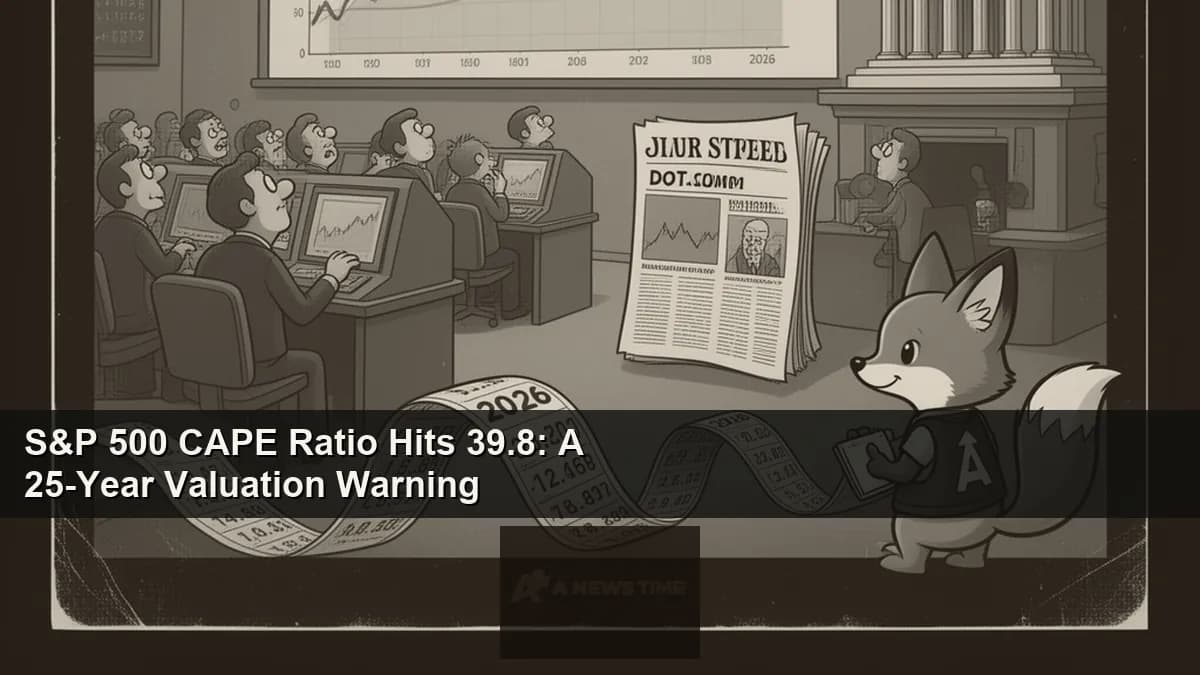
The S&P 500's CAPE ratio, the valuation metric popularized by Nobel laureate Robert Shiller that averages earnings over a ten-year period to smooth out business cycle volatility, has climbed to 39.8 as of early . That reading places current stock market valuations at the highest level since the dot-com peak of early 2000, when the ratio briefly exceeded 44 before the subsequent crash erased more than three-quarters of the Nasdaq's value and roughly half of the broader S&P 500's gains.
The CAPE ratio is not a timing tool. Shiller himself has consistently said that an elevated CAPE tells you about the risk of being in the market over the subsequent decade, not about when a correction will occur. Markets with CAPE ratios above 30 have delivered significantly below-average 10-year returns historically, but the specific timing of any correction that follows an elevated reading has been notoriously impossible to predict. In 1996, Alan Greenspan's "irrational exuberance" warning was delivered when the CAPE was in the low 20s. The market ran for another four years before the peak.
The Economic Context Behind the Valuation
What makes the current CAPE reading particularly notable is the economic backdrop against which it has developed. The S&P 500 has maintained elevated valuations through a period of decidedly mixed economic data. GDP growth for 2025 came in at 2.2 percent, which is positive but below the trend growth rate that would justify premium valuations in a standard economic model. Job creation in the most recent month hit its lowest pace since , with 181,000 positions added, a number that still indicates expansion but is significantly below the pace needed to absorb new labor force entrants at the rate the economy had been generating in 2023 and 2024.
The oil price spike driven by the US-Iran conflict and restrictions on Strait of Hormuz shipping has contributed to an inflation environment that the Federal Reserve has been unable to fully declare resolved. Core inflation remains above target, which limits the Fed's flexibility to cut rates, which in turn limits the interest rate catalyst that historically has driven equity valuations to extreme levels.
"A CAPE of 39.8 is not a crisis reading, but it is a reading that demands you understand the assumptions embedded in current stock prices. Those assumptions include continued strong earnings growth and continued investor willingness to pay very high multiples. Both of those things are possible, but neither of them is guaranteed."
David Rosenberg, economist and strategist, in a client note published in early April 2026
The bulls' case for sustaining the current valuation is built around two structural arguments. The first is that the technology sector, which represents an unusually large share of the S&P 500's current composition relative to historical norms, genuinely deserves higher multiples than traditional industrial or consumer businesses because of its higher growth rates and higher return on invested capital. The second is that low levels of new equity supply, driven by reduced IPO activity and the wave of corporate buybacks that has been running for a decade, mean that investor capital chasing the equity asset class is competing for a shrinking pool of shares.
What History Says About These Levels
The CAPE ratio has exceeded 35 only twice in its recorded history before the current period: during the final run of the dot-com bubble from 1998 to 2000, and briefly during the post-pandemic equity surge in 2021. Both previous excursions above 35 ended with significant corrections that brought the ratio back toward historical mean levels in the low-to-mid twenties.
The 2001-2002 correction brought the CAPE from its peak of 44 down to approximately 27. The 2022 correction brought it from its 2021 peak of approximately 38 down to around 27 as well. In both cases, the correction was not immediate upon reaching elevated levels; the CAPE at 35 in 1999 continued rising for another year before the market peaked. But in both cases, the elevated CAPE proved to be an accurate predictor of below-average subsequent returns, even if the specific timing was unforeseeable.
| Period | Peak CAPE | Subsequent 5-Year Return | Correction Depth |
|---|---|---|---|
| Dot-com peak (2000) | 44 | -1.2% annualized | -49% (S&P 500) |
| Post-pandemic (2021) | 38 | 3.1% annualized | -25% peak to trough |
| Historical average | 16-17 | 7-8% annualized | N/A |
| Current (April 2026) | 39.8 | TBD | Unknown |
The AI Premium: Is It Justified?
The most important structural argument for sustaining elevated valuations centers on artificial intelligence as a genuine driver of earnings growth rather than speculation. The S&P 500's technology weighting means that the index's overall CAPE is heavily influenced by the valuations of companies like NVIDIA, Microsoft, Alphabet, and Amazon, all of which trade at multiples that would have been considered extreme in any prior era.
NVIDIA's current valuation embeds assumptions about AI chip demand growth that are, by the company's own guidance, expected to compound at extraordinary rates for multiple years. If those projections prove accurate, the current stock price may prove reasonable in retrospect. If AI deployment slows, corporates pull back on data center spending, or competitive pressure emerges from Chinese or alternative semiconductor providers, the earnings required to justify current valuations may not materialize on the expected schedule.
Goldman Sachs Research published a note in arguing that AI-driven productivity gains are beginning to show in enterprise earnings data across sectors beyond pure technology, including logistics, healthcare administration, and financial services. If that broadening of AI's earnings impact continues, the valuation premium embedded in the index is capturing a genuine shift in corporate earning power rather than speculative excess. Several prominent economists dispute that reading of the data, arguing that the earnings gains attributed to AI adoption remain too small to justify the scale of the current valuation premium.
Tariffs and Geopolitical Risk: The Wild Cards
Layered on top of the AI valuation debate is a set of geopolitical and trade policy risks that standard CAPE analysis cannot easily incorporate. The tariff regime implemented by the current administration has added cost pressure across supply chains that is showing up in corporate margin data in ways that are not yet fully reflected in trailing earnings. When the CAPE averages earnings over ten years, years of pre-tariff margin structure are diluting the current-period pressure, which may be making current valuations look more favorable relative to CAPE norms than they actually are on a forward-looking basis.
The Iran conflict and oil price implications are particularly relevant here. Corporate earnings estimates for 2026 were built on oil price assumptions that the Strait of Hormuz disruption has made too optimistic. A sustained period of oil above $100 per barrel compresses margins across the transportation, manufacturing, and consumer goods sectors in ways that push actual 2026 earnings below the consensus forecasts embedded in current stock prices.
The market volatility generated by the Iran conflict earlier in the year demonstrated that investor sentiment can shift rapidly in response to geopolitical developments, even in a market that was previously pricing in continued growth. Whether those shifts are temporary or represent a lasting reset of risk premiums is the question that will determine whether the CAPE reading of 39.8 holds, rises further, or corrects.
What Investors Are Watching
For investors monitoring CAPE as part of a broader market assessment, the practical implication is not necessarily to exit equities but to calibrate expectations for future returns. At CAPE levels of 39.8, historical data suggests that 10-year annualized returns from the S&P 500 are likely to be lower than the 7-10 percent long-run average, possibly significantly lower, even if a dramatic correction does not occur.
The standard institutional response to elevated CAPE is to modestly reduce equity allocation, increase exposure to international markets where CAPE ratios are considerably lower (Europe's CAPE is approximately 17, Japan's approximately 24), and to hold more of the portfolio in short-duration bonds that now offer yields that are competitive with historical equity returns for the first time in more than a decade.
The individual investor response to CAPE, in practice, is often nothing at all, which is sometimes the rational choice. Markets can sustain elevated valuations for extended periods, and the opportunity cost of sitting out a continued rally while waiting for a correction that may not materialize on any specific timeline is real. The CAPE ratio is a risk management lens, not a market timing signal, and understanding that distinction matters for how this data should inform actual financial decisions.
What 's reading does confirm is that equity markets are pricing in a relatively optimistic future. Whether that future arrives depends on AI earnings, Federal Reserve policy, geopolitical stability, and corporate revenue execution across dozens of sectors simultaneously. A reading of 39.8 does not make a bad outcome inevitable. It does make a bad outcome more consequential if it arrives.