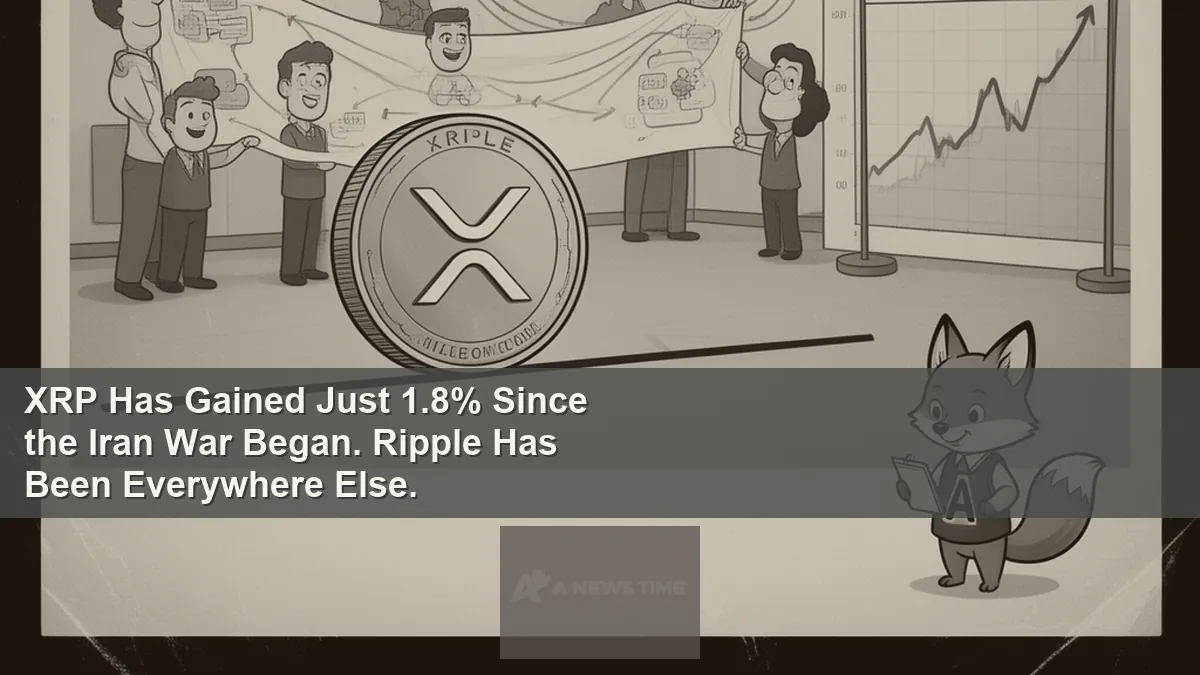
XRP is trading at approximately $1.40 as of , virtually unchanged since the U.S.-Iran war began on , in San Francisco, where Ripple is headquartered. In a period when Bitcoin gained 8.3% and Ethereum advanced 14.4%, XRP has returned just 1.8%, leaving the token at the bottom of the major-asset performance table for the war period. The underperformance is not a result of negative news flow from Ripple. The company has announced regulatory approvals in Singapore and Australia, live payment integrations in Brazil, and the launch of a SPAC-backed institutional custody vehicle, all in the space of roughly five weeks. The market, for now, is not paying for any of it.
That divergence between operational momentum and price action is the defining story of XRP in early 2026, and it matters not only for holders of the token but for any investor trying to understand how geopolitical macro risk filters through the cryptocurrency market at the asset level. The data shows that XRP is behaving differently from both Bitcoin and the AI token sector, and the reasons are worth examining in detail.
Price Action: A Year of Compression
XRP entered 2026 at elevated levels following a late-2025 rally that was partly driven by regulatory optimism in the wake of the initial Ripple-SEC settlement. The retreat since January has been approximately 25% from the start of 2026, more severe than Bitcoin's decline over the same period and reflecting a combination of profit-taking from late-cycle buyers, reduced speculative appetite in the broader crypto market, and XRP-specific factors including persistent legal uncertainty about token classification.
| Asset | Performance Since Iran War (Feb 28 – Apr 1) | 30-Day Change | Key Catalyst |
|---|---|---|---|
| Hyperliquid (HYPE) | +48.0% | +31.2% | 24/7 oil price speculation vehicle |
| Ethereum (ETH) | +14.4% | +5.8% | Glamsterdam pre-upgrade positioning |
| Bitcoin (BTC) | +8.3% | -8.2% | ETF inflows, $65K support holds |
| S&P 500 | -4.9% | -3.1% | Recession risk, oil shock |
| XRP | +1.8% | -5.3% | Ripple expansion; macro range compression |
The intra-period price history tells a story of failed recoveries. XRP hit a low of $1.16 in early February 2026, its weakest level since the post-settlement rally of late 2025. A recovery to $1.60 in mid-March was brief, lasting less than a week before the token retreated to the $1.35-$1.45 range where it has since consolidated. Each attempted breakout above $1.55 has been met with selling that returned the token to the lower portion of its range within days. The pattern is consistent with a market that has limited conviction in the near-term upside but is also not willing to drive the price significantly below $1.32, which has held as support since the war began.
Why Hyperliquid Outperformed and What It Means
The standout performer in the cryptocurrency market since the Iran war began is not Bitcoin or Ethereum, it is Hyperliquid (HYPE), the decentralized perpetual futures trading platform, which gained 48% over the same period that XRP gained 1.8%. Understanding why Hyperliquid outperformed illuminates something important about how the crypto market has evolved in its relationship with geopolitical events.
Traditional financial markets close on weekends. The Iran war, like all military conflicts, does not. When significant geopolitical developments occur on Saturday or Sunday (ceasefire rumors, escalation events, oil supply disruption announcements), traditional commodity and equity markets cannot respond until Monday's open. Cryptocurrency markets operate 24 hours a day, seven days a week, and perpetual futures platforms like Hyperliquid allow traders to take directional positions on oil prices, equity indices, and macro-sensitive assets at any time.
When Trump made de-escalation comments during the war period, Bitcoin jumped from $68,500 to $71,500 in a matter of hours, a $3,000 move driven partly by Hyperliquid traders establishing long positions before traditional markets could react. That kind of event-driven volatility, with cryptocurrency markets serving as the first-mover venue for macro pricing, is a new dynamic in the market's development. Hyperliquid's token price has appreciated because the platform's fee revenue and usage metrics are directly tied to trading volume, which has surged during the conflict period.
XRP has not benefited from this dynamic. It does not have a deep perpetual futures market of the same scale as Bitcoin or Ethereum, and its price movements have been less correlated with the specific macro headlines (oil prices, conflict escalation) that have driven the war-period crypto volatility. XRP's price is more sensitive to Ripple-specific regulatory and business developments, which move on their own schedule regardless of weekend geopolitical events.
Ripple's Ground Game: Five Weeks of Institutional Progress
The irony of XRP's price underperformance is that Ripple has delivered more substantive institutional and regulatory progress in the first quarter of 2026 than in any comparable five-week period in the company's history. The announcements span four continents and multiple regulatory jurisdictions.
In Singapore, Ripple is collaborating with supply chain technology firm Unloq in the MAS-backed BLOOM initiative, a central bank-supported program for financial technology innovation. The specific use case involves automated supply chain payments: funds are released instantly when shipment verification conditions are met, with Ripple's RLUSD stablecoin on the XRP Ledger handling settlement. The practical significance is regulatory validation from one of Asia's most credible financial regulators. MAS participation in a pilot does not imply endorsement of XRP as a speculative asset, but it does significantly reduce the regulatory risk premium that institutional investors have historically assigned to any Ripple-adjacent position.
In Australia, Ripple is pursuing an AFSL through the acquisition of a local licensed entity. The AFSL would allow Ripple to offer fully regulated cross-border payment services to Australian institutions, covering onboarding, compliance, liquidity management, and final settlement under Australian financial law. The Australian payments market has been identified by Ripple as a priority because of the country's significant exposure to Asia-Pacific trade corridors, where Ripple's network has existing infrastructure and counterparty relationships.
- Singapore: MAS-backed BLOOM initiative, RLUSD stablecoin for automated supply chain payments with Unloq
- Australia: Pursuing AFSL via local entity acquisition for regulated cross-border payment services
- Brazil: Live with Banco Genial, Braza Bank, Nomad, Azify; applying for VASP license; offering payments, custody, treasury
- US: Evernorth Holdings SPAC merger to create institutional custody and compliance vehicle
In Brazil, Ripple has moved from pilot to production across four financial institutions: Banco Genial, Braza Bank, Nomad, and Azify. The company is offering a full suite of financial services in the market, including payments, custody, treasury management, and brokerage, and is in the process of applying for a VASP license that would formalize its regulatory standing under Brazilian law. Brazil's large and growing crypto adoption base, combined with its significant cross-border payment volume with the U.S. and Europe, makes it a strategically important market for Ripple's payments network.
"Ripple is building a genuinely global regulated payments infrastructure. The XRP price does not reflect that progress right now, but institutional buyers are not indifferent to it. The question is whether the macro headwinds dissipate before the regulatory catalysts that could unlock a sustained price move." — Peter Wind, Analyst, BeinCrypto
Evernorth Holdings: The Institutional Custody Play
The Evernorth Holdings SPAC merger is perhaps the most complex of Ripple's Q1 announcements and the one with the clearest potential to affect XRP's institutional demand profile. Evernorth CEO Asheesh Birla argued publicly in March that the current regulatory clarity in the U.S. makes this "the ideal time to launch" an institutional-grade digital asset vehicle, a statement that reflects the changed regulatory environment following the CLARITY Act's progress in Congress.
The Evernorth structure holds substantial XRP reserves, which means the company's valuation is directly tied to XRP's price performance. The business model centers on providing institutional investors with the full stack of services they require to hold digital assets in a regulated framework: custody (segregated, insured, institutional-grade), compliance (KYC/AML, regulatory reporting), and security (multi-signature custody, insurance coverage). This addresses the specific barriers that have kept large pension funds, endowments, and insurance companies out of direct digital asset positions despite interest in the asset class.
Evernorth plans to generate yield from its XRP holdings by participating in liquidity provision and staking mechanisms, using those returns to expand its XRP reserves over time. If successful, the model creates a flywheel: larger reserves generate more yield, yield funds reserve growth, and growing institutional AUM increases demand for XRP. The strong XRP ETF inflows that preceded the Iran war period are cited by Evernorth as evidence that institutional demand for XRP exposure is real and durable despite the current price weakness.
Brad Garlinghouse's Global Tour and What It Signals
Ripple CEO Brad Garlinghouse visited Dublin, London, Singapore, and Sydney across five days in March 2026, a pace of international travel that signals something specific about where the company's priorities are focused. The four cities are not randomly selected. Dublin is Ripple's European headquarters and a hub for regulatory engagement with the EU's MiCA framework. London is a critical market for Ripple's correspondent banking relationships. Singapore is the MAS pilot location. Sydney is the base for the Australian AFSL application.
A chief executive physically present across four regulatory jurisdictions in five days is sending a clear operational signal to regulators, banking partners, and institutional clients in each market. It is a signal that Ripple is not outsourcing its international expansion to regional management, which matters in markets where regulatory relationships are built on personal trust and consistent senior engagement. The pace also reflects the competitive pressure Ripple faces from both Bitcoin's growing institutional infrastructure and from SWIFT's own digital payment upgrades, which have historically been cited as the primary competitive threat to Ripple's payments network.
Ripple Payments has now processed more than $100 billion across 60-plus markets, a milestone that Garlinghouse cited in a March statement as evidence that the network has achieved meaningful scale. The number is meaningful in context: SWIFT processes roughly $5 trillion in daily transactions, which means Ripple's $100 billion cumulative total, while significant for a crypto-native payments network, represents a fraction of the addressable market. The growth trajectory, rather than the absolute number, is what institutional clients are evaluating.
CoinCodex Forecast: Patient Path to October
CoinCodex's algorithmic price model for XRP, updated in April 2026, projects a gradual recovery from current levels rather than the sharp catalyst-driven rally that some XRP holders have been anticipating. The model projects a peak of $1.68 in , a 19% gain from the current $1.40 level, followed by a local peak of $2.21 in , representing a 56% gain from current prices.
The October target of $2.21 is meaningful for a second reason: it would represent the highest XRP price since the post-settlement rally of late 2025, but it would still be well below XRP's all-time high of $3.92. The CoinCodex model does not project a challenge to the all-time high within the next 12 months, a conservative outlook that aligns with the broader analyst consensus that XRP's return to $3.92 would require both a significant overall crypto market rally and XRP-specific catalysts of the magnitude of the original Ripple-SEC settlement.
"The CoinCodex model is pricing in a slow, fundamental-driven recovery for XRP rather than a momentum-driven spike. The June and October targets assume that Ripple's institutional wins begin to flow through to demand for XRP as a settlement asset, which is a thesis that is credible but requires patience. The macro environment needs to cooperate, and so far in 2026 it has not." — Peter Wind, Analyst, BeinCrypto
The gap between the $2.21 October target and the $3.92 all-time high underscores the scale of the rebuild required. XRP remains approximately 64% below its all-time high, a deeper discount than Bitcoin (46%) and comparable to Ethereum (50%), despite Ripple's operational progress. The market is pricing in the regulatory and competitive risks that remain, including the unresolved aspects of the SEC enforcement history and the ongoing question of whether XRP's role as a settlement asset in Ripple's network creates sufficient organic demand to support a significantly higher price without speculative inflows.
The Fundamental-Price Disconnect: When Does It Close?
The core question for XRP investors in April 2026 is straightforward: if Ripple is executing at the highest operational pace in its history, expanding into regulated markets across four continents, processing $100 billion in payments, and building institutional infrastructure through the Evernorth vehicle, why is the token trading at $1.40 with a 1.8% gain since the war began?
The honest answer involves several factors that operate independently of Ripple's operational performance. First, the macro environment is broadly negative for risk assets. The S&P 500 has posted five straight weeks of losses, and the correlation between crypto and risk assets has been elevated throughout the Iran war period. XRP is not immune to that macro pressure regardless of what Ripple is announcing.
Second, XRP's price is not mechanically linked to Ripple's payments volume. Unlike a protocol token where fee revenue directly accrues to token holders, XRP's value proposition as a bridge currency in Ripple's payment network depends on the velocity of transactions rather than the accumulation of fees. High payment volumes require large XRP liquidity pools to function efficiently, but they do not inherently reduce the circulating supply or create the kind of direct value accrual that drives protocol token appreciation.
Third, the CLARITY Act's progress in Congress, however positive for the asset class broadly, has not yet provided the specific token-level clarity that would remove the legal risk premium from XRP positions held by the most conservative institutional investors. Until those investors can hold XRP with the same regulatory confidence they have for Bitcoin (following the CFTC's commodity classification) or Ethereum, some demand that might otherwise flow to XRP will remain on the sidelines.
What changes the picture, according to analysts watching the token closely, is a convergence of the macro and micro. An end to the Iran war-driven inflation shock that allows the Fed to signal rate cuts, combined with the CLARITY Act providing explicit token-level classifications, would remove two of the three major headwinds simultaneously. Add a Ripple-specific catalyst at the scale of the Australia AFSL approval or a major U.S. bank publicly announcing adoption of Ripple Payments, and the fundamental case for a move toward $2.00 and beyond becomes substantially more credible. The pieces are being assembled. The timeline for when they align is the question that April 2026 cannot yet answer, and patient capital watching Ripple's global expansion is prepared to wait for the answer.