Wall Street ended the first quarter of 2026 with a two-day rally that, by its sheer size, revealed how badly investors had wanted a reason to buy. On , the Dow Jones Industrial Average surged 1,100 points, its largest single-session gain since , as reports of back-channel diplomatic progress between Washington and Tehran circulated through trading desks in New York. The following day, , the S&P 500 added more than 1%, closing at approximately 6,940, as traders extended the optimism into the final session of Q1. After five consecutive weeks of losses that wiped out nearly all of the index's gains since late 2025, the relief was palpable. Whether it will last is another question entirely.
The catalyst, as it has been for nearly every meaningful market move since late February, was geopolitical. Signals emerged over the weekend of that UN-mediated discussions between U.S. and Iranian officials had resumed and that both sides had agreed to a temporary pause in naval operations near the Strait of Hormuz. Brent crude, which had been trading above $110 per barrel for the better part of two weeks, pulled back on the news, removing the single most immediate threat to the inflation and earnings outlooks that had driven the selloff. The market responded the only way an oversold market can: by buying, fast and in size.
Five Weeks Down, Two Days Up: The Numbers Behind the Bounce
Context matters enormously when assessing a rally of this magnitude. The S&P 500's two-day move of roughly 2% followed a five-week losing streak that was, by any measure, severe. The index had fallen from a December 2025 peak, confirming correction territory alongside the Dow, which had already declined more than 10% from its own recent high. The five-week losing streak was the longest for the S&P 500 since the September-October 2022 inflation scare, and the cumulative damage was substantial enough that even a sharp two-day bounce left the index meaningfully below where it started the year.
The Dow's 1,100-point gain on was the kind of headline number that generates attention, but percentage terms tell the more accurate story. At an index level near 40,000, 1,100 points represents roughly a 2.75% gain in a single session. That is a large daily move by historical standards. For comparison, the average daily change for the Dow over a full calendar year is typically less than 0.5% in either direction. A 2.75% single-day gain places the session in the top few percent of all daily Dow returns on record.
Brent crude's retreat from above $110 per barrel was the direct fuel for the equity rally. Brent had been trading above $110/barrel for the better part of two weeks before the de-escalation signals emerged, and even a modest pullback from those levels meaningfully changes the calculus for airline stocks, consumer discretionary companies, and any business with significant transportation or logistics costs. The energy sector gave back some of its recent gains on the oil price drop, which was entirely expected. Almost everything else went up.
Breadth data confirmed the broad-based nature of the buying. For the first time in five weeks, advancing stocks outnumbered declining stocks on the NYSE by a ratio exceeding 3 to 1. All eleven S&P 500 sectors posted gains on , led by consumer discretionary, technology, and industrials, precisely the sectors that had been hit hardest during the selloff. When the most-beaten-down sectors lead a rally, it typically indicates that short-sellers are covering positions and value buyers are stepping in, both of which are signs of a technically significant bounce.
The Anatomy of the Selloff That Preceded It
To understand why this rally mattered, it helps to trace the five weeks of selling that preceded it. The S&P 500's losing streak began in late February and ran through , encompassing everything from the initial shock of renewed U.S.-Iran military engagement to the collapse of Swiss-mediated back-channel talks on to Goldman Sachs raising its recession forecast to 30%.
| Period | S&P 500 Weekly Change | Key Driver |
|---|---|---|
| Week ending Feb 28 | -1.2% | Initial Hormuz naval engagement |
| Week ending Mar 7 | -2.1% | OPEC declines to increase production |
| Week ending Mar 14 | -0.8% | Brief cease-fire optimism gives way to renewed selling |
| Week ending Mar 21 | -2.4% | Swiss-mediated talks collapse on Mar 17 |
| Week ending Mar 28 | -2.9% | Iranian missile test; Goldman raises recession odds to 30% |
| Mar 30-31 (two-day bounce) | +2.1% (est.) | De-escalation signals; Brent crude retreats from $110+ |
The pattern across the five losing weeks shows an escalation of both the underlying conflict and the market's assessment of its economic consequences. The selling was not uniform panic but a sequential repricing as each new piece of information made the outlook incrementally worse. That cumulative repricing is what made the market vulnerable to a sharp reversal once even modestly positive news arrived.
The Fed Sits Still While the Market Moves Around It
One of the defining features of the current market environment is the Federal Reserve's near-paralysis in the face of competing pressures. The FOMC holds its benchmark rate at 3.50% to 3.75%, and the futures market on assigned only a 6.2% probability to a rate hike at the April 28-29 FOMC meeting, according to CME FedWatch data. The market is not expecting the Fed to raise rates in April. But it is not expecting rate cuts either.
The Fed's dilemma has been articulated most clearly by FOMC Vice Chair Philip Jefferson, who said on that geopolitical uncertainty "complicates, at least in the short term, the picture on both sides of our dual mandate," referencing the Fed's twin goals of price stability and maximum employment. Jefferson acknowledged "downside risk to the labor market and upside risk to inflation" in the same sentence, a formulation that captures the policy bind precisely. He also offered reassurance, noting: "I am confident that our current policy stance is well positioned to respond to a range of outcomes." That kind of confident ambiguity is what central bankers produce when they genuinely do not know what comes next.
The underlying inflation data gave the Fed reason to stay cautious. Import prices jumped 1.3% in February, the largest monthly increase since March 2022 and a direct consequence of oil price pressure on the cost of imported goods. The OECD raised its U.S. inflation forecast to 4.2%, more than 1.5 percentage points above the Fed's own projection of 2.7%. If the OECD is right and the Fed is wrong, the case for rate cuts weakens considerably, even if economic growth softens. That is the inflation trap the Fed finds itself in, and de-escalation in Iran would not immediately dissolve it.
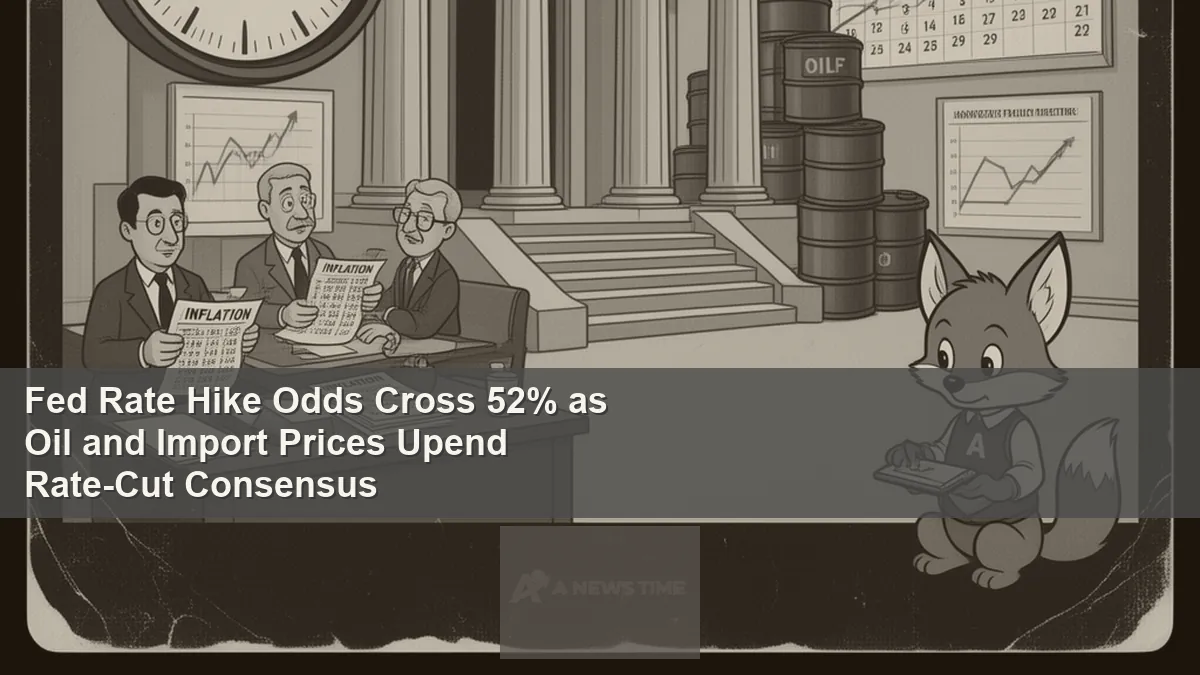
Markets have begun pricing in the possibility of a rate hike before year-end, rather than a cut. CME FedWatch data crossed the 50% threshold for the first time on the probability of at least one Fed hike by December 2026, a dramatic shift from the rate-cut expectations that were consensus at the start of the year. That repricing of Fed expectations was itself one of the factors that weighed on equities throughout Q1.
Recession Odds: A Range of Pessimism
The rally did nothing to change the recession forecasts that have been accumulating since the conflict began. Moody's Analytics put near-term recession probability at close to 50% heading into the final week of March. Goldman Sachs, which raised its forecast to 30% earlier in the month, has not revised that figure down. EY Parthenon and Wilmington Trust have both put recession odds above 40%.
These numbers represent a meaningful deterioration from where consensus stood at the start of 2026, when the U.S. economy appeared to be navigating toward a soft landing. The shift in the outlook reflects several compounding factors:
- Oil prices above $110 per barrel acting as a consumption tax on businesses and households
- Import price inflation running at its fastest monthly pace in four years
- Consumer confidence declining as energy costs bite into disposable income
- Corporate earnings growth already decelerating before the conflict began
- The Fed unable to provide the interest rate relief it delivered during previous economic slowdowns
- Q4 2025 GDP revised down to 0.7%, with core inflation running at 3.1%
"The combination of a geopolitical shock, a supply-side inflation impulse, and a constrained monetary policy response is one of the more challenging macro environments we have seen in the post-2008 era. A two-day equity rally does not change any of those structural conditions." — Mark Zandi, Chief Economist, Moody's Analytics
The recession probability data matters for equity investors because the relationship between recessions and corporate earnings is historically brutal. During the 2008-2009 recession, S&P 500 earnings fell roughly 40%. During the brief 2020 recession, they fell approximately 15% before recovering sharply. Even a mild recession, which some forecasters define as one or two quarters of negative GDP growth with a relatively quick recovery, typically produces double-digit earnings declines that compress equity valuations.
What Analysts Are Watching
The de-escalation rally generated immediate analysis across Wall Street, with most strategists cautioning against reading too much into a two-day move while acknowledging that the market's technical condition had become ripe for a bounce.
The S&P 500's relative strength indicators had reached levels not seen since the early weeks of the COVID-19 selloff in 2020, a reading that historically has preceded at least a short-term bounce. Institutional investors who had spent five weeks reducing risk exposure were, by late March, sitting on elevated cash positions that needed to be put to work eventually. The geopolitical catalyst provided the justification for deploying some of that cash.
Looking further ahead, the sustainability of the rally depends on answers to questions that the de-escalation signals have raised but not resolved. Are the back-channel negotiations substantive enough to lead to a genuine reduction in Hormuz tensions, or are they a temporary pause that breaks down again? Will oil prices remain below $110 even if the diplomatic process continues? How quickly will lower oil prices feed through into consumer prices and corporate cost structures?
The S&P 500's five-week losing streak did not develop because of a single bad week. It built over months of escalating risk. A two-day bounce, however sharp, does not unwind that process. What it does is change the immediate momentum, reduce the technical pressure on the most oversold sectors, and buy time for the fundamental picture to either improve or deteriorate further.
The Broader Market Fragility Beneath the Rally
Even setting aside geopolitical uncertainty, the S&P 500 was not in robust fundamental health when the correction began. The index started 2026 at 6,845, and even with the end-of-quarter bounce it is sitting at approximately 6,940, a gain of less than 1.5% for the full quarter despite the enormous volatility along the way. For investors who expected the AI-spending boom and anticipated Federal Reserve rate cuts to power double-digit returns in 2026, the reality has been deeply disappointing.
The internal structure of the market reflects the same fragility. The top ten holdings of the S&P 500 in early 2026, led by Nvidia, Apple, Alphabet, Microsoft, and Amazon, account for a disproportionate share of total index performance. When those mega-cap names sell off on recession concerns, the market-cap-weighted index suffers disproportionately. The Dow's entry into correction territory during the selloff was a signal that the weakness had spread beyond technology into the more economically sensitive components of the blue-chip index.
Corporate earnings season, which begins in mid-April with major bank reports, will be the next major test. First-quarter earnings will reflect the full impact of elevated oil prices, slowing consumer spending, and the uncertainty that has been visible in corporate guidance withdrawals since the conflict began. Companies that provide cautious or withdrawn full-year guidance will be punished. Those that manage to maintain or raise guidance will be rewarded, potentially disproportionately given how negative the prevailing sentiment has become.
The Goldman Sachs recession forecast revision to 30% was one of several institutional calls that accelerated the late-March selling. Whether Goldman and other forecasters revise those odds lower in April will depend heavily on how the Iran diplomatic process develops and whether oil prices can sustain a meaningful decline from recent highs. The OECD's assessment that the Iran conflict has effectively erased its prior global growth upgrade underscores how much of the macroeconomic optimism that entered 2026 has already been consumed.
What to Watch Heading Into Q2
The first week of April brings several data points capable of extending the rally or reversing it. The March jobs report, due , will be the first major labor market read since the conflict escalated to its current intensity. A labor market that remains resilient would support the soft-landing narrative and reduce the probability of near-term recession. A weak number, below consensus expectations, would validate the more pessimistic forecasts and likely reignite selling pressure.
The CPI report for March, scheduled for , will show how much of the oil price surge has fed through into broader consumer prices. If CPI comes in above expectations, it reinforces the case for the Fed to stay on hold indefinitely, removing any prospect of rate relief. A softer CPI print, which could result from lower oil prices in the final days of March, would give the Fed more optionality and likely extend the equity rally.
The United Nations Security Council meeting scheduled for will be watched closely for any concrete movement on a Hormuz ceasefire framework. Even preliminary agreement on the outlines of a process would likely be enough to push oil below $100 and equity markets meaningfully higher. A breakdown or boycott of the talks would have the opposite effect.
Two days of buying after five weeks of selling is a start, not a resolution. The recession risks that have built up over Q1 do not evaporate because of geopolitical signals. The inflation data that is making the Fed's job harder does not improve because of a single positive diplomatic headline. What the rally has done is remind investors that oversold markets can move sharply higher when the narrative shifts, and that the Iran conflict, for all its damage, is a geopolitical variable that can change direction quickly. Whether it does will determine whether the Q1 trough becomes the 2026 trough.