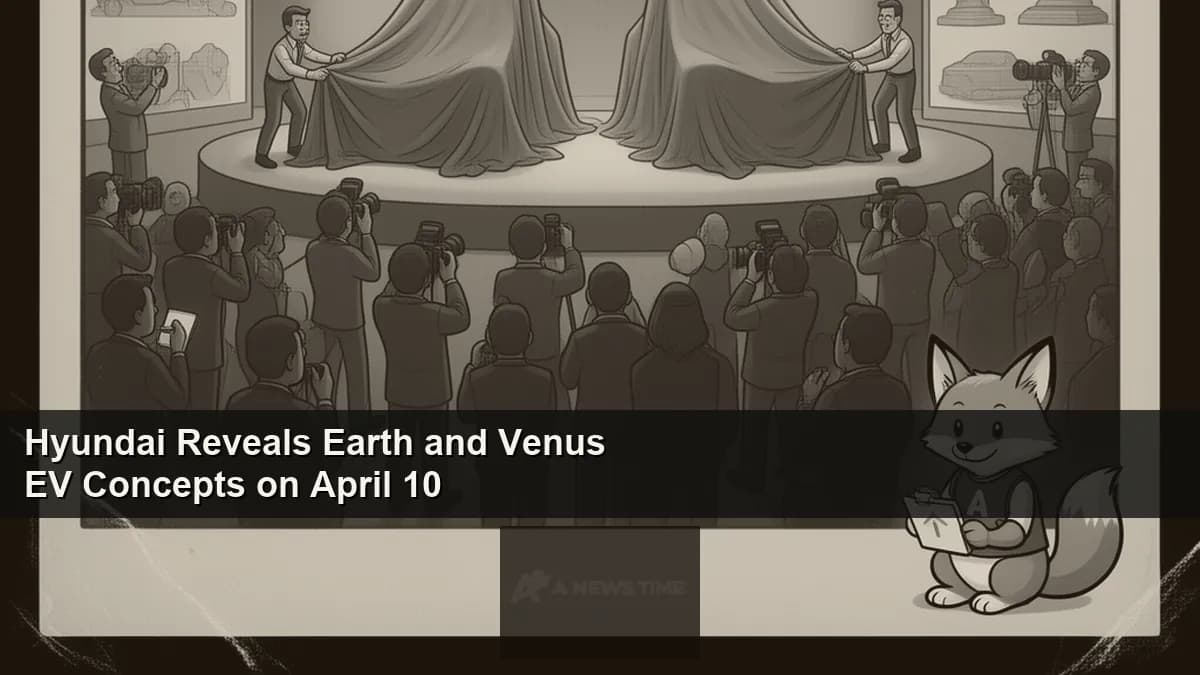
Hyundai Motor Company is scheduled to unveil two new electric vehicle concept cars on , offering the clearest preview yet of where the South Korean automaker's EV design language is heading for the latter half of the decade. The two concepts, named Earth and Venus, represent different ends of Hyundai's intended electric lineup: Earth is a boxy, upright SUV form factor with a design language that deliberately echoes classic utility vehicles while incorporating unmistakably contemporary lighting elements, while Venus is a low-slung fastback whose proportions prioritize aerodynamic efficiency and visual drama over maximum interior volume.
Both concepts are understood to be previewing production vehicles rather than serving as purely speculative design exercises. Hyundai has confirmed April 10 as an event date but has not released production timelines officially. Industry sources tracking the automaker's factory scheduling suggest Earth targets production in and Venus in , aligning with gaps in the existing Ioniq lineup where Hyundai's planning documents point toward additions.
Earth: The Boxy Utility EV
Earth's design signals a departure from the aerodynamically smoothed forms that have dominated the first wave of electric SUV design. Where the Ioniq 5 used flat panels and pixel-inspired lighting to create a retro-futurist profile, Earth takes a more upright approach with a higher roofline, near-vertical front fascia, and what Hyundai's design team has described internally as a "confident volume" aesthetic that maximizes interior space within a form that communicates purpose and durability.
The signature exterior element is the Y-shaped LED light signature, which runs from a center point on the hood downward through the front corners of the vehicle and continues as a thematic element through the rear design. The lighting architecture is distinctive enough to be recognizable as a family signature from a distance, which is exactly the function brand design teams assign to daytime running light patterns: they are the face of the vehicle at a glance.
"Earth is about reclaiming the idea of a utility vehicle as something that actually looks purposeful rather than something that has been smoothed into a generic blob. The Y-light makes it immediately identifiable as a Hyundai, but the architecture is completely new."
A Hyundai design executive, speaking to automotive media ahead of the April 10 reveal event
Interior details are being kept under embargo until the reveal event, but renderings circulating in Hyundai enthusiast communities suggest a flat-floor cabin made possible by the skateboard-style battery platform, a large panoramic roof, and a dashboard architecture that continues the clean, screen-forward approach of the current Ioniq family.
Venus: The Fastback Performance Concept
Venus occupies a different position in Hyundai's concept story. Where Earth communicates utility and accessibility, Venus communicates performance and aspiration. The fastback roofline is the defining visual element: it rises from a low hood over the front wheels and flows in a continuous curve down to a short, active-spoiler integrated tail. The result is a silhouette that is unusually low for an electric vehicle, requiring packaging solutions for the battery and cabin that are more complex than those used in taller form factors.
The wheel arch design is prominent, with wide, flared shoulders that give Venus a planted, athletic stance in three-quarter view. The slim, horizontal LED treatment at the front is a visual counterpoint to Earth's Y-shaped signature: both have LED elements as their identity anchors, but the specific forms communicate different character values. Venus reads as precise and controlled where Earth reads as confident and upright.
Hyundai has not officially confirmed a powertrain specification for Venus, but the fastback form and performance positioning are consistent with a dual-motor all-wheel-drive configuration in the production version. The Ioniq 5 N, Hyundai's first performance-oriented electric vehicle, demonstrated that the company has the capability to tune electric powertrains for driving character rather than just efficiency, and Venus appears to be extending that program further up the lineup.
Strategic Context: Hyundai's EV Repositioning
The Earth and Venus reveals arrive at a moment when the global electric vehicle market has been recalibrating after its rapid growth phase. New EV sales have slowed across most major markets as early adopters have been served and the expansion into mainstream buyers has proved slower than the most optimistic forecasts predicted. The slowdown has created pricing pressure throughout the industry and forced several manufacturers to delay or cancel models that had been planned for the 2025-2027 period.
Hyundai has managed this transition more competently than most, partly because it never committed to a fully electric-only timeline and maintained its hybrid and internal combustion investment while building out the Ioniq brand. The Ioniq 5 and Ioniq 6 both received strong critical reception and performed commercially ahead of several competitors in the European and US markets. The Ioniq 6 specifically earned enough consumer confidence to sell effectively despite launching into a market where price competition from Chinese manufacturers was intensifying.
| Concept | Form Factor | Design Signature | Expected Production |
|---|---|---|---|
| Hyundai Earth | Boxy SUV | Y-shaped LED lighting | 2027 (estimated) |
| Hyundai Venus | Fastback | Slim horizontal LED | 2028 (estimated) |
| Ioniq 5 (current) | Crossover | Pixel LED, retro-futurist | In production |
| Ioniq 6 (current) | Sedan | Aerodynamic streamliner | In production |
The introduction of Earth and Venus fills two gaps in that lineup. Hyundai currently does not have a boxy utility-format EV that competes directly with vehicles like the Ford Bronco or Land Rover Defender in the premium utility segment, and it does not have a pure performance EV that positions itself against rivals like the Porsche Taycan or the Polestar 6. Both are genuine market opportunities where Hyundai's platform and technology capability give it a realistic competitive position.
The E-GMP Platform and Technical Underpinnings
Both Earth and Venus are built on Hyundai Motor Group's E-GMP architecture, the same platform underlying the Ioniq 5, Ioniq 6, and the Genesis GV60 and GV70 electric vehicles. E-GMP's 800-volt electrical architecture enables faster charging than the competing 400-volt systems used by most competitors: compatible chargers can take a compatible E-GMP vehicle from 10 to 80 percent in approximately 18 minutes, a charging speed that significantly reduces range anxiety for longer journeys.
The platform's battery technology for the Earth and Venus production variants has not been confirmed, but Hyundai has been working with LG Energy Solution and SK On on next-generation battery cells with higher energy density that would allow larger usable range within the same physical battery volume. Production timing for those cells is expected to align with the 2027-2028 vehicle launch schedule, suggesting Hyundai is planning to introduce Earth and Venus with battery improvements rather than carrying over current-generation cell specifications.
Vehicle-to-load and vehicle-to-grid capabilities, features that allow the EV's battery to power external devices or feed electricity back to the grid, have been present in the Ioniq 5 lineup and are expected to continue in both production vehicles derived from the April 10 concepts. The outdoor utility positioning of Earth makes V2L particularly relevant as a feature for the target customer, who is likely to want to power camping equipment, tools, or emergency devices from the vehicle's battery.
Competitive Positioning and Market Expectations
Earth's eventual production form will enter a segment that includes the competitive EV utility market, where the Rivian R1S and Ford F-150 Lightning dominate in the US and where several European manufacturers are developing boxy SUV concepts of their own. The design direction Hyundai has chosen for Earth, upright and capable-looking rather than aerodynamically compromised, is specifically targeted at buyers who have been reluctant to adopt current-generation electric SUVs because those vehicles do not look like utility vehicles.
Venus faces a different competitive landscape. The pure electric fastback segment is populated by high-performance vehicles with price points that exceed $70,000 in most configurations, and the buyers for that segment are evaluating aesthetic aspiration as much as performance specification. Hyundai's positioning, a brand that is respected for value and technology but not historically associated with premium aspiration, means Venus will need to demonstrate both striking design and performance credentials that can stand next to more established competitors.
The April 10 reveal will establish the initial reception to the design concepts. Consumer and media reaction to concept cars is an imperfect predictor of production success, but extremely negative concept reception has derailed production vehicles before, and Hyundai will be carefully monitoring responses to both Earth and Venus as it finalizes the production specifications for both models.
Sources
- Hyundai Motor Company Newsroom — Earth and Venus Concept Reveal Announcement
- Car and Driver — Hyundai Earth and Venus: What We Know Before the April 10 Reveal
- Motor Trend — Hyundai EV Concept Preview and E-GMP Platform Analysis
- Electrek — Hyundai's Earth and Venus EVs Signal Next Phase for Ioniq Lineup