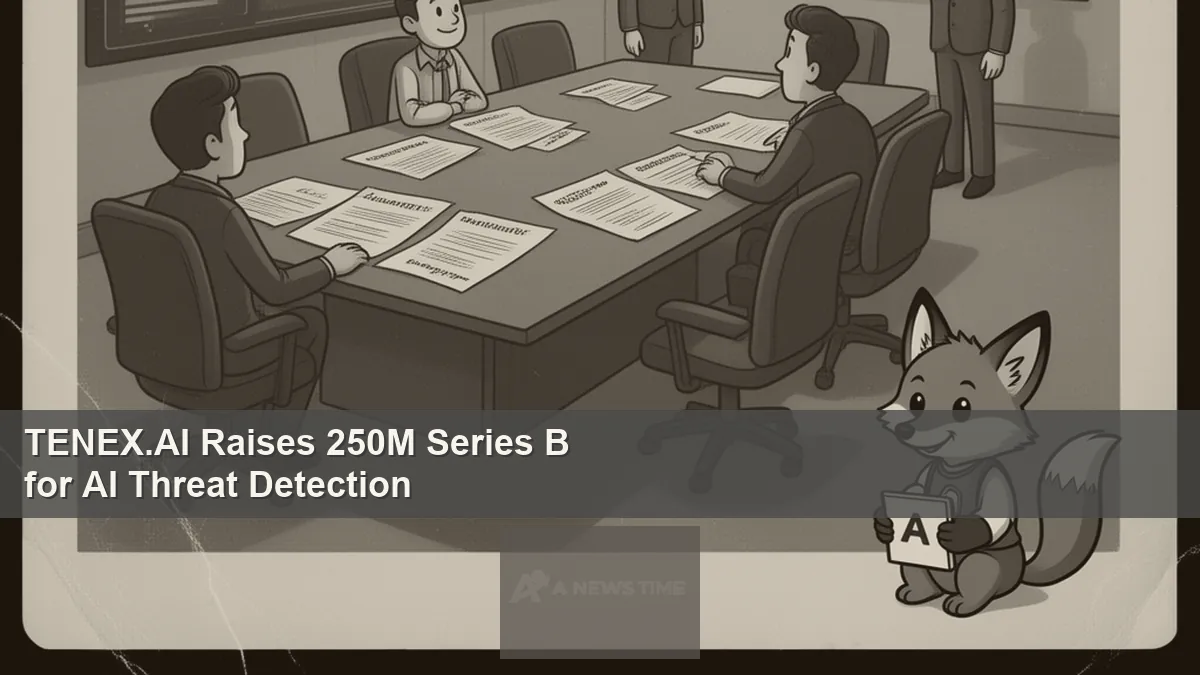
TENEX.AI, a Sarasota, Florida cybersecurity startup that emerged from stealth less than a year ago, closed a $250 million Series B on , in one of the largest venture funding rounds ever recorded in the Tampa Bay and Sarasota region. The round was backed by top-tier investors including Andreessen Horowitz, with notable participation from Greg Clark, the former CEO of Broadcom and Symantec, who brings direct operational credibility to the company's enterprise security pitch. TENEX.AI plans to use the capital to scale its AI-powered autonomous threat detection platform globally and expand its workforce, according to the Tampa Bay Business Journal.
The raise is a striking milestone for a company that was barely known outside a small circle of Florida VCs eighteen months ago. In , the company closed a $27 million early-stage round backed by regional investors. By , it had opened a European office. Now, four months later, it has raised nearly ten times that early round in a single Series B. The speed of that trajectory reflects both the quality of the product and the intensity of the market tailwind pushing capital toward AI-native cybersecurity solutions.
What TENEX.AI Actually Builds: Autonomous Threat Detection Without the SOC Bottleneck
The cybersecurity industry has operated for two decades on a model that was never designed to handle the scale of modern threats. Security tools generate alerts. Analysts read those alerts. Analysts investigate some percentage of them. The rest pile up in a queue. By the time a real attack is identified and escalated, hours or days may have passed since the initial intrusion. In a ransomware attack, those hours represent the difference between an isolated incident and a company-wide encryption event.
TENEX.AI's platform attempts to break this bottleneck by replacing the human analyst triage step with an AI system capable of autonomous detection, investigation, and response. The platform integrates across an enterprise's existing security stack, ingesting telemetry from endpoints, networks, cloud environments, and identity systems, then uses AI to distinguish genuine threats from noise at machine speed. When the system identifies a high-confidence threat, it can initiate containment actions autonomously, without waiting for a human to review a ticket queue.
This is the fundamental architecture that separates the emerging generation of AI-native security platforms from older SIEM and XDR tools that still require heavy analyst involvement to generate actionable output. The competitive implications are significant: if AI-autonomous threat detection can reduce mean time to respond from hours to minutes, it addresses the single most important metric in enterprise security operations.
The Investors: Why Greg Clark's Involvement Matters
Andreessen Horowitz is the marquee name in this round, and the firm's participation sends a clear signal to enterprise buyers and competitors alike. a16z has built one of the most active cybersecurity investment portfolios in Silicon Valley, with prior bets on companies like Cybereason and Dragos. Their decision to lead a Florida startup's Series B is a meaningful endorsement of TENEX.AI's technical differentiation.
But the more operationally significant investor may be Greg Clark. Clark served as CEO of Symantec from 2016 to 2019, overseeing one of the largest enterprise security portfolios in the world before the company's enterprise business was acquired by Broadcom. He subsequently led the security division at Broadcom before departing. That background means Clark has spent years operating at the intersection of enterprise security products, CISO relationships, and corporate deal-making at the highest level.
"The cybersecurity landscape is facing unprecedented threats, and TENEX.AI is addressing the critical need for autonomous, AI-driven security solutions that can operate at machine speed."
Greg Clark, Investor and former CEO of Broadcom and Symantec, via Tampa Bay Business Journal
Clark's involvement is not simply a credential. It represents access to a network of CISOs, enterprise IT buyers, and global system integrators that a Florida startup would normally take years to develop. Bashar Abouseido, serving as CISO in an advisory or operational capacity, adds direct enterprise credibility to how the platform is positioned to security leadership at prospective customers.
The investor roster also reflects a recognition that the AI-cybersecurity category is moving from proof-of-concept to production deployment. Series B rounds of this scale typically fund companies that have already validated product-market fit and are racing to capture enterprise market share before the category consolidates around two or three dominant vendors.
The Market Context: Why This Money Is Flowing Now
| Company | Stage | Valuation | Core Approach |
|---|---|---|---|
| CrowdStrike | Public (CRWD) | ~$85B | Cloud-native EDR + threat intelligence |
| SentinelOne | Public (S) | ~$18B | AI-powered autonomous endpoint detection |
| Palo Alto Networks | Public (PANW) | ~$115B | Integrated platform, AI-assisted SOC |
| TENEX.AI | Series B (private) | Undisclosed | Fully autonomous AI threat detection |
Cybersecurity spending is accelerating for a set of concrete, observable reasons. A sustained wave of Iran-linked cyberattacks against US infrastructure, documented by the Cybersecurity and Infrastructure Security Agency, has pushed threat awareness to board-level attention across industries that previously treated security as an IT budget line item. Healthcare breaches at CareCloud and Panera Bread demonstrated that no sector is outside the target set, and the operational disruption from those incidents translated directly into C-suite urgency around detection capabilities.
The IBM Cost of a Data Breach Report has consistently found that the speed of detection is the single most important factor in limiting breach costs. Organizations that detect and contain a breach in under 200 days spend an average of $1 million less than those that take longer. That data point is the core commercial argument for autonomous AI detection: not that it replaces human security teams, but that it compresses the detection and response window in ways human teams structurally cannot.
TENEX.AI is entering a market where CrowdStrike, SentinelOne, and Palo Alto Networks already hold deep enterprise relationships and multi-year contracts. The path to displacing incumbents runs through CISOs who are dissatisfied with the analyst-hours required to operate their existing platforms and are willing to evaluate a next-generation architecture. The $250 million Series B gives TENEX.AI the resources to build that enterprise sales motion at scale. For context on the broader startup funding environment fueling rounds like this one, see our coverage of February 2026 setting an all-time global startup funding record.
Florida's Emerging Tech Identity: More Than Sunshine and Theme Parks
TENEX.AI's raise is also a data point in a larger story about the Tampa Bay and Sarasota corridor. Florida has historically been overshadowed by Miami's fintech and crypto ecosystem when discussions of tech investment arise, but the corridor from Tampa to Sarasota has developed a distinct identity around cybersecurity, defense tech, and enterprise software, partly driven by proximity to MacDill AFB and the defense community around it.
The $250 million Series B is among the largest venture rounds ever recorded in the region. That distinction matters for talent recruitment, for signaling to other founders that the region can support venture-scale ambition, and for building the kind of investor network that makes subsequent rounds easier. Florida VCs who participated in the $27 million October 2025 round are now sitting on a position in a company with a credible path to becoming a nationally significant cybersecurity vendor.
The global expansion plans announced alongside the round include a particular focus on European markets, where GDPR compliance requirements and a distinct set of threat actors have created demand for security platforms that can demonstrate both technical effectiveness and regulatory alignment. The European office opened in was a pre-positioning move for this expansion, suggesting the company had already secured early customer interest in the region before the Series B closed.
What Comes After $250 Million: Execution Risk and the Road to Market Leadership
The funding round is a milestone, not a guarantee. The cybersecurity market has seen multiple well-funded AI-native startups struggle to convert technical promise into enterprise sales at scale. The challenges are consistent: the procurement cycles for enterprise security software run six to eighteen months, incumbent vendors have negotiated multi-year renewal contracts that create switching costs, and CISOs are deeply skeptical of vendors who cannot demonstrate operational results from comparable production environments.
TENEX.AI's execution plan will be tested on several fronts simultaneously. Scaling a global sales organization while maintaining product quality requires a different management capability than building a technical platform. The European expansion adds regulatory complexity, including data sovereignty requirements that affect how the platform processes and stores telemetry. And competing directly against CrowdStrike and SentinelOne for enterprise contracts means going head-to-head with companies that have spent years building customer success organizations designed to retain accounts.
Greg Clark's operational network and Bashar Abouseido's CISO credibility are the most important assets for navigating these challenges. Enterprise security sales are relationship-driven in ways that consumer software sales are not. A CISO who has worked directly with Clark at a previous company, or who respects Abouseido's technical judgment, is more likely to run a serious proof-of-concept evaluation than one who encounters TENEX.AI through a cold outreach. That social capital, not the AI architecture itself, will likely determine whether the company converts its $250 million runway into durable market position. For a broader view of the AI-powered security landscape and the threat environment driving this investment, see our reporting on Iran-linked cyber retaliation activity surging in 2026.
The market window is real and the funding is substantial. Whether TENEX.AI can translate both into a defensible position in one of the most competitive and well-capitalized sectors in technology will be one of the more interesting startup narratives to track over the next eighteen months.
Frequently Asked Questions
What does TENEX.AI's platform do differently from traditional cybersecurity tools?
TENEX.AI uses AI to autonomously detect, investigate, and respond to threats without requiring a human analyst to initiate each action. Traditional SIEM and XDR platforms still rely heavily on human analysts to triage alerts and escalate genuine threats, creating bottlenecks when alert volumes are high.
Who are the investors behind TENEX.AI's $250M Series B?
The round was backed by Andreessen Horowitz (a16z) along with Greg Clark, the former CEO of Broadcom and Symantec. Florida-based venture investors who participated in the company's earlier $27 million round also have stakes in the company.
Why is TENEX.AI based in Sarasota rather than a traditional tech hub?
The Tampa Bay and Sarasota corridor has developed a distinct cybersecurity and defense tech ecosystem, partly due to proximity to MacDill Air Force Base and the defense community around it. Florida has become an increasingly active startup market outside of Miami's traditionally dominant fintech scene.
What is the competitive landscape TENEX.AI is entering?
TENEX.AI competes in a market dominated by publicly-traded incumbents including CrowdStrike, SentinelOne, and Palo Alto Networks. These companies have deep enterprise relationships and multi-year contracts, meaning TENEX.AI will need to win new deployments and displace existing vendors with clear technical differentiation.