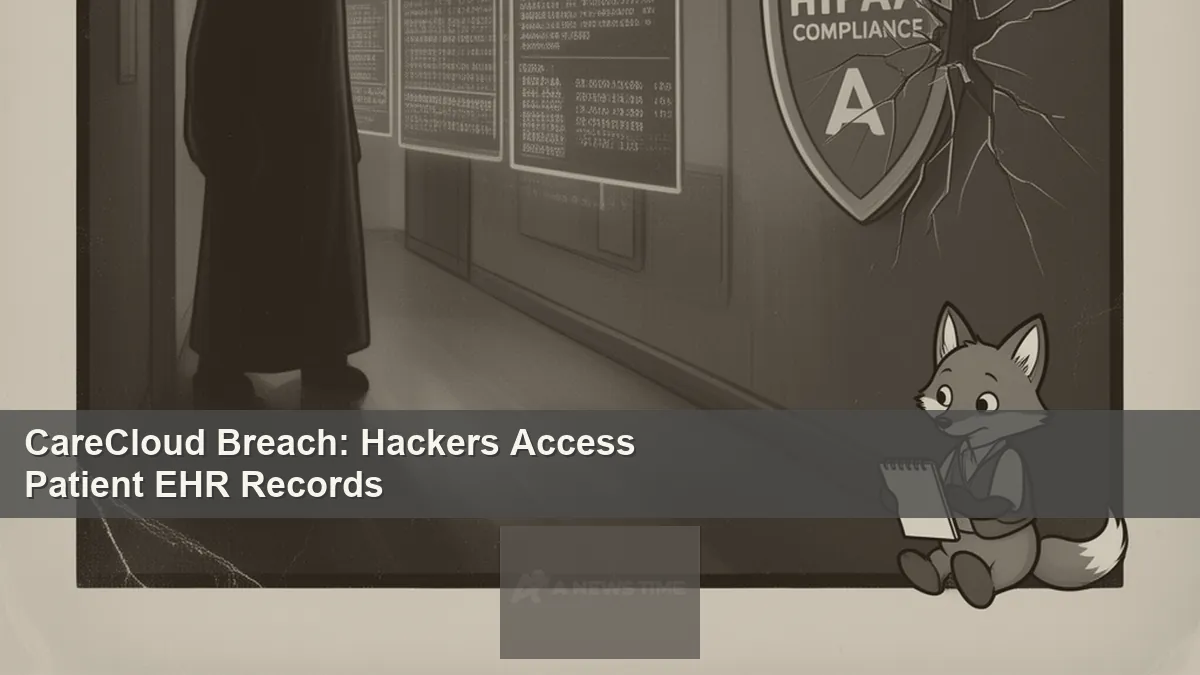
CareCloud Health, a publicly traded healthcare technology company serving medical providers across the United States, confirmed on that unauthorized actors gained access to one of its six electronic health record environments on . The intrusion lasted approximately eight hours before CareCloud's security team detected and contained it. The compromised environment primarily stores protected patient health information, the category of data that sits at the most sensitive intersection of personal privacy and federal regulation. CareCloud, which trades publicly, triggered mandatory disclosure requirements and filed a Form 8-K with the SEC, formally classifying the incident as material under the Commission's cybersecurity disclosure rules.
The breach arrives during a concentrated period of healthcare sector cyber incidents and alongside other major data disclosures: on the same day CareCloud made its public announcement, Panera Bread confirmed a separate breach affecting 5.1 million customers. Healthcare, however, occupies a distinct legal and ethical category when it comes to data exposure. Patient health records are protected under federal law, and breaches in this sector carry consequences that extend from hospital billing departments to the personal medical histories of ordinary people.
What Happened on March 16 and How It Was Contained
According to CareCloud's public filings and statements, the incident began as "an unexpected network disruption" on . An unauthorized actor had gained access to one of the company's six distinct EHR environments. CareCloud's incident response protocols activated the same day, and the company states that it restored operations by the evening of March 16, containing the intrusion within approximately eight hours of its detection.
Eight hours is a meaningful containment window. For context, the average time to detect a data breach in the healthcare sector has historically been measured in weeks rather than hours, with detection delays allowing attackers to move laterally across networks, extract larger data sets, and establish persistence before defenders are even aware of the intrusion. The fact that CareCloud identified and contained this incident within a single day suggests either robust monitoring infrastructure or, depending on what the forensic investigation ultimately finds, that the intrusion was detected at an early stage before the attacker had fully executed their objectives.
What the eight-hour window does not resolve is whether data was exfiltrated before containment. Skilled ransomware operators and data theft actors can copy substantial datasets in minutes once they have positioned themselves correctly within a target network. The forensic investigation that CareCloud has engaged is specifically tasked with answering that question.
CareCloud's Response: Forensics, Law Enforcement, and the SEC
CareCloud's documented response to the March 16 incident followed a sequence that reflects both regulatory requirements and corporate risk management priorities. The company immediately activated its incident response protocols, which it states included engaging an external forensic investigation team. Notably, CareCloud retained a Big Four accounting firm's cyber response advisory practice, a choice that signals both the seriousness with which the company treated the incident and the kind of investigation depth it was commissioning.
Big Four cyber advisory practices (the forensic divisions of firms like Deloitte, PricewaterhouseCoopers, KPMG, and Ernst and Young) are standard choices for high-stakes breach investigations because they combine technical forensic capabilities with the legal defensibility that comes from their institutional credibility. Their investigation reports are designed to withstand regulatory scrutiny and, if necessary, litigation discovery.
CareCloud also reported the incident to law enforcement and notified its cybersecurity insurance carrier, the latter a step that triggers the carrier's own incident response resources and begins the documentation process for any eventual insurance claim. The insurance notification is significant because it creates a paper trail about the company's assessment of the incident's severity that exists independently of its public statements.
Eight days after the incident, on , CareCloud formally classified it as a "material incident" under Item 1.05 of the SEC's cybersecurity disclosure rules, which took effect in December 2023. That classification triggered the requirement to file a Form 8-K within four business days of the materiality determination. The public acknowledgment of the breach was, in other words, not a voluntary disclosure but a regulatory obligation that the company fulfilled after concluding it could not reasonably argue the incident was immaterial.
In its 8-K filing, CareCloud noted that the breach "has not materially impacted current financial operations" but acknowledged "anticipated remediation costs, regulatory notification requirements, and potential reputational damage" as downstream consequences that necessitated public disclosure.
CareCloud Health, Form 8-K, SEC Filing, March 24, 2026
The Data at Risk: Protected Health Information and Why It Matters
The compromised EHR environment at CareCloud "primarily stores patient health records," according to the company's disclosures. This is the category of data that federal law treats most stringently, and for good reason.
PHI is defined under HIPAA to include any information that can identify a patient and relates to their past, present, or future health condition, healthcare treatment, or payment for healthcare services. In practice, an EHR environment stores information that most people would consider among the most private details of their lives: diagnoses, medications, mental health treatment history, reproductive health records, substance abuse treatment, HIV status, and the full chronological account of every clinical encounter they have had with a healthcare provider who uses CareCloud's platform.
When that information is accessed by an unauthorized actor, the potential harms extend well beyond the usual identity theft and fraud concerns that dominate coverage of retail data breaches. Exposed health records can be used for insurance fraud (billing under a victim's identity), for targeted blackmail or coercion in cases involving sensitive diagnoses, and in some employment and housing contexts where individuals have legal protections that depend on their medical history remaining confidential. The Federal Trade Commission, which has expanded its enforcement activities in health data cases under a 2023 policy statement, treats unauthorized access to health information as a distinct and elevated category of privacy harm.
HIPAA's BNR adds another layer of obligation on top of the SEC disclosure. Under the Breach Notification Rule, covered entities and their business associates must notify affected individuals, the Department of Health and Human Services, and in cases involving more than 500 people in a single state, prominent media outlets in that state. CareCloud, as a business associate providing EHR services to covered healthcare entities, sits within HIPAA's regulatory scope. The HIPAA notification obligations run in parallel with and separately from the SEC disclosure requirements.
Who Is Actually Affected
CareCloud does not provide direct patient care. It provides the technology infrastructure that healthcare providers use to manage patient records and billing. Understanding who is affected by this breach therefore requires understanding who CareCloud's clients are and who those clients serve.
CareCloud serves physician practices, specialty medical groups, behavioral health clinics, and other ambulatory care providers. Its platform processes medical billing, scheduling, and clinical documentation for thousands of healthcare providers. When CareCloud says that one of its EHR environments was compromised, the patients affected are not people who necessarily have any direct relationship with CareCloud itself. They are patients of the healthcare providers who contracted with CareCloud to manage their records.
This is a structural feature of healthcare data breaches that makes them particularly complex from a notification standpoint. The breach happens at the vendor level. The obligation to notify runs to the patients. But those patients' primary relationship is with their healthcare provider, not with the technology company that stores their data. Coordinating notification across thousands of provider clients, each with their own patient populations, is a logistical challenge that helps explain why HIPAA notifications in healthcare vendor breaches often take months rather than days.
The scope of the affected patient population is not yet publicly known. CareCloud's forensic investigation is ongoing, and the company has stated that it is still determining whether data was exfiltrated. The final notification scope will depend on those findings. If the investigation confirms that patient data was copied and removed from the compromised environment, the number of affected individuals could be substantial given CareCloud's scale as a vendor serving providers nationally.
| Timeline Event | Date | Details |
|---|---|---|
| Network disruption detected | Unauthorized access to one of six EHR environments | |
| Incident contained | (evening) | Operations restored within approximately 8 hours |
| Law enforcement notified | March 16-17, 2026 | Standard incident response protocol |
| Big Four forensics engaged | March 16-17, 2026 | Ongoing investigation to determine exfiltration |
| SEC 8-K filed (material incident) | Item 1.05 disclosure; materiality determination |
Healthcare Cybersecurity Context: Why the Sector Keeps Getting Hit
The CareCloud breach is not an anomaly. Healthcare has ranked as the most heavily targeted sector for ransomware attacks in every major threat intelligence report for the past four consecutive years. Understanding why requires understanding what makes healthcare organizations structurally attractive targets.
Healthcare data is uniquely valuable on underground markets. A complete patient record (medical history, insurance details, Social Security number, billing address) commands prices on dark web forums that are multiples of what standard financial records fetch. The comprehensive nature of EHR data, which combines financial identifiers with deeply personal health history, creates a one-stop dataset for identity fraud and targeted attacks that is hard to replicate from any other single source.
Healthcare organizations also face an operational constraint that attackers exploit deliberately: they cannot simply take systems offline and wait. When EHR systems go down, clinicians lose access to medication records, allergy histories, and treatment plans that are directly relevant to patient safety. Hospitals and medical practices under ransomware attack face pressure to restore operations quickly in ways that industrial companies or retailers do not, because the alternative is not just business disruption but potential patient harm. That urgency is the structural advantage ransomware operators are targeting.
The Department of Health and Human Services cybersecurity guidance for healthcare organizations notes that ransomware incidents in healthcare increased by roughly 130 percent between 2021 and 2024. The introduction of SEC disclosure rules in late 2023, which created a new mandatory public reporting mechanism for publicly traded companies, has made the full scope of the problem more visible without meaningfully reducing the attack rate.
CareCloud's handling of this incident, from rapid containment to transparent SEC disclosure, represents a response that is in important respects more proactive than what many breached healthcare organizations have historically provided. The company's engagement of a major forensic investigation firm, its prompt law enforcement notification, and its timely 8-K filing all reflect a compliance posture that the SEC's new rules were specifically designed to encourage. Whether that posture is sufficient to satisfy HIPAA obligations, satisfy affected patients, and withstand the regulatory scrutiny that healthcare breaches invariably generate is a question that the investigation's final findings will need to answer.
The related breach at Panera Bread, confirmed the same day, illustrates that the current threat environment is applying pressure across multiple sectors simultaneously. The CareCloud incident's specific risk is not just about one company's systems. It is about the patient records of an indeterminate number of people who have no direct relationship with CareCloud and may not know the company handles their medical history at all.
As the forensic investigation proceeds and HIPAA notification obligations become clearer, the coming weeks will determine whether CareCloud's swift operational response translated into genuine data protection or whether it was containment that came too late to prevent the exfiltration that would trigger the most serious consequences. The investigation's conclusions will also shape how other healthcare vendors assess and communicate about similar incidents in the months ahead, making this disclosure an important data point in an ongoing sector-wide reckoning with cybersecurity risk.
Frequently Asked Questions
What is CareCloud and what kind of data does it store?
CareCloud is a publicly traded healthcare technology company that provides electronic health record, medical billing, and practice management software to physician practices and medical groups across the United States. Its EHR environments store protected patient health information, including medical histories, diagnoses, treatment records, prescriptions, and billing information for patients of the providers who use CareCloud's platform.
Was my data compromised in the CareCloud breach?
The forensic investigation is ongoing. CareCloud has not yet confirmed how many patients are affected or whether data was exfiltrated from the compromised environment. Patients of healthcare providers who use CareCloud's platform may be affected. CareCloud is obligated under HIPAA to notify affected individuals once the investigation determines the scope of the breach.
Why did CareCloud file a Form 8-K with the SEC?
In December 2023, the SEC adopted rules requiring publicly traded companies to disclose cybersecurity incidents that are determined to be material to investors within four business days of that determination. CareCloud classified the March 16 incident as material on March 24 and filed accordingly. The rule was designed to ensure investors have timely information about significant cybersecurity risks affecting the companies they invest in.
How is a healthcare data breach different from a retail data breach?
Healthcare data is protected under HIPAA with specific notification requirements, enforcement mechanisms, and civil and criminal penalties. The data itself, which includes medical history, mental health records, and treatment details, creates harms that go beyond financial fraud, including potential discrimination, coercion, and violations of medical privacy protections. Healthcare organizations also face a distinct operational constraint: they cannot delay restoring access to patient records without risking patient safety.
What is CareCloud doing about the breach?
CareCloud has engaged a Big Four accounting firm's cyber advisory practice to conduct a forensic investigation, notified law enforcement, notified its cybersecurity insurance carrier, filed an SEC 8-K disclosing the material incident, and stated that it has implemented additional security measures following the breach. The company has restored operations and states that financial operations have not been materially impacted.