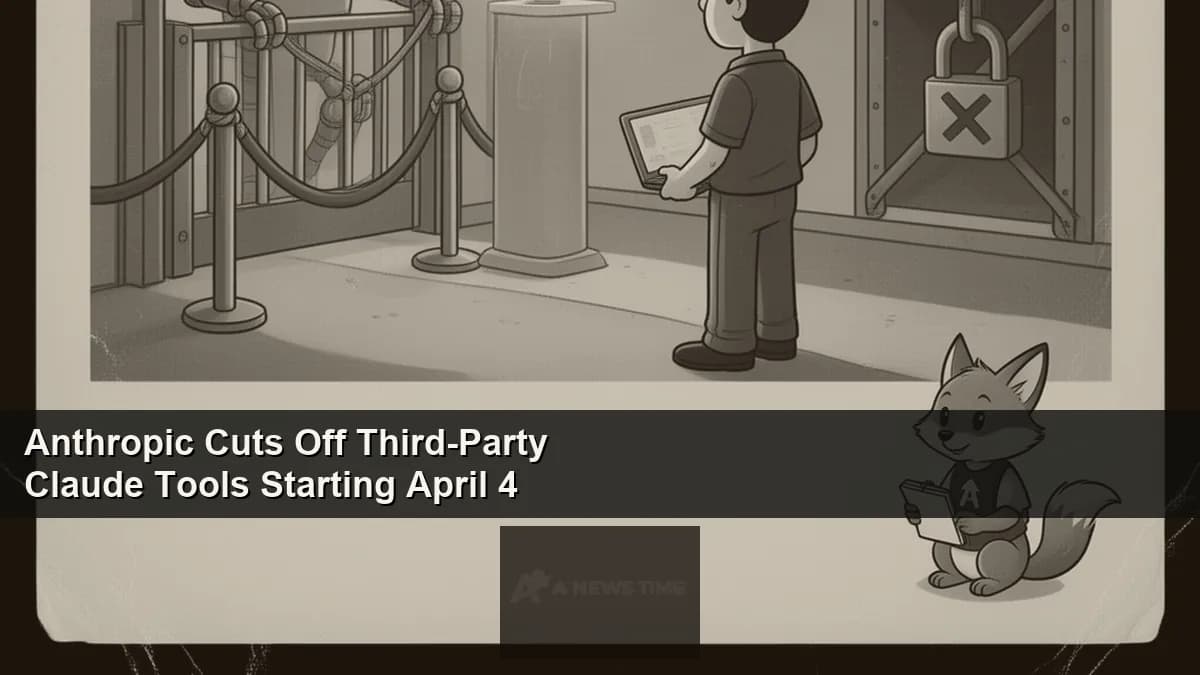
Anthropic is ending support for third-party tools that access Claude outside of official paid channels, effective . The change directly targets applications like OpenClaw and similar utilities that routed user requests to Claude by leveraging shared credentials or unofficial integration methods that bypassed the company's standard API billing. Users who built workflows around these tools have two paths forward: obtain a personal Anthropic API key, or purchase one of the company's new extra usage bundle add-ons for their existing subscription.
The policy shift affects a subset of Claude's user base that skews heavily toward power users, developers, and researchers who assembled Claude into custom productivity setups outside of Anthropic's official Claude.ai interface. For these users, third-party tools often provided the flexibility and automation capabilities that the official interface does not offer, at a cost that was, in many cases, lower than direct API access.
What Changed and When It Takes Effect
Anthropic's updated usage policy, which rolled out via notification to affected users beginning in late , draws a clear distinction between authorized and unauthorized access pathways. The company defines unauthorized access as any connection to Claude's capabilities that does not route through a paid API key registered to the requesting user or a valid Anthropic subscription with sufficient usage allocation.
Tools like OpenClaw functioned by aggregating Claude access in ways that effectively distributed a single API connection across multiple end users, or by operating within browser environments in ways that circumvented standard billing. Anthropic says these access patterns created unpredictable load on its systems and made it difficult to accurately attribute compute costs. Beginning , requests arriving through these pathways are blocked at the API level.
The notice sent to affected users outlined two compliant alternatives. The first is a direct API key: users can sign up for Anthropic API access, which is billed per token at rates that vary by model tier. Claude 3.7 Sonnet, the current primary model, costs $3 per million input tokens and $15 per million output tokens at standard pricing. For users with moderate usage patterns, direct API costs can be manageable, though they scale with use in a way that flat subscriptions do not.
The second option is Anthropic's extra usage bundles, a new add-on product announced alongside the policy change. These bundles attach to an existing Claude Pro or Claude for Teams subscription and provide a defined block of additional message capacity at a fixed price. Specific bundle pricing was not fully disclosed in the initial announcement, but Anthropic described them as designed for users who need "significantly more capacity than the standard plan provides."
Why Anthropic Is Making This Move Now
The timing connects to several simultaneous pressures. Anthropic has been scaling its model infrastructure significantly, with Claude 3.7 representing a substantial increase in capability and, correspondingly, in per-inference compute costs. The company also released Claude 3.7 with extended thinking capabilities, a feature that substantially increases token usage for complex reasoning tasks.
Running that infrastructure profitably requires that usage costs map to revenue. Third-party tools that accessed Claude without proper billing broke that equation. At small scale, the leakage was tolerable. As the user base for unofficial tools grew, the economics became harder to ignore.
Dario Amodei, Anthropic's CEO, discussed sustainable AI deployment in broad terms during a interview, noting that Anthropic's commercial success is "not separate from its mission, but essential to it." The company has been clear that it views revenue as the mechanism that funds the safety research at its core. Third-party access patterns that generate no revenue while consuming significant compute work directly against that model.
There is also a security dimension. Unofficial tools that route through Claude's API using pooled or borrowed credentials create audit and attribution problems. Anthropic's updated policy explicitly addresses this, stating that official API keys create a clear record of who is making what requests, which the company says is necessary for responsible use monitoring and potential abuse investigation.
Who Is Affected and How Severely
The affected population is difficult to quantify precisely because unofficial tool usage by definition does not generate Anthropic billing records. Developer communities on Reddit, GitHub, and Discord have been discussing the change since the notifications went out, and the affected tools include OpenClaw, several browser extensions that offered Claude access without separate subscriptions, and automation platforms that embedded Claude through non-standard pathways.
For casual users of these tools, the disruption is moderate. The official Claude.ai interface offers most of the functionality that drove them to third-party alternatives, and a standard Claude Pro subscription at $20 per month provides a practical alternative for most use patterns. The interface limitations that drove users to third-party tools, primarily around automation, bulk processing, and integration with other software, remain real, but Anthropic has been steadily expanding its official API capabilities to address them.
For power users who had built sophisticated workflows, the calculus is more complex. Direct API access at token-based pricing can become expensive quickly for high-volume use cases. A researcher running hundreds of document analyses per day through Claude, a developer testing a pipeline against thousands of inputs, or a small business owner who automated customer support responses through Claude could see costs jump substantially when moving from an unofficial flat-rate tool to per-token billing.
| Access Method | Status After April 4 | Monthly Cost (Approximate) |
|---|---|---|
| Claude.ai (Pro subscription) | Fully supported | $20/month |
| Anthropic API (direct) | Fully supported | Per token ($3/$15 per million input/output) |
| Extra usage bundles (new) | Fully supported | Pricing not fully disclosed |
| Third-party unofficial tools (OpenClaw, etc.) | Blocked | N/A |
The Developer Community Response
Reaction from the developer community has been mixed but largely resigned. The consensus in technical forums is that Anthropic's decision is commercially rational, even if it is frustrating for users who benefited from the unofficial pathways. Several developers have pointed out that the situation was always somewhat precarious: building a workflow on top of an access method that Anthropic never officially sanctioned carried inherent risk.
A more pointed criticism has emerged around Anthropic's transparency on usage bundle pricing. Developers trying to evaluate whether to switch to direct API access, pay for a bundle, or move to an alternative model provider have found it difficult to make an informed decision without concrete bundle pricing. Several GitHub discussions note that this ambiguity seems designed to push users toward direct API access, where per-token billing aligns most directly with Anthropic's revenue interests.
OpenClaw's developers have not yet published an official response, but the tool's primary GitHub repository shows a sharp uptick in issues and pull requests since the March 2026 notifications went out, with users looking for workarounds or transition paths. Several forks have appeared with experimental approaches, though Anthropic's API-level enforcement makes purely software-based workarounds difficult to sustain.
The change has also prompted comparisons to Anthropic's approach to AI policy more broadly. The company's emphasis on controlled, accountable AI deployment is consistent with restricting unmonitored access pathways, but it puts Anthropic in a different competitive position than providers who prioritize developer accessibility over usage accountability.
Alternatives Developers Are Considering
The third-party tool shutdown has accelerated evaluation of alternative large language models for price-sensitive use cases. Google's Gemini 2.0 Flash, available at $0.075 per million input tokens, and Meta's Llama-based models available through various hosting providers at comparable or lower rates, have seen increased discussion as migration targets in developer communities.
The comparison is not straightforward. Claude's reputation for instruction-following precision and long-context handling means that switching models is not a drop-in replacement for many applications. Users who built workflows specifically because Claude performed better on their tasks than competitors will face real quality tradeoffs if they migrate primarily to cut costs.
Anthropic appears to be betting that Claude's quality advantage is strong enough that power users will pay official prices rather than downgrade to cheaper alternatives. That bet is likely correct for enterprise and professional use cases. For the more price-sensitive edge of the power user market, the outcome is less certain.
The broader question for the AI industry is whether this enforcement approach becomes standard. OpenAI has taken similar steps to curtail unofficial access pathways at various points, and as AI providers' compute costs grow, the pressure to ensure every unit of inference generates corresponding revenue increases. The era of relatively permissive access that characterized early large language model deployment appears to be ending.
What Users Should Do Before April 4
For users currently relying on affected third-party tools, the pre-deadline window is the right time to audit current usage patterns and evaluate which path makes most financial sense. Users with relatively low usage, primarily conversational, occasional tasks, will find that a Claude Pro subscription covers their needs without additional cost. The official Claude.ai interface has improved substantially over the past year and handles most tasks that unofficial tools were being used for.
Higher-volume users should pull approximate token counts from whatever usage data is available through their current tools before the deadline. That figure, combined with Anthropic's published API pricing, gives a realistic cost estimate for direct API access. Comparing that to the emerging bundle pricing, once Anthropic makes it fully available, will determine the economical choice.
Developers with production applications built on unofficial access should treat April 4 as a hard migration deadline. Building on officially unsupported infrastructure was always a risk, and the enforcement date gives a clear forcing function. The Anthropic API documentation is comprehensive, and migrating properly built unofficial integrations to official API access is technically straightforward, even if the cost increase requires a business case review.
Anthropic has said it will provide direct API access with a grace period for users who can demonstrate they are transitioning from affected tools, though the specific terms of that grace period were not finalized as of the initial policy announcement. Checking current Anthropic communications before the deadline is advisable for anyone in that category.