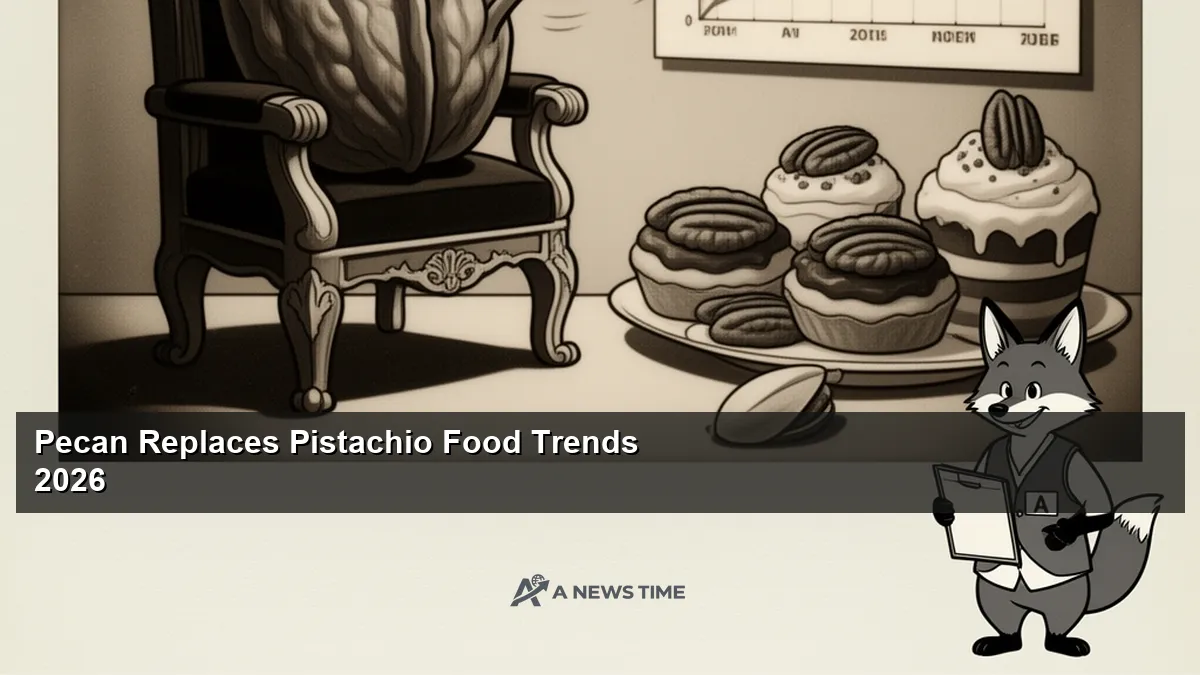
Pistachio had its moment. For the better part of three years, the green nut dominated everything from gelato counters to Trader Joe's endcaps, its distinctive color and mild, slightly sweet flavor turning up in pastries, lattes, pasta sauces, and even cocktails. Pistachio butter replaced peanut butter in influencer smoothie bowls. Pistachio crusts appeared on salmon fillets at mid-range restaurants from Portland to Philadelphia. The pistachio era was thorough, profitable, and, as of 2026, firmly over. According to The Guardian's annual food trends hotlist, the nut of the year is now the pecan, and the shift tells a larger story about how food trends work, what consumers are craving, and where the American palate is headed.
The Guardian's 2026 Food Trends Hotlist
Each year, The Guardian publishes a comprehensive survey of what is in and what has passed its best-before date in the food world. The 2026 edition identifies pecan as the ascendant flavor of the year, alongside several other trends that collectively paint a picture of a food culture in transition. Air fryers continue their march toward kitchen ubiquity. Hot honey has solidified its position as a permanent condiment rather than a passing fad. Doner kebabs are experiencing a global moment of elevated reinvention. And CBD-infused food and drink, once positioned as the future of wellness eating, has largely faded from mainstream interest.
The hotlist functions as both a mirror and a predictor. It reflects what is already happening in kitchens, restaurants, and grocery aisles, while also signaling where the next wave of consumer interest is likely to land. For food industry professionals, from restaurant operators to product developers to grocery buyers, the annual hotlist is valuable market intelligence. For home cooks, it is a roadmap of flavors worth exploring.
The pecan's elevation to the top of the list is not random. It reflects converging factors in agriculture, taste, cultural identity, and market economics that have been building for years. Understanding why pecan is having its moment requires looking at each of those factors in turn.
Why Pecan, Why Now
The Flavor Profile Advantage
Pecans possess a flavor complexity that pistachio, for all its popularity, cannot match. Where pistachio is mild, subtly sweet, and relatively one-dimensional, pecan offers a buttery richness layered with caramel notes, a slight bitterness from its tannins, and a warmth that food scientists describe as "toasty" or "roasted" even before the nut has been heated. This complexity makes pecan more versatile in both sweet and savory applications.
In baking, pecan has always been a star. Pecan pie is one of the most iconic American desserts, and pecan pralines are a cornerstone of Southern confectionery. But the 2026 trend is pushing pecan into savory territory where pistachio previously dominated. Pecan crusts on fish and chicken. Pecan butter as a finishing sauce for roasted vegetables. Pecan pesto replacing the pine nut and pistachio versions that have dominated for years. Toasted pecans scattered over salads, grain bowls, and pasta dishes where their buttery crunch adds both texture and depth.
The nut's fat profile contributes to its culinary versatility. Pecans contain approximately 72 percent fat by weight, the highest of any tree nut, with a particularly high proportion of monounsaturated oleic acid. This fat content gives pecan a luxurious mouthfeel and allows it to carry and amplify other flavors in a dish. When you toast a pecan, the Maillard reaction acts on its sugars and proteins to produce a flavor that is substantially richer and more complex than a toasted pistachio.
The American Origin Story
Unlike pistachio, which is primarily associated with Mediterranean and Middle Eastern cuisines, pecan is an American native. The tree (Carya illinoinensis) is indigenous to the Mississippi River Valley and was a staple food of Native American peoples for thousands of years before European colonization. The word "pecan" itself derives from the Algonquin word pacane, meaning "a nut requiring a stone to crack."
This American provenance gives pecan a cultural resonance that imported nuts lack. In a food culture that increasingly values locality, provenance, and connection to place, the fact that pecans grow abundantly across the American South and Southwest gives them an authenticity advantage. A pecan harvested in Georgia or Texas carries a story that a pistachio from Iran or Turkey, however delicious, cannot replicate for the American consumer.
The United States produces approximately 80 percent of the world's pecan supply, with major growing regions in Georgia, New Mexico, Texas, Arizona, and Oklahoma. This domestic production base also means that pecans face fewer supply chain vulnerabilities than nuts that must be imported, a factor that has become increasingly important as global trade disruptions and climate-related agricultural challenges affect international food supply chains.
The Fall of Pistachio: What Happened
Understanding pecan's rise requires understanding pistachio's decline, which follows a pattern that is common in food trend cycles. A flavor or ingredient emerges, gains popularity through a combination of genuine quality and media amplification, reaches a saturation point where it appears in seemingly every product category, and then experiences a backlash driven by consumer fatigue.
Pistachio hit saturation somewhere around mid-2025. At that point, you could buy pistachio-flavored yogurt, pistachio-crusted everything, pistachio ice cream from every major brand, pistachio butter, pistachio milk, pistachio-flavored coffee creamer, and pistachio croissants at every bakery chain in the country. The flavor was everywhere, and everywhere is precisely where a food trend goes to die. When an ingredient becomes so ubiquitous that it no longer signals anything distinctive about the person buying it or the restaurant serving it, its trend value collapses even if its intrinsic quality remains unchanged.
The pistachio trend was also undermined by supply-side dynamics. As demand surged, quality became inconsistent. Mass-market pistachio products often used lower-grade nuts or pistachio flavoring rather than actual nuts, diluting the quality association that had driven the trend's initial appeal. A pistachio croissant at an artisan bakery using premium Sicilian pistachios is a fundamentally different experience from a pistachio-flavored muffin at a gas station, but both trade on the same trend cachet. That gap between expectation and experience erodes consumer trust and accelerates trend fatigue.
Air Fryers: The Appliance That Will Not Quit
The Guardian's hotlist also highlights the continued dominance of air fryers, which have now been a top kitchen trend for five consecutive years. According to market research from NPD Group, air fryer ownership in American households now exceeds 60 percent, making it one of the fastest-adopted kitchen appliances in consumer history.
The air fryer's staying power defies the typical appliance trend cycle, where a hot new gadget (bread maker, panini press, Instant Pot) surges in popularity, occupies countertop space for a year or two, and then migrates to a cabinet or a Goodwill shelf. Air fryers have avoided this fate because they solve a genuine, recurring cooking need: producing crispy, roasted-tasting food quickly and with less mess than traditional frying or oven roasting.
In 2026, the air fryer conversation has shifted from "should you buy one?" to "what else can you do with it?" Advanced users are air-frying everything from steaks and whole chickens to cakes and dehydrated fruit. Air fryer cookbooks have become a substantial publishing subcategory. The best cookbooks of winter 2026 include titles that feature air fryer recipes alongside traditional methods, reflecting the appliance's full integration into mainstream cooking practice.
Hot Honey: From Trend to Pantry Staple
Hot honey's appearance on the 2026 hotlist is notable not because it is new but because it represents the rare food trend that has successfully transitioned from novelty to permanent fixture. Mike's Hot Honey, the Brooklyn-based brand that largely popularized the condiment in the United States, launched in 2010. It took nearly a decade for hot honey to break into the mainstream, driven primarily by its association with pizza (specifically, drizzled over pepperoni pizza at Prince Street Pizza in Manhattan).
By 2024, hot honey had expanded well beyond pizza. It appeared on fried chicken, biscuits, cheese boards, cocktails, and ice cream. Grocery store shelves now carry multiple hot honey brands at a range of price points. The condiment's appeal lies in its simplicity: the sweetness of honey combined with the heat of chili peppers creates a flavor combination that enhances almost any savory or salty food without adding complexity or requiring any cooking skill.
The transition from trend to staple is significant because so few food trends make it. Most are consumed by the cycle described above: emergence, acceleration, peak, saturation, decline. Hot honey has navigated that cycle successfully by being genuinely versatile and genuinely delicious, two qualities that are necessary but not always sufficient for trend survival. Its continued presence on the 2026 hotlist confirms that it has earned a permanent place in the American pantry, alongside other condiments like sriracha and ranch dressing that followed similar trajectories from niche curiosity to kitchen essential.
Doner Kebabs: A Global Street Food Goes Upscale
The doner kebab's inclusion on the 2026 hotlist reflects a trend that has been building across Europe and is now reaching the United States with force. In Germany, where the doner kebab is effectively the national fast food, the dish has undergone a quality revolution, with new-generation kebab shops using premium meats, house-baked bread, and made-from-scratch sauces to elevate a food that was long dismissed as low-end drunk food.
That elevation is now crossing the Atlantic. American cities are seeing a wave of doner kebab concepts that take the fundamental format, meat shaved from a vertical rotisserie, served in bread with vegetables and sauce, and apply higher-quality ingredients and more polished presentation. The appeal is obvious: the doner kebab is handheld, flavorful, customizable, and relatively affordable. It fills the same quick-service niche as tacos and burritos but with a flavor profile that feels fresh and different to American consumers.
The cultural context matters here. Doner kebabs are deeply embedded in the food cultures of Turkey, Germany, and much of the Middle East and Central Asia. Their elevation in the American market is part of a broader trend toward taking global street foods seriously as culinary traditions worth celebrating rather than cheap calories worth ignoring. This mirrors what happened with tacos (elevated from fast-food associations to respected cuisine), ramen (transformed from instant noodle cups to gourmet dining), and pizza (rescued from delivery chains by the artisan pizza movement).
CBD: Past Its Best-Before Date
On the opposite end of the hotlist, The Guardian places CBD-infused food and drink firmly in the "over it" category. This is a dramatic fall from the late 2010s, when CBD was positioned as the next great revolution in wellness eating. CBD lattes, CBD gummies, CBD-infused chocolate, CBD cocktails, and CBD sparkling water flooded the market between 2018 and 2021, fueled by the legalization of hemp-derived CBD in the 2018 Farm Bill and a consumer wellness movement eager for the next natural remedy.
The decline was driven by several factors. Regulatory uncertainty limited the ability of major food and beverage companies to fully commit to CBD products, keeping the market fragmented among smaller brands with inconsistent quality. Scientific evidence for CBD's purported benefits (reduced anxiety, pain relief, improved sleep) remained inconclusive, making it difficult for products to deliver on their marketing promises. And the flavor of CBD oil itself, earthy, slightly bitter, and distinctly plant-like, proved to be a persistent barrier to consumer enjoyment in food and drink applications.
The lesson of CBD's decline is instructive for anyone trying to predict which 2026 trends will endure and which will fade. Trends built primarily on health claims rather than flavor pleasure are inherently fragile, because health claims can be challenged by new research while flavor pleasure is self-reinforcing. Pecan, hot honey, and doner kebabs all succeed on flavor first. CBD succeeded on promise first, and when the promise was not fully delivered, the trend collapsed.
What These Trends Mean for Home Cooks
For the home cook trying to navigate the 2026 food landscape, the hotlist suggests several practical directions worth exploring.
Stock your pantry with pecans. Buy them raw and toast them yourself in a dry skillet or a 350-degree oven for 8 to 10 minutes. Toasted pecans are a transformative addition to salads, grain bowls, pasta dishes, yogurt, and oatmeal. Pecan butter, increasingly available at grocery stores and easy to make at home in a food processor, is a richer, more flavorful alternative to almond or peanut butter.
Invest in a quality hot honey. If you have not yet added hot honey to your condiment shelf, 2026 is past time. Start with a drizzle over pizza, fried chicken, or a cheese plate, and then experiment with adding it to salad dressings, marinades, and glazes. The sweet-heat combination is remarkably versatile.
Explore doner kebab recipes at home. While a proper vertical rotisserie is not practical for most home kitchens, the flavors of a doner kebab can be approximated using thinly sliced, well-seasoned lamb or chicken cooked in a very hot pan or under a broiler. The key is the spice blend (cumin, coriander, paprika, garlic, oregano) and the sauce (a yogurt-based garlic sauce or a tahini dressing). The food trends section of our site will continue tracking these developments throughout the year.
Use your air fryer more creatively. If your air fryer has been limited to frozen fries and chicken nuggets, challenge yourself to expand its range. Air-fried Brussels sprouts, cauliflower, and sweet potatoes develop extraordinary crispness and caramelization. Air-fried fish tacos are a weeknight revelation. Air-fried pecan-crusted chicken thighs would combine two of 2026's hottest trends in a single dish.
| Trend | Status in 2026 | Longevity Prediction |
|---|---|---|
| Pecan | Rising star | 2-3 years as dominant nut trend |
| Air fryers | Established essential | Permanent kitchen staple |
| Hot honey | Graduated to pantry staple | Permanent condiment |
| Doner kebabs | Accelerating in the US | 2-4 years of growth |
| Pistachio | Declining from saturation | Will stabilize as normal ingredient |
| CBD food/drink | Past its best-before | Niche market only |
The Bigger Picture: How Food Trends Reflect Who We Are
Food trends are never just about food. They are cultural indicators, reflecting economic conditions, social values, and collective mood. The 2026 hotlist tells a story about an American food culture that is moving away from novelty for its own sake and toward flavors that are rooted, familiar, and genuinely satisfying.
Pecan is an American nut with deep historical roots. Grandma-style cooking is back in force. Hot honey has proven itself through years of actual use rather than hype. Air fryers have earned their counter space through reliable daily utility. Even the doner kebab trend is fundamentally about a humble, working-class food being recognized for its intrinsic quality rather than being reinvented into something it is not.
Contrast this with the trends that are fading. CBD food was about aspiration and wellness claims rather than flavor. Pistachio, at its saturation point, was about visual aesthetics (that green color) and trend participation rather than culinary substance. The 2026 hotlist suggests that American food culture is growing up, moving from a phase where the most important question about food was "is it new?" to a phase where the most important question is "is it good?"
That is a maturation worth celebrating. A food culture that values goodness over newness is a food culture that builds lasting traditions rather than chasing disposable trends. It is a food culture that rewards craft over marketing, substance over surface, and flavor over photogenics. The pecan, sitting quietly in its shell, has been good for thousands of years. It did not need a trend cycle to validate its quality. But now that the spotlight has found it, it is ready. And unlike pistachio, which was arguably elevated beyond its natural range, pecan has the depth of flavor to sustain the attention. This is a trend with roots, in every sense of the word.
Frequently Asked Questions
Is pistachio completely over as a food trend?
Pistachio is declining as a trend, but it remains a perfectly good ingredient. The difference is between being the "it" flavor that appears on every menu and being a normal ingredient used where it genuinely belongs. Pistachio will always have a place in gelato, Middle Eastern pastries, and certain pasta dishes. It just will not be the default special flavor on every new product launch.
What is the healthiest nut on the 2026 trends list?
Pecans are rich in monounsaturated fats, fiber, and minerals including manganese, copper, and zinc. They contain more antioxidants than any other tree nut. However, they are also calorie-dense at approximately 200 calories per ounce, so portion awareness is important. All nuts, consumed in moderation, are considered part of a healthy diet by major nutritional guidelines.
Are doner kebabs healthy?
Traditional doner kebabs can be high in fat and calories depending on the meat used and the portion size. However, the elevated versions appearing in 2026 often use leaner meats, fresh vegetables, and yogurt-based sauces that improve the nutritional profile significantly. As with most foods, the healthfulness depends on the specific preparation.
Why did CBD food trends fail?
CBD food trends declined due to a combination of regulatory uncertainty, inconclusive scientific evidence for health claims, inconsistent product quality, and the fact that CBD oil does not taste good in most food and drink applications. Trends built primarily on health promises rather than flavor enjoyment tend to be fragile.
Sources
- The Guardian Food - 2026 food trends hotlist: what's in and what's past its best-before
- NPD Group - Air fryer household penetration data
- American Pecan Council - U.S. pecan production and export data