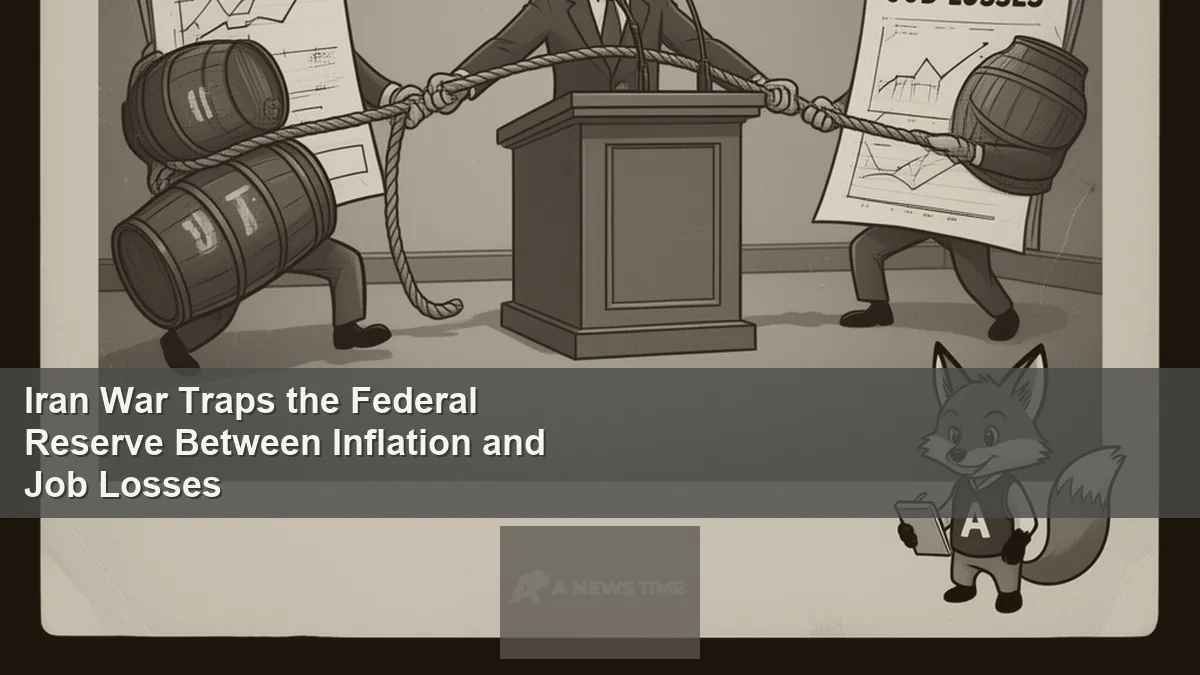
The Federal Reserve held its benchmark federal funds rate at 3.50%-3.75% at the FOMC meeting on , a decision that 99% of futures market traders had expected, according to the CME FedWatch tool. The unanimous nature of the hold, and the near-certainty that preceded it, would ordinarily make the decision unremarkable. Instead, the March meeting has become a pivotal moment in Federal Reserve history, because the war that began on has placed the central bank in a position it has not occupied since the 1970s: forced to choose between fighting inflation and protecting employment, with no policy tool that addresses both simultaneously.
The Iran conflict has sent Brent crude oil prices above $100 per barrel, elevated transportation and food costs across the entire supply chain, and effectively erased the rate-cut trajectory that the Fed and financial markets had built their 2026 plans around. What was, in January, a debate about how many cuts the Fed would deliver has become a debate about whether cuts come at all, with a growing faction of economists and traders now asking whether the next move might be a hike rather than a cut.
The Probability Collapse: From Cuts to Holds to Hikes
The speed with which the rate-cut consensus evaporated is without parallel in the current policy cycle. In early February 2026, CME FedWatch data showed a 31% probability that the Fed would hold rates at the April meeting. A 70% probability of a cut at the June meeting reflected a broad expectation that easing would begin in the first half of the year. Those probabilities have inverted entirely. By March 18, the probability of a hold at the April 28-29 meeting had risen to 95%. The probability of the Fed holding all the way through June, with no cut, stood at 77%.
That shift from a 70% cut probability to a 77% hold probability for the same June meeting, in the span of roughly six weeks, represents a complete repricing of the Federal Reserve's policy path. It is driven not by any change in the Fed's own stated objectives, which remain maximum employment and 2% inflation, but by the recognition that oil-driven inflation has made those two objectives temporarily incompatible. The Iran war did not change the Fed's mandate. It changed the economic reality that mandate must navigate.
| Meeting Date | February Probability (Cut) | March 18 Probability (Hold) | Shift |
|---|---|---|---|
| March 18, 2026 | ~1% (cut) / ~99% (hold) | 99% hold (actual) | No change (hold always expected) |
| April 28-29, 2026 | ~31% hold probability | 95% hold probability | Hold probability rose +64 points |
| June 2026 | ~70% cut probability | 77% hold probability | Cut flipped to hold; swing of ~147 points |
| Year-end 2026 | Multiple cuts priced | 0 cuts; 52% hike probability by late March | Full inversion of rate path |
The March 18 hold was not a difficult decision. The difficult decisions are the ones that follow, at meetings where the Fed must weigh deteriorating labor data against inflation that refuses to behave as the models predict.
The Stagflation Trap: Two Mandates, One Problem
The Federal Reserve's dual mandate requires it to maintain maximum employment and stable prices. The two objectives function well as complementary goals in most economic environments. When inflation is the primary concern, the Fed raises rates, slows the economy, and cools price pressure. When unemployment rises, the Fed cuts rates, stimulates borrowing and spending, and supports job creation. The mechanism is well understood and has worked reasonably well for decades, with notable exceptions.
The exception is when both problems occur simultaneously, a condition known as stagflation. The word combines stagnation and inflation, and it describes an economy in which prices are rising while economic growth is slowing or contracting and unemployment is rising. It is the monetary policy version of a no-win scenario: the tool that addresses one problem makes the other worse.
"The job market has softened over the past few years, and inflation is running higher than the Fed would like and will pick up even more in the near term. The dilemma for the central bank: cut the fed funds rate to support the labor market and inflation could move even higher, or keep the fed funds rate where it is and risk further weakness in the labor market." — Gus Faucher, Chief Economist, PNC Financial Services
The February jobs report made the labor-market side of this dilemma concrete. Employers shed 92,000 jobs in February 2026, an unexpected contraction that came against a consensus forecast of modest job growth. The labor market had been cooling gradually through 2025, but February's number was the first clear negative reading of the cycle, a data point the Fed cannot dismiss as noise. For an institution whose mandate includes maximum employment, a job loss of that magnitude demands a policy response in the direction of easing.
But easing, in the current environment, means cutting rates into an economy where the Federal Reserve's preferred inflation gauge, the PCE price index, has already been ticking higher and where energy-driven cost increases have not yet fully transmitted to consumer prices. The OECD raised its 2026 U.S. inflation forecast to 4.2%, more than double the Fed's 2% target. Cutting rates into a 4%+ inflation environment would represent an explicit acknowledgment that the central bank is prioritizing employment over price stability, a policy choice with long-term credibility consequences.
Energy Prices and the Transmission Mechanism
Oil's impact on the broader economy does not stop at the gas pump. The transmission mechanism runs through multiple channels simultaneously, each with a different lag time and a different degree of visibility in the official data.
The most direct channel is transportation. Every good that moves by truck, rail, ship, or air becomes more expensive when fuel prices rise. Those costs show up first in PPI data for transportation services, then in the prices businesses charge for goods that required transportation to reach their customers. The February import price jump of 1.3%, the largest monthly increase since March 2022 per the Bureau of Labor Statistics, is in large part a transportation cost story.
- Transportation: Fuel surcharges on freight, shipping, and air cargo rise immediately with oil prices, adding cost to every physical good in the supply chain
- Food production: Fertilizers, pesticides, and farm machinery all depend on petroleum inputs; higher oil prices raise food production costs before they reach grocery store shelves
- Utilities: Natural gas prices, used for home heating and industrial processes, often track crude oil and push utility bills higher for households and businesses
- Housing: Higher energy costs increase the operating expenses of residential and commercial properties, adding upward pressure to rents and home ownership costs that the shelter component of CPI captures with a lag of six to 12 months
For the mortgage market, the Iran war's impact was rapid and measurable. The 30-year fixed mortgage rate had dropped below 6% in late February 2026, the lowest level since September 8, 2022, offering a window of affordability that the housing market had not seen in years. By March 16, the rate had jumped to 6.26%, erasing much of the improvement in a matter of weeks. The Mortgage Bankers Association attributed the reversal to bond market dynamics: "Mortgage rates are based on bonds, and bonds spent last week bracing for the impact of higher energy prices. In the bond world, higher inflation begets higher rates, all else equal." As covered in detail in reporting on mortgage rates jumping following the Iran war shock, that reversal hit the housing market at a particularly sensitive moment.
Economist Forecasts: The Rate Cut That May Never Come
Across the major economic forecasting firms, a consensus is forming that the rate cuts priced into early-2026 market expectations will not materialize on the originally projected timeline, and may not materialize at all.
EY-Parthenon chief economist Gregory Daco has revised his baseline forecast to show only a single quarter-point cut in 2026, likely in December, down from the multiple cuts he and many colleagues had expected at the start of the year. The qualifier he attached is significant.
"Given our higher headline and core PCE inflation forecast, we have revised our baseline to show only one 0.25-percentage-point rate cut in 2026, likely in December, but it is entirely plausible that the Fed won't deliver any rate cuts this year." — Gregory Daco, Chief Economist, EY-Parthenon
Sonu Varghese, chief macro strategist at Carson Group, goes further, arguing that the Fed may not merely delay cuts but could be forced to pivot to hikes later in the year.
"An already large headache for the Federal Reserve is going to turn into an even larger one, and it's likely the Fed will not cut rates in 2026 and may even start talking about rate hikes later this year." — Sonu Varghese, Chief Macro Strategist, Carson Group
The CME FedWatch tool, which reflects actual institutional money rather than forecaster opinion, confirmed that rate-hike probability crossed 52% by late March, as covered in reporting on the 52% hike probability milestone. Markets and economists are converging on the same conclusion: the easing cycle that was supposed to continue through 2026 has effectively been suspended by an oil shock that the Fed did not anticipate and cannot directly control.
The broader macroeconomic backdrop reinforces this view. Goldman Sachs raised its recession probability to 30%, a significant upward revision, as detailed in analysis of Goldman's recession forecast driven by the oil surge. The OECD's own assessment, covered in reporting on how the Iran war erased the OECD's global growth upgrade, paints a picture of an international economy under simultaneous inflationary and contractionary pressure.
The Fed's Leadership Transition: Timing That Could Not Be Worse
The difficulty of the policy situation is compounded by the fact that the Federal Reserve is about to undergo its most significant leadership transition in a decade. Chair Jerome Powell's term expires in May 2026, and President Trump has nominated Kevin Warsh to succeed him. Warsh is a former Fed governor with a reputation as a monetary policy hawk, someone who has historically placed a high priority on inflation credibility and has been willing to accept economic pain to maintain price stability.
His nomination, however, has not yet been confirmed by the Senate. That confirmation process, which typically takes months, means the Fed could be navigating some of its most difficult policy decisions of the post-pandemic era under a lame-duck chairmanship or a temporary leadership arrangement. The institutional dynamics of that transition matter: a confirmed successor with a clear mandate is better positioned to make controversial decisions than an outgoing chair whose authority is in its final weeks.
EY-Parthenon's Daco offered a pointed assessment of what the Warsh era would need to establish from its first moments in office. "He will first need to demonstrate that his policy views are grounded in economic fundamentals rather than political considerations," Daco said, a reference to the ongoing tension between the Fed's statutory independence and political pressure from the executive branch to keep rates low.
The political dimension is not hypothetical. President Trump has publicly and repeatedly called for lower interest rates throughout his presidency, arguing that lower borrowing costs support economic growth and his policy agenda. The Iran war has, at least temporarily, made lower rates more economically problematic at precisely the moment political pressure for them might intensify if economic growth slows further. A new Fed chair facing that combination, economic stagflation plus political pressure for cuts, would be tested immediately.
Winners, Losers, and the Broader Stakes
The rate-path reversal does not affect all economic actors equally. The stakes are distributed unevenly across sectors, income levels, and asset classes.
For the housing market, the most rate-sensitive major sector of the consumer economy, the suspension of cuts is a direct blow to affordability. The brief dip below 6% in late February had represented a meaningful improvement in purchasing power for prospective homebuyers who had been sitting on the sidelines through 2024 and 2025 waiting for relief. The snap back to 6.26% by mid-March, with the trajectory pointing higher, means that window closed as quickly as it opened. As reported in housing market price predictions for 2026, the combination of elevated rates and constrained supply continues to squeeze affordability metrics to historically challenging levels.
For corporations with floating-rate debt, the news that cuts are off the table means elevated interest expense persists longer than projected. Companies that refinanced during the low-rate era of 2020-2022 at fixed rates below 3% are insulated. Companies that carry variable-rate facilities indexed to the federal funds rate face higher financing costs for the foreseeable future, a dynamic that is already showing up in tightening financial conditions and widening credit spreads in the high-yield bond market.
For savers and money market investors, the situation is the inverse. Rates staying at 3.50%-3.75% or potentially moving higher means money market funds and high-yield savings accounts continue to offer meaningful returns. The depositors who responded to the high-rate environment, as explored in coverage of how much Americans are saving and what bank balances look like, are the clearest near-term beneficiaries of a suspended easing cycle.
The energy sector stands apart from most of the economy as a clear winner in the current environment. Higher oil prices directly benefit domestic producers, who are pumping at elevated margins. That dynamic creates a bifurcated domestic economy: energy-producing regions and companies are experiencing a windfall while energy-consuming sectors, essentially everyone else, are absorbing a tax-like cost increase that reduces purchasing power and compresses margins.
What the Fed Watches Next
The FOMC's next scheduled meetings are April 28-29 and June 17-18. Between now and June, the Fed will receive three monthly CPI reports, two monthly jobs reports, one quarterly GDP reading, and a continuous stream of oil price data. Each of those data points will either reinforce or complicate the current assessment.
The scenarios that could shift the calculus are narrow but plausible. A rapid diplomatic resolution that eased the conflict and brought oil back toward $80 per barrel would allow inflation expectations to moderate, potentially reviving the cut timeline. A further deterioration in the labor market, with additional months of job losses, would put acute pressure on the employment side of the mandate and force the Fed to weigh whether the inflation risk is worth the employment damage. A third scenario, in which oil stays elevated and job losses continue simultaneously, is the stagflation path that no one at the Fed wants to navigate and for which there is no painless policy response.
The credibility of the Federal Reserve's inflation-fighting commitment, rebuilt at considerable economic cost between 2022 and 2024, is now a central variable. If the Fed cuts rates into rising inflation to address employment concerns, it risks validating the argument that it will always blink when conditions get difficult. If it holds or hikes into a weakening labor market, it risks a harder economic landing than would otherwise be necessary. The institution's own communications over the coming months, from the April meeting statement to the post-meeting press conference to the speeches of individual FOMC members, will be parsed for any signal about which of those risks is being weighted more heavily. The answer will shape the financial conditions every American faces for the rest of 2026.