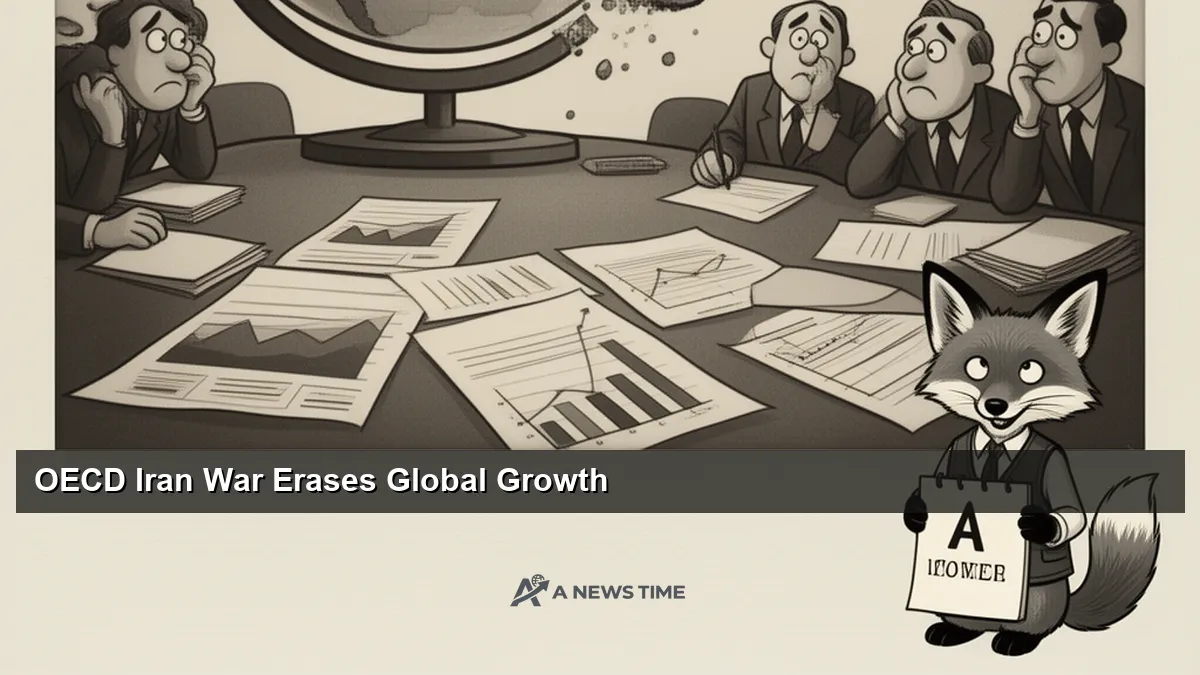
The OECD issued an interim economic outlook on Monday that effectively retracted the growth upgrade it had announced just two months earlier. In January, the Paris-based organization had raised its 2026 global GDP growth forecast to 3.3%, citing resilient labor markets, easing monetary policy in several major economies, and the dissipation of the energy shock from the Russia-Ukraine conflict. By March, the escalating U.S.-Iran military conflict had erased that optimism entirely. The revised forecast now stands at 2.8%, a reduction of half a percentage point that translates to approximately $530 billion in lost global economic output relative to what the OECD expected just weeks ago.
OECD Secretary-General Mathias Cormann, presenting the findings in Paris, described the conflict as having "knocked the global economy off a stronger growth path at precisely the moment when conditions appeared to be normalizing after several years of post-pandemic disruption." The phrasing was careful and diplomatic, but the data behind it was not. Every major economy received a downgrade, with the United Kingdom absorbing the largest single hit, a point that carries implications for the global supply chain, energy markets, and the increasingly fragile architecture of international trade.
The January Optimism and Its Unraveling
To understand the significance of the March revision, it helps to recall the January outlook in detail. The OECD's January 2026 forecast had been notably upbeat by the organization's characteristically cautious standards. Global growth of 3.3% would have represented the strongest expansion since 2021, when economies were still experiencing the mechanical rebound from pandemic lockdowns. The U.S. was projected to grow at 2.4%, China at 4.6%, the eurozone at 1.4%, and the UK at 1.5%. Inflation was forecast to continue moderating toward central bank targets in most advanced economies, supported by lower energy prices and stabilizing supply chains.
The first U.S. military strikes against Iranian nuclear facilities in late January did not immediately prompt a revision. The OECD's initial assessment, shared with member governments in early February, was that the conflict would likely remain limited in scope and that oil market disruptions would be manageable. That assessment was consistent with the prevailing view in financial markets during the first two weeks of February, when the S&P 500 actually rose 1.4% as investors bet on a quick, contained operation.
The reassessment began in late February, when naval engagements near the Strait of Hormuz raised the possibility of sustained disruptions to oil shipping. Reuters reported that the OECD convened an emergency meeting of its Economic Policy Committee in the first week of March, at which staff economists presented scenarios showing significantly lower growth if oil prices remained above $100 per barrel for more than two months. By mid-March, with Brent crude averaging $105 per barrel and diplomatic channels frozen, the revision became unavoidable.
Country-by-Country Damage
The revised forecasts distribute the economic pain unevenly across the global economy, reflecting each country's specific vulnerabilities to energy prices, trade disruptions, and financial market volatility.
The United States received a downgrade from 2.4% to 1.8%, a 0.6 percentage point reduction. The OECD cited three primary factors: higher consumer energy costs reducing purchasing power, tighter financial conditions from elevated interest rates and equity market declines, and direct fiscal costs associated with the military operation. The organization estimated that the federal government is spending approximately $300 million per day on the conflict, a figure that, while small relative to the overall federal budget, adds to the deficit at a time when fiscal space is already constrained.
The eurozone forecast was cut from 1.4% to 0.9%, reflecting the region's heavy dependence on imported energy and its proximity to the Middle East trade routes. Germany, the eurozone's largest economy, was downgraded from 1.1% to 0.5%, placing it uncomfortably close to stagnation for the third consecutive year. France was cut from 1.2% to 0.8%. Italy, whose economy is particularly sensitive to energy costs due to its manufacturing-heavy industrial base, was reduced from 0.9% to 0.4%.
China received a more modest downgrade, from 4.6% to 4.3%, because it has partially insulated itself from the oil price shock through bilateral purchasing agreements with Iran that predate the conflict and continue despite U.S. secondary sanctions. China is effectively buying Iranian crude at a significant discount to the global benchmark, a fact that has drawn sharp criticism from Washington but has limited China's direct exposure to the energy price surge. The OECD noted, however, that China's export-oriented manufacturing sector would be affected by weaker demand from Europe and the United States.
Japan was downgraded from 1.3% to 0.9%, as the world's fourth-largest economy imports virtually all of its crude oil and is therefore highly exposed to global price movements. The Bank of Japan, which had been cautiously moving toward interest rate normalization after decades of ultra-loose monetary policy, is now expected to pause its rate-hiking cycle as the economic outlook deteriorates.
The UK Takes the Biggest Hit
The most striking single-country revision was reserved for the United Kingdom, whose growth forecast was slashed from 1.5% to 0.7%, a reduction of 0.8 percentage points, the largest among all major economies. The BBC reported that the OECD's assessment reflected a combination of factors that make the UK uniquely vulnerable to the current shock.
First, the UK is a net energy importer with limited strategic petroleum reserves compared to the United States. While North Sea production provides some domestic supply, it covers roughly 45% of the UK's crude oil needs, leaving the remainder exposed to global prices. Second, the UK's post-Brexit trade arrangements have reduced its flexibility to redirect supply chains in response to disruptions, because it no longer benefits from the EU's collective bargaining power in energy markets. Third, the Bank of England had already been struggling to bring inflation below 3% before the oil shock, and the additional upward pressure on prices from higher energy costs is expected to keep rates elevated for longer than the central bank had planned.
"The UK economy was already growing below its potential before this shock. The combination of energy price increases, constrained monetary policy, and trade friction from the post-Brexit regime creates a compounding effect that is more severe than in economies with greater fiscal and trade buffers."
Alvaro Pereira, OECD Chief Economist
The implications for British households are stark. The OECD estimates that the average UK household will see its annual energy costs rise by approximately 800 pounds sterling (roughly $1,020) compared to the pre-conflict baseline, on top of increases that were already in the pipeline from the October 2025 energy price cap adjustment. Real wages, which had finally begun growing in the second half of 2025 after two years of inflation-adjusted declines, are expected to stagnate or decline again in the first half of 2026.
The Energy Transmission Channel
The OECD report dedicates an entire chapter to what it calls the "energy transmission channel," the mechanism through which oil price increases propagate into broader economic activity. The analysis divides the impact into first-round effects (higher fuel and heating costs directly reducing consumer purchasing power) and second-round effects (higher energy costs feeding into production costs, transportation costs, and eventually the prices of goods and services throughout the economy).
First-round effects are already visible in the data. Gasoline prices in the United States have risen to a national average of $4.15 per gallon, up from $3.42 in December. In the UK, petrol prices have risen to 1.58 pounds per liter, the highest since the Russia-Ukraine spike of 2022. In Japan, gasoline has reached 190 yen per liter despite government subsidies designed to cap retail prices.
Second-round effects take longer to materialize but are potentially more damaging because they are harder to reverse. The OECD notes that producer price indexes in the US, eurozone, and Japan have all turned upward in the most recent monthly data, suggesting that manufacturers are beginning to pass higher energy costs through to their customers. If that process continues, it will push consumer inflation higher and make it more difficult for central banks to justify the rate cuts that would otherwise help cushion the economic slowdown.
The OECD explicitly warns against a repeat of the "embedded inflation" dynamic of the 1970s, when an initial oil price shock triggered a wage-price spiral (workers demanded higher wages to compensate for higher prices, which raised production costs, which raised prices further, and so on). The report notes that the institutional safeguards against such a spiral are stronger today than in the 1970s, particularly the independence of central banks and their credible commitment to inflation targets. But it also notes that those safeguards have never been tested against a sustained oil shock in an environment where inflation was already running above target.
Trade and Supply Chain Effects
Beyond the direct energy price channel, the OECD identifies several secondary economic effects of the conflict that are less visible but potentially significant. The most important is the disruption to global shipping routes. The Strait of Hormuz is not only a transit point for oil but also a critical lane for container shipping between Asia and Europe. Approximately 15% of seaborne trade by value passes through the strait annually.
Insurance costs for vessels transiting the Persian Gulf have tripled since the conflict began, according to Lloyd's of London data cited in the report. Some shipping companies have begun routing vessels around the Cape of Good Hope, adding approximately 10 to 14 days to the transit time between Asia and Europe. That rerouting adds cost (fuel, crew time, vessel availability) and reduces the effective capacity of the global shipping fleet, since the same number of ships takes longer to complete each journey. The OECD estimates that the shipping disruption alone could add 0.2 to 0.3 percentage points to global consumer inflation by the second quarter of 2026.
The report also notes that the conflict has disrupted arms exports, construction contracts, and infrastructure investment in the broader Middle East region, where several countries had been engaged in ambitious economic diversification programs. Saudi Arabia's NEOM project, the UAE's sustainable city initiatives, and Qatar's post-World Cup development plans have all been affected by investor caution and supply chain disruptions. The OECD estimates that Middle East regional GDP growth will slow to 2.1% from a pre-conflict projection of 3.4%.
Central Bank Responses
The report surveys the central bank landscape and finds that the conflict has significantly complicated monetary policy in every major economy. The Federal Reserve, the ECB, and the Bank of England are all facing the same dilemma: inflation that is being pushed higher by oil costs (which suggests rates should remain elevated) and growth that is being pulled lower by the same oil costs (which suggests rates should be cut). The OECD gently recommends that central banks "look through" the first-round effects of the oil shock (which are by nature temporary, since oil prices do not rise forever) and focus on keeping second-round effects, particularly wage-price dynamics, under control.
In practice, "looking through" an oil shock is easier to prescribe than to implement. The Fed's most recent dot plot showed a median expectation of one rate cut in 2026, down from three in December. The ECB, which had been expected to cut rates twice more by mid-year, has signaled that those cuts may be delayed. The Bank of England is now expected to hold rates through at least September, abandoning a planned August cut that had been widely anticipated before the conflict began.
The OECD's implicit message to central banks is: do not overreact. The worst possible outcome would be a premature tightening of monetary policy in response to an oil-driven inflation spike, which would compound the growth damage without addressing the underlying supply-side cause of the price increases. The report draws an explicit parallel to the ECB's controversial rate hike in July 2008, just months before the global financial crisis, which many economists regard as one of the worst monetary policy decisions of the 21st century.
The Fiscal Policy Question
With monetary policy constrained, fiscal policy is theoretically the next line of defense against an economic slowdown. But the OECD report notes that fiscal space has narrowed considerably in most advanced economies since the pandemic. Government debt levels relative to GDP are at or near record highs in the US (124%), the UK (102%), France (113%), and Japan (254%). Interest costs on that debt have risen sharply as a result of the 2022-2023 rate hike cycle, consuming a growing share of government budgets.
The report identifies targeted energy subsidies (caps on retail fuel prices, direct payments to low-income households) as the most effective short-term fiscal response, because they cushion the most vulnerable populations without stoking broader demand-side inflation. Several governments have already implemented or announced such measures: Japan extended its fuel subsidy program through June, Germany introduced a temporary reduction in the energy tax, and the UK government expanded the Winter Fuel Payment to additional income brackets.
The US has not announced a comparable consumer support program, though the White House has authorized releases from the Strategic Petroleum Reserve and has pressured OPEC to increase production. The OECD diplomatically notes that "direct fiscal support to households facing energy cost increases could help maintain consumer spending and prevent a sharper economic downturn," a recommendation that reads as a polite suggestion that Washington do more.
The Bigger Picture
The OECD's March revision stands as a quantified statement of something that the global business community has understood intuitively for weeks: the U.S.-Iran conflict has changed the economic trajectory of 2026. The upgrade that seemed justified in January, when the world appeared to be settling into a period of steady, moderate growth, has been replaced by a forecast that looks more like 2022 than the normalization story that everyone had been hoping for.
The $530 billion in lost global output is not a number that corresponds to any single company or household. It is an aggregate estimate of the economic activity that will not happen, the jobs that will not be created, the investments that will not be made, the consumer purchases that will not occur, because the cost of energy has risen and the uncertainty about the future has increased. It is, in the economist's antiseptic language, a "negative supply shock with demand-side amplification." In plain language, it means the world economy got hit, and it is going to leave a mark.
For policymakers, the OECD report provides both a diagnosis and a set of implicit recommendations: use fiscal tools to protect the most vulnerable, avoid monetary policy overreaction, coordinate energy reserve releases internationally, and pursue diplomatic resolution with urgency. Whether those recommendations will be heeded is another question. The conflict that created the economic damage is, by its nature, a political and military matter, not an economic one. The economists can measure the cost. Only the diplomats and generals can stop it from rising further.