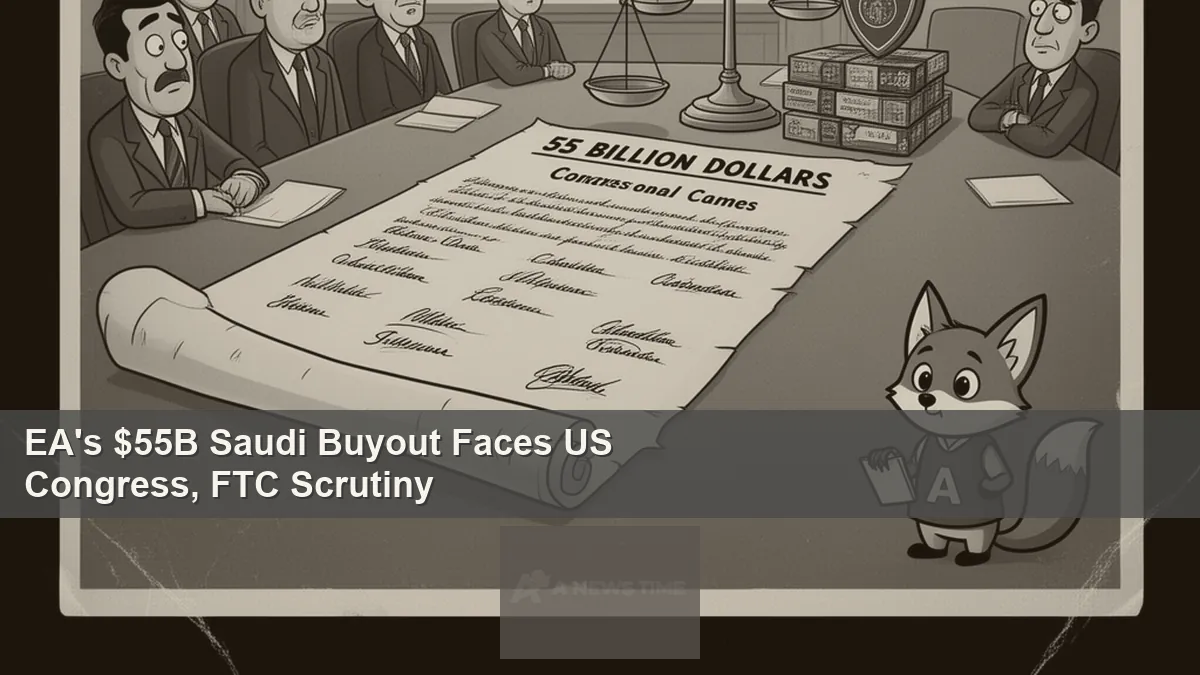
Electronic Arts's agreement to be taken private in a $55 billion all-cash transaction by a consortium led by Saudi Arabia's PIF, Silver Lake, and Jared Kushner's Affinity Partners has cleared its first major regulatory hurdle while drawing mounting scrutiny from US lawmakers who want the FTC to intervene before the deal closes. The transaction, announced on , is structured as the largest all-cash sponsor take-private investment in history, and its path to completion is becoming one of the most politically charged stories in gaming's corporate history.
Forty-six House Democrats, led by Labor Caucus co-chairs Steven Horsford, Debbie Dingell, Mark Pocan, and Donald Norcross, sent an open letter to FTC Chair Andrew Ferguson in asking the commission to "thoroughly review" the transaction. The letter cited concerns about EA's history of layoffs, the $20 billion in debt the consortium is using to fund part of the acquisition, and the structural risks the deal poses to workers and competition in the US gaming market.
The Structure of the Deal
Under the terms of the agreement, the consortium acquires 100 percent of EA's outstanding shares at $210 per share in cash, representing a 25 percent premium to EA's unaffected share price of $168.32 at market close on September 25, 2025. PIF, which already held a 9.9 percent stake in EA, is rolling that position into the new transaction rather than selling it. The remaining equity comes from new investment by all three parties, totaling approximately $36 billion in equity financing alongside the $20 billion debt tranche committed by JPMorgan Chase.
The $20 billion debt component is the element most cited by critics. An anonymous industry analyst writing for a gaming financial newsletter described it as "a $20 billion time bomb sitting under one of the most important content libraries in American gaming," noting that debt-funded acquisitions at this scale historically generate strong pressure to reduce costs quickly. EA employs tens of thousands of people across its studios, including operations at BioWare, DICE, Respawn, Maxis, and Codemasters, among others.
"We are committed to preserving fair, competitive labor markets and safeguarding American jobs, and given the impact of this acquisition on workers, labor market concentration, and the long-term competitiveness of the U.S. video game industry, we urge you to thoroughly review this transaction."
46 House Democrats, open letter to FTC Chair Andrew Ferguson, January 2026
EA Chairman and CEO Andrew Wilson has said the company "will maintain creative control" after the buyout closes and that EA will remain headquartered in Redwood City, California. Those assurances did not appear in the binding terms of the merger agreement, which has given fuel to critics who argue they are aspirational rather than contractual.
What the Congress Letter Actually Says
The 46-member letter is specific about the risks it identifies. It notes EA's own recent layoff history, which included multiple rounds of workforce reductions over the past several years, and argues that the additional $20 billion in debt "creates strong incentives for the acquiring firms to pursue further cost-cutting measures, including layoffs, offshoring, restructuring, or studio closures." The letter also flags antitrust concerns, citing the "cross-ownership" among PIF, Silver Lake, and Affinity Partners across sports media, sports franchises, and sports video games as a potential source of anticompetitive coordination.
The CEO pay disparity also features in the letter's argument. EA CEO Andrew Wilson earned 260 times more than EA's median worker in the most recently reported fiscal year, according to figures cited from a report by Game Developer. The lawmakers used this figure to frame the acquisition as a transaction that benefits EA's executive leadership and institutional investors at the direct expense of the workers whose continued employment is not protected in the deal documentation.
The letter closes by calling on the FTC to investigate "EA's existing wage-setting power, the likelihood of post-transaction layoffs, the degree of labor-market concentration in relevant geographic and occupational markets, and the role of cross-ownership in shaping labor outcomes." Whether the current FTC, under the Trump administration's appointee Andrew Ferguson, pursues an aggressive review is a separate question from whether the case for scrutiny is substantive. Most legal observers believe the transaction is likely to receive approval, noting that the regulatory environment has been relatively permissive on media and entertainment consolidation.
The Saudi Arabia Dimension
PIF's involvement brings a layer of political and cultural complexity that goes beyond standard antitrust concerns. PIF is the sovereign wealth fund of Saudi Arabia, a country that has executed journalists, criminalized same-sex relationships, and is currently the subject of multiple international human rights investigations. The fund has been aggressively expanding into gaming and sports as part of Saudi Arabia's Vision 2030 economic diversification program, which aims to reduce the country's dependence on oil revenue by investing in entertainment, tourism, and technology sectors.
EA's portfolio includes titles with characters, storylines, and relationship mechanics that would be illegal under Saudi Arabian law if performed by real people. The Sims franchise, which Maxis has developed since 2000, explicitly supports same-sex relationships and gender expression that are criminalized in Saudi Arabia. Maxis issued a statement in early 2026 saying its "values remain unchanged," but the development community and player base have not found those assurances convincing. Employees at BioWare, EA's RPG studio, were reported to have expressed internal concern about the acquisition's implications for the studio's creative direction.
| Entity | Role in Deal | Equity Component |
|---|---|---|
| PIF (Saudi Arabia sovereign wealth fund) | Lead acquirer, rolling existing 9.9% stake | Largest single equity contributor |
| Silver Lake | Technology-focused private equity co-investor | Significant equity contributor |
| Affinity Partners (Jared Kushner) | Growth equity co-investor | Minority equity contributor |
| JPMorgan Chase | Debt financing lead | $20 billion debt commitment |
The precedent for PIF influencing creative decisions in games it backs has already been documented. A report in PC Gamer noted that the fund had used its investment relationships to secure appearances for Saudi-affiliated sports figures in video games, including the inclusion of soccer star Cristiano Ronaldo, who has commercial ties to PIF, in SNK's Fatal Fury reboot. The developers and publishers involved did not confirm whether PIF exerted direct pressure; the correlation was noted, and game developers are drawing conclusions from it.
The broader concern among developers extends beyond individual creative decisions to structural questions about how Saudi-backed ownership handles commercially sensitive content across a portfolio. BioWare has historically shipped games that include same-sex romance options as integral relationship mechanics, including the Mass Effect and Dragon Age franchises. Dragon Age: The Veilguard, the studio's most recent release, shipped with those mechanics intact in 2024. Whether PIF-aligned ownership would eventually apply pressure to remove or deprioritize that content in future titles is not addressed in the deal documentation. The assurances given publicly by EA's leadership carry no contractual binding on the acquiring consortium, and developers at BioWare and Maxis who build those mechanics into their games have no formal protection in the merger terms.
Regulatory Timeline and What Happens Next
The deal is expected to close in Q1 of EA's fiscal year 2027, which runs from through . EA shareholders have already approved the transaction. The remaining conditions are regulatory approvals from jurisdictions including the FTC in the United States, the European Commission, and antitrust bodies in other major markets where EA operates.
South Africa's Competition Commission approved the acquisition in , becoming one of the first jurisdictions to sign off. The FTC review is the most consequential outstanding approval, both because of the US market's scale and because the political pressure from Congress gives the commission more political cover to demand detailed remedies or impose conditions.
The gaming industry is watching the outcome closely. An EA deal that closes without significant conditions would signal that sovereign wealth fund acquisitions in the gaming sector face no structural regulatory barrier regardless of the fund's national origin or the cultural sensitivity of the content. That precedent would matter well beyond EA, touching every major publisher in the industry.
The hardware cost pressures already reshaping the gaming market create additional context for what happens inside EA under new ownership. When developers are squeezed between rising development costs, aggressive competition for player time, and now the prospect of a $20 billion debt load requiring cost discipline, the studios with the least commercial momentum are typically the first to see workforce reductions. BioWare, which has not released a commercially successful title in nearly a decade, is the studio most observers cite as the highest risk. The technological shifts in game development will add to that pressure as studios are asked to do more with fewer people. The FTC's decision, expected in the months ahead, will determine whether those concerns remain theoretical.
Sources
- EA Announces Agreement to be Acquired by PIF, Silver Lake, and Affinity Partners for $55 Billion - Electronic Arts Investor Relations
- 46 US Congress Members Express "Serious Concerns" to FTC Over EA Buyout - Wccftech
- EA's $20 Billion Debt a "Ticking Time Bomb" for Studios - Wccftech
- BioWare Developers Reportedly Worried About $55 Billion EA Buyout - Wccftech