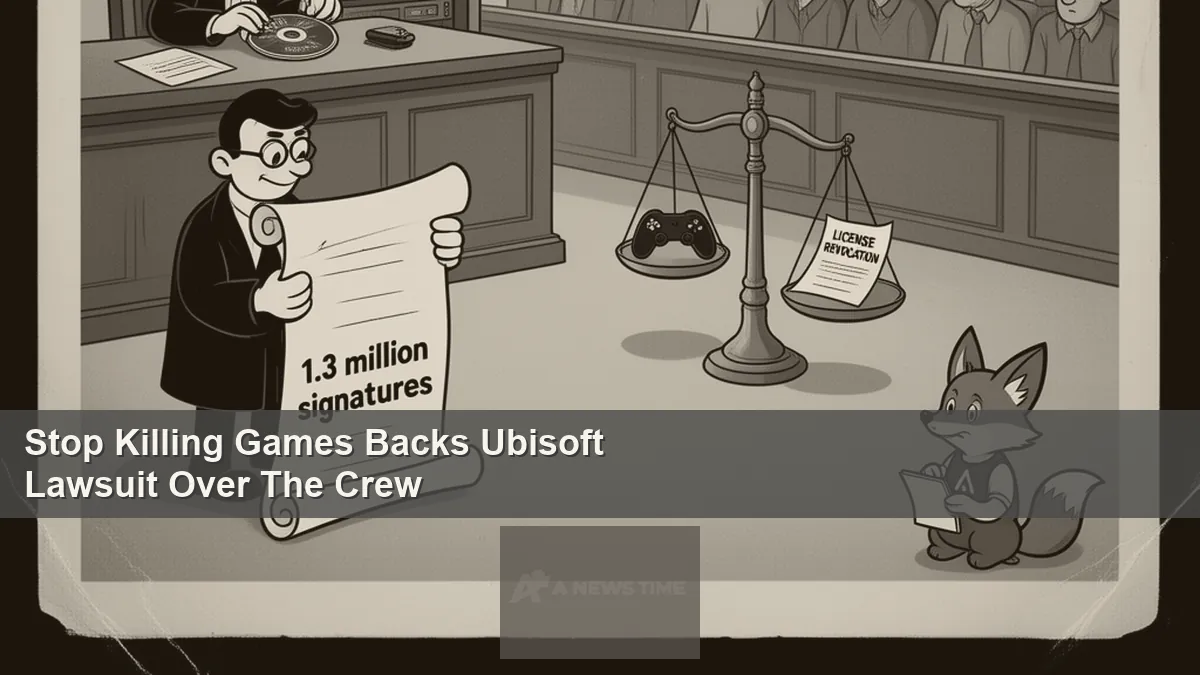
France's leading consumer protection association, UFC-Que Choisir, filed a lawsuit against Ubisoft on , over the publisher's shutdown of online racing game The Crew. The case, backed by the European consumer movement Stop Killing Games, alleges that Ubisoft misled consumers about the permanence of their purchase and imposed contractual terms that stripped players of ownership rights after they paid for the game. A EU Parliament hearing on the matter is expected on , less than three weeks away.
Ubisoft delisted The Crew from digital marketplaces in December 2023 and shut down its servers on , exactly two years before the lawsuit was filed. The shutdown rendered the game permanently unplayable for all who had purchased it, as the title required an active server connection to function at any level, including single-player mode. Ubisoft began revoking player licenses in April 2024 without issuing refunds, a decision that triggered the Stop Killing Games movement and the EU citizens' initiative that followed.
The Core Legal Argument
UFC-Que Choisir's complaint centers on two allegations. First, the association argues that Ubisoft misled consumers about the nature of their purchase, framing it as ownership of a product when the terms the company enforced on shutdown treated it as a limited, revocable license. Second, it alleges that Ubisoft imposed abusive contractual clauses that stripped players of their consumer rights without adequate notice, transparency, or compensation.
Ubisoft's public position has been that customers "only bought a limited access to the game, not full ownership." UFC-Que Choisir argues that this characterization was not made adequately clear at the point of purchase, that the game was marketed and sold using language and framing consistent with permanent ownership, and that the shift to revocation without refund constitutes deceptive commercial practice under French and EU consumer law.
"The case could have sweeping implications for millions of players worldwide: can a video game company simply 'erase' a product consumers paid for by shutting down its servers?"
Reuters, reporting on the UFC-Que Choisir lawsuit against Ubisoft, March 31, 2026
The Crew launched in 2014 as a multiplayer racing game set across a scaled-down recreation of the continental United States. It required an upfront purchase and offered in-game transactions for additional content, a monetization structure that positioned it as a premium product with optional additions rather than a free-to-play title dependent on continued revenue from active players. The game built a community over nearly a decade before Ubisoft announced its shutdown.
Stop Killing Games and the EU Petition
The Stop Killing Games movement formed in direct response to The Crew's shutdown, positioning the shutdown as a canary in the coal mine for the broader games industry's practice of maintaining server-dependent game architectures without any obligation to preserve player access after commercial support ends. The movement launched a European Citizens' Initiative in 2024 asking the EU Commission to legislate minimum standards for game preservation and offline functionality when publishers shut down servers.
That petition collected 1.3 million signatures, surpassing the threshold that mandates a review by the European Commission. The Commission is expected to present its findings by the end of July 2026. Moritz Katzner, Stop Killing Games' general director, confirmed to Reuters that the EU Parliament is expected to hold a hearing on the matter on , with SKG planning to demonstrate "broad parliamentary support in order to encourage the industry to engage with us on a constructive solution."
Katzner's framing is deliberately conciliatory: SKG is positioning itself as open to industry negotiation rather than seeking punitive legislation. The practical ask is that game publishers be required to implement some form of offline mode, peer-to-peer functionality, or server transfer mechanism before permanently shutting down titles, so that purchased games remain playable in some form even after commercial support ends.
Why This Case Is Different From Previous Shutdowns
Online game shutdowns are not new. Publishers and developers have been shutting down multiplayer games and revoking access since the earliest days of broadband gaming. What makes The Crew case legally distinct, according to consumer advocates, is the combination of a premium purchase price, a decade-long commercial relationship with players, and the revocation of licenses without refunds after the shutdown was announced.
Most previous shutdowns involved free-to-play games where the economic relationship between player and publisher was primarily through ongoing microtransactions rather than an upfront purchase. The Crew required an upfront payment and sold additional content on the same model as traditional premium titles, which creates a different consumer expectation about what was purchased and what permanence was implied.
| Timeline | Event |
|---|---|
| The Crew launched at full retail price on PC and consoles | |
| Ubisoft delisted The Crew from all digital storefronts | |
| Ubisoft shut down The Crew servers, game became permanently unplayable | |
| Ubisoft began revoking player licenses without issuing refunds | |
| Stop Killing Games movement launches EU citizens' initiative | |
| SKG petition presented to European Commission with 1.3 million signatures | |
| UFC-Que Choisir files lawsuit against Ubisoft in French court | |
| EU Parliament hearing on server shutdown practices expected |
The Ubisoft case is also unusual because it involves a French company being sued by a French consumer association under French law, in a jurisdiction where consumer protection legislation is relatively strong. Ubisoft did not respond to Reuters's request for comment when the lawsuit was announced, which is standard practice in active litigation but does not help the company's public relations position in a case that has generated significant industry press coverage.
Industry Implications Beyond Ubisoft
The outcome of this lawsuit matters well beyond Ubisoft's immediate financial exposure. If UFC-Que Choisir prevails, it establishes a legal precedent under French consumer law that would apply to any publisher selling server-dependent games in France. A European Commission requirement following the SKG petition could extend similar obligations across all EU member states, creating a regulatory framework that affects every major publisher operating in the European market.
The games industry's current architecture is deeply dependent on server-side functionality. Modern releases frequently require internet connections even for single-player content, store progression and save data on publisher servers, and use online services for features like achievements, cloud saves, and anti-cheat systems. An obligation to preserve offline functionality after commercial server support ends would require meaningful engineering investment at the design stage, not a retrofit applied years after a game ships.
The engineering challenge is substantial. A game like Destiny 2 or World of Warcraft, which rely on live server infrastructure for combat balancing, seasonal content delivery, and anti-cheat enforcement, cannot simply be switched to offline mode through a software update. Building offline compatibility into games designed from the ground up as server-dependent would require architectural decisions at the earliest stages of development, not a patch applied when shutdown becomes commercially inevitable. The legislative question is whether regulators would require publishers to plan for offline modes years before they become relevant, and what technical standards would satisfy that obligation.
Individual country rulings are also on the table if the EU process stalls. Germany's consumer protection framework, which is stricter than the EU baseline on digital goods, could produce a separate national ruling before any Commission-level requirement takes effect. The UK's CMA, which has been among the more aggressive competition regulators in digital markets since Brexit, is independently monitoring the SKG petition's outcome. A fragmented regulatory response where different jurisdictions impose different standards would be more expensive for publishers to comply with than a single harmonized EU requirement, which gives publishers a structural incentive to engage with the Commission's process rather than resist it.
Publishers are watching the French litigation and the EU process closely. Several major publishers have reportedly begun internal legal reviews of their EULA language and server shutdown procedures in anticipation of regulatory movement, though none have made public statements about changing their practices in response to the SKG initiative. The SKG initiative's practical ask is narrow enough to be workable: a mechanism that keeps purchased games playable after commercial server support ends, not a requirement that publishers maintain active development indefinitely. That framing gives the industry a viable compliance target if regulators choose to act. The regulatory pressure on EA's acquisition represents a parallel shift in how governments are beginning to treat the games industry: less like a niche entertainment sector and more like a market with meaningful consumer protection obligations. The scale of the global gaming market, now generating over $180 billion in annual revenue, makes that shift inevitable. The question is how far the legal and regulatory obligations extend and whether publishers will get ahead of them or wait to be compelled.
Sources
- French consumer group sues Ubisoft over shutdown of online game The Crew - Reuters
- France's leading consumer association, backed by Stop Killing Games, sues Ubisoft over The Crew shutdown - PC Gamer
- Ubisoft sued for shutting down The Crew's servers by major French consumer group - Rock Paper Shotgun
- French Consumer Group Sues Ubisoft Over The Crew Shutdown - This Week In Video Games