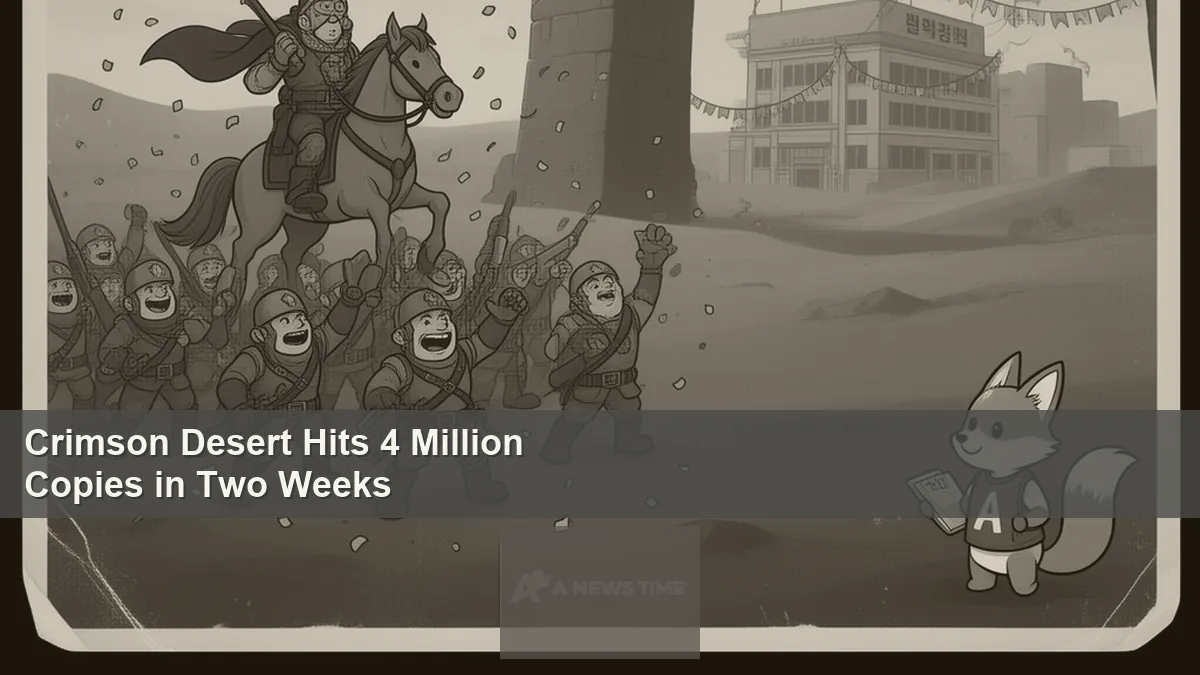
Pearl Abyss's Crimson Desert crossed four million copies sold on , just twelve days after its simultaneous debut on PS5, Xbox Series, and PC. The milestone, confirmed by the developer in a social media post to its player community, marks one of the most commercially successful launches for a new single-player RPG IP from a Korean studio in recent memory, and one that validates years of delayed but determined development from a studio better known for live-service games.
"Crimson Desert has sold through four million copies worldwide," Pearl Abyss said in its announcement. "Thank you to all the Greymanes who have been a part of this journey with us and for all of your incredible love and support." Greymanes is the name the studio uses for the player community following protagonist Macduff, a mercenary commander navigating a land torn apart by competing factions and ancient forces.
The Sales Trajectory: From Day One to Four Million
The pace at which Crimson Desert accumulated its sales figures is as notable as the total. Pearl Abyss confirmed two million units within a single day of launch on . By , five days after release, the studio announced three million units sold. The jump from three to four million took another week, arriving on March 31 as day-one enthusiasm settled into a sustained sales pattern across the game's four distribution platforms: PlayStation Store, Xbox storefront, Steam, and the Epic Games Store.
For context, that arc puts Crimson Desert alongside some of the stronger new IP launches of the current console generation. Titles like Guerrilla Games's Horizon: Zero Dawn and Insomniac's Ratchet & Clank: Rift Apart set benchmarks for first-party launches, but Crimson Desert is a third-party title from a Korean developer with no first-party marketing subsidy, which makes the comparison more favorable than the raw numbers might suggest.
| Milestone | Date Confirmed | Days from Launch |
|---|---|---|
| 2 million copies sold | 1 day | |
| 3 million copies sold | 5 days | |
| 4 million copies sold | 12 days |
Pearl Abyss did not break out platform-specific sales in any of its announcements. Given the game's simultaneous four-platform release, the distribution is likely weighted toward PC (where Black Desert Online established the studio's core audience) and PS5 (which has consistently been the dominant platform for action RPG sales this generation).
Six Years in the Making: What Crimson Desert Actually Is
Crimson Desert has one of the more convoluted development histories in recent memory. Pearl Abyss first revealed the title publicly at The Game Awards in late 2019, framing it as a spin-off prequel to Black Desert Online with a blend of single-player storytelling and multiplayer functionality. At the time, the studio was riding high on Black Desert Online's global expansion and positioned Crimson Desert as the next step toward a broader gaming identity beyond its core MMO audience.
The years that followed involved multiple internal pivots. The multiplayer components were progressively deprioritized in favor of a denser, more focused single-player open-world design. Pearl Abyss rebuilt substantial portions of the game's systems, recalibrated its scope, and released a series of technically impressive trailers that kept enthusiasm alive even as launch dates came and went without commitment. When the studio finally announced a firm release date for , it had been roughly six years since the game's first public appearance.
"Crimson Desert has sold through four million copies worldwide. Thank you to all the Greymanes who have been a part of this journey with us and for all of your incredible love and support."
Pearl Abyss, official Crimson Desert social media channels
What launched in March was an open-world action RPG focused on Macduff, the leader of a mercenary band called the Greymanes, navigating the continent of Pywel during a period of political collapse and supernatural upheaval. The game's combat system, inherited in part from the Black Desert engine's deep action mechanics, is the aspect reviewers praised most consistently. Its world design, a dense network of regions with distinct visual and cultural identities, also drew favorable comparisons to the better-realized open worlds of the past decade.
Korean Studios and the Premium Market
Pearl Abyss is one of a small number of South Korean developers with a genuine global commercial footprint in premium gaming. Its core business remains Black Desert Online, a live-service MMO that continues to generate revenue across mobile, PC, and console. Crimson Desert represents the studio's most serious attempt to compete in the premium single-player space, a market where Korean developers have historically struggled to break through the visibility ceiling set by Western and Japanese publishers.
The four million unit figure changes that narrative in a meaningful way. Shift Up's Stellar Blade demonstrated in 2024 that Korean visual identity and character design could find a global premium audience; Crimson Desert suggests that Korean studios can also compete on the scale and scope of open-world design. Both data points are significant for an industry watching whether Korean game development is building the infrastructure to sustain global premium franchises rather than just strong live-service businesses.
That said, four million units is a milestone, not a verdict on long-term profitability. Crimson Desert was in development for at least six years, and its production costs, while not publicly disclosed, were substantial enough that Pearl Abyss made multiple announcements about equity financing tied to the game's completion. Whether the title achieves returns that justify both the investment and the studio's strategic pivot away from pure live-service is a question that will take additional quarters of sales data to answer.
Market Conditions and Launch Window Timing
Open-world action RPGs are among the most competitive segments in gaming. The benchmarks set by Elden Ring, The Witcher 3, and the Zelda franchise are commercially and critically daunting for any new entrant. Crimson Desert arrived in a market that has been flooded with open-world titles over the past several years, many of which launched to disappointing commercial results despite large budgets and strong pre-release coverage.
Pearl Abyss benefited from a favorable launch window. Crimson Desert released in mid-March before most of the major April releases had arrived, including Housemarque's Saros and the PS5 port of Starfield. The clear competitive window allowed early adopter enthusiasm to build and compound via word of mouth, driving the rapid succession of sales milestones in the title's first two weeks. That kind of launch window management is as much a strategic decision as a commercial outcome.
The studio also committed to fast patch cycles following launch, addressing early feedback on performance and combat fine-tuning within the first several days. Responsiveness to player concerns in the immediate post-launch period has a documented effect on retention and word-of-mouth, and Pearl Abyss's live-service background, where rapid content and balance updates are standard operating procedure, translated effectively to the premium launch context.
The original Crimson Desert launch coverage noted the game's rapid early patch cadence and Pearl Abyss's commitment to addressing day-one performance issues on all platforms. That responsiveness appears to have contributed to the strong second-week retention. The mobile gaming market's growth trajectory is an instructive contrast: where mobile titles live and die by engagement metrics in the first 48 hours, premium titles have a longer window to build sustained commercial momentum through critical consensus and community advocacy.
What Comes Next for Pearl Abyss
Pearl Abyss has not announced a formal post-launch content roadmap for Crimson Desert beyond the immediate patch cycle. The studio operates Black Desert Online with seasonal expansions and paid content additions, a model that works for a live-service audience but carries different expectations when applied to a premium single-player title. The studio will need to make deliberate decisions about what post-launch support looks like and how it communicates those plans to a player base that bought the game expecting it to be complete at launch.
The four million unit figure will almost certainly influence Pearl Abyss's internal resource allocation. Studios that launch a successful premium title tend to face a familiar fork: build on the single-player momentum with DLC, pivot toward live-service monetization, or attempt both simultaneously. Pearl Abyss has the infrastructure for the live-service path from its Black Desert operations, but the Crimson Desert community's expectations are likely different from those of a player who bought into a subscription-based MMORPG.
With sales still climbing and no commercial ceiling yet in sight, Pearl Abyss is in a stronger position heading into the second quarter of 2026 than analysts anticipated when the game was announced. Four million units in twelve days is not just a sales milestone. It is a signal to the premium gaming market about who the competitive players are in the global action RPG space. How Pearl Abyss manages that position over the next 12 months will be worth watching closely.