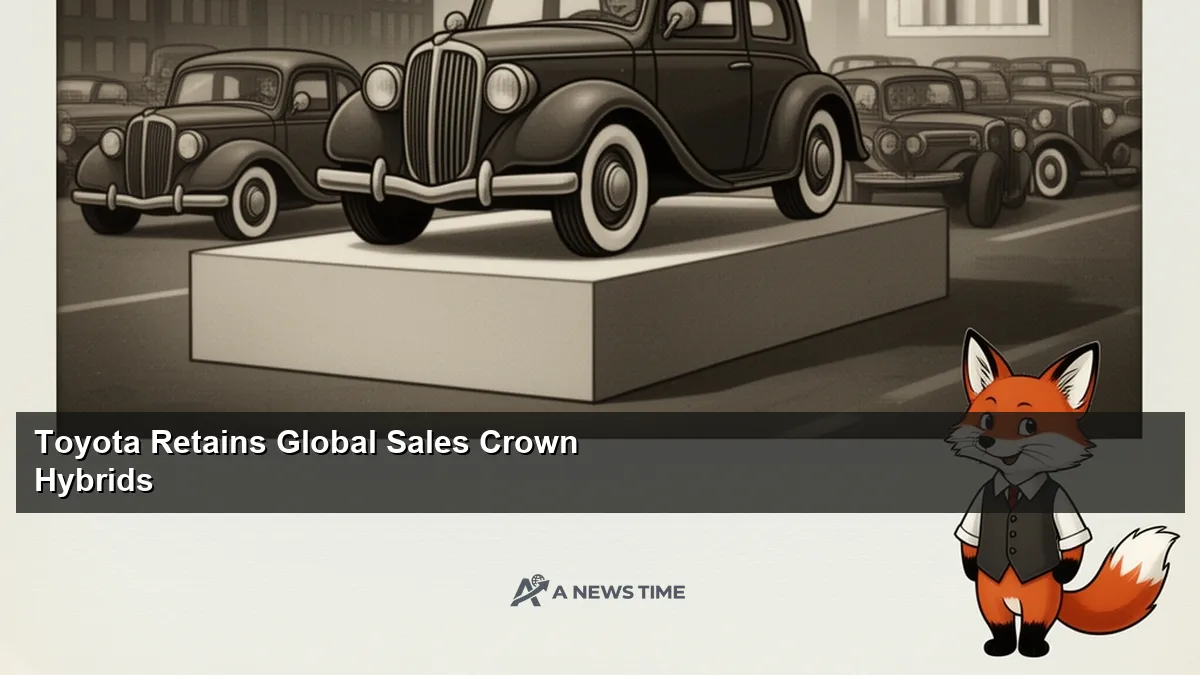
Toyota Motor Corporation retained its position as the world's best-selling automaker for the fourth consecutive year in 2025, delivering approximately 10.5 million vehicles globally, according to figures compiled by the company and confirmed by industry trackers. The number represents a 1.8 percent increase over 2024, a modest gain that might not command headlines on its own but becomes significant when placed against the backdrop of a year in which nearly every other major automaker struggled with tariff disruptions, slowing EV adoption, and geopolitical uncertainty. Toyota did not just survive 2025. It navigated the turbulence better than anyone else in the industry, and the reason is a powertrain strategy that the rest of the sector spent years dismissing.
The engine of Toyota's 2025 performance was, both literally and figuratively, the hybrid. While competitors poured tens of billions into battery electric vehicles that consumers were increasingly hesitant to buy, Toyota doubled down on hybrid-electric technology, the system it pioneered with the original Prius in 1997 and has since refined across virtually its entire lineup. Hybrid sales accounted for approximately 38 percent of Toyota's global volume in 2025, up from 31 percent in 2024, and in the United States specifically, Toyota sold more hybrid vehicles than any other automaker sold EVs.
The Numbers Behind the Crown
Toyota's global sales figure of 10.5 million vehicles includes its Lexus luxury division and its Daihatsu and Hino subsidiaries. The core Toyota and Lexus brands, which represent the vast majority of volume, accounted for approximately 9.8 million of those units. Volkswagen Group, which has been Toyota's closest competitor for the global sales crown in recent years, delivered approximately 9.0 million vehicles in 2025, a 3.1 percent decline from 2024 driven primarily by weakness in China and the ongoing restructuring of its European operations. Hyundai Motor Group (including Kia and Genesis) placed third at approximately 7.3 million units, followed by Stellantis at 5.8 million and General Motors at 5.6 million.
| Rank | Manufacturer Group | 2025 Sales (Millions) | Year-over-Year |
|---|---|---|---|
| 1 | Toyota Motor | 10.5 | +1.8% |
| 2 | Volkswagen Group | 9.0 | -3.1% |
| 3 | Hyundai Motor Group | 7.3 | +2.4% |
| 4 | Stellantis | 5.8 | -6.2% |
| 5 | General Motors | 5.6 | -1.9% |
| 6 | Ford Motor | 4.4 | -2.7% |
| 7 | Honda Motor | 4.1 | +0.8% |
| 8 | Nissan-Renault-Mitsubishi | 6.2 | -4.5% |
| 9 | BYD | 4.3 | +18.6% |
| 10 | BMW Group | 2.6 | +1.1% |
The most striking number in that table is not Toyota's. It is BYD's. The Chinese automaker delivered 4.3 million vehicles in 2025, an 18.6 percent increase that makes it the fastest-growing major automaker in the world by a wide margin. BYD's volume is still less than half of Toyota's, but its trajectory is steep enough that it could challenge for a top-five position within two to three years if current growth rates hold. More on BYD's technology strategy can be found in our coverage of BYD's super-fast charging battery development.
Why Hybrids Won 2025
The conventional narrative in the auto industry from roughly 2020 through 2024 was that hybrids were a transitional technology, a bridge between internal combustion and the inevitable all-electric future. Toyota was frequently criticized by analysts, environmental groups, and competitors for its reluctance to commit more aggressively to battery electric vehicles, with some going so far as to call the company's hybrid-first approach a form of climate delay.
The 2025 data tells a different story. Across the U.S. market, hybrid and plug-in hybrid vehicles collectively outsold battery electric vehicles for the first time since 2020, accounting for approximately 11.4 percent of total sales compared with 9.2 percent for BEVs. The shift was driven not by a decline in EV sales (which grew modestly) but by an acceleration of hybrid demand as consumers discovered that hybrid technology delivers 80 to 90 percent of the fuel economy benefit of a full EV with none of the range anxiety, charging infrastructure dependency, or price premium.
Consider the Toyota RAV4, the best-selling non-truck vehicle in America. The RAV4 Hybrid, which starts at approximately $33,500, delivers an EPA-estimated 41 miles per gallon combined. The equivalent all-electric SUV in Toyota's lineup, the bZ4X, starts at approximately $43,000, requires access to a charging network, and does not meaningfully outperform the hybrid in total cost of ownership for a buyer who drives 12,000 to 15,000 miles per year. The RAV4 Prime plug-in hybrid, which can travel 42 miles on electricity alone before its gasoline engine engages, splits the difference at approximately $41,000 and has carried a waiting list for over a year.
"The customer is telling us very clearly what they want. They want better fuel economy. They want lower running costs. They want a vehicle that fits into their life without requiring them to change their habits. The hybrid does all of that today, for millions of people, at a price they can afford."
Akio Toyoda, Chairman, Toyota Motor Corporation
Toyoda's framing reflects a strategic bet that Toyota made years ago and that 2025 appears to have validated. Rather than pursuing a rapid, capital-intensive transition to pure EVs (the path chosen by Volkswagen, General Motors, and Ford), Toyota chose to electrify its existing lineup gradually through hybrid technology while investing in solid-state battery research for a future generation of EVs that it believes will be fundamentally superior to today's lithium-ion vehicles. The bet was that consumers would reward the company that gave them electrification on their terms rather than forcing them to adapt to a technology that the infrastructure was not yet ready to support.
U.S. Market Performance and Tariff Insulation
In the United States specifically, Toyota and Lexus combined to sell approximately 2.3 million vehicles in 2025, a 2.6 percent increase that outpaced the overall market's 1.1 percent growth. The U.S. performance was particularly notable because it occurred despite the tariff environment that has added billions in costs to the industry. Toyota's relative insulation from tariffs stems from its extensive domestic manufacturing footprint.
Toyota operates 10 manufacturing facilities in the United States, including major assembly plants in Georgetown, Kentucky (Camry, RAV4, ES, Venza); Princeton, Indiana (Highlander, Grand Highlander, TX); San Antonio, Texas (Tundra, Sequoia); and Huntsville, Alabama (engines and transmissions). Those plants, combined with additional facilities in Blue Springs, Mississippi, and Troy, Missouri, give Toyota the ability to build approximately 1.8 million vehicles per year on U.S. soil, more than any other foreign-headquartered automaker.
That domestic production capacity means that a large percentage of the Toyotas sold in America are also built in America, using a supply chain that sources a high proportion of its components from domestic or USMCA-compliant suppliers. When tariffs hit finished vehicle imports and foreign-sourced components, Toyota's exposure was smaller than competitors who relied more heavily on Mexican or overseas assembly. The company was not immune, certain components and some Lexus models are still imported from Japan, but its tariff bill was meaningfully lower than that of Stellantis (which assembles many vehicles in Mexico and Canada), Hyundai (which imports from South Korea), or Volkswagen (which imports from Germany and Mexico).
| Plant Location | Key Models Produced | Annual Capacity (Est.) |
|---|---|---|
| Georgetown, KY | Camry, RAV4, Lexus ES, Venza | 550,000 |
| Princeton, IN | Highlander, Grand Highlander, Lexus TX | 350,000 |
| San Antonio, TX | Tundra, Sequoia | 200,000 |
| Blue Springs, MS | Corolla, Corolla Cross | 230,000 |
| Huntsville, AL | Engines, transmissions | N/A (powertrain) |
| Troy, MO | Cylinders, axles | N/A (components) |
| Buffalo, WV | Engines, transmissions | N/A (powertrain) |
The China Problem Toyota Does Not Have
One of the most underappreciated aspects of Toyota's 2025 performance is what did not happen in China. Volkswagen, which has historically been the dominant foreign automaker in the Chinese market, saw its China sales fall 9 percent in 2025 as local competitors, led by BYD, Geely, and Chery, captured an ever-larger share of the world's largest vehicle market. Stellantis effectively exited China as a volume player. General Motors' China joint ventures reported declining volumes for the third consecutive year.
Toyota's China sales also declined, falling approximately 5 percent, but the company's relatively modest China exposure (China accounts for roughly 15 percent of Toyota's global volume, compared with 30 to 40 percent for Volkswagen) means that the decline had a proportionally smaller impact on its global numbers. Toyota has been quietly repositioning its China strategy, reducing investment in internal-combustion models for the Chinese market while selectively introducing hybrid and plug-in hybrid models that target a different customer segment than the pure-EV products offered by BYD and its Chinese competitors.
The broader lesson from Toyota's China experience is that the global auto market is fracturing into regional blocs with different technological preferences. In China, BEVs are dominant and growing. In Europe, regulatory mandates are pushing the market toward electrification at a pace that may or may not match consumer demand. In the United States, hybrids are surging while BEV growth decelerates. Toyota's multi-powertrain strategy, offering internal combustion, hybrid, plug-in hybrid, and battery electric options across its lineup, is better suited to a fractured global market than a strategy that bets everything on a single powertrain technology.
Challenges Ahead
Toyota's 2025 results are strong, but they do not make the company immune to the forces reshaping the industry. The most immediate challenge is the continued escalation of U.S. tariffs. While Toyota's domestic manufacturing base provides insulation, the company still imports certain models (notably the Tacoma from Mexico and several Lexus vehicles from Japan) that carry significant tariff exposure. Any expansion of the tariff regime to cover additional vehicle categories or component types would erode Toyota's cost advantage relative to its current position.
The longer-term challenge is the EV transition. Toyota has committed to launching 30 battery electric models by 2030, a number that sounds ambitious but is modest relative to the commitments made by Volkswagen (which plans to have 25 BEV models in production by 2027) and Hyundai (which is investing $28 billion in EV-specific platforms through 2030). Toyota's solid-state battery technology, which the company has said will offer twice the range and one-third the charging time of current lithium-ion batteries, is not expected to reach mass production until 2028 at the earliest. If a competitor achieves a comparable breakthrough sooner, Toyota's cautious approach could shift from looking prescient to looking late.
There is also the regulatory dimension. California's Advanced Clean Cars II regulation, which requires 100 percent of new vehicle sales in the state to be zero-emission by 2035, applies to battery electric and hydrogen fuel cell vehicles but does not count hybrids as zero-emission. A dozen additional states have adopted California's standards. If those regulations survive legal challenges and are implemented as written, Toyota's hybrid-heavy portfolio would face a compliance gap in a market that currently accounts for roughly 12 percent of national sales volume. How the company navigates that regulatory landscape while maintaining its current product strategy will be one of the defining strategic questions of the next decade.
For now, the scoreboard is clear. Toyota built the vehicles that the most people wanted to buy, at prices they could afford, from factories that minimized tariff exposure, with a powertrain technology that matched the market's actual preferences rather than its theoretical trajectory. The sales crown stays in Toyota City for another year, and the company's competitors have run out of reasons to dismiss the strategy that put it there.