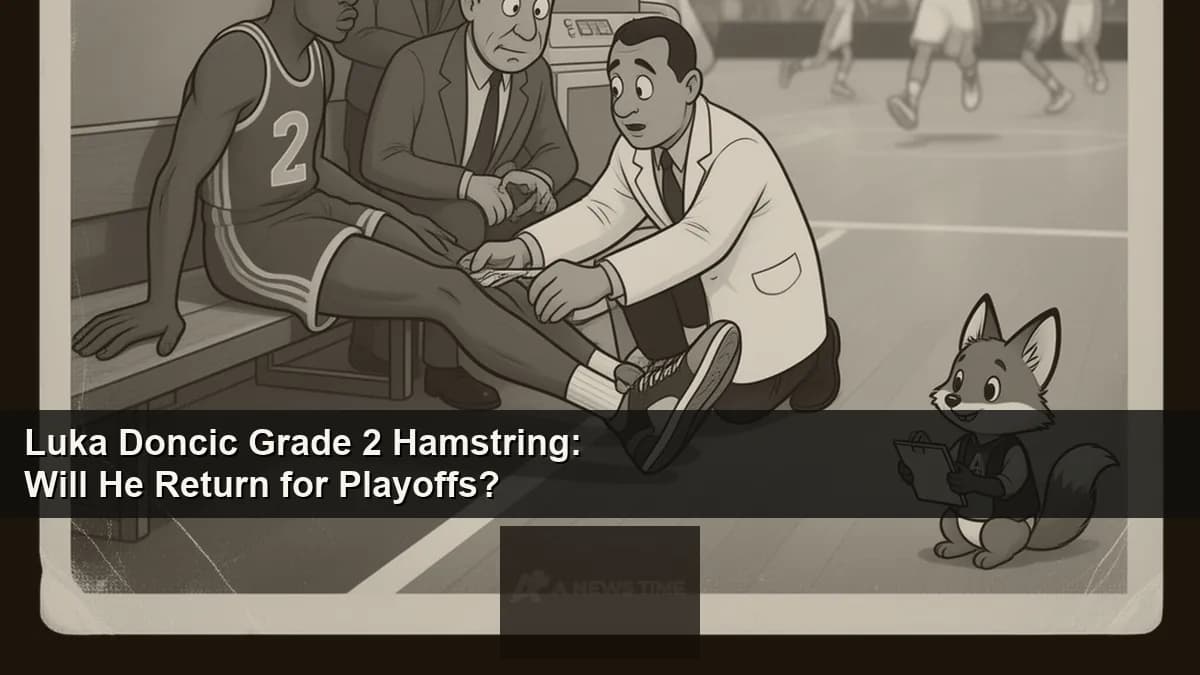
Luka Doncic is out for the remainder of the NBA regular season with a Grade 2 hamstring strain, the Los Angeles Lakers confirmed this week. The diagnosis came after Doncic left early in the third quarter of a loss to the Sacramento Kings, grabbing the back of his left leg and immediately signaling to the bench that he could not continue. The injury represents the latest and most serious setback in a season that had already been punctuated by multiple soft-tissue concerns for the 26-year-old guard.
The severity classification is what makes this situation particularly difficult for Los Angeles to navigate. A Grade 1 hamstring strain, the mildest category, typically allows players to return within one to three weeks. Grade 2, which indicates partial tearing of the hamstring muscle fibers, carries a significantly wider and less predictable recovery window, typically four to eight weeks for athletes in high-demand sports. With the regular season ending in roughly two weeks and the first round of the playoffs set to begin shortly after, the math is uncomfortable for the Lakers' medical staff and coaching staff alike.
The Medical Reality of Grade 2 Hamstring Injuries
Grade 2 hamstring strains are the category that coaches and trainers most hate to see on a playoff roster. They are serious enough to significantly impair function, but not so serious that the recovery timeline has a definitive floor. A Grade 1 strain typically resolves predictably. A Grade 3, a complete rupture, usually requires surgery and an extended timetable that removes all playoff return ambiguity. Grade 2 sits in the uncomfortable middle: partial tear, uncertain progression, and strong temptation to return before full healing because the player can physically move and the team can make a case that the stakes justify the risk.
Across NBA history, Grade 2 hamstring injuries have produced unpredictable return timelines. Kevin Durant's 2018 calf injury, which progressed from a calf strain to a catastrophic Achilles rupture during the NBA Finals, is the case that haunts every trainer's conversation about returning players from lower-body soft tissue injuries before they have fully healed. The specifics differ, but the underlying principle, that soft tissue injuries in the legs can compound unpredictably under game-speed load, is consistent across injury types.
"With a Grade 2 hamstring, you're not looking at when the player is pain-free. You're looking at when the structural integrity of the muscle is sufficient to handle an explosive cutting movement at full speed. Those are very different timelines."
An orthopedic sports medicine specialist, speaking to ESPN on the general characteristics of Grade 2 hamstring recovery
Doncic's specific injury affects his left hamstring, the same leg that supported his primary drive direction and was already being monitored by the Lakers medical staff before this acute incident. That monitoring context matters: the strain did not emerge from a completely healthy baseline, and the underlying tissue state heading into the recovery process affects how quickly the muscle repairs.
What It Means for the Lakers' Playoff Picture
Los Angeles entered this week projected in the six-to-seven seed range in the Western Conference, precisely the position that would likely have them entering the play-in tournament rather than receiving a direct playoff berth. Without Doncic, that seeding question becomes largely academic, because the real decision will be whether the Lakers try to get through the play-in with a backup plan around Anthony Davis and a healthy supporting cast, or whether they manage Doncic's return timeline against the risk of worsening the injury.
Anthony Davis, who has been the team's second star throughout the season, has his own durability questions from previous playoff campaigns. The two-big lineup that the Lakers have run during Doncic's absences earlier this season produced mixed results, functional in some matchups, genuinely limited in others. Against the kind of athletic, switch-capable defense that playoff-caliber teams deploy, the Lakers without Doncic are a team that needs everything to go right to advance past the first round.
Los Angeles also lost Austin Reaves earlier this month to an oblique strain that the team initially described as mild but has kept him out for multiple games. The Doncic and Reaves injuries together have stripped the Lakers of their two most reliable creators in a two-week window that could not have been more poorly timed.
Doncic's Season in Context
The injury closes what has been a statistically excellent but physically complicated season for Doncic. His first full year in Los Angeles following the December 2024 blockbuster trade from Dallas produced the expected offensive numbers: 28.4 points, 8.1 rebounds, and 8.8 assists per game, with a usage rate that placed him among the top five ball handlers in the league by volume. His three-point shooting returned to elite levels after an inconsistent stretch in Dallas, and his integration into JJ Redick's offensive system addressed several of the defensive transition concerns that plagued him in his final Dallas seasons.
What the season also produced was a concerning frequency of soft-tissue management situations. Doncic missed nine games with various knee, ankle, and calf issues before the hamstring injury, an absence total that reflects both the physical demands of being a 26-year-old who absorbs enormous defensive attention and the Lakers' cautious approach to his long-term health. The hamstring strain at the end of the regular season fits a pattern that the organization will need to address structurally in the offseason, regardless of how the playoff run unfolds.
Doncic's playoff history in Dallas was not uniformly positive on the injury front. He played through a calf injury during the 2022 Western Conference Finals that visibly limited his explosiveness, and the Lakers' medical staff will be managing institutional memory of that decision as they calculate how aggressive to be with his return from the current strain.
Historical Precedents for Playoff Returns from Grade 2 Strains
The NBA's playoff injury history offers limited but instructive precedents for Grade 2 hamstring returns. Klay Thompson returned to play in the 2019 Finals with a hamstring strain that several medical observers described as more serious than officially disclosed, though the specific grade was not confirmed publicly. His performance in those games, effective but clearly limited in the cutting and lateral movements that define his off-ball game, illustrates what a partially recovered return from a significant soft-tissue injury looks like in playoff competition.
More recently, several role players have attempted and largely failed to make Grade 2 hamstring returns within four weeks. The general pattern in those cases was that players could participate in limited minutes but that the explosive demands of playoff basketball, the cut, the contest, the landing from a drive, imposed load on the healing tissue that caused either re-aggravation or protective muscle guarding that significantly reduced effectiveness.
The Lakers' decision about Doncic's return will ultimately rest on two variables: the rate of his specific tissue healing as tracked by imaging, and the team's assessment of what competitive situation they will be in when he becomes medically clearable. If Los Angeles survives the play-in without him and enters a first-round matchup that they might lose in five or six games without him, the incentive to accept some injury risk accelerates. If they fall in the play-in, the return question becomes moot.
The Broader Injury Problem in the Western Conference Playoffs
Doncic's injury is not isolated context. The Western Conference heading into these playoffs has been shaped significantly by injury: multiple teams in the middle of the bracket have managed soft-tissue issues in their primary players over the second half of the season. The Denver Nuggets, projected as a potential Doncic opponent in a higher-seeded first-round, have been managing Michael Porter Jr.'s minutes carefully. The Golden State Warriors have been navigating Stephen Curry's maintenance schedule.
The cumulative physical toll of the 82-game regular season, which expanded from 72 games to its current length following years of load management controversy, continues to produce these late-season soft-tissue concerns in the players who matter most. The league's schedule compression in the back half of the season, with fewer rest days relative to the first half, is a structural contributor that team medical staffs work around rather than solve.
For the Lakers specifically, the Doncic injury serves as a forcing function on a question the organization had perhaps hoped to defer: how does a team built around two stars who both have injury histories navigate a deep playoff run while protecting those players' long-term health? The answer, unavoidably, starts with the next several weeks of medical reporting and the team's honest assessment of where the hamstring healing stands when the first round tips off.
The best realistic scenario for Los Angeles is a Doncic return sometime in the second week of the first round, assuming they advance through the play-in. That timeline would give the torn fibers approximately four to five weeks to heal and would allow Doncic to participate with some limitation in what would likely be a deciding game four or five. Whether that scenario materializes, and whether participating with a partially healed hamstring against an elite Western Conference opponent is worth the risk of a setback, are questions that will define the final chapter of Los Angeles's 2025-26 season.