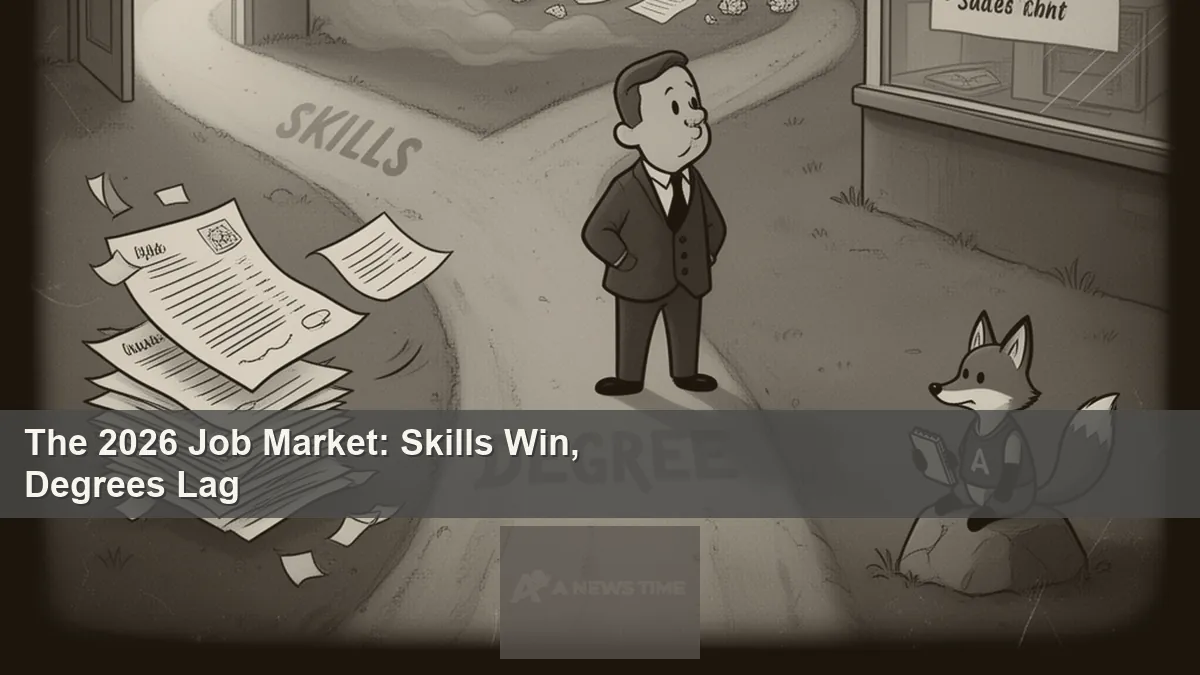
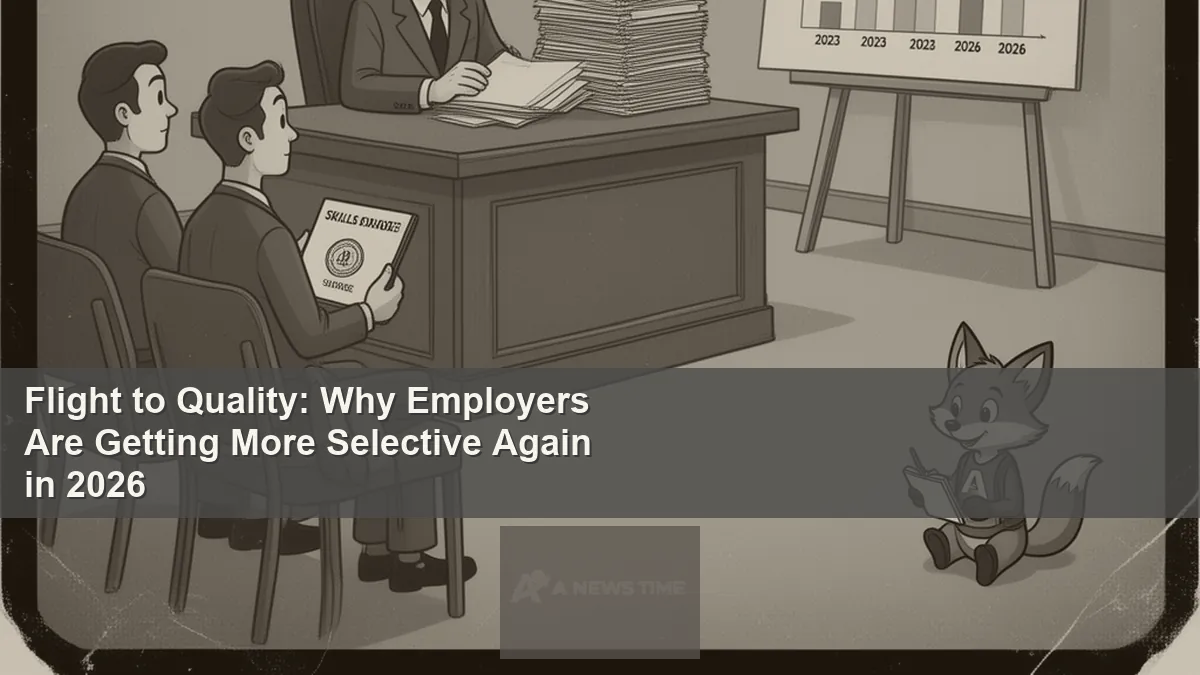
By , the evidence had piled up into an unmistakable pattern. The BLS reported a contraction of 92,000 jobs in February. The Federal Reserve Bank of New York documented a 5.7 percent unemployment rate among recent graduates aged 22 to 27, the steepest reading in more than a decade. And the NACE projected a flat 1.6 percent hiring increase for the Class of 2026, a "fair" rating the organization had not assigned since 2021. What those numbers collectively describe is a labor market in the grip of something career economists call a "flight to quality": employers, like investors retreating to safer assets during turbulent markets, are pulling back from broad hiring and concentrating on candidates they consider lowest-risk. The question for anyone navigating the job market right now is what, exactly, counts as "quality" in 2026, and whether a college degree is still part of that definition.
The Credential Experiment Quietly Reverses
Between 2020 and 2023, a genuine structural movement swept through corporate HR departments. A tight labor market forced employers to widen their candidate pools, and dropping the four-year degree requirement became the visible symbol of that opening. IBM, Delta Air Lines, state governments in Maryland and Florida, and dozens of others announced they were removing bachelor's degree requirements for a wide range of roles. Skills-based hiring became the dominant framing in workforce development circles, and for a window, the data seemed to confirm the shift: the share of U.S. job postings on Indeed requiring at least a bachelor's degree fell from roughly 20 percent in 2019 to a multi-year low of 18.5 percent in .
That low-water mark was not, however, the permanent new baseline. Research published in by Sneha Puri of the Indeed Hiring Lab tracked the reversal in granular detail. By , 19.3 percent of U.S. job postings required a bachelor's degree or higher, up from 16.6 percent just two years earlier. More telling than the raw share was the adjusted figure: after holding the occupational mix constant to isolate genuine changes in employer standards, the degree-requirement rate had been trending upward since , reaching 18.6 percent in November 2025. That means employers are increasing formal education requirements within the same kinds of jobs, not just because the mix of available positions has shifted toward white-collar fields.
The Hiring Lab analysis also found that Harvard Business School research had already flagged an important layer beneath the headline numbers: even roles that do not formally list a degree requirement tend in practice to hire candidates who hold college degrees. The announced policy change and the actual hiring behavior are not always the same thing, a gap that job seekers navigating skills-first marketing need to account for.
What the New York Fed Numbers Actually Mean
The 5.7 percent unemployment figure for recent graduates is striking enough on its own, but Kelly Collins, Executive Director of the Rockwell Career Center at the University of Houston Bauer College of Business and a board member of the Career Services Employer Alliance, points to a second statistic that tells a harder story.
We are confronting a sobering reality: a degree no longer guarantees a degree-level role. The underemployment rate for recent graduates has climbed to 42.5 percent. Nearly half of our new alumni are landing in roles that don't actually utilize their hard-earned credentials. This isn't a sign of a shrinking economy. It's a hyper-competitive flight to quality. In this environment, our students aren't just competing against each other; they are competing against a seasoned workforce for the same entry-level seats.
Kelly Collins, Executive Director, Rockwell Career Center, University of Houston Bauer College of Business
The underemployment figure deserves scrutiny. The Federal Reserve Bank of New York's definition of underemployment for this cohort covers graduates working in jobs that typically do not require a degree, and the current reading reflects something specific to the 2025-2026 hiring cycle: mid-level layoffs in tech, finance, and media have pushed experienced workers down the ladder into roles that had previously been entry-level territory. When an employer can choose between a new graduate and a candidate with two years of directly relevant experience who was caught in a corporate restructuring, risk calculus strongly favors the experienced hire. This is the mechanism driving the "flight to quality" label: it is less about credentials per se and more about demonstrated, verifiable competence under conditions of employer uncertainty.
For a broader view of what that uncertainty looks like in the raw numbers, the February 2026 jobs report provides useful context: the contraction was concentrated in sectors where entry-level hiring had expanded most aggressively during the 2021-2023 boom.
The Internship as Extended Audition
One of the clearest behavioral signals in the 2026 data is what employers are doing with their intern cohorts. NACE benchmarks show that employers plan to convert approximately 57 percent of their intern cohorts into full-time hires, a figure that reflects a fundamental shift in the role of the internship. In the tight labor market of 2021, internships were often a foot in the door for students who would then compete in broad open hiring rounds. In 2026, for many large employers, the internship has become the primary (sometimes the only) structured pathway into full-time employment.
Collins describes it directly: "The internship is no longer just a resume builder. It's an extended, 10-week interview designed to de-risk the hire for the employer." That framing has concrete implications. Students who do not complete internships are not merely missing a line on a resume; they are missing the audition itself. And because many competitive internships have their own credential screens (a number of large employers have quietly reinstated GPA minimums and target-school lists even for intern recruiting), the entry point has moved earlier in the educational pipeline.
A 2025 survey of more than 150 companies found that 26 percent were recruiting from a narrow selection of target schools, up from 17 percent two years earlier. That increase is modest in percentage-point terms but directionally significant: the trend toward broader, skills-first recruitment that characterized 2021-2023 has, at the margins, reversed. This connects directly to the patterns the Indeed Hiring Lab documented: the share of jobs requiring a degree is rising within occupations, not just because high-degree fields are growing.
What Employers Are Actually Screening For
If a degree is necessary-but-not-sufficient in 2026, what constitutes the sufficient part? The Gallup and Lumina Foundation survey of 2,000 U.S.-based employers, published in , found that 76 percent of employers prefer candidates with a four-year degree and 78 percent prefer those with a two-year degree. But the same survey found that only 54 percent of those employers believe students are graduating with the skills their organizations actually need. Employers reported that 20 percent of recent graduates needed only "a little" extra training, while 49 percent needed "a moderate amount" and 20 percent needed "a great deal."
That readiness gap is driving a secondary screening layer that sits on top of the degree requirement. The employer advisory board at the Rockwell Career Center described three specific competencies that now determine whether a credentialed candidate actually gets hired.
The first is in-person presence and communication. With return-to-office mandates reshaping workplace expectations at major employers, the ability to present clearly without a script, manage face-to-face professional conflict, and command attention in a room has re-emerged as a practical filter. Remote-first hiring in 2021-2022 made this less visible; it is visible again now.
The second is what Collins calls "radical accountability": not just task completion, but ownership culture. Punctuality, proactive follow-through, and the emotional composure to receive critical feedback without defensiveness. These are traits that an internship or a substantial co-op experience tends to reveal, which is part of why the conversion-from-internship pathway has become so dominant.
The third is AI orchestration and auditing. The framing here is precise and worth noting: employers are not impressed by students who use AI tools. They want graduates who can audit AI output, which requires enough domain knowledge and critical judgment to identify errors, hallucinations, and bias before work reaches a supervisor. This distinction matters because it places a premium on deep subject-matter understanding, the kind that a rigorous undergraduate curriculum in a relevant field is designed to build. The skills-based hiring movement sometimes implied that stackable credentials and short-term training could substitute for that depth; the 2026 employer feedback suggests the market is pushing back against that substitution at the high end. For more on where AI competency requirements are heading, the AI skills gap analysis details how training alone is proving insufficient across multiple sectors.
Geographic and Sectoral Variation
The "flight to quality" narrative is real, but it is not uniform. The Indeed Hiring Lab data reveals stark geographic polarization that shapes how much a degree matters in practice. After adjusting for occupational mix, 22.4 percent of jobs in Washington, D.C. required a bachelor's degree or higher in , compared to 10.6 percent in Alaska. States including Massachusetts (20.3 percent adjusted), Virginia (19.4 percent), Maryland, Illinois, and New York all show substantially higher degree requirements even when controlling for job-type composition. Employer culture and regional labor market norms are themselves a variable.
The practical implication: a software developer in Boise faces different screening realities than one in Boston. A marketing coordinator role in rural Nebraska may carry no degree requirement; the same title at a financial services firm in New York or a tech company in the Bay Area almost certainly does. Workers who interpreted the headline "companies are dropping degree requirements" as a universal statement were reading a partial truth. The Hiring Lab's own conclusion is careful: "Even in an era of skills-first hiring, bachelor's degrees remain a powerful screening tool within job postings in several regions across the country."
Sectoral variation follows a similar pattern. Roles in installation and maintenance, food preparation, and logistics have never relied heavily on degree requirements and are not changing in that respect. The reversals documented in 2024-2025 are concentrated in professional services, finance, technology, and management consulting, precisely the industries where the credential-dropping experiment generated the most attention. The LinkedIn skills report for 2026 documents which specific competencies are gaining the most traction as hiring signals in these sectors, and the picture is one where verified, demonstrated skills and credentials increasingly reinforce rather than substitute for each other.
How Workers Are Responding
Enrollment data offers one indicator of how workers and prospective students are reading these signals. Despite sustained public skepticism about the return on investment of a college education, enrollment has continued to climb, as covered in detail in the college enrollment analysis. That counterintuitive pattern likely reflects the same logic driving employers: when the labor market tightens and screening intensifies, credentials reduce friction in ways that become more visible precisely when competition is fiercest.
A separate behavioral response is visible in the certificate and bootcamp markets. Providers of short-form credentials in data analytics, cloud computing, and AI tooling have reported sustained demand, and a number of large employers do accept these credentials as meaningful signals, particularly when combined with a degree or directly verifiable work experience. The key word is "combined." The NACE GPA-screening figure is instructive here: GPA screening has fallen to an all-time low of 42 percent. What has not fallen is the internship-experience screen. Employers have largely stopped caring about grades; they have not stopped caring about demonstrated performance in professional settings.
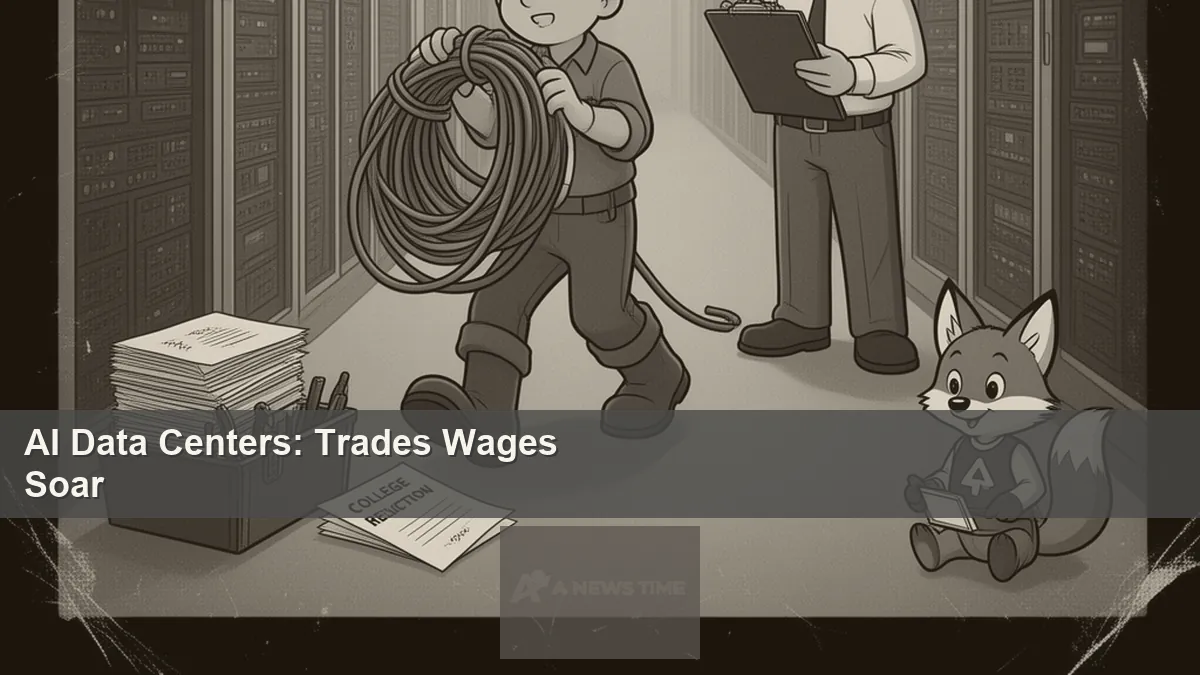
For workers without four-year degrees, the picture is mixed but not closed. Trades and technical roles remain structurally short of qualified candidates in most U.S. regions, and the wage premium for skilled trades work has increased as a result. The Monster 2026 job market outlook identifies healthcare support, construction trades, and logistics as sectors with persistent openings that do not require a bachelor's degree and offer genuine wage growth. The flight to quality, in other words, is a phenomenon concentrated in white-collar professional hiring, not a description of the entire labor market.
The Burning Glass Picture: Announcements Versus Practice
The Burning Glass Institute's research on skills-based hiring is worth examining as a check on both the optimistic and pessimistic readings of the 2026 data. Their longitudinal work documented that many high-profile announcements of degree-requirement removal between 2020 and 2023 did not translate into proportional changes in who was actually hired. Roles that officially dropped the degree requirement continued to hire degree-holders at near-identical rates, because hiring managers maintained implicit standards even when formal JD language changed. The research framed this as "a long road from pronouncements to practice," a phrase that applies, with some irony, to the current counter-movement as well. Some companies that have reinstated formal degree requirements in their job postings may find that their hiring managers had never fully abandoned them.
The Harvard Business School "Degree Reset" research, led by Joseph Fuller, tracked the original dismantling of degree requirements during the tight labor market and identified it as a cyclical rather than structural phenomenon for most employers: requirements loosened when talent was scarce and are tightening as slack returns to the market. This is not a particularly comforting finding for advocates of permanent skills-based hiring reform, but it is consistent with the mechanism driving current trends. The Gallup-Lumina survey authors put it plainly: "Employers still see higher education as a core driver of job success and talent competitiveness, even amid broader concerns about the ROI of a college degree."
Frequently Asked Questions
Are employers actually reinstating degree requirements, or is this anecdotal?
The data is documented rather than anecdotal. Indeed Hiring Lab's January 2026 analysis of job postings shows the share requiring a bachelor's degree or higher rose to 19.3 percent by November 2025, up from 16.6 percent two years earlier. Critically, after controlling for occupational mix, the increase reflects genuine shifts in employer standards within the same job categories, not just a compositional change in the types of roles being posted.
If a company says it dropped degree requirements, does that mean a non-degree candidate has a fair shot?
Not reliably. Harvard Business School research by Joseph Fuller found that roles without formal degree requirements still predominantly hired degree-holders in practice. Hiring manager behavior and formal job description language do not always align. The Burning Glass Institute reached the same conclusion in their longitudinal work: announced policy changes and actual hiring outcomes diverge significantly at many large employers.
What does the 42.5 percent underemployment rate for recent graduates mean for job seekers with degrees?
It means holding a degree is not sufficient protection against landing in a role that does not use it. The Federal Reserve Bank of New York's underemployment measure covers graduates in jobs that do not typically require a college degree. The rate's rise to 42.5 percent in 2026 reflects mid-career workers displaced by layoffs competing for the same entry-level seats as new graduates, with employers favoring demonstrable experience over potential.
Which sectors are most affected by tightening degree requirements, and which are not?
The tightening is concentrated in professional services, finance, technology, and management consulting, the same sectors that most visibly embraced skills-first hiring between 2020 and 2023. Trades, healthcare support, logistics, and hospitality show minimal change in degree requirements and continue to face talent shortages. Geographic variation is also substantial: coastal metro areas with high concentrations of white-collar roles show significantly higher degree-requirement rates than rural regions or states with more blue-collar employment mixes.
The 2026 labor market is not telling workers that credentials are the only thing that matters, or that skills are worthless without a diploma. It is telling them something more precise: in a market where employers hold more leverage than they have since before the pandemic, the bar for demonstrating readiness has risen, and the screening tools employers reach for first tend to be the ones with the longest track records. A degree is a filter that survived the tight-labor-market experiment largely intact. It does not guarantee a good outcome. But for the professional roles where the "flight to quality" is most acute, not having one makes every subsequent hurdle harder to clear. The workers who will navigate this market most successfully are those who treat the degree as a floor rather than a ceiling, layering verified experience, demonstrated AI fluency, and provable professional judgment on top of the credential, rather than waiting for the credential alone to do the work.
Sources
- Indeed Hiring Lab: Where Do College Degrees Still Matter in a Skills-First Job Market? (January 2026)
- Career Services Employer Alliance: The Flight to Quality: Why the 2026 Labor Market Demands More Than a Degree (March 2026)
- Inside Higher Ed: Data: Most Employers Still Value College Degrees, citing Gallup/Lumina Foundation Survey (March 2026)
- Burning Glass Institute: Skills-Based Hiring: The Long Road from Pronouncements to Practice