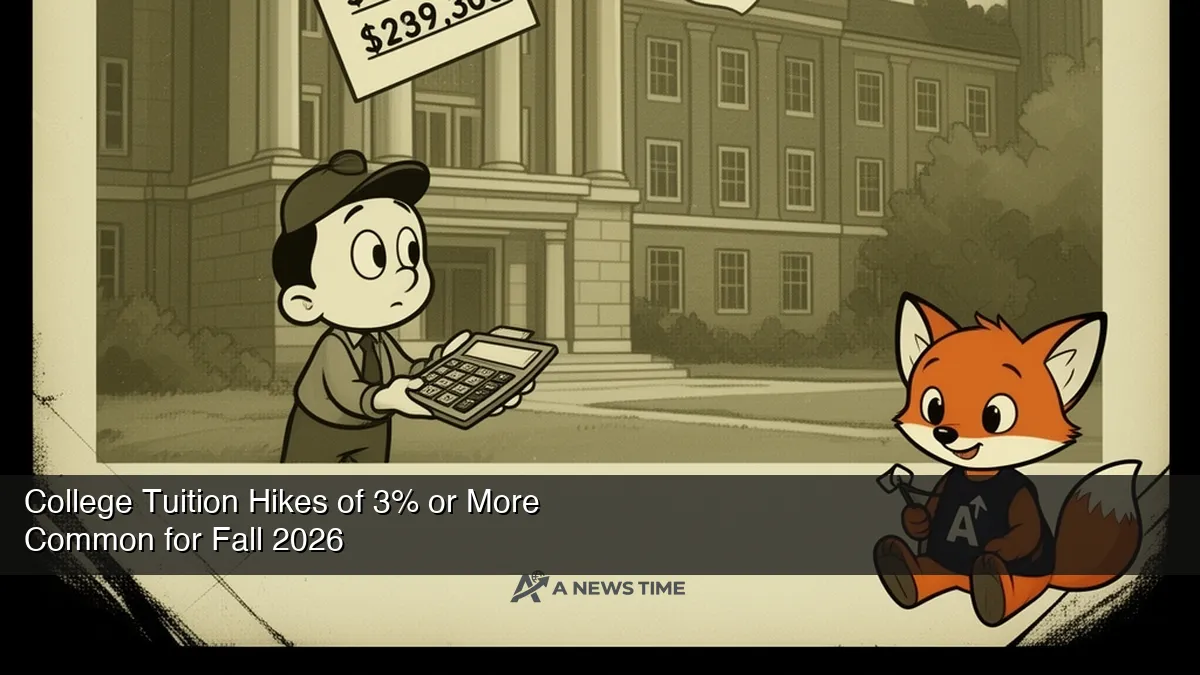
American families comparing college acceptance letters this spring are encountering a now-familiar pattern: tuition increases at many institutions are outpacing general inflation, with a notable cluster of schools announcing hikes of 3 percent or more for the semester. But the full picture of college affordability in is considerably more complicated than the headline numbers suggest. A Forbes analysis by Michael Nietzel published in surveyed tuition announcements from across the higher education landscape, and the data reveals a sector divided between institutions still raising prices and a growing number that have frozen them entirely, alongside a long-term trend in net tuition that most families never see in coverage of sticker-price increases.
What the Numbers Actually Show: The 2026 Tuition Landscape
Among the most prominent price increases for fall 2026, the University of Pennsylvania is raising tuition 3.9 percent, bringing sticker tuition to $65,670 and pushing the total cost of attendance, including room, board, and fees, to $94,582. Brown University is increasing tuition 4.25 percent, reaching $74,568. Georgetown University announced a 4.75 percent increase to $74,520. The University of Rochester is raising tuition 3.9 percent to $71,750. Marquette University raised tuition 3.5 percent to $53,890.
At smaller liberal arts colleges, Kenyon College is increasing tuition 3.9 percent, pushing total costs to approximately $93,090. Middlebury College raised tuition 4 percent to $94,386. Grinnell College announced a more modest 2.5 percent increase. Among larger private universities, Baylor University announced a 6.5 percent increase to $67,756, one of the more aggressive pricing moves in the survey. Texas Christian University raised tuition 4.7 percent to $66,500. Elon University raised tuition 5.42 percent.
Public university systems are also moving. The University of North Carolina system announced its first tuition increase in nine years, capping new increases at 3 percent and applying them only to new students, not current enrollees. The Iowa Board of Regents approved a 3 percent increase. Washington State University is raising tuition 3.3 percent. The University of Illinois system approved a roughly 2 percent increase.
The Schools That Froze Tuition, and Why That Matters
The tuition-increase narrative is real but incomplete without the contrasting data. A significant number of universities, including several high-profile institutions, have frozen tuition for fall 2026. Stanford University is holding tuition flat. The University of Connecticut is maintaining its current rates. The University of Arizona announced a freeze. Texas A&M University, Grand Canyon University, and all Indiana public universities are holding prices steady.
These freezes reflect different institutional calculations. Some schools are using flat tuition as a competitive recruitment tool, particularly in a period of demographic pressure as the traditional college-age population declines in certain regions. Others are responding to state legislative pressure or political commitments made to voters. A few are absorbing the cost of maintaining enrollment in markets where price sensitivity has become a meaningful enrollment driver.
The freeze story and the increase story together describe a higher education market in genuine flux. Institutions are making different bets about whether premium pricing still drives perceived quality or whether price competitiveness is becoming a more important factor in enrollment decisions. That strategic divergence is itself a data point about where higher education is headed.
The Net Tuition Reality: What Families Actually Pay
Perhaps the most important number in the entire tuition debate is one that almost never appears in headlines: net tuition, meaning what families actually pay after grants and scholarships, has declined in inflation-adjusted terms over the past decade. For four-year public universities, net tuition per student dropped from approximately $4,450 to $2,300 in inflation-adjusted dollars over a ten-year period, according to College Board data. That decline happened even as sticker prices were rising.
"The gap between published tuition and what students actually pay has widened dramatically. When people see a headline about a 4 percent tuition increase, they are almost never reading about what the median student at that institution will actually pay, which is a fundamentally different number."
Michael Nietzel, Forbes Higher Education Contributor
The mechanism behind this divergence is the expansion of institutional grant aid. Universities, particularly selective private institutions, have significantly expanded their financial aid programs, meaning that the sticker price increases accrue primarily to full-pay students and families above certain income thresholds. Yale University announced that students from families earning below $200,000 annually will pay no tuition at all. More than 100 universities nationwide now offer some form of income-based free tuition program.
This is not to argue that college is affordable or that tuition trends are benign. It is to argue that the coverage gap between sticker-price reporting and net-price reality distorts the public's understanding of who is actually being hurt by tuition increases and who is not. A family earning $75,000 annually whose child attends Penn may not be paying anywhere near the $94,582 cost-of-attendance figure. A family earning $250,000 almost certainly is.
The Student Debt Picture: Where the Real Stress Lives
Even with expanded grant aid, the student debt data tells a story of ongoing financial stress for millions of borrowers. Total student loan debt increased by approximately $60 billion year-over-year in the third quarter of , according to Education Data Initiative tracking. The stock of outstanding student debt remains at historically high levels, and the borrower population includes substantial numbers of people who attended institutions that provided little or no grant aid, took out loans to cover living expenses as well as tuition, or enrolled in programs whose labor market returns did not justify the debt load they took on.
The relationship between sticker-price tuition increases and student debt accumulation is real but indirect. The families most likely to take on unsustainable debt are often not those attending the high-sticker-price institutions announcing 4 percent increases. They are frequently students attending lower-selectivity institutions with less grant aid to offer, or students who chose degree programs with weaker employment outcomes relative to their cost. The tuition-hike story and the debt-crisis story overlap but are not the same story.
What has changed most materially for borrowers in recent years is the policy environment around loan repayment and potential forgiveness. That policy landscape connects to broader economic pressures documented in coverage of GDP revisions and inflation data that shape the income environment in which graduates are repaying loans.
The College Board Data: System-Wide Trends
For a system-wide view rather than individual institution announcements, the College Board's annual Trends in College Pricing data provides the most comprehensive benchmark. For , the College Board tracking shows average published tuition and fees increasing approximately 2.7 percent at two-year public colleges and approximately 2.9 percent at four-year public colleges. These averages are below the rates seen at the individual institutions receiving the most press coverage, because the sample includes institutions holding flat as well as those increasing significantly.
The College Board data also tracks total cost of attendance trends, which include room, board, transportation, and personal expenses alongside tuition and fees. Total cost of attendance increases have been somewhat lower than tuition-only increases because the non-tuition components, especially room and board at schools with owned housing, have not increased at the same pace. That gap between total cost trends and tuition-only trends matters for how families should be building their financial planning models.
At the two-year college level, tuition increases are particularly meaningful because community colleges serve a disproportionate share of first-generation, low-income, and working students. Even modest tuition increases at two-year institutions can create real enrollment barriers for students without financial cushion. The 2.7 percent average increase at two-year publics is worth watching closely because those institutions often have less institutional grant aid to deploy in offsetting sticker-price increases for their student populations.
The UNC System: A Case Study in Political Constraints on Tuition Policy
The University of North Carolina system's announcement deserves particular attention because of its political backstory. The system had held tuition flat for nine consecutive years, a freeze that was partly a legislative political commitment and partly a response to public pressure on affordability. That nine-year freeze created its own financial strains: cost pressures from inflation, rising salaries needed to retain faculty, deferred maintenance, and expanding student services were all accumulating during the freeze period.
The 3 percent increase announced for new students represents a significant policy shift, and the decision to apply it only to new students, grandfathering existing students at their current rates, reflects an attempt to limit political and financial disruption for families already enrolled. Similar "new students only" approaches have been adopted by other systems managing the politics of ending price freezes without triggering enrollment anxiety from current students and their families.
The UNC case illustrates a structural tension in public university tuition policy. Political pressure to hold prices flat is real and electorally powerful. But the cost structures of running a university do not freeze when tuition does. Systems that hold flat for extended periods are effectively building up deferred cost pressure that eventually requires larger or more disruptive increases to address. The choice between modest annual increases and periodic large corrections is one of the fundamental governance questions in public higher education.
Income-Based Free Tuition: The Landscape in 2026
The expansion of income-based free tuition programs represents one of the more significant structural shifts in higher education affordability over the past decade, and it is substantially underreported relative to its scale. Yale's announcement that families earning below $200,000 will pay no tuition is the highest-profile example, but it is part of a pattern now encompassing more than 100 institutions.
These programs vary considerably in their terms. Some cover tuition only, leaving families to cover room and board, which at many residential colleges represents a substantial portion of total cost of attendance. Others cover total cost of attendance up to an income threshold. Some use sliding scales that reduce rather than eliminate cost for middle-income families. The practical impact for any individual family depends heavily on the specific terms of the program at the institutions their student is considering.
What the expansion of these programs does change is the calculus for high-achieving students from middle-income families who might previously have assumed that elite private universities were financially out of reach. The effective cost at a highly selective private university with a generous income-based program can be lower than the cost at a less selective state university for a family in a particular income band. Financial aid offices at selective institutions have invested significantly in communicating this reality, but the perception gap remains large among first-generation students and families without experience navigating the aid system.
For students navigating these decisions alongside career planning, the certification credentials covered elsewhere on ANewsTime, including the most valuable IT certifications for 2026, offer a parallel pathway that sidesteps the degree cost question entirely for certain career tracks. The relationship between degree-based and credential-based career paths is itself a defining question of this decade in workforce development.
What Families Should Actually Do With This Information
The practical takeaway from the 2026 tuition landscape is that sticker price is not the number that should drive college selection decisions, but it is also not entirely irrelevant. Here is how to think about the information:
First, net price calculators are the tool that actually matters for financial planning. Every institution that accepts federal financial aid is required to provide a net price calculator that estimates actual family cost based on income and asset inputs. Running those calculators at every institution your student is considering gives you a far more accurate picture than any headline tuition figure.
Second, understand whether a tuition freeze is masking aid cuts. Some institutions manage their total revenue by holding tuition flat while reducing grant aid. A freeze at an institution that is simultaneously trimming its financial aid budget may result in higher net costs for many families than a modest tuition increase at an institution that is also expanding aid.
Third, the income threshold for income-based free tuition programs has moved significantly upward at selective institutions. If your household income is below $200,000 and your student is academically competitive for selective private universities, those institutions may have a lower effective cost than you assume. The College Board's BigFuture tool and individual institution net price calculators are the places to verify this.
Fourth, multi-year cost commitments matter. An institution that raises tuition 5 percent for one year but then freezes for two years may have a lower four-year cumulative cost than one that raises 2 percent every year. Ask about multi-year tuition commitment programs, which some institutions offer to provide cost certainty for enrolled students.