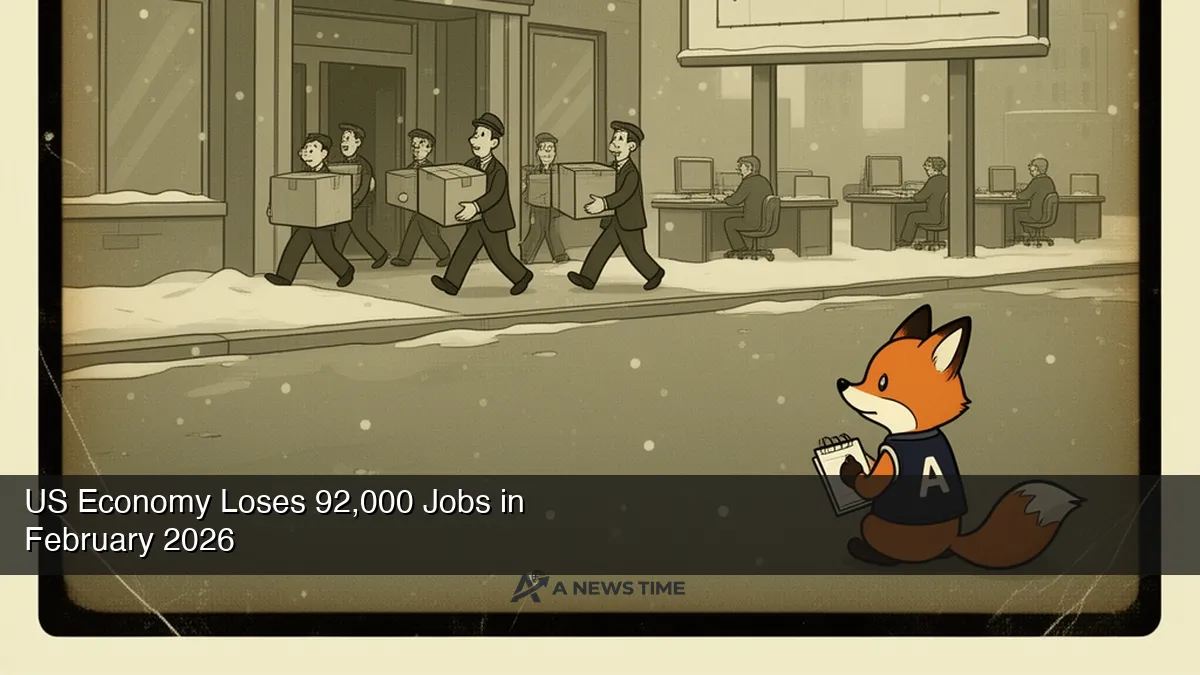
The U.S. economy shed 92,000 nonfarm jobs in February 2026, the Bureau of Labor Statistics reported on Friday, March 7, marking a sharp reversal from a labor market that had defied pessimistic forecasts for most of the past three years. Analysts polled by Bloomberg had anticipated a gain of 55,000 jobs for the month. The miss, a gap of 147,000 jobs from expectations, sent the unemployment rate to 4.4%, up from 4.3% in January, and reignited debate over whether the economy is entering a genuine soft patch or absorbing a cluster of one-time shocks.
The February report arrives against a complicated backdrop. Severe winter weather swept through much of the country during the survey reference week, disrupting construction activity, commercial operations, and transportation across multiple states. A major strike in the healthcare sector pulled thousands of workers out of payroll counts. And the Bureau of Labor Statistics, as part of its annual revision cycle incorporating updated Census population estimates, revised downward the measured size of the labor force, adding more than a million people to the "not in labor force" category. Any one of those factors alone would have complicated the headline reading. All three arriving simultaneously produced a jobs figure that analysts are carefully disaggregating rather than reading at face value.
What the Numbers Actually Show
The headline loss of 92,000 jobs masks divergent trends across industries, and understanding those divergences matters more for anyone thinking about career trajectory than the top-line number does.
Healthcare, which had been the single most reliable engine of job creation over the preceding 18 months, lost 28,000 jobs in February, the first monthly decline in more than a year. The BLS attributed the drop almost entirely to strike activity, with workers in hospital settings accounting for the bulk of the absence from payrolls. That is a meaningfully different signal than, say, layoffs driven by falling demand. When workers are on strike rather than laid off, payroll employment falls temporarily, then bounces back once bargaining concludes. Industry-specific unemployment in hospitals stands at 1.8%, a figure Eliza Hetrick, a labor market analyst at Actalent, described as "functionally at full employment." "The healthcare sector is not contracting," Hetrick told industry contacts in a research note published the same day as the BLS release. "It is in a labor dispute. Those are very different things for anyone thinking about entering the field."
Construction lost jobs as well, with severe winter weather in the Midwest and Northeast the primary explanation. The construction unemployment rate of 6.3% remains elevated relative to other industries, reflecting the sector's inherent seasonal sensitivity, but spring typically restores construction hiring as temperatures rise and project backlogs are worked through.
Leisure and hospitality, a sector that had been recovering steadily from pandemic losses, also declined, again with weather cited as the likely culprit. Hotels, restaurants, and event venues in storm-affected regions reduced hours and staffing during the reference week. Manufacturing posted modest job losses, consistent with a broader trend in which domestic goods production has been squeezed between elevated input costs, softening export demand, and the ongoing uncertainty around trade policy.
The Data Revision That Changes the Baseline
Embedded within the February report was a significant methodological revision that received less attention than the headline job loss but arguably matters more for understanding where the labor market actually stands.
The BLS incorporated updated Census Bureau population estimates that increased the number of people counted as "not in the labor force" by 1.2 million and reduced the measured size of the labor force itself by 1.4 million. Those are not job losses. They are a statistical reclassification reflecting the Census's updated estimates of the U.S. civilian noninstitutional population by age, sex, race, and ethnicity.
What this means practically is that the labor force participation rate of 62.0% in February is not directly comparable to January's figure without accounting for the revised baseline. Economists who track participation as a measure of how many working-age adults are engaged with the labor market must work with the revised historical series rather than treating the February figure as a continuation of the prior trend. The revision adds uncertainty to the picture without changing the fundamental direction: participation remains below its pre-pandemic high and shows no sign of recovering to levels last seen in 2019.
Tyler Roush, writing for Forbes on the day of the release, noted that "the revisions make it harder to know exactly where we stand, but they do not change the core trajectory. The labor force is smaller, participation is flat, and the jobs picture for February was genuinely soft regardless of what adjustments you apply to the headline number."
Who Is Most Exposed to the Slowdown
The February report's sector breakdown offers a practical map of which workers face the most and least labor market risk heading into the second quarter of 2026.
At the more protected end, workers in utilities (2.6% unemployment), healthcare (1.8% in hospitals specifically), and professional and business services (3.4%) remain in labor markets where demand for their skills substantially exceeds supply. The low unemployment rates in these sectors are not a coincidence: they reflect structural long-term demand driven by demographic aging in healthcare, growing regulatory complexity in professional services, and the capital-intensive, geographically fixed nature of utility infrastructure.
At the more vulnerable end, manufacturing workers face a 3.3% unemployment rate that, while not historically high, reflects a sector that has been buffeted by tariff-related input cost increases, Chinese competition in consumer goods, and the ongoing shift toward automated production processes that reduce labor content per unit of output. Construction workers, as noted, face 6.3% unemployment, the highest sector-specific rate in the BLS breakdown.
The geographic dimension of February's report is also worth noting. States and metropolitan areas with heavy concentrations of construction employment, particularly those that experienced the worst February weather, will show the most pronounced job losses in state-level data released in subsequent weeks. Workers in those markets who are considering industry transitions or upskilling investments should treat the February numbers as a prompt to review their options rather than a crisis requiring immediate action.
For context on the broader economic backdrop shaping these numbers, see our earlier reporting on Goldman Sachs raising recession odds to 30% amid the oil price surge and the Q4 GDP revision that put fourth-quarter growth at 0.7%.
Wages: The Number That Actually Affects Take-Home Pay
Buried beneath the job loss headline is a wages story that offers genuine encouragement for workers already employed, even as hiring slows.
Average hourly earnings rose 3.8% year-over-year in February 2026, continuing a trend of wage growth that has consistently outpaced inflation since mid-2024. With the Consumer Price Index running at 2.4% year-over-year, "real" wages, earnings adjusted for inflation, are up approximately 1.4% on an annualized basis. That means the average worker's paycheck is buying more than it did a year ago, a fact that tends to get underweighted in jobs-focused coverage because it requires more calculation than a headline job count.
For workers in the middle and lower portions of the wage distribution, where the gains from the post-pandemic labor market tightening were most pronounced, the wage picture has been particularly strong. Industries that struggled to hire during the 2021-2023 period, including logistics, food service, and retail, raised base pay substantially and have largely maintained those higher floors even as hiring pace has moderated.
The wage data also carries implications for the Federal Reserve's rate deliberations. The Fed's dual mandate requires it to balance maximum employment against price stability. With unemployment at 4.4% and wage growth at 3.8%, the central bank faces a labor market that is cooling, which argues for rate cuts, but not one that has collapsed, which would argue for aggressive easing. The most likely path, absent a sharp deterioration in March and April data, is the cautious, gradual reduction in rates that Fed officials have signaled for most of 2026.
The Healthcare Strike: A Temporary Drag, Not a Trend Reversal
The healthcare sector's unexpected job loss deserves extended analysis because healthcare employment has been the most consistent bright spot in the labor market since 2022, and the February number will prompt questions about whether that reliability is ending.
It is not. The 28,000 job loss in healthcare reflects the specific mechanics of payroll measurement during strike activity. When workers are on strike during the BLS reference week, they are counted as not employed even if they fully intend to return to their jobs once the dispute is resolved. Strike activity in the healthcare sector has increased over the past two years as nurses, technicians, and other clinical workers have organized around staffing ratios, wages, and working conditions. The strikes are evidence of labor market tightening, not labor market weakness: workers only strike successfully when they have bargaining power, which requires employers to need them.
The underlying demand fundamentals for healthcare employment remain as strong as they have been throughout the decade. The U.S. population over 65 is growing by approximately 1.4 million people per year. That age cohort consumes healthcare at roughly three times the rate of working-age adults. New therapies, including the expanding class of GLP-1 drugs and advances in oncology, are increasing treatment intensity for conditions that previously had fewer options. And the administrative infrastructure that supports care delivery, including medical coding, billing, health information technology, and care coordination, continues to expand alongside clinical services.
Eliza Hetrick put it directly: "One month of strike-driven payroll losses does not change a decade of structural healthcare demand. Anyone in nursing, physical therapy, or clinical social work who is second-guessing their career path because of a single BLS report is misreading the data."
What Workers Should Take From the February Report
The February jobs report is a genuine data point about a labor market that is cooling from a period of unusual tightness. It is not a signal of imminent broad-based deterioration. The practical implications differ significantly depending on a worker's sector, geography, and career stage.
For workers in healthcare, professional services, and technology, the February report changes very little. Those sectors are operating at or near full employment, and the structural forces driving demand for skilled workers in those fields remain firmly in place. The primary risk for workers in these sectors is not job loss but the more diffuse challenge of navigating an economy in which interest rates remain elevated, housing is expensive, and consumer purchasing power, while positive, is growing slowly.
For workers in construction, manufacturing, and leisure and hospitality, the February data is a prompt to assess exposure. These sectors are more cyclically sensitive, more affected by weather volatility, and, in the case of manufacturing, more exposed to the trade policy uncertainty that has persisted throughout 2025 and 2026. Workers in these sectors who have been contemplating additional training, certification, or lateral moves toward more structurally supported occupations have more reason than usual to accelerate those plans.
For workers currently unemployed or recently displaced, the February report does not fundamentally alter the calculus of job search. The unemployment rate of 4.4%, while rising, remains low by historical standards. Industries with high open positions, healthcare, skilled trades, and logistics, continue to post more vacancies than they can fill. The job market is tighter for some roles than for others, but it has not broadly closed.
The broader economic context, including the OECD's warning that the Iran conflict has erased global growth upgrades and elevated energy prices, adds a layer of uncertainty to second-quarter hiring forecasts. Businesses that were planning to expand headcount tend to delay hiring decisions when the macroeconomic picture is unclear. That behavior, if it persists through March and April, could produce a consecutive string of soft jobs reports that would more clearly signal a broad slowdown. For now, February remains a month where multiple one-time factors produced an unusually negative headline that is not fully representative of underlying labor market conditions.
Reading the February Report in Full Context
Labor market data always requires context to interpret properly, and the February 2026 report is a case study in how multiple simultaneous distortions can produce a number that misleads if read in isolation.
The strike-driven healthcare loss, the weather-driven construction loss, the Census population revision, and the adverse weather effects on leisure and hospitality together account for the bulk of the gap between the 55,000 gain that analysts expected and the 92,000 loss that was reported. That does not mean the underlying labor market is as healthy as it was six months ago. Hiring has been slowing gradually, as it typically does when interest rates are high and economic uncertainty is elevated. The trend is real even if February's specific numbers overstated it.
The March jobs report, due in early April, will be closely watched for signs of bounce-back in healthcare and construction, which would support the interpretation that February was distorted, and for any signs of broader weakness in sectors that were not affected by the February-specific factors. Until that data arrives, February 2026 is best understood as a genuinely soft month in a labor market that is normalizing from an exceptionally tight period, rather than the beginning of a pronounced contraction.
For workers and job seekers, the message is the same one that has been consistent throughout this economic cycle: skills in structurally demanded occupations, healthcare, skilled trades, data analysis, logistics management, continue to command strong wages and reliable employment prospects. The headline number changes monthly. The structural demand for those skills does not.