By , the question most K-12 district technology leaders are asking about edtech is no longer "what should we adopt?" It is "what is actually worth keeping, and how do we know?" That shift, documented across district surveys and technology conferences from Arizona to Connecticut this year, marks the end of a decade-long era defined by rapid acquisition and the beginning of one defined by accountability. The platforms that thrived on post-pandemic emergency purchasing are now facing a harder question: what does your tool actually do for student learning, and where is the data proving it?
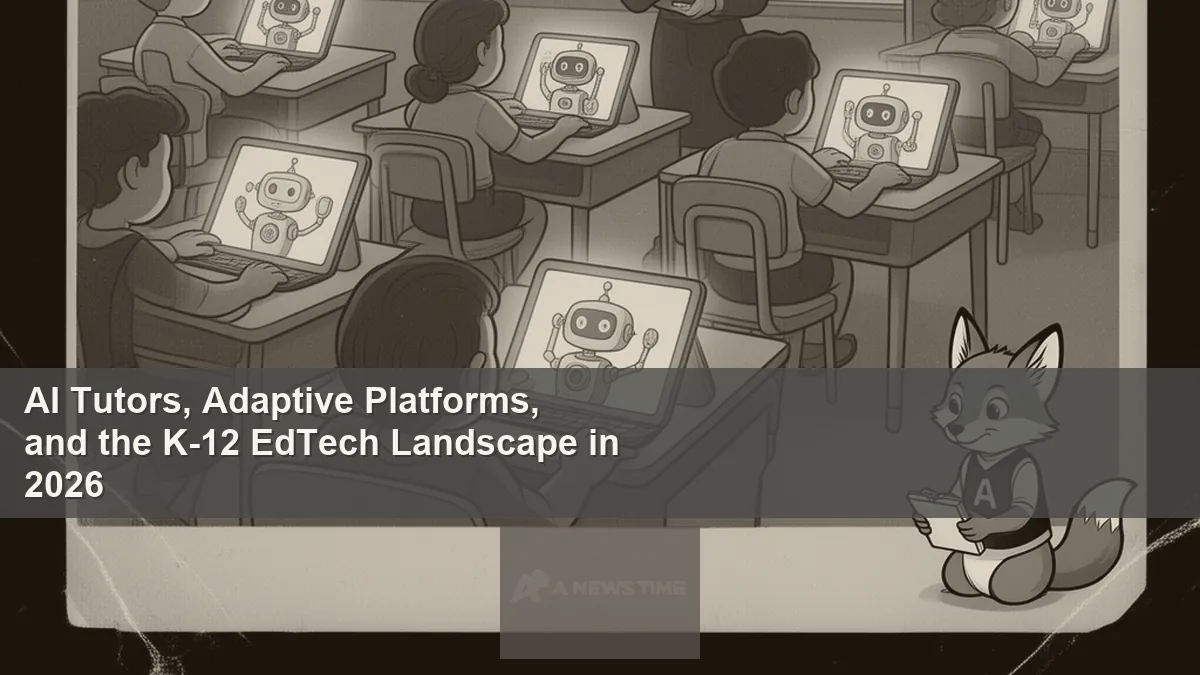
This reckoning is arriving simultaneously with the most consequential wave of AI integration K-12 has ever seen. Khan Academy's Khanmigo, Carnegie Learning's AI-augmented math platform, and Duolingo for Schools have each moved from pilot programs into broad district deployment. Their outcomes, where rigorously measured, are more nuanced than either their advocates or critics tend to acknowledge. And the policy environment surrounding them, district AI task forces, state-level guardrail frameworks, and federal data privacy pressure, is evolving faster than most vendors anticipated.
AI Tutoring Platforms: What the Research Actually Shows
Khan Academy's Khanmigo launched as a general-access tool in and has since moved into structured district partnerships. The platform uses LLM-based conversational tutoring to guide students through math and reading concepts using the Socratic method rather than direct answer delivery. Khan Academy's internal efficacy data, shared publicly in , found that students who used Khanmigo for at least 30 minutes per week demonstrated measurably stronger performance on formative assessments compared to Khan Academy users who did not use the AI tutor. The organization has been explicit, however, that these are internal findings, not peer-reviewed outcomes, and that the comparison group is other Khan Academy users rather than a control group with no digital platform access at all.
Carnegie Learning's platform takes a different approach. Its AI components are embedded within a structured math curriculum rather than offered as a standalone tutor, and the company has invested heavily in independent efficacy research. A What Works Clearinghouse review found evidence of positive effects on math achievement for middle school students using Carnegie Learning's MATHia software, with effect sizes in a range that education researchers describe as educationally meaningful. The key distinction Carnegie Learning's research team emphasizes is that the platform's adaptive engine does not just adjust difficulty; it models individual student misconceptions and targets those specific gaps rather than simply routing students to easier content when they struggle.
A 2025 RAND Corporation analysis of AI-assisted tutoring programs across 47 districts found that platforms with embedded misconception modeling produced learning gains roughly twice as large as those relying solely on difficulty-adjustment algorithms. That finding matters because many tools marketed as "adaptive learning" adjust only the level of content, not the type of instructional support, a distinction that classroom teachers recognize immediately but that is often invisible in vendor marketing materials.
"The distinction between engagement and learning is the central accountability problem in edtech right now. A tool that keeps students on-task longer is not the same as a tool that improves their understanding. Vendors know this. Districts are starting to demand the difference be shown in data, not promises."
Susan Moore, Director of Instructional Technology, Meriden Public Schools, Connecticut
The Guardrail Moment: How Districts Are Pulling Back
The enthusiasm for AI tools in K-12 has not arrived without friction. Across the country, district leaders who moved quickly to deploy AI writing assistants and tutoring tools in and are now installing formal governance structures that were absent at the point of adoption. In Gilbert, Arizona, the district assembled an AI task force that spent the entirety of the - school year training teachers before any student-facing deployment proceeded. "We wanted it to be conservative and meaningful," said Jon Castelhano, executive director of technology for Gilbert Public Schools.
The privacy concerns driving much of this caution are specific. Aaron Feuer, CEO of Panorama Education, which supports over 700 districts with AI-backed student support tools, described a scenario that district leaders find genuinely alarming: an educator using a free, consumer-grade AI tool uploads sensitive information about a student's behavioral history. That information enters the model's training data. Years later, the same model might surface that detail in a context, a college admissions screening tool, an employer background platform, where its presence damages the student's opportunities.
A 2026 survey by the Consortium for School Networking found that fewer than 40 percent of districts have formal data governance policies specifically addressing AI tools, even as the majority report that teachers are using AI platforms in their classrooms. That gap, between adoption and governance, is where most district technology leaders say their attention is currently focused. Chantell Manahan, director of technology at Metropolitan School District of Steuben County in Indiana, put the problem plainly: "AI is exposing issues we have ignored for years. We have to focus on data governance, privacy, and ethics."
ExcelinEd, the education policy organization, released a Model Policy for AI-Powered Educational Tools in that has since been adopted as a starting framework by a growing number of state education agencies. The policy addresses procurement standards, student data handling, vendor transparency requirements, and educator training minimums. It does not endorse specific tools but establishes a process by which districts can evaluate any tool against consistent criteria before deployment. For context on broader policy frameworks shaping this landscape, see our coverage of the Bipartisan Policy Center's AI education commission.
The Post-Pandemic Shakeout: Which Edtech Darlings Didn't Survive
The ESSER funding cliff arrived in and has done what market analysts predicted: it has thinned the edtech market with considerable speed. Platforms that scaled on emergency pandemic purchasing, particularly those in the reading intervention and social-emotional learning space, have faced the sharpest contractions. Several companies that reached unicorn valuations during the - period have since undergone significant layoffs, pivoted their business models, or been acquired at distressed valuations.
The companies that are retaining district contracts share several characteristics. First, they can demonstrate learning outcomes using independent evidence, not just engagement metrics. Second, their platforms integrate with existing SIS and LMS infrastructure rather than requiring parallel workflows. Third, their pricing structures survived the transition from emergency funding to general operating budgets. "The device is not the teacher," said Debbie Leonard, executive director of technology for Greenwood School District 50 in South Carolina. "We need direct instruction and platforms that support teachers as a resource, not replace them."
That last point bears on how districts are now evaluating AI tools specifically. The question being asked in procurement reviews is whether a platform reduces teacher workload on administrative tasks while preserving teacher judgment on instructional decisions, or whether it attempts to substitute for pedagogical expertise entirely. The first approach is winning contracts. The second is generating resistance, and in some cases, union-led pushback at the bargaining table.
EdSurge's 2026 Trends Report found that the majority of district technology leaders now describe "return on instruction" as their primary evaluation metric for edtech tools, compared to "engagement" or "usage rates," which dominated procurement conversations as recently as 2023. That shift in vocabulary reflects a genuine change in what districts consider evidence of value.
Coding Education's Pivot: From Scratch to AI Literacy
For most of the past decade, K-12 coding education followed a recognizable sequence. Students began with Scratch, the MIT Media Lab's block-based programming environment, in elementary school, moved toward text-based Python in middle school, and encountered introductory computer science electives in high school built around languages and concepts that most professional developers would recognize. That sequence is not disappearing, but it is being substantially reorganized around a new central question: what does it mean to be computationally literate when AI tools can generate functional code from natural language prompts?
Dr. Stacy Hawthorne, executive director of the EdTech Leaders Alliance, argues that the answer is not to abandon programming instruction but to reframe its purpose. "As AI lowers the floor for routine tasks, educators need to raise the bar for deeper thinking," she has said in public presentations. In practice, that means programs like Code.org, which has updated its middle school curriculum for to include units on prompt engineering, model evaluation, and the ethics of automated decision-making, alongside traditional programming concepts.
Atlanta Public Schools has taken a more infrastructure-level approach. Through partnerships with Verizon Innovative Learning Labs deployed in Title I schools across the district, students in K-12 programs are now working with AR tools, 3D modeling software, and project-based learning environments that treat coding as one component of digital creation rather than its central purpose. Jen Hall, content integration specialist for Atlanta Public Schools, described the district's approach as focused on developing "best practices for using AI rather than establishing policies and guidelines," with teacher and student training preceding any platform deployment.
The debate in computer science education circles is whether the shift toward AI literacy risks producing students who can converse fluently with AI tools but lack the foundational computational thinking to evaluate, debug, or critically assess the outputs those tools generate. Carnegie Mellon University's School of Computer Science has been vocal about this concern, arguing in a position paper that the ability to prompt an LLM is not a substitute for understanding the data structures and algorithms that determine what an LLM can and cannot reliably produce. This connects directly to the broader workforce preparedness questions being asked at the national level, which our coverage of the AASA superintendents survey on future-ready schools addresses in depth.
Engagement vs. Outcomes: The Evidence Question Nobody Wants to Ask
The hardest question in K-12 edtech in is whether the tools that generate the most enthusiastic student and teacher responses are the same tools that produce the strongest learning outcomes. The honest answer, based on available research, is: not reliably. Platforms optimized for engagement, including many gamified learning apps and certain adaptive reading tools, have generated impressive usage data without consistently translating that usage into gains on standardized assessments or long-term skill retention.
The neuroscience literature offers a partial explanation. A widely cited analysis from the MIT Media Lab examined how cognitive offloading, the practice of outsourcing mental effort to a tool, affects long-term memory consolidation. The research found that when students receive immediate, low-friction answers to questions, the neural pathways associated with retrieval practice and effortful recall are not activated in the same way they are during productive struggle. Applied to edtech, this suggests that platforms designed to reduce friction for students may inadvertently reduce the cognitive effort that produces durable learning.
This is not an argument against AI tutoring. It is an argument for specificity about mechanism. The Khanmigo design philosophy, which uses Socratic questioning rather than direct answers, appears to be aligned with what learning science recommends. So does Carnegie Learning's misconception-modeling approach. What is less clear, and what the research literature has not yet resolved definitively, is whether these benefits persist at scale, across diverse student populations, and over academic years rather than weeks. The Institute of Education Sciences has active research grants studying exactly these questions, with preliminary findings expected later in .
For educators watching this space, the practical guidance from researchers like those at the RAND Corporation is consistent: treat vendor efficacy claims as hypotheses rather than findings until they have been tested by independent researchers using controlled designs and student populations that resemble your own district demographics. The Education Week Research Center's edtech product database has become a useful tool for this, cataloging independent research findings, or the absence of them, for hundreds of widely marketed platforms. On the workforce implications of these skill development gaps, see our reporting on the 2026 AI skills gap and the patterns already visible in hiring data.
What's Coming: The Near-Term Trajectory
The trajectory for K-12 edtech through the remainder of runs along several converging lines. District procurement will continue tightening around evidence standards, with more states adopting frameworks like ExcelinEd's model policy and requiring independent efficacy review as a condition of state funding for edtech purchases. The platforms most likely to survive this scrutiny are those that have invested in partnerships with independent research organizations rather than relying solely on internal data.
On the AI tutoring front, the next frontier is not the tutor itself but the ecosystem around it: tools that help teachers understand what an AI platform is actually doing with their students, where it is succeeding and where it is struggling, and how individual student interaction patterns connect to classroom-level patterns teachers can act on. Freddie Cox, chief technology officer of Knox County Schools in Tennessee, described the AI integration challenge with characteristic precision: "This is the year a leader cannot bury their head in the sand. AI becomes part of the purchasing decision." What he means is that districts can no longer evaluate a platform as if its AI components are optional add-ons. The AI is now the product.
For students and families, the most consequential shift may be the one happening in coding and AI literacy curricula. The students moving through middle and high school today will enter a workforce where the ability to work effectively with AI tools is table stakes rather than a differentiator. The K-12 system is attempting to respond to that reality in real time, without consensus on what AI literacy actually means at different grade levels, without enough trained teachers to deliver whatever curriculum gets designed, and without a stable research base to draw on. The World Economic Forum's reskilling projections frame the urgency at scale: 850 million workers globally will need foundational digital skill updates by 2030, and the window for K-12 systems to shape the entering cohorts of that workforce is measured in years, not decades.
The districts getting this right share a disposition more than a specific tool set. They are starting with the learning problem, not the product catalog. They are demanding evidence before contracts, not after. And they are treating teacher capacity, not device ratios, as the binding constraint on how well any technology investment can possibly perform. That disposition is not new. What is new is how much harder the environment is making it to maintain, and how much more consequential it now is to let it slip.
Frequently Asked Questions
Does Khanmigo actually improve student learning outcomes?
Khan Academy's internal data shows that students using Khanmigo for at least 30 minutes per week demonstrate stronger formative assessment performance than comparable Khan Academy users who do not use the AI tutor. However, these are internal findings, not peer-reviewed outcomes, and the comparison group is other platform users rather than students without any digital learning tool. Independent researchers at RAND and IES are conducting more rigorous studies, with findings expected later in 2026. The honest answer is that Khanmigo shows genuine promise, particularly because its Socratic design aligns with what learning science recommends, but durable outcome evidence at scale remains limited.
What guardrails are districts placing on AI tools in 2026?
Districts are implementing governance at several levels. At the procurement stage, many are now requiring vendor transparency about data storage, model training practices, and security certifications before purchase. At the deployment stage, AI task forces, teacher training prerequisites, and phased rollouts have replaced the rapid adoption that characterized 2022-2024. ExcelinEd's Model Policy for AI-Powered Educational Tools has been adopted as a starting framework by a growing number of state education agencies and provides specific standards for student data handling and vendor accountability.
Is block-based coding like Scratch still relevant in an AI-powered classroom?
Yes, but its role is being redefined. Scratch and similar block-based environments remain valuable for introducing computational thinking to younger students, including concepts of sequencing, conditionals, and debugging, that underpin the ability to evaluate AI outputs critically. The shift is happening in middle and high school, where curricula are now incorporating prompt engineering, model evaluation, and AI ethics alongside traditional programming. Carnegie Mellon University's School of Computer Science has argued specifically that foundational programming knowledge is more important, not less, when students need to assess what AI tools can and cannot reliably produce.
How can parents evaluate whether their school's edtech tools are evidence-based?
The most accessible independent resource is the What Works Clearinghouse, maintained by the Institute of Education Sciences, which reviews studies on educational interventions including software platforms and assigns evidence ratings based on study quality and effect size. Education Week's Research Center also maintains a database of edtech products with information on available research. Parents can ask district technology coordinators specifically whether a platform has been reviewed by either source, and whether the research used populations demographically similar to their school district. Vendor-produced case studies and engagement metrics are not substitutes for independent efficacy research.