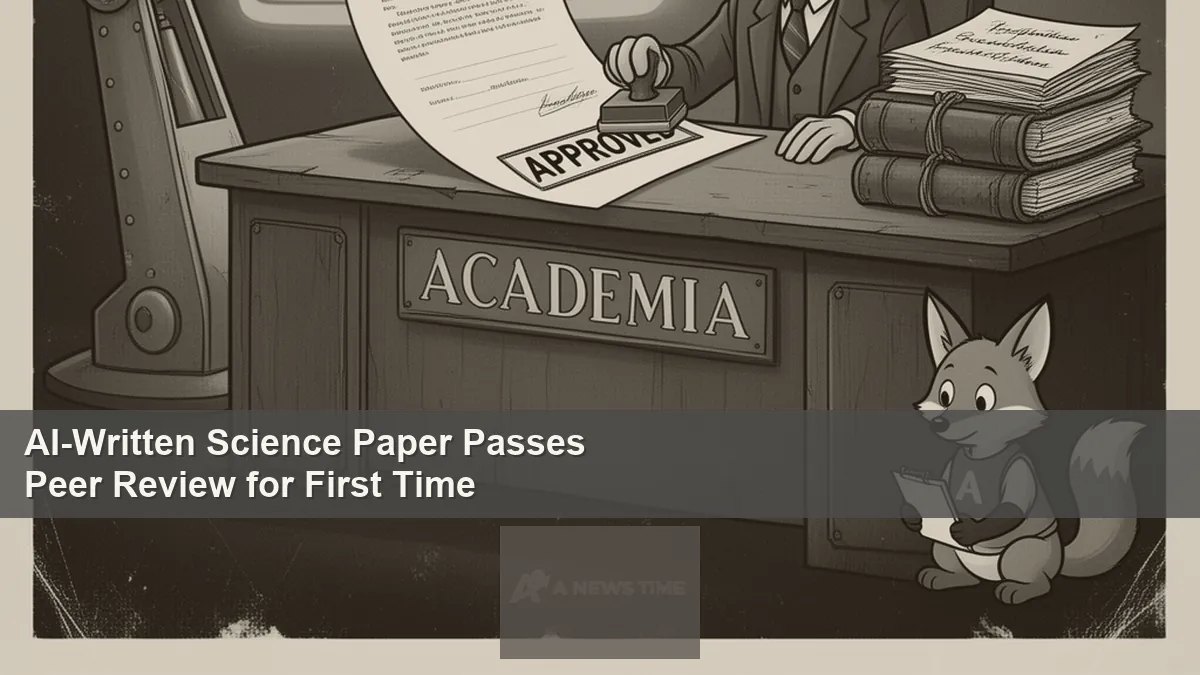
For the first time, an artificial intelligence system wrote a scientific research paper without human involvement and had that paper pass peer review. The paper, produced by a system called the AI Scientist developed by Jeff Clune and colleagues at the University of British Columbia, was accepted at a workshop at the ICLR conference, one of the most competitive venues in machine learning. A study describing the experiment was published in Nature in . The scientific community's reaction has ranged from qualified interest to genuine alarm.
The result is, depending on who you ask, either a milestone toward genuinely autonomous scientific discovery or a demonstration of exactly the kind of problem that could overwhelm an already strained peer-review system. Both readings are defensible from the same set of facts.
How the AI Scientist Works
The AI Scientist is not a single model but a pipeline of coordinated modules. After researchers give the system a broad topic prompt — Clune described it as "come up with something interesting to study on how the AI learns" — the system surveys available literature, generates hypotheses, filters out ideas it judges to be insufficiently novel, designs and runs experiments, analyzes and plots data, writes a paper, and conducts its own internal peer review pass. The system relies on existing foundation models, including Anthropic's Claude Sonnet and OpenAI's GPT-4o, as underlying components; the contribution from Clune's team is the pipeline that orchestrates them into a coherent research workflow.
The team submitted three AI-generated papers to the ICBINB workshop at the 2025 ICLR. One was accepted. The workshop accepted roughly 70 percent of submitted papers. The conference organizers were informed of the nature of the submissions and gave permission for them to be included; all three papers were subsequently withdrawn after the review process concluded.
"We're saying the AI gets to be the scientist."
Jeff Clune, Professor of Computer Science, University of British Columbia
Clune is candid about the paper's limitations. The ideas generated by the AI Scientist sometimes struck him as genuinely creative, he said, but execution was a persistent problem. "The logic and the writing and the thinking throughout the whole paper didn't all fit together beautifully," he acknowledged. Reviewers and independent experts noted hallucinated references, duplicated figures, and gaps in methodological rigor. The paper passed review at a venue with a high acceptance rate for a lower-stakes workshop format, not a main conference track.
Speed and Cost vs. Quality
The number that has attracted the most attention in coverage of the AI Scientist is not its acceptance rate but its production cost. The system produced a formally passable paper on machine learning in 15 hours at a cost of approximately $140. Jodi Schneider, an associate professor of information sciences at the University of Wisconsin-Madison who was not involved in the work, offered a pointed frame of comparison: a human graduate student might spend a full semester writing their first accepted workshop paper.
"Would a mediocre graduate student get one paper in three accepted at a place that accepts 70 percent of papers? Sure!"
Jodi Schneider, Associate Professor of Information Sciences, University of Wisconsin-Madison
That framing cuts in two directions. On one hand, it suggests the AI Scientist's output is not impressive relative to even a novice researcher. On the other, it illustrates the scale problem. A graduate student produces a few papers per year. An AI system operating at $140 per paper, running continuously across many instances simultaneously, could in principle submit to every open venue in a field within days.
| Factor | AI Scientist | Human Graduate Student |
|---|---|---|
| Paper completion time | ~15 hours | One full semester (3-6 months) |
| Cost per paper | ~$140 | Tens of thousands (salary, lab overhead) |
| Acceptance at ICBINB workshop | 1 of 3 submitted (33%) | Variable, first paper typically lower |
| Reference accuracy | Hallucinated citations found | Human-verified, correctable |
| Methodological coherence | Weak ("didn't fit together beautifully") | Supervised and revised by advisor |
| Post-review status | Withdrawn by research team | Published in proceedings |
Expert Reactions: From Lukewarm to Alarmed
The broader scientific community's response to the AI Scientist has been, at best, cautious. Maria Liakata, a professor of natural language processing at Queen Mary University of London, who was not involved in the work, assessed the system's approach as "agentic and without any real novelty." The system automates and chains existing capabilities; it does not introduce a new scientific method.
"I believe the future is not fully autonomous scientific discovery but advanced human-agent interaction where the human can scrutinize and contribute to the process."
Maria Liakata, Professor of Natural Language Processing, Queen Mary University of London
Yanan Sui, an associate professor at Tsinghua University and a senior workshop chair for ICLR 2026, took a harder line. The practical consequences of AI-generated submissions arriving in volume at peer-review venues are not theoretical: the flood of mediocre output threatens to bury genuine research under automated submissions that reviewers cannot feasibly screen at scale. The main conference at ICLR 2026 now prohibits purely AI-written submissions, though Sui acknowledged that enforcement is constrained by the available detection tools.
Aaron Schein, a data scientist at the University of Chicago and one of the ICBINB workshop organizers, was more fatalistic. "We're not going to be able to remove the power to generate AI scientific papers," he said. "This technology is only going to get better. I don't think there's anything to do about that."
The Peer Review Problem
Peer review was not designed to operate under the pressure that AI-generated submissions could create. The current system depends on volunteer experts giving time to evaluate manuscripts. Those experts are already stretched: reviewers at major machine learning conferences handle dozens of papers per cycle, and acceptance rates at top venues have been declining for years as submission volumes rise.
Several developments compound the detection challenge. AI detection tools are unreliable and easily fooled. Researchers who use AI assistance are now required by many venues to disclose how they used it, but the line between AI-assisted and AI-authored is contested and hard to verify. The Intology company claims its AI system Zochi passed peer review for the main proceedings of the 2026 Annual Meeting of the Association for Computational Linguistics (with human researchers involved in results verification and communication with reviewers). The Autoscience Institute states its AI system produced papers accepted at ICLR workshops before the AI Scientist was announced.
- Top conferences including ICLR 2026 now prohibit purely AI-written submissions
- Required AI-use disclosure is now standard at major venues but enforcement is difficult
- No reliable automated tool currently detects AI-generated scientific writing at scale
- Multiple competing AI research-writing systems are now publicly known
- Hallucinated citations remain a documented problem across AI writing systems
What Could Change, and What Could Not
Clune envisions the AI Scientist developing in two distinct phases. The short-term phase involves exactly what critics fear: "a lot of slop and garbage" that peer-review systems will have to manage. That phase may be unavoidable regardless of what venues do to restrict AI submissions, because the tools to generate papers are already widely distributed. The longer-term phase, Clune argues, will look different. He predicts that AI systems will eventually surpass human researchers across a broad range of scientific tasks, reducing human scientists to something closer to curators reviewing AI output rather than primary generators of new knowledge.
"I predict the AI Scientist actually marks the dawn of a new era of rapid scientific advances."
Jeff Clune, University of British Columbia
Liakata's counter-position is that this prediction misunderstands what scientific discovery is for. The value of research is not just the production of correct propositions but the development of understanding that humans can use, verify, build on, and question. A system that generates hundreds of technically passable papers per day, most of mediocre quality, does not accelerate discovery. It adds volume to a record that humans must still interpret. "Advanced human-agent interaction," in her framing, means AI systems that amplify human scientific judgment rather than replace it.
For now, the scientific community is operating in the gap between those two futures. Venues are writing policies for a problem they cannot fully detect. Scientists are debating whether AI-generated research should be categorized as a form of automated output or as a new kind of authorship. The AI Scientist paper currently sits as a confirmed existence proof: a system with no human co-authors submitted a research paper, and a peer-review process accepted it. The parallel expansion of AI into scientific data analysis suggests the question of where human oversight ends and automation begins will not stay confined to the publishing process. Questions about what it means to verify a scientific finding are likely to become more, not less, contested as these systems develop.