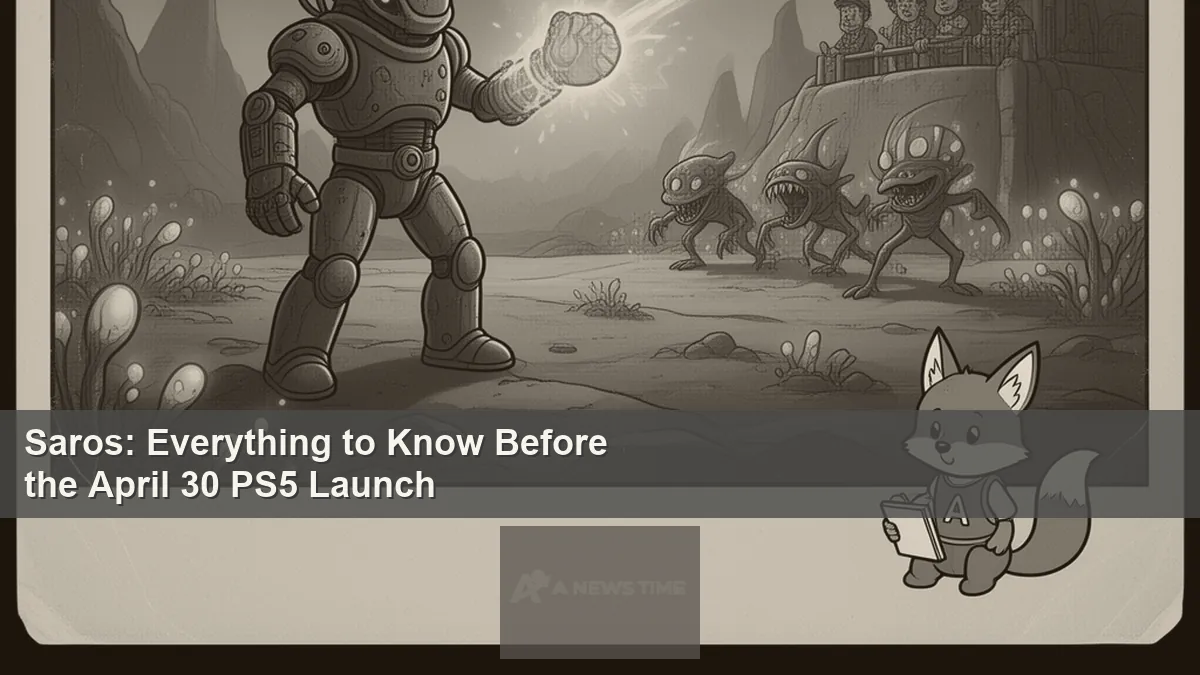
Housemarque's Saros arrives on PS5 on , carrying the Finnish studio's signature commitment to precision-engineered action gameplay into a new setting, a wider cast, and a rogue-lite structure that expands on the foundation the studio built with Returnal in 2021. Saros is a PS5 exclusive and the studio's most ambitious title since Returnal, which itself was Housemarque's most ambitious title to that point. Based on three hours of hands-on play with the first two levels, the game appears to be delivering on that ambition.
Players control Arjun Devraj, an Enforcer dispatched to the alien planet Carcosa as part of a rescue crew investigating a human colony that went silent. Carcosa has its own rules. Arjun cannot die permanently; when he falls, he resurrects at the rescue crew's home base and starts again. What he learns on each run, about the planet's layout, its enemies, and the colony's fate, accumulates between cycles. Death in Saros is the mechanism of discovery, not the obstacle to progress.
The Core Combat System: Turning Threats into Resources
Housemarque's core mechanical innovation in Saros is the relationship between the game's two weapon systems: Soltari human-made tech and Carcosan alien energy. Human tech covers Arjun's collectable weapons, including Hand Cannons, Rifles, and Shotguns, each with primary and alternate fire modes mapped to the DualSense's adaptive triggers. A pull of R2 fires; pulling L2 halfway down activates the weapon's alt-fire mode with a trigger of R2 to release it. The adaptive trigger resistance communicates the transition between modes through physical feedback, a design integration that rewards playing on PS5 hardware specifically.
The alien component comes from Carcosan energy, which Arjun's arm absorbs from the environment and stores as a Power Weapon attack mapped to a full pull of L2. That Power Weapon requires energy to fire, and energy is accumulated by deploying a bubble Shield (held with R1) and using it to absorb blue-colored enemy projectiles. The combat loop Housemarque has built from these interactions is the central design idea: in Saros, charging toward enemy fire rather than evading it is frequently the optimal strategy, because absorbing projectiles charges the weapon that dispatches the enemies firing them.
"We wanted to make projectiles opportunities. It's a shift away from the obstacle course of our previous title to something more akin to a playground."
Gregory Louden, Creative Director, Housemarque, via PlayStation Blog
Creative Director Gregory Louden described the design philosophy to PlayStation Blog as moving away from the "obstacle course" feel of Returnal's combat toward a "playground" dynamic where every enemy action presents a decision rather than a hazard to route around. The result, in practice, is a combat system that maintains Returnal's bullet-hell intensity while rewarding engagement rather than evasion. Every fight involves split-second choices between dodging, absorbing, using melee to break enemy shields, and deploying the Power Weapon to clear groups.
The Eclipse: Optional Risk, Amplified Reward
Each area of Carcosa contains a device that, when activated, triggers a biome-specific eclipse. Eclipses are optional after the first introductory activation and can be triggered at any time when Arjun finds the device. The eclipse state visually transforms the level and adds corrupted enemy projectile types. If struck by yellow-colored enemy fire during an eclipse, Arjun's maximum health ceiling is permanently lowered for that run, creating a risk stack that accumulates with each hit.
The reward structure makes this risk meaningful rather than punitive. Lucenite, Carcosa's collectable currency used to unlock permanent upgrades between runs, increases in value during eclipses, making them the most efficient path to the game's persistent progression system. The eclipse state also unlocks access to corrupted weapon variants with unique properties and perks that are unavailable in the standard world state, creating a separate tier of build variety accessible only to players who accept the increased danger.
Art Director Simone Silvestri noted to PlayStation Blog that the level design is "handcrafted art, handcrafted design, handcrafted combat encounters, connected in a procedural matter." The studio playtests extensively to ensure consistent flow across the procedural configurations, a labor-intensive approach to rogue-lite design that produces more reliably satisfying runs than pure random generation but requires significantly more upfront work from level designers.
From Returnal to Saros: What Changed and What Stayed
Returnal was a solo experience built around isolation, psychological ambiguity, and the creeping revelation that Selene's loop on Atropos was as much internal as external. The horror was intimate. Saros deliberately moves away from that structure. Arjun is not alone; he operates as part of a crew whose individual members radio in with perspectives and reactions as he explores, and whose interpersonal dynamics are fleshed out gradually over multiple runs. The horror is still present, but it comes from the pressure between companions rather than from the protagonist's solitude.
Louden confirmed that the crew structure was an intentional design choice from the beginning of development: "We immediately knew we wanted more viewpoints." The crew includes human members grappling with the operation's complexity and their unease about Arjun's resurrection ability, alongside Primary, described as "a huge black box of a Soltari AI" that speaks on behalf of the company's profit-focused operations on Carcosa and maintains an unsettling stoicism throughout. The dynamic creates what Louden called "a pressure cooker of an experience, with multiple perspectives."
| Feature | Returnal (2021) | Saros (2026) |
|---|---|---|
| Story structure | Solo protagonist, solitary dread | Crew dynamics, multiple perspectives |
| Rogue-lite progression | Lightweight, limited carry-over | Deeper, broader Armor Matrix upgrade tree |
| Combat philosophy | Evasion-focused (obstacle course) | Engagement-focused (playground) |
| Level design | Procedural with handcrafted rooms | Handcrafted layouts connected procedurally |
| Risk escalation | Parasites and curse mechanics | Optional eclipse with raised stakes |
The rogue-lite progression in Saros is more expansive than Returnal's. Arjun's Armor Matrix upgrade tree is accessed at the home base between runs, providing permanent improvements to combat abilities including a parry mechanic that unlocks mid-game and allows Arjun to knock back high-powered enemy projectiles to their originator. The parry operates outside the eclipse state and adds another layer of aggressive defensive option to a combat system already built around converting enemy fire into player resources.
Level Design: Gold Path and Side Routes
Every level in Saros has a golden path (tapping down on the D-Pad shows a gold flag icon marking the main objective's approximate location) and a network of optional side routes. Side paths contain rewards gated behind puzzles and challenges, including sequences that require specific tools or fast reaction times. Not every route is accessible on every run due to procedural layout variation, encouraging players to explore aggressively rather than routing directly to objectives.
Lounded and Silvestri described the design intent as building replayability not through content scarcity but through density: there are more things in any given level than most players will encounter on a single run, and the procedural connection system ensures that the optimal route through that content changes across playthroughs. The two levels available in the hands-on (Shattered Rise and Ancient Depths) include boss encounters that Housemarque confirmed have multiple phases, testing both mechanical execution and tactical adaptability under pressure.
The hands-on report described both boss encounters as "intense" and noted that each brings multiple attack phases that escalate Saros's core bullet pattern system to its logical extreme, forcing players to maintain the absorb-and-fire cycle under conditions designed to overwhelm reactive players who haven't internalized the system. That escalation structure is characteristic of Housemarque's design lineage from its arcade roots through Super Stardust and Resogun to the more ambitious scope of its post-acquisition PS5 titles.
Colony log entries scattered throughout levels give players a secondary reading layer for the narrative: the fate of the colony and the nature of Carcosa are mysteries that accumulate through optional lore, not cutscenes. For players who want to understand what happened on the planet, the effort of exploration is rewarded with context. For players who want to focus on the combat loop, the story delivers through action and environmental cues without demanding supplementary reading. That dual-track narrative approach reflects the studio's understanding that rogue-lite players engage with story differently than linear game players, and designing for both modes rather than forcing one is a design maturity that Returnal demonstrated at a smaller scale.
The Xbox Partner Preview in March filled April's early and mid-period with notable releases, but Saros closes the month at with a positioning that should generate significant player attention. April 2026 is one of the most content-dense months in recent gaming history, with Starfield's PS5 launch, Diablo 4's Lord of Hatred expansion, and Pragmata all arriving before Saros. The question is whether Housemarque's track record and the game's critical reception translate into sales performance that reflects the studio's effort and Sony's investment in the project. Based on three hours of hands-on play, the game has the mechanical depth to justify the attention. Whether the story and world deliver over a full playthrough is something only the full release will settle.