Byline: Kieran Wolfe, Senior Gaming Reporter
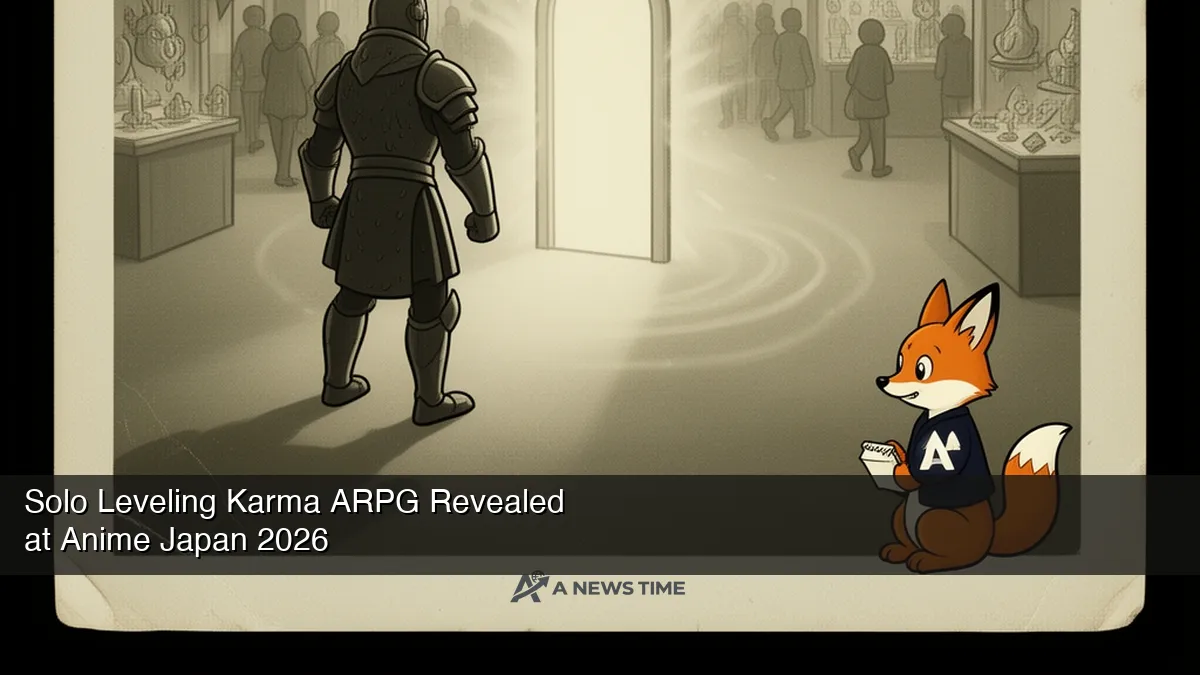
Solo Leveling Karma, a new ARPG for mobile platforms based on the hit manhwa and anime franchise, was unveiled at Anime Japan 2026 in Tokyo, adding another major title to a mobile gaming landscape that is increasingly shaped by anime and manga IP. The reveal generated immediate attention within both the gaming and anime communities, reflecting the franchise's unusual crossover reach: Solo Leveling built its audience through a Korean web novel, expanded it through a webtoon adaptation, and then exploded internationally when A-1 Pictures' anime adaptation aired in 2024 to enormous viewership.
Karma is being developed as a full ARPG, not a simplified gacha collection title, which positions it differently from many anime-to-mobile adaptations that have used licensed IP primarily as visual decoration on top of existing genre templates. The choice of ARPG as the format is a meaningful statement about what the developers are attempting. Solo Leveling's source material is fundamentally about combat progression, a protagonist who starts at the bottom of a power hierarchy and ascends through increasingly dangerous dungeons. An ARPG framework maps naturally onto that story structure in ways that a turn-based or idle format would not.
The announcement at Anime Japan 2026 was accompanied by a trailer showing real-time combat sequences, dungeon environments drawn directly from the anime's visual language, and what appears to be a progression system built around Sung Jin-Woo's iconic leveling mechanics from the source material. No release window has been confirmed, and the developers have not yet specified whether Karma will use a premium or free-to-play monetization model, two questions that will significantly shape the game's market positioning and commercial prospects.
Anime Japan 2026 as a Platform for Mobile Gaming Reveals
The choice of Anime Japan 2026 as the venue for Karma's reveal is itself worth noting. The event, held annually in Tokyo, has grown into one of the most significant announcement platforms for games built on anime and manga IP, partly because it assembles the exact audience that matters most for this category of title, people who are already emotionally invested in the franchises being adapted and willing to engage deeply with new products built on those properties.
This year's Anime Japan saw an unusually high concentration of mobile gaming announcements, reflecting the industry's recognition that anime fans are a premium mobile gaming audience. They are engaged, organized into passionate online communities, willing to pre-register and pre-order, and capable of generating the kind of social media attention that marketing budgets cannot easily replicate. For a mobile game studio, a successful anime adaptation can reduce customer acquisition costs significantly by leveraging existing fan infrastructure rather than building awareness from scratch.
Karma's reveal was among the most-discussed gaming announcements at the event, according to social media tracking data aggregated following the show. The Solo Leveling franchise's particular combination of kinetic action, clear power-fantasy progression, and high production-value visuals from the anime adaptation gives it strong content marketing potential. Players who love the anime want to experience Sung Jin-Woo's power growth firsthand, and an ARPG is the format most likely to deliver that.
"Solo Leveling's appeal is specific and replicable in a game context: you want to feel the moment-to-moment thrill of a character who is growing stronger in real time, who can feel the difference between where he started and where he is now. The ARPG format can deliver that in a way that passive collection mechanics simply cannot."
Community discussion, r/gachagaming, March 2026
The Anime-to-Mobile Pipeline: Context and Track Record
Solo Leveling Karma enters a market with a complicated history of anime IP adaptations for mobile. The category has produced both genuine successes and high-profile disappointments, and the distinction between them often comes down to a single question: did the development team build a game around the IP, or did they build a game and apply the IP as a skin?
The failures in this category share a common pattern. A popular anime generates licensing interest, a studio acquires the rights, and the result is a title that uses the character designs and music but plays identically to dozens of other games in the genre. Fans download it because of their attachment to the source material, encounter a game that does not capture what they loved about the anime, and churn rapidly. Day-30 retention rates for poorly executed anime mobile games are often even lower than the already-challenging industry average of below 4 percent.
The successes take a different approach. Arknights, which has built one of the most loyal mobile gaming communities in recent years, combines its distinctive visual identity with genuinely deep tower-defense mechanics. Persona 5: The Phantom X, among the most anticipated mobile titles of 2026, is developed by the team with deep understanding of the Persona franchise's gameplay systems rather than by a studio that licensed the IP and worked backward from a mobile template. These titles succeed because the IP and the gameplay are developed in genuine conversation with each other.
Where Karma fits on this spectrum depends on execution details that are not yet fully available. The ARPG format choice and the apparent quality of the reveal trailer are encouraging signals, but they are not a guarantee. The critical question, which will only be answerable once more gameplay is publicly demonstrated, is whether the combat and progression systems feel like Solo Leveling specifically or like a generic ARPG wearing Solo Leveling's aesthetic.
Warhammer 40K: Supremacy and the Premium Mobile Experiment
Karma's reveal at Anime Japan 2026 coincides with another notable moment for anime and IP-driven mobile gaming. Warhammer 40K: Supremacy launches on , positioning itself as a premium mobile strategy title built on one of tabletop gaming's most elaborate and devoted fan communities.
The Warhammer 40K franchise has been navigating the games market with increasing sophistication over the past decade, producing titles across multiple formats and genres rather than concentrating all licensing activity in a single type of product. Supremacy enters mobile as a turn-based strategy title, a format that aligns well with the tabletop origins of the Warhammer 40K universe and with the older, more deliberate playstyle that characterizes much of the franchise's fanbase.
The premium pricing model for Supremacy, paid upfront rather than free-to-play with in-app purchases, is an interesting experiment given current market conditions. The data on premium mobile gaming is mixed: the audience for paid mobile titles exists and tends to have higher engagement and retention than free-to-play players, but it is substantially smaller, and discovery through app stores is harder for premium titles that cannot use the "free" label to drive initial downloads.
The Warhammer 40K community's organizational capacity, built through decades of tabletop gaming culture, online forums, podcasts, and content creation, provides a built-in distribution network for Supremacy that most premium mobile titles lack. This kind of existing community infrastructure is one of the few viable alternatives to paid user acquisition for premium mobile releases, and it will be worth watching how effectively the Warhammer community activates around the title's launch.
Arknights Endfield and Persona 5: The Phantom X Set the Bar
Any discussion of the most anticipated mobile games of 2026 centers quickly on two titles that have generated sustained excitement over long pre-release windows. Arknights: Endfield and Persona 5: The Phantom X represent different approaches to adapting established gaming properties for mobile audiences, and both set a high standard that Karma will need to meet if it wants to compete for the same players' attention and spending.
Arknights: Endfield is the most significant departure from an established mobile franchise's established format. The original Arknights is a tower-defense game with a deep lore infrastructure and one of the most engaged gacha gaming communities in the world. Endfield moves to a full 3D open-world ARPG format, a significant technical and design investment that signals confidence in the community's appetite for a more premium experience. The transition is not without risk: players who love the original game's tower-defense mechanics may not automatically love an open-world action title, even with the same visual identity and lore.
Persona 5: The Phantom X brings the Persona franchise's turn-based combat and social simulation systems to mobile in a format that, from what has been publicly shown, treats the gameplay mechanics with genuine fidelity rather than simplifying them for a perceived mobile audience. The game is designed around the understanding that Persona fans are the primary audience, which means building for their expectations rather than for a hypothetical casual player who might be attracted to the visual style without knowing the franchise.
Both titles are positioned as premium experiences within a free-to-play monetization framework, which is the model that has worked best for high-quality anime and game-franchise mobile adaptations: no purchase barrier for entry, but meaningful optional spending for players who want to progress faster or access additional content. The success of this model depends on building sufficient game depth that players who do not spend heavily still find the experience worthwhile, which in turn generates the community goodwill that sustains long-term player acquisition through word of mouth.
Neural Networks and User Acquisition: The Technology Reshaping How Players Find Games
Karma, Supremacy, Arknights: Endfield, and Persona 5: The Phantom X will all launch into a mobile gaming advertising environment that looks significantly different from the one that existed three years ago. Neural network-based user acquisition systems are increasingly replacing rule-based targeting approaches, with implications for how studios find the players most likely to engage deeply with specific types of games.
Traditional mobile advertising operated on relatively simple segmentation: age, location, device type, and basic behavioral signals. Neural network-based systems can process far more complex patterns, identifying the intersection of behavioral, contextual, and creative response data that indicates high potential for specific game types. A player who has demonstrated engagement with narrative-heavy games, demonstrated tolerance for complex progression systems, and engaged with anime content across multiple platforms can be identified and targeted with more precision than demographic segmentation alone would allow.
For anime-to-mobile adaptations specifically, this represents a meaningful shift. The audience for a game like Karma is not defined by demographics but by a specific set of interests and behavioral patterns that overlap across age groups, geographies, and device preferences. The ability to identify that audience with greater precision reduces wasted acquisition spend and increases the likelihood that the players who install Karma are the ones who will actually engage with it long enough to become paying customers.
The broader transformation that neural networks and AI are bringing to data-intensive industries is explored in our technology coverage, where recent reporting on AI in diagnostics provides context for how machine learning systems are developing the capability to identify patterns that human analysts would miss. The methodological parallels to mobile user acquisition are more direct than they might initially appear.
Hybrid Casual and the Genre Evolution That Created Space for Premium Mobile ARPGs
One of the structural trends creating favorable conditions for premium mobile ARPGs like Karma is the evolution of the hybrid casual genre. Hybrid casual games, which combine accessible onboarding with deeper long-term engagement mechanics, have been quietly reshaping player expectations about what mobile games can and should offer.
A player who has been trained by a well-executed hybrid casual title to expect both quick session accessibility and meaningful long-term progression brings different expectations to the app store than a player who has only experienced pure casual games. They are more willing to invest time in understanding a deeper game, more patient with a steeper learning curve, and more likely to find value in systems that reward sustained engagement over time.
The hybrid casual wave has effectively expanded the addressable audience for games like Karma by raising the average depth of engagement that mobile players are willing to commit to. The three billion mobile gamers who play for 8.5 hours per week include a significant population that has already demonstrated the appetite for deeper engagement that a premium ARPG requires. The question for Karma and its contemporaries is whether they can convert that demonstrated engagement into long-term retention with the specific systems they are building.
The industry's adaptation to this evolving player base mirrors changes happening in other entertainment sectors. The relationship between audience sophistication, product depth, and willingness to spend is one that our business coverage has examined in adjacent contexts, particularly in analysis of how consumer behavior shifts in response to changing economic conditions, where the premium-versus-value calculation that consumers apply to entertainment spending has become more deliberate.
Community Reaction and the Gacha Gaming Discourse
Solo Leveling Karma's announcement generated a response that was enthusiastic but not uncritical, which is precisely the kind of response you should expect from a gacha gaming community that has been burned by poorly executed IP adaptations before.
The dominant reaction on dedicated gaming communities was cautious optimism, with particular attention paid to the monetization model. Gacha gaming communities have developed sophisticated frameworks for evaluating the fairness of monetization systems, and any new title, regardless of how beloved the source IP is, will be subjected to immediate scrutiny on the question of whether it is designed to be a player-hostile extraction machine or a genuine game that happens to offer optional spending.
The developers behind Karma have not yet announced specific monetization details, which is standard practice at the reveal stage of a mobile game's lifecycle. But the community's appetite for this information is intense, and the announcement of those details will likely generate a second wave of coverage and discussion that rivals the initial reveal in terms of community engagement. In an era where players have access to detailed data on gacha probability rates, spending requirements, and banner value from day one of a game's launch, the monetization announcement for Karma will be one of the most significant events in the game's pre-launch timeline.
MiniReview's analysis of Solo Leveling mobile content ahead of Karma's announcement noted that the franchise's community has "unusually high expectations for gameplay depth, because the source material is fundamentally about the experience of getting stronger, not just the aesthetics of power." This is an important insight for the developers. The fans who will be most valuable to Karma's long-term health are not the ones who will install it for the visuals and churn after thirty days. They are the ones who need the progression to feel meaningful, the combat to feel satisfying, and the power growth to carry genuine emotional weight. Meeting that expectation is the hardest part of the job.
What to Watch: Karma in Context of Mobile Gaming's 2026 Landscape
Solo Leveling Karma's path from Anime Japan reveal to commercial release will unfold against the backdrop of a mobile gaming market that, as the $81.7 billion revenue figure demonstrates, is large enough to support multiple major titles competing simultaneously for player attention and spending.
The specific competitive context Karma faces is demanding. Arknights: Endfield brings deep community loyalty from an established franchise. Persona 5: The Phantom X brings the Atlus brand and the most dedicated fan base in Japanese RPG gaming. Warhammer 40K: Supremacy is already live. And the mobile gaming calendar continues to fill with new titles competing for the same finite hours that the average mobile gamer allocates each week.
Success for Karma will require more than good trailers and a beloved franchise. It will require a combat system that captures what makes Solo Leveling's action sequences compelling in the source material, a progression system that makes players feel the power growth that is the franchise's defining emotional experience, and a monetization model that does not undermine either of those by making meaningful progress contingent on spending beyond what the community will accept as fair.
The developers have demonstrated the right instincts so far: choosing an ARPG format that fits the source material, investing in visual quality that matches the anime's production standards, and selecting a launch venue, Anime Japan 2026, that signals awareness of where their most important audience is concentrated. Whether those instincts extend to the harder decisions around game design and monetization will determine whether Karma becomes one of the defining mobile games of 2026 or another IP adaptation that generated excitement it ultimately could not sustain.