Byline: Kieran Wolfe, Senior Gaming Reporter
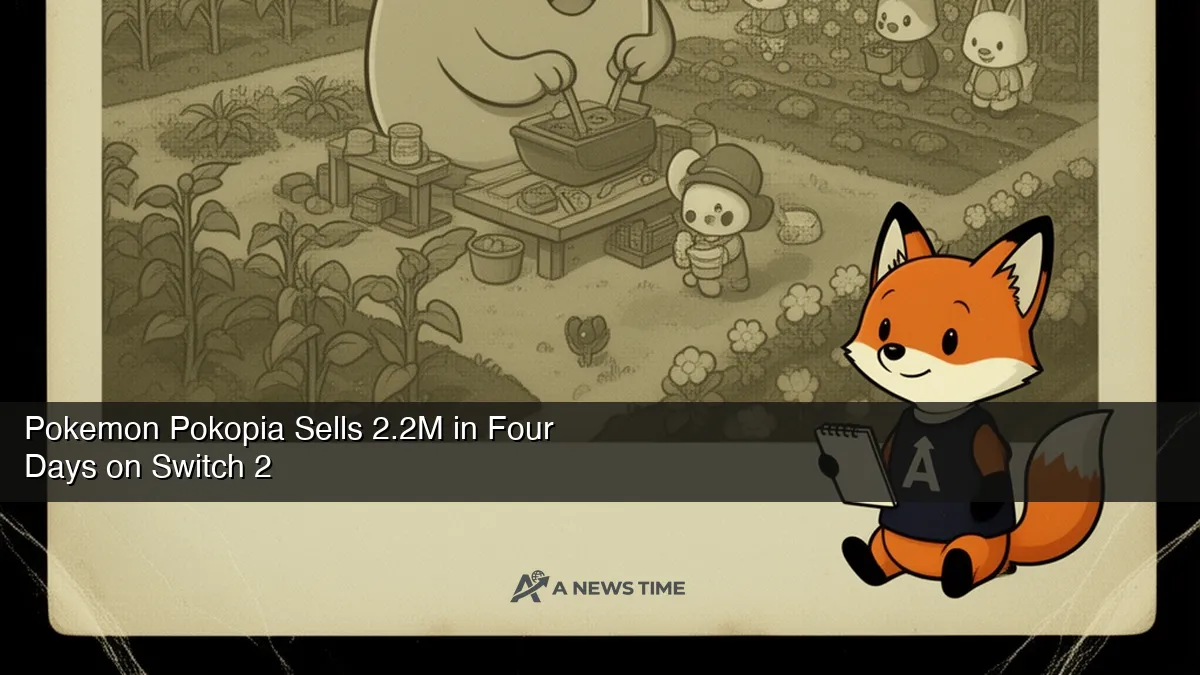
Nintendo has confirmed that Pokemon Pokopia sold 2.2 million copies in its first four days on the Switch 2, making it one of the fastest-selling Pokemon spinoffs in the franchise's thirty-year history. Launched on as a Switch 2 launch title, Pokopia arrived with a Metacritic score of 89, tying with Capcom's Resident Evil Requiem as the best-reviewed game of 2026 so far. Those two numbers together, an exceptional review score and a blowout opening weekend, tell a story that goes well beyond hype: they suggest Nintendo and Game Freak may have finally cracked the code on Pokemon spinoffs that critics and players both take seriously.
The game stars a Ditto tasked with restoring a withered, faded world to life, a premise that doubles as an elegant metaphor for what Pokemon Pokopia itself is trying to do. It blends mechanics from Animal Crossing and Dragon Quest Builders, adding crafting, crop-growing, habitat construction, and deep decoration systems, while wrapping all of it in the warm visual language of the Pokemon universe. The result is something that feels simultaneously familiar and genuinely new, which is not an easy trick for a franchise that has been releasing games since 1996.
For context on why 2.2 million in four days matters, consider the historical record. The previous best-selling Pokemon spinoff was Pokemon Stadium, which moved 5.4 million copies over its entire commercial lifespan. Pokopia, on its current trajectory, is expected to surpass that figure well before the end of the year. Nintendo has not projected final sales targets, but analysts covering the franchise expect the game to become the highest-selling Pokemon spinoff in history.
A Switch 2 Launch Title That Actually Delivered
Nintendo's track record with launch titles is mixed. The original Switch launched in 2017 with The Legend of Zelda: Breath of the Wild, which set an almost unfair standard. The Switch 2 carries different expectations, and Nintendo appears to have assembled a more balanced launch lineup rather than betting everything on a single franchise tentpole.
Pokopia was positioned as a core part of that launch strategy, and by all available measures it delivered. The game sold 2.2 million units in four days across both digital and physical formats. To put that in perspective, some well-regarded Pokemon spinoffs have not reached that number in their first year. The combination of a major hardware launch, strong review scores, and genuine word-of-mouth drove adoption in a way that feels organic rather than manufactured.
Paul Tassi, writing for Forbes on , noted that the 89 Metascore represents "an unusual achievement for a Pokemon spinoff, a category of games that has historically ranged from beloved (Pokemon Mystery Dungeon) to deeply cynical (any number of rushed licensed titles)." That critical credibility appears to be contributing directly to consumer confidence in ways that marketing spend alone cannot replicate.
The Switch 2 hardware itself also plays a role in this story. Pokopia's decoration and habitat-building systems take advantage of the Switch 2's improved processing power to render more complex environments with greater draw distances than would have been possible on the original hardware. The photo mode, which lets players capture their Pokemon companions in custom habitats, has generated extensive engagement across social platforms, functioning as organic marketing for the game in a way that Nintendo likely anticipated and planned around.
What Pokemon Pokopia Actually Is: Mechanics and Design
Understanding why Pokopia has resonated requires understanding what it is actually asking players to do, which is quite different from mainline Pokemon titles.
The core loop places you in the role of a Ditto attempting to revitalize a world that has been drained of color and life. You build structures, cultivate crops, and create habitats that attract different Pokemon species to your territory. As the world fills with returning Pokemon, the environment transforms visually, rewarding careful habitat construction with increasingly spectacular landscapes. It is a design philosophy borrowed directly from Animal Crossing: the satisfaction of patient accumulation and visible environmental change over time.
The Dragon Quest Builders influence is most apparent in the crafting and construction systems. Unlike Animal Crossing, which gives players pre-designed furniture and structures to place, Pokopia allows freeform building using gathered materials. You can construct custom architecture, design Pokemon habitats with specific terrain features, and engineer ecosystems that attract particular species. The depth of these systems is considerable, and the game rewards players who engage seriously with the construction mechanics with unique Pokemon encounters and story beats that casual players will not see.
The social layer, implemented through a feature called House Parties and GameShare, allows players to invite friends into their constructed worlds. GameShare, a Switch 2 feature, enables local multiplayer experiences without requiring every participant to own a copy of the game. This is a meaningful design decision: it lowers the barrier for group engagement and positions Pokopia as a social experience in ways that most Pokemon spinoffs have not attempted.
"Pokopia understands something that a lot of life-sim games forget: the Pokemon themselves need to feel like they have genuine personalities and preferences, not just be decorations. When a Snorlax wanders into a habitat you built specifically for it and seems genuinely content there, that is the moment the game earns your emotional investment."
Nintendo Life review,
Critical Reception and the 89 Metascore
An 89 Metascore is not a number that arrives by accident. It requires a game to be consistently excellent across the criteria that different reviewers weight differently, including visual design, mechanical depth, accessibility, performance, and that harder-to-define quality of whether the game does what it sets out to do better than you expected.
The reviews for Pokopia cluster around several shared observations. First, the game is visually stunning, with a pastel-to-vibrant color progression that makes the world's restoration feel genuinely meaningful. Second, the construction and crafting systems are deep enough to sustain long-term engagement without becoming opaque or frustrating for players who are less interested in optimization. Third, the Ditto protagonist is a genuinely effective creative choice, allowing the game to explore themes of identity and potential without the franchise iconography that would normally dominate a Pokemon title.
The criticisms that appear in review scores below the aggregate are mostly about pacing. The early hours of Pokopia ask players to work with limited resources in a world that is, by design, bleak and depleted. Some reviewers found this opening stretch slow, particularly for players who came to the game expecting the immediate pop and color of a mainline Pokemon title. This is a fair criticism but also arguably a misread of the game's artistic intentions. The bleakness is the point. It is setting up the payoff.
IGN's review highlighted the photo mode specifically as one of the game's strongest features, noting that the ability to stage Pokemon in custom habitats and capture them at specific times of day creates "a degree of personal expression that most games in this genre never achieve." This kind of player-generated content has a long tail effect on a game's cultural footprint, and Pokopia appears to be benefiting from it already.
Historical Context: Pokemon Spinoffs and the Franchise's Complicated Relationship With Critical Success
The Pokemon franchise has generated billions of dollars across games, anime, merchandise, and the trading card game. But the spinoff category specifically has a checkered history. For every Pokemon Mystery Dungeon that earned genuine affection, there have been titles that felt like brand extensions with minimal creative ambition.
The best-selling spinoff benchmark, Pokemon Stadium at 5.4 million copies, is instructive. Stadium succeeded largely because it was one of the few ways to see Pokemon in 3D at a time when that was a novelty, and because it gave players a competitive battle format that felt meaningfully different from the handheld games. Its commercial success was driven more by timing and novelty than by critical acclaim.
Pokopia's path to potentially surpassing Stadium's lifetime total is different in kind. It is succeeding because it is genuinely good, not because it is filling a gap that nothing else fills. The 89 Metascore is evidence of quality that the market is then rewarding with sales. This sequence, critical quality driving commercial success rather than the other way around, is healthier for the franchise's long-term creative reputation and signals something important about what Game Freak and Nintendo believe the Pokemon brand can sustain.
The relationship between creative risk and franchise health is something the broader gaming industry has been navigating with increasing urgency. Our coverage of how entertainment companies are rethinking content investment touches on similar dynamics in adjacent industries, where franchises that take creative risks tend to maintain audience loyalty in ways that safe sequels cannot.
Competition and the Switch 2 Landscape for the Rest of 2026
Pokopia's launch was strong, but the Switch 2's release calendar for the rest of 2026 means it will not have the spotlight to itself for long. Two titles in particular represent meaningful competition for attention and wallet share.
Yoshi and the Mysterious Book, scheduled for , targets a similar audience in terms of visual style and family-friendly accessibility. Nintendo has positioned the two games as complementary rather than competing, but consumers allocate time and money in zero-sum ways regardless of how publishers position their catalogs. If Yoshi delivers on its promise, Pokopia will face the challenge of sustaining momentum when there is a new Nintendo title competing for the same demographic.
Fire Emblem: Fortune's Weave is a more direct challenge for the older, more strategically-inclined segment of the Nintendo audience. The Fire Emblem franchise has built a devoted following that overlaps with Pokemon players who prioritize depth and complexity over accessibility. How Nintendo manages the positioning of these titles against each other, through marketing, release timing, and post-launch support, will be one of the more interesting platform strategy stories of 2026.
For Pokopia specifically, post-launch support will be critical to sustaining the sales momentum that a 2.2-million-unit opening generates. The game's construction and decoration systems are exactly the kind of mechanics that benefit from regular content updates: new Pokemon species, new building materials, new habitat types, and seasonal events. Nintendo's experience with Animal Crossing: New Horizons, which sustained active engagement for over three years through updates, provides a clear template for how to handle Pokopia's ongoing development.
What the Sales Numbers Mean for Pokemon's Creative Future
There is a larger argument embedded in Pokopia's commercial success that extends beyond the game itself. The Pokemon franchise has faced persistent criticism over the past decade for prioritizing speed of release over quality of execution. Games released with performance issues, limited postgame content, and visible evidence of insufficient development time have generated headlines that the franchise's commercial resilience allowed Nintendo and Game Freak to largely ignore.
Pokopia represents a different approach: a spinoff given sufficient time and resources to be genuinely excellent rather than merely adequate. The 89 Metascore and 2.2-million-unit opening suggest that this approach is commercially viable, perhaps even more viable than the faster-release strategy that characterized the franchise's recent history.
The question now is whether Pokopia's success influences how Nintendo and Game Freak approach future titles across the franchise. If a well-made spinoff can compete for lifetime sales records against games that benefited from novelty and timing, then the case for prioritizing quality over release cadence becomes considerably stronger. Industry analysts who have been skeptical about the Pokemon franchise's creative direction will be watching the next mainline title's development cycle with particular interest.
The gaming industry's broader relationship with quality investment and franchise stewardship is a theme we have explored in our technology coverage, particularly in analysis of how major platforms manage long-term investment versus short-term returns. The dynamics are different, but the underlying tension between quarterly thinking and long-term brand health is recognizable across industries.
Community Reaction and What Comes Next
The Pokemon community's response to Pokopia has been notably different from recent mainline titles, where discourse often splits quickly between enthusiastic defenders and critics cataloguing technical shortcomings. With Pokopia, the community conversation has been predominantly about what people are building, which habitats they have created, which Pokemon have taken up residence, and what the photo mode has allowed them to capture.
This shift in the nature of community discourse is significant. When players are talking about their own creations rather than debating whether the game is "good enough," it indicates the kind of creative engagement that sustains a game's cultural presence over time. The Pokopia subreddit and dedicated Discord servers are full of habitat showcases, photo mode galleries, and construction guides. This is the kind of organic community content that Nintendo cannot buy with marketing and that signals genuine long-term viability.
The GameShare feature deserves specific mention here. By allowing players to host friends in their worlds without requiring everyone to own the game, Nintendo has created a natural word-of-mouth mechanism that operates through direct experience rather than secondhand recommendation. Players who visit a friend's Pokopia world and enjoy the experience have a clear and immediate path to purchasing their own copy. This is smart platform design, and it appears to be working.
As Pokopia approaches the end of its launch window and settles into its post-release cadence, the metrics to watch are Day-30 retention, which will indicate whether the construction and habitat systems are deep enough to sustain long-term engagement, and total software sales at the three-month mark, which will signal whether the game can maintain momentum beyond the hardware launch window. If it crosses the 5.4-million-unit mark before the end of 2026, it will become the best-selling Pokemon spinoff in franchise history, a milestone that would mark a genuine inflection point for how Nintendo thinks about the Pokemon brand's potential outside its mainline format.