Byline: Kieran Wolfe, Senior Gaming Reporter
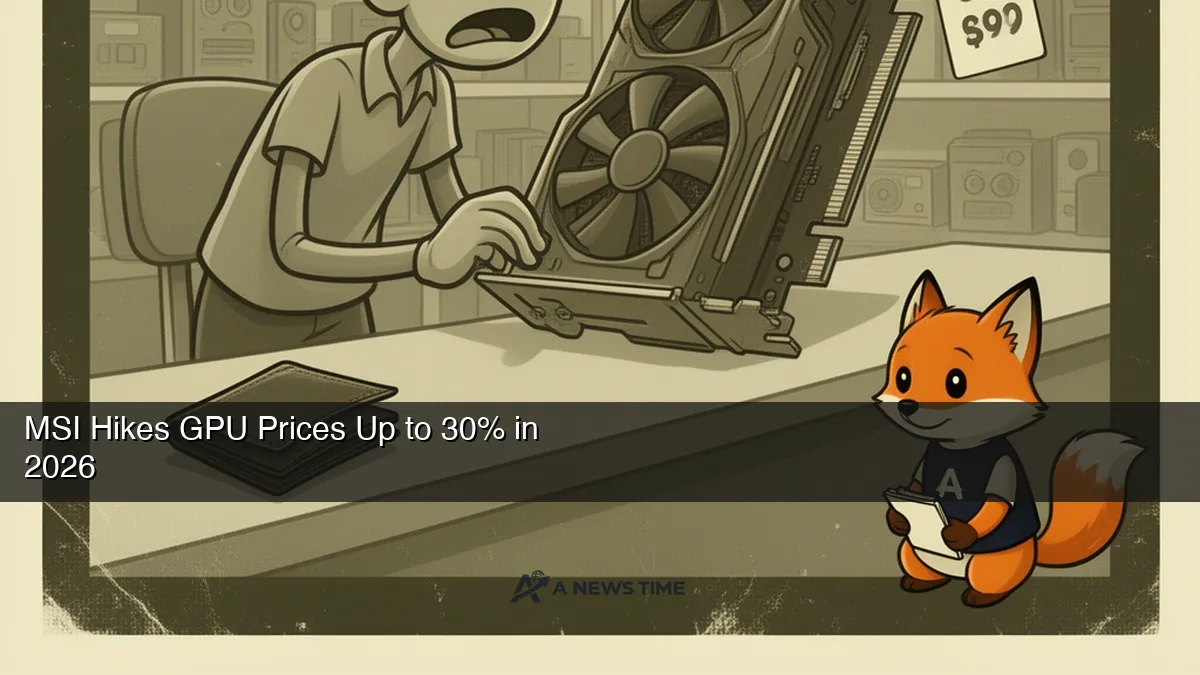
MSI, one of the world's largest manufacturers of discrete graphics cards, announced during its earnings call that it will raise GPU prices by 15 to 30 percent over the next nine months. General Manager Huang Jinqing delivered the news to investors with unusual candor, calling 2026 "the most challenging year since the company was founded." The statement was not hyperbole. Behind it sits a supply chain shock that stretches from DRAM fab floors in Taiwan to the server halls of hyperscale cloud providers, and the people who will feel it most are ordinary PC gamers already squeezed by years of inflation.
The immediate trigger is a dramatic spike in memory costs. DRAM modules that MSI sourced for roughly $40 per unit not long ago now command prices above $170, a 325 percent increase in component cost that the company says it cannot absorb without passing a significant share on to buyers. That math is brutal for a product category where consumer price sensitivity has historically been high and where the GPU market was only just recovering from the crypto-driven supply chaos of the early 2020s.
For PC gamers who had hoped 2026 would bring relief after several turbulent years of hardware pricing, Huang's remarks are a cold splash of water. The increases are not hypothetical, and they are not temporary discounts being rolled back. They represent a structural shift in how MSI intends to operate in a market the company itself describes as deeply uncertain.
Why DRAM Costs Jumped So Dramatically
To understand why MSI is facing this cost cliff, you need to follow the memory supply chain upstream to the hyperscalers. Companies like Amazon Web Services, Microsoft Azure, and Google Cloud have been expanding their AI data center capacity at a pace that strains global DRAM production. Training large language models and running inference workloads at scale requires enormous amounts of high-bandwidth memory, and the fabs that produce that memory have finite capacity.
When hyperscalers outbid everyone else for DRAM allocation, the ripple effects hit every product category that depends on the same fabs. Consumer graphics cards use GDDR memory, which shares manufacturing lines with some server-grade memory components. The tight supply does not map perfectly across product lines, but the pressure is real enough that MSI is reporting sourcing costs that make low-end GPU production economically inviable at current retail price expectations.
MSI's response to this pressure has been to deprioritize the bottom of its product stack. The company is cutting production of entry-level and budget GPUs to concentrate manufacturing resources on mid-range and high-end cards, where margins are wider and where the cost increases can be spread across a higher base price without looking quite as dramatic in percentage terms. This is a rational business decision that is simultaneously a significant problem for PC gaming accessibility. The budget segment, the part of the market where first-time builders and cost-conscious upgraders live, is shrinking precisely when new buyers need it most.
The situation is not unique to MSI. Component cost pressures affect every board partner building on NVIDIA and AMD silicon. But MSI's public acknowledgment of both the scale of the increases and the strategic pivot away from entry-level products is unusually direct, and it signals that the industry as a whole is recalibrating its expectations for what consumer PC hardware looks like in 2026.
MSI's $625 Million Bet on AI Infrastructure
While raising prices on consumer products, MSI is simultaneously making one of the largest capital investments in its history. The company has committed more than 20 billion New Taiwan Dollars (approximately $625 million USD at current exchange rates) to building a new AI server facility. The investment signals where MSI's leadership believes the durable revenue opportunity lies: not in selling GPUs to gamers, but in supplying the infrastructure that powers machine learning at industrial scale.
This strategic pivot is not unique to MSI. NVIDIA itself has been steadily tilting its production mix toward data center products and away from GeForce gaming cards, a shift that has contributed to constrained supply of consumer-grade silicon. When the company that designs the chips prioritizes a different market, the board partners that build products around those chips face their own supply constraints on top of the memory cost pressures already squeezing margins.
The framing of 2026 as MSI's most challenging year is significant because it comes from a company that navigated the pandemic supply crisis, the crypto mining boom and bust, and multiple rounds of component shortages. For Huang Jinqing to characterize this moment as uniquely difficult suggests that the combination of forces at play, rising memory costs, hyperscaler demand crowding out consumer supply, slowing PC market growth, and enormous capital requirements for AI infrastructure, is qualitatively different from the disruptions of recent years.
The AI infrastructure investment also illustrates the bind that hardware companies find themselves in. Staying competitive in the AI server market requires enormous capital commitment. That capital has to come from somewhere, and the consumer gaming segment, which is both lower-margin and more price-elastic than enterprise customers, becomes a logical place to extract additional revenue through higher prices, even if doing so risks long-term market share.
The Ripple Effect Across PC Gaming
MSI's announcement does not exist in isolation. The same cost pressures that are driving GPU price increases are creating turbulence across the broader PC gaming ecosystem, and several major players are already showing the strain.
Valve's Steam Deck, the handheld PC gaming device that opened up an entirely new market segment, has been experiencing stock shortages that the company has not fully explained publicly. Industry observers have pointed to component constraints as a likely factor, and the DRAM cost spike fits the pattern. Steam Deck units use custom memory configurations, and sourcing those components at scale becomes significantly harder when hyperscaler demand is crowding out supply.
Microsoft's next-generation Xbox hardware has reportedly been delayed, though the company has not confirmed a specific timeline publicly. The logic here is similar: console manufacturers build hardware at price points that require careful component cost management, and when key components spike in price, the calculus for a hardware launch changes significantly. Launching a console at a price consumers will pay while maintaining acceptable margins becomes much harder when DRAM costs triple.
Intel, which has been trying to establish a meaningful position in the discrete GPU market with its Arc product line, faces the same component cost pressures as MSI while also managing the challenges of being a relatively new entrant in a market dominated by NVIDIA and AMD. Price increases would be especially damaging for Intel, whose Arc cards have positioned themselves as value alternatives. Raising those prices undercuts the primary competitive advantage that gave Arc any market foothold at all.
The interconnected nature of these pressures is worth emphasizing. This is not a single company making a bad strategic decision, or a temporary supply blip that will resolve itself in a quarter or two. The AI infrastructure buildout that is consuming DRAM supply is a multi-year phenomenon driven by capital commitments that have already been made and facilities that are being built right now. The competition for memory between AI applications and consumer devices is structural, not cyclical.
For more context on how AI investment is reshaping the broader technology landscape, see our coverage of big tech AI spending coming under investor scrutiny in 2026 and how energy tech startups are surging to meet AI infrastructure power demands.
What 15 to 30 Percent Actually Means for Buyers
Numbers like "15 to 30 percent" can feel abstract until you apply them to specific products. Consider the current retail landscape. A mid-range GPU priced around $400, a tier that has historically represented the sweet spot for enthusiast PC gamers on reasonable budgets, would see its price rise to somewhere between $460 and $520 under MSI's announced increases. A $600 high-end card could reach $690 to $780. These are not trivial differences for consumers who are already managing housing costs, food prices, and general inflation.
The timing compounds the problem. Zack Zwiezen, writing for Kotaku in March 2026, noted that these increases arrive as the PC gaming market itself is projected to contract by 10 to 20 percent. That projection suggests that manufacturers are raising prices into a market where demand is already softening, a dynamic that typically ends badly for the segment raising prices, but that can also signal that manufacturers are willing to accept lower sales volume in exchange for higher per-unit revenue.
The contraction projection is itself a symptom of multiple pressures: general consumer spending caution, the growing library of older games available at deep discounts through services like Steam and Game Pass, the increasing quality of gaming on smartphones and tablets, and the simple fact that the current console generation has been available long enough that many households that wanted to upgrade have already done so.
MSI's decision to cut low-end production rather than try to hold price points in the budget segment suggests the company has made a clear-eyed assessment: the volume of sales it would need at maintained low prices to justify production does not materialize in a contracting market. Better to serve fewer customers at higher prices than to chase volume in a segment where margins are already razor-thin and getting thinner.
"2026 is the most challenging year since the company was founded."
Huang Jinqing, General Manager, MSI (March 2026 earnings call)
Community Reaction and the Long View
The PC gaming community's reaction to the MSI announcement has been predictably frustrated, with threads across Reddit's r/hardware and r/pcgaming communities cycling through disbelief, resignation, and dark humor. The frustration is legitimate. PC gaming has always carried a premium compared to console gaming, justified by the flexibility, upgrade path, and software library that the platform offers. When that premium starts to look like a barrier rather than a reasonable tradeoff, it threatens one of the foundational assumptions of the PC gaming value proposition.
Some community members have pointed out that the timing creates an interesting dynamic for AMD, whose GPU lineup competes directly with MSI's NVIDIA-based products. If MSI raises prices aggressively and AMD's board partners follow more cautiously, AMD could gain meaningful market share among budget-conscious buyers. Others have noted that if both NVIDIA and AMD board partners face similar component cost pressures, the competitive dynamics may not provide much relief for consumers regardless of which team they prefer.
The longer view requires some honesty about what the gaming hardware market has been through over the past five years. The pandemic-era GPU shortage, driven by a combination of mining demand, supply chain disruptions, and stimulus-fueled consumer spending, created a period of grotesquely inflated prices that eventually normalized. The normalization felt like a correction toward sanity. What MSI is announcing now is different: not artificial scarcity or speculative demand, but genuine structural cost pressure from a competing use case that is better capitalized and more strategically important to chip and memory manufacturers than consumer gaming.
The question is whether this represents a permanent repricing of PC gaming hardware or a cycle that will eventually ease as AI infrastructure buildout stabilizes and memory production capacity catches up with demand. The honest answer is that nobody knows with confidence, but the capital commitments being made in AI infrastructure suggest that the pressure is not going away in 2026, and probably not in 2027 either.
For PC gamers, the practical advice is familiar: if you have a system that meets your current needs, the case for upgrading has rarely been weaker from a cost-benefit standpoint. If you need to build or upgrade, doing so sooner rather than later, before the full weight of MSI's announced increases hits retail shelves, may be the most sensible approach. The window for that may be narrow.