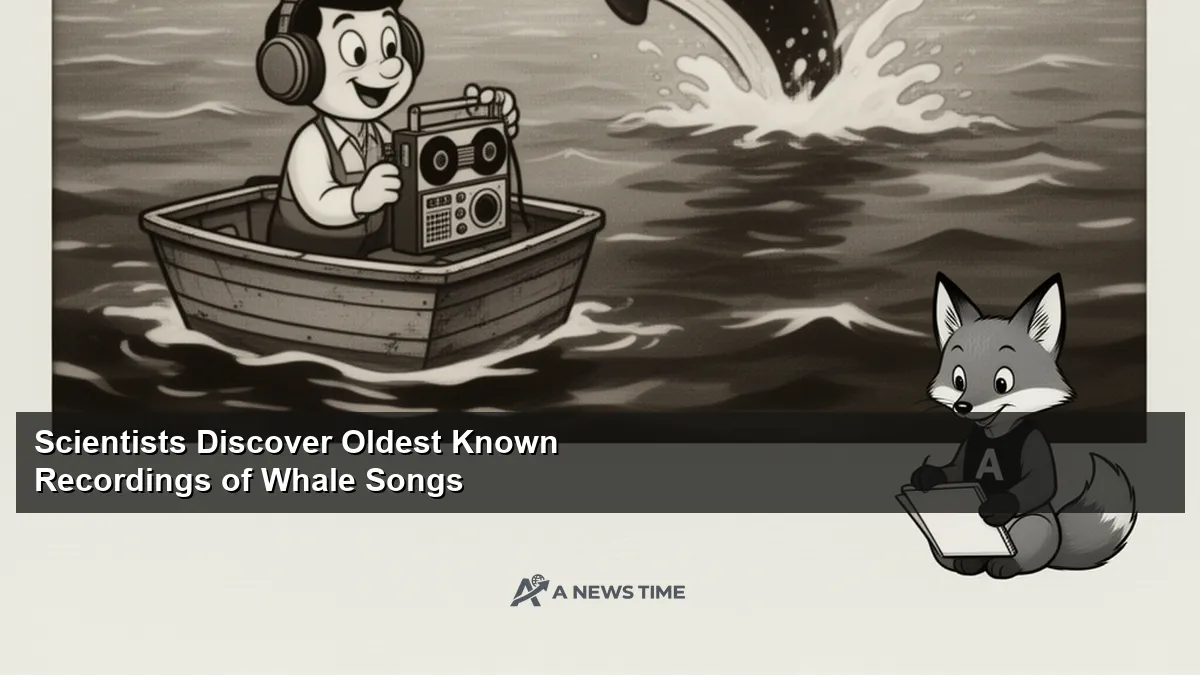
Deep in a research archive on Cape Cod, Massachusetts, scientists have uncovered what are believed to be the oldest known recordings of whale songs, audio artifacts that predate any previously catalogued whale vocalization recordings by a significant margin. The discovery, announced in , offers researchers an unprecedented window into how whale communication has changed over decades, providing baseline data that could transform our understanding of how these animals adapt their vocal behavior to a changing ocean environment.
Found in the Archives
The recordings were not captured by a new expedition or a novel underwater listening technology. They were found where many scientific treasures hide in plain sight: in an institutional archive, stored on aging media, catalogued but unexamined for their full significance. Researchers working at a Cape Cod research facility were conducting a systematic review of historical audio collections when they identified recordings of whale vocalizations that had been made decades earlier than the oldest previously known whale song recordings.
The precise dating and provenance of the recordings are still being verified through archival documentation and audio analysis, but preliminary assessment places them well ahead of the recordings made in the 1960s and 1970s that launched the modern era of whale acoustic research. Those mid-century recordings, particularly the famous recordings of humpback whale songs made by Roger Payne and Scott McVay and released to the public in 1970, are widely credited with catalyzing the "Save the Whales" movement and fundamentally changing public attitudes toward marine mammals.
The newly discovered recordings may push the timeline of documented whale vocalizations back considerably, offering a sonic snapshot of whale populations that lived in an ocean quite different from today's, one with less ship traffic, less ambient noise, different water temperatures, and whale populations that had been decimated by centuries of commercial whaling but had not yet begun the recovery enabled by the International Whaling Commission's 1986 moratorium.
Why Old Recordings Matter
Whale songs are not fixed compositions. They change over time, sometimes gradually and sometimes dramatically. Humpback whales, the species whose songs have been most extensively studied, are known to modify their songs from year to year, with all males in a given population converging on the same version of the song at any given time before collectively evolving it further. This process of cultural transmission and modification has been called one of the most complex forms of non-human culture observed in nature.
But understanding how songs change requires having recordings from different time periods to compare. Until now, the baseline for such comparisons has been limited to roughly the last 50 to 60 years, the period since systematic whale acoustic research began. Any changes that occurred before that window are invisible to science, a gap that the Cape Cod discovery could help fill.
Consider an analogy from human music. If you wanted to understand how jazz evolved, you would need recordings from different eras: early New Orleans jazz, the swing era, bebop, cool jazz, free jazz, and modern iterations. Without the early recordings, you could describe how jazz sounds today and how it has changed over the past few decades, but you would miss the foundational period that shaped everything that followed. The Cape Cod whale recordings potentially represent that foundational period for whale song research, an era when whale populations, ocean conditions, and acoustic environments were fundamentally different from what exists today.
What Changes in Whale Songs Tell Us
The scientific value of historical whale recordings extends far beyond musicological curiosity. Whale vocalizations are sensitive indicators of multiple factors that affect marine ecosystems, and changes in those vocalizations can reveal information about:
- Population structure: Different whale populations sing different variations of their species' songs. By comparing the acoustic characteristics of historical recordings with modern ones from the same geographic area, researchers can infer whether the population's composition has changed, whether individuals from other populations have migrated in, or whether cultural traditions have been lost or gained.
- Ocean noise: One of the most significant changes in the marine environment over the past century has been the dramatic increase in anthropogenic (human-caused) underwater noise, primarily from shipping, but also from sonar, seismic surveys, and construction. Whales are known to modify their vocalizations in response to noise, adjusting frequency, amplitude, and timing. Historical recordings from a quieter ocean could reveal the "natural" acoustic behavior of whales before noise pollution became pervasive.
- Population health: Some research suggests that the complexity and vigor of whale songs may correlate with population health and breeding success. Stressed or depleted populations may produce simpler or less varied songs. Comparing historical songs from heavily whaled populations with modern songs from recovering populations could test this hypothesis.
- Climate impacts: Ocean temperature, salinity, and current patterns affect sound propagation underwater, which in turn influences how whales produce and receive vocalizations. Historical recordings could provide data on how acoustic communication has adapted to changing ocean conditions over time, a question with growing relevance as ocean warming accelerates.
The Science of Whale Acoustics
For readers unfamiliar with the field, whale acoustics is a discipline that sits at the intersection of marine biology, physics, and signal processing. Whales produce sound through mechanisms that vary by species. Baleen whales (including humpbacks, blue whales, and fin whales) are thought to produce sound by passing air through structures in their larynx, though the precise mechanism is still debated and may differ between species. Toothed whales (including sperm whales, dolphins, and beaked whales) produce clicks and other sounds using specialized structures called phonic lips in their nasal passages.
The sounds themselves span an enormous range. Blue whale calls can be as low as 10 to 20 hertz, below the threshold of human hearing, and can travel thousands of kilometers through deep ocean sound channels. Humpback whale songs occupy a broader frequency range, from roughly 80 hertz to several kilohertz, and are structured into complex hierarchical patterns of units, phrases, and themes that can last 10 to 30 minutes before repeating.
Studying these sounds requires hydrophones (underwater microphones) deployed either from ships, on the seafloor, or attached to autonomous underwater vehicles. Modern digital recording equipment can capture whale sounds with high fidelity and store vast quantities of data for later analysis. But in the era when the Cape Cod recordings were made, the technology was far more primitive: analog tape recorders, limited frequency response, shorter recording durations, and no automated detection or analysis tools. The fact that usable recordings were made at all speaks to the skill and dedication of the original researchers.
The technical challenge now is to extract maximum information from these historical recordings despite their limitations. The analog media may have degraded over time, introducing noise and frequency distortion. The recording equipment may not have captured the full frequency range of the whale vocalizations. And the documentation accompanying the recordings, including the species, location, water depth, and environmental conditions, may be incomplete. Careful forensic analysis of both the audio content and the archival metadata will be essential to realizing the recordings' full scientific value.
The Cultural Dimension of Whale Song
One of the most remarkable aspects of whale song research over the past two decades has been the accumulating evidence that whale songs represent a form of culture, socially transmitted behaviors that are learned, shared, and modified within and between populations rather than being genetically programmed.
The clearest evidence comes from humpback whales, where researchers have documented "song revolutions," episodes in which a population rapidly adopts an entirely new song, apparently learned from individuals belonging to a neighboring population. These revolutions have been observed to spread across the South Pacific from Australia eastward, with each population adopting the new song within one to two years of its arrival from the west. The mechanism appears to be cultural transmission: males hear the new song from migrants or during encounters on shared feeding or breeding grounds, learn it, and begin singing it themselves.
This cultural dynamic means that whale songs are not merely biological signals but historical documents in their own right. Each recording captures a specific moment in an ongoing cultural evolution, much as a recording of a human musical performance captures a moment in the evolution of a musical tradition. The older the recording, the further back we can trace that cultural evolution and the more we can learn about how whale societies change over time.
The Cape Cod recordings could be particularly valuable in this regard if they capture songs from populations that were at a critical juncture in their history. In the mid-twentieth century, many whale populations had been reduced to fractions of their pre-whaling numbers. Small populations tend to lose cultural diversity, just as small human communities can lose languages, traditions, and knowledge when their populations decline. If the recordings preserve songs from depleted populations, they may document a cultural bottleneck, a period of reduced vocal diversity that parallels the population bottleneck documented in genetic studies. This kind of archival discovery has parallels in recovering ancient astronomical observations that provide irreplaceable historical baselines.
Noise, Ships, and the Changing Ocean Soundscape
Perhaps the most immediately relevant application of historical whale recordings is in understanding how anthropogenic noise has altered whale communication. The modern ocean is dramatically noisier than the ocean of 50 or 100 years ago. Commercial shipping traffic has increased enormously, with large vessels producing low-frequency noise that can propagate across entire ocean basins. The cumulative effect is a rise in ambient noise levels that has been estimated at roughly 3 decibels per decade since the 1960s in some frequency bands, a doubling of noise intensity every ten years.
For whales that rely on sound for communication, navigation, foraging, and social bonding, this increase in background noise has measurable consequences. Research has shown that some whale species call louder in noisy conditions (the Lombard effect, also observed in humans speaking in crowded rooms), shift their call frequencies to avoid overlap with shipping noise, time their calls to gaps between ship passages, or reduce their calling rates altogether. Each of these responses carries costs: calling louder requires more energy, shifting frequencies may reduce communication range or clarity, and reducing call rates may interfere with breeding success.
Historical recordings from a pre-noise or lower-noise ocean would provide a baseline against which these behavioral changes can be measured. If the Cape Cod recordings capture whale vocalizations from an era before shipping noise became dominant in their acoustic environment, researchers could directly compare the amplitude, frequency, complexity, and timing of those historical calls with modern recordings from the same geographic area, quantifying the acoustic adaptation that whale populations have undergone. Understanding these long-term shifts in communication is analogous to tracking shifting environmental baselines in other domains.
Technical Challenges of Working With Historical Audio
Extracting scientific data from decades-old audio recordings is not straightforward. The original recording media (likely reel-to-reel magnetic tape) degrades over time through several mechanisms:
- Oxide shedding: The magnetic oxide coating that stores the audio signal can separate from the tape backing, causing permanent data loss. This is particularly common with tapes stored in humid conditions.
- Print-through: When tape is stored on reels, the magnetic signal from one layer can transfer to adjacent layers, creating faint echoes or ghost signals that contaminate the original recording.
- Frequency response degradation: High-frequency components of the recorded signal tend to degrade faster than low-frequency components, altering the spectral balance of the recording over time.
- Speed drift: If the tape was recorded on equipment that was not precisely calibrated, or if the playback equipment differs from the recording equipment, the playback speed may not match the recording speed, introducing pitch and timing errors.
Modern digital restoration techniques can mitigate some of these issues. Noise reduction algorithms can separate the whale signals from tape hiss and other recording artifacts. Spectral analysis can identify and compensate for frequency response anomalies. And careful calibration against known reference signals (if any were included on the tapes) can correct for speed drift.
But restoration has limits. Information that was never captured (frequencies outside the recorder's range, signals below the noise floor of the equipment) cannot be recovered. And aggressive noise reduction can introduce artifacts of its own, potentially altering the very characteristics of the whale sounds that researchers want to analyze. The challenge is to extract as much authentic information as possible while being transparent about the limitations of the source material.
What Comes Next
The immediate next steps for the Cape Cod research team involve several parallel tracks. The recordings themselves need to be fully digitized, catalogued, and characterized in terms of their technical quality, temporal coverage, and species content. Archival research will attempt to establish the precise dates, locations, and circumstances of the original recordings, information that is essential for placing them in their proper ecological and historical context.
Once the recordings are fully documented, the comparative analysis can begin. Researchers will examine the acoustic features of the historical songs (frequency ranges, temporal patterns, harmonic structure, song length, phrase composition) and compare them with the extensive modern databases of whale vocalizations maintained by institutions worldwide. Differences between historical and modern songs, if confirmed to be genuine rather than artifacts of recording quality, could provide insights into decades of acoustic and cultural evolution in whale populations.
The broader scientific community is watching the Cape Cod discovery with interest. Whale acoustics is a field where data from the past is inherently irreplaceable: you cannot go back and record whale songs from 1950. Every historical recording that survives represents a unique data point that no future technology can reproduce. The Cape Cod discovery is a reminder that archives, often underfunded and underappreciated, can hold scientific treasures that no amount of new data collection can substitute for. This type of careful archival investigation, recovering and reinterpreting historical data through modern analytical lenses, connects to a broad tradition in science that includes efforts like reviving decades-old theoretical concepts with new technology.
For the whales themselves, the recordings carry a different kind of significance. They are, in a sense, the voices of ancestors, songs from a generation of animals that navigated oceans shaped by the tail end of industrial whaling, the beginnings of modern shipping, and ocean temperatures that now serve as the pre-warming baseline. What those voices tell us about the ocean they lived in, and how it compares to the ocean their descendants inhabit today, may be one of the most valuable scientific narratives to emerge from a dusty archive on Cape Cod.