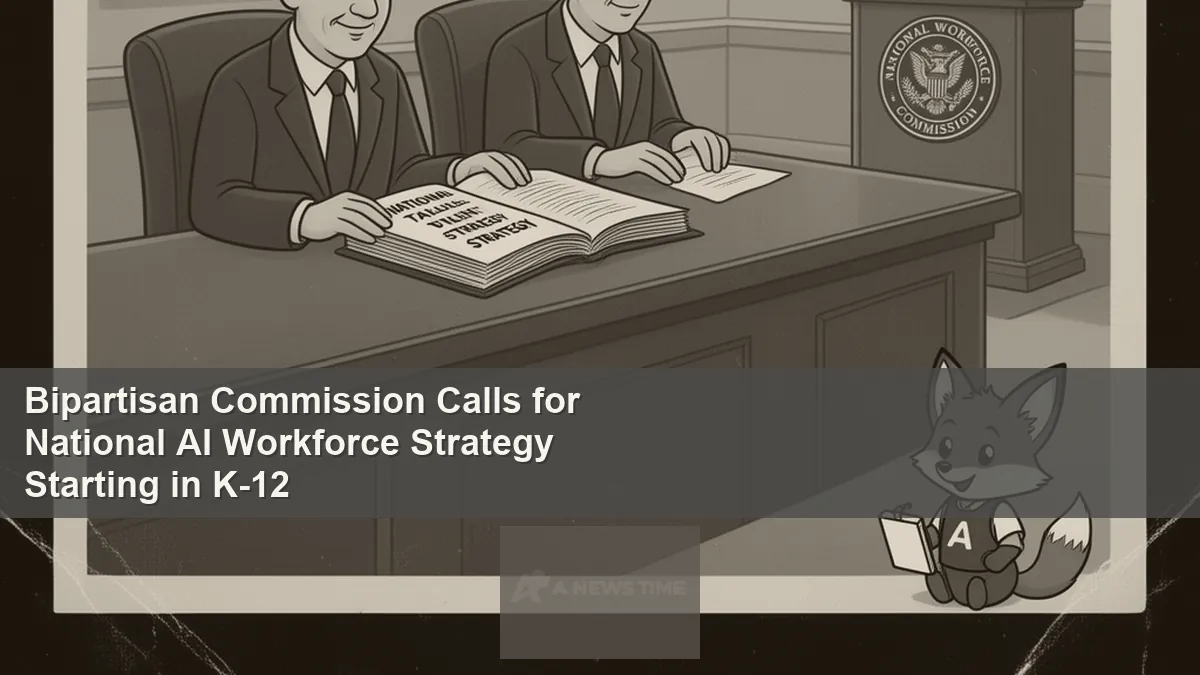
On , the Commission on the American Workforce, convened by the BPC in Washington, D.C., published "A Nation at Risk to a Nation at Work: The Case for a National Talent Strategy," a 70-page blueprint that argues the United States is heading toward an economic competitiveness crisis unless it fundamentally overhauls how it develops, tracks, and deploys human talent. The report, two years in the making and signed by 24 commissioners drawn from both political parties, identifies artificial intelligence as the central accelerant of labor market disruption and names K-12 schooling as the most consequential and most neglected lever available to federal and state policymakers. The commission was co-chaired by former Republican Governor Bill Haslam of Tennessee and former Democratic Governor Deval Patrick of Massachusetts, a pairing that the authors say reflects the document's deliberate attempt to find policy ground outside the current culture-war stalemate.
A Workforce System Built for a Different Century
The report's opening diagnosis is stark. The federal government currently spends more than $250 billion annually across more than 150 education, workforce training, and social support programs, yet no single agency has a mandate to coordinate them. The result, the commission argues, is a fragmented landscape that forces workers, students, and employers to navigate contradictory requirements, redundant applications, and incompatible data systems at exactly the moment when speed and coherence matter most.
The underlying numbers explain the urgency. Between 2021 and 2024, one-third of the skills required for the average U.S. job changed, according to labor market data cited in the report. By late 2025, independent analyses suggested that 57 percent of current U.S. work hours could be automated using technologies that already exist. Those two figures together describe a system under pressure from two directions at once: the floor is moving (existing jobs are changing faster than workers can retrain) and the ceiling is lowering (AI tools are automating tasks once considered safely human).
The commission is also pointing to warning signs in the educational pipeline that feeds the workforce. Math and reading scores on the NAEP remain at historic lows following the pandemic. Underemployment rates for recent college graduates have climbed. And roughly 43 million Americans have left college without earning any credential at all, representing a substantial pool of trained potential that the current system has failed to convert into economic participation.
"As the gap grows between what people learn and what the labor market and society demand, and as too many leaders have become distracted by partisan priorities that fail to broadly serve the American people, the nation lacks a coherent strategy that links individuals to opportunity and the nation to a secure future," the report states. "The result is a landscape where learners, workers, and employers must navigate fragmentation at precisely the moment when clarity and agility matter most."
Three Imperatives, One Direction
The commission organized its recommendations around three interdependent imperatives. The first calls for building an actual national talent strategy, as opposed to the implicit strategy that currently emerges from the interaction of 150-plus overlapping programs. The centerpiece of this imperative is a new Talent Advisory Council, which would sit within the executive branch under a Senate-confirmed director and would have an explicit mandate to coordinate across the Departments of Education, Labor, Commerce, and other relevant agencies.
Paired with the council would be a Talent Data System: a longitudinal tracking infrastructure that follows individual students and workers from K-12 through employment, generating the kind of real-time labor market intelligence that neither employers nor policymakers currently have access to at scale. Advocates for such systems have long argued that state-level longitudinal data, which exists in various incomplete forms, needs to be more publicly accessible and interactive so that a student can trace a clear line from a course selection today to a wage outcome years later.
The council's mandate, the report specifies, would include formal coordination with governors, state workforce boards, and industry leaders. The intent is to preserve local execution, where states and employers actually know the specific conditions of their labor markets, while providing a federal coordination layer that prevents duplication and ensures evidence-based investment. "The strategy should be national, but the tactics should be state and local," former Governor Haslam said at the March 11 summit accompanying the report's release.
The second imperative centers learners and workers by calling for the redesign of education systems around where students actually need to go, rather than around institutional convenience. The commission recommends expanding post-secondary pathways to include apprenticeships, short-term credentials, two-year degrees, and stackable certificates alongside traditional four-year programs. It also calls for federal funding of competitive grants that allow states and districts to experiment with new secondary education models, including competency-based approaches that award credentials on demonstrated skill rather than seat time.
The third imperative addresses the structural barriers that prevent families from participating in workforce development at all: inadequate child care access, the absence of a national paid family and medical leave standard, and the lack of portable skill-savings accounts that workers can use to invest in their own retraining throughout their careers. The commission's argument here is that workforce development is not purely an education-system problem; it is also an economic-security problem, and no amount of curriculum redesign will move the needle if workers cannot access training without losing income or dependent care.
K-12 as a Critical but Underused Lever
The commission's K-12 recommendations are among its most specific and, in the current political environment, its most contested. States must update academic standards to reflect what a competitive labor market actually requires, the report argues, and the federal government must give them both incentives and accountability mechanisms to do so.
On the accountability side, the commission calls on the Education Department to create a "K-12 scorecard" that compares each state's definition of academic proficiency to actual performance on NAEP. The gap between the two numbers, familiar to education researchers as the "honesty gap," has widened in many states over the past decade as legislatures set lower bars to avoid uncomfortable public conversations about school performance. The scorecard would make those gaps visible and invite public advocacy organizations to push for state action.
On the incentive side, the commission recommends a "beating the odds" program that would funnel additional Title I dollars to states demonstrating NAEP score improvements, accelerated growth for English learners and students with disabilities, and progress on state-level college and career readiness metrics. The program is designed to reward states that take the political risk of raising standards and investing in underserved populations, rather than distributing federal funds based on enrollment counts alone.
For high school specifically, the commission calls for a redesign that offers students multiple genuine pathways rather than a single academic track with vocational options appended as afterthoughts. Virginia's diploma endorsement system, which allows graduates to earn documented competencies in areas including civic engagement and technical fields, is cited as a model worth examining. Federal flexibility around competency-based education would allow more states to explore similar approaches without running into the time-based requirements embedded in current federal law.
"There will never be a substitute for teaching students to read and be numerate at some level," Margaret Spellings, president and CEO of the Bipartisan Policy Center and former U.S. Secretary of Education under President George W. Bush, said at the release event. "Period. With or without AI."
That grounding in foundational literacy is significant. The commission is not arguing for replacing core academic content with technology training. It is arguing that the two are not in tension: AI literacy, employer-aligned credentials, and strong reading and math skills are all components of the same preparation for a labor market that now demands all three simultaneously. For more on how AI skills are being mapped at the K-12 and post-secondary level, see our coverage of the AASA superintendents conference on preparing schools for future jobs.
Expert Voices on the Report's Ambitions
"Employers report persistent difficulty finding qualified workers, while millions of Americans struggle to navigate unclear pathways to good jobs. We need systems and practices that give everyone a fair shot at a great education, a good job, and the chance to live their own American dream."
Deval Patrick, Commission Co-Chair and Former Governor of Massachusetts
Patrick's framing captures the two-sided failure the commission is trying to address. The gap is not simply one of worker preparation; it is also one of system legibility. Even workers who are willing and capable of retraining often cannot determine which credentials employers actually value, which training providers are reputable, or which career paths connect their current skills to higher-wage opportunities. The Talent Data System, if built as described, would directly address that navigation problem by creating public-facing tools that map skills to careers to specific educational pathways.
The commission's membership includes two former U.S. Secretaries of Education from opposite ends of the political spectrum: Spellings, who served under President George W. Bush and has historically advocated for accountability-driven federal education policy, and John B. King Jr., who served under President Barack Obama and is now chancellor of the State University of New York. Their presence on the same commission signals that the recommendations were designed to survive changes in administration, rather than to serve any single political agenda.
That bipartisan design is also pragmatic. The federal laws governing K-12 education, higher education, and workforce development are all overdue for reauthorization. The Every Student Succeeds Act, which governs K-12, has been in place since 2015. The Workforce Innovation and Opportunity Act, which governs the federal job-training system, has not been substantively updated in over a decade. The commission is releasing its blueprint at a moment when the legislative calendar, however uncertain, creates at least a theoretical opening for the kind of cross-sector reauthorization the report envisions.
The report's treatment of AI specifically does not attempt to predict which jobs will survive automation or which sectors will grow fastest. That kind of specificity, the commission argues, would be obsolete before the ink dried. Instead, the blueprint focuses on building adaptive capacity: workers who can learn continuously, credentials that are portable and legible across employers, and data systems that update in real time rather than producing retrospective analyses of trends that have already passed. For context on how the private sector is measuring the same gap, see our coverage of LinkedIn's 2026 fastest-growing skills report and the World Economic Forum's reskilling projections.
Implementation Challenges Ahead
The commission acknowledges that translating these recommendations into policy will not be simple. The political environment for federal education initiatives has shifted significantly. The current administration has consistently framed its education agenda around returning authority to states, and has sought waivers that loosen the conditions attached to federal education funding. A report calling for stronger federal coordination, a Senate-confirmed talent council director, and new federal data mandates runs against that current in specific ways the commission does not fully resolve.
Budget pressures compound the challenge. In June 2025, the administration's fiscal year 2026 budget proposal called for eliminating dedicated funding for the $28.5 million Statewide Longitudinal Data Systems grant program by folding it into a consolidated block grant with reduced total funding. Congress ultimately maintained the program's current funding in the January 2026 continuing resolution, but the episode illustrates how quickly the data infrastructure the commission treats as foundational can become a budget target.
The commission's response to skeptics is essentially a bet on urgency. The scale of disruption caused by AI is unlikely to respect partisan boundaries. Workers across the income spectrum, in red states and blue states, in union shops and gig platforms, are encountering the same underlying shift: the skills that earned a living five years ago are not guaranteed to do so five years from now. That shared exposure, the commission argues, creates the conditions for a genuinely bipartisan response even in an era of high polarization. The analysis aligns with what researchers have been documenting on the ground; for a closer look at where the training gap is currently being felt most acutely, see our coverage of why AI skills training alone is not closing the workforce gap and our guide on AI upskilling for the 80 percent of workers who will need it by 2027.
Frequently Asked Questions
What is the Bipartisan Policy Center's Commission on the American Workforce?
The Commission on the American Workforce is a 24-member body convened by the BPC in February 2025. It includes former governors, CEOs, education leaders, and workforce experts from both political parties. Its mandate was to diagnose shortcomings in the U.S. talent pipeline and recommend practical policy responses, particularly in light of accelerating labor market disruption driven by artificial intelligence. The commission was co-chaired by former Republican Governor Bill Haslam of Tennessee and former Democratic Governor Deval Patrick of Massachusetts.
What does the report recommend specifically for K-12 schools?
The report calls for states to raise academic standards and align them with real labor market demands. Specific federal recommendations include creating a K-12 scorecard that compares state proficiency definitions to NAEP scores, establishing a performance incentive program that directs additional Title I funding to states demonstrating measurable improvement, funding competitive grants for innovative secondary education models including competency-based learning, and modernizing federal school report card requirements so families can more easily interpret the data. The commission also recommends federal flexibility around competency-based education to allow states to award credentials based on demonstrated skills rather than time in seat.
What is the proposed Talent Advisory Council and how would it work?
The Talent Advisory Council is the centerpiece of the commission's first imperative. It would sit within the executive branch, led by a Senate-confirmed director, and would have an explicit mandate to coordinate federal workforce programs across the Departments of Education, Labor, Commerce, and other relevant agencies. The council would evaluate national skill needs, review and streamline federal funding applications, set research priorities, and advocate for investment in state longitudinal data systems. Its mandate would specifically include coordination with governors, state workforce boards, and industry leaders to ensure that federal strategy aligns with local implementation realities.
Is the BPC report consistent with the current administration's education priorities?
There is partial alignment and partial tension. The Trump administration has championed workforce development through measures like the $145 million apprenticeship funding expansion in early 2026 and the passage of Workforce Pell in 2025, which allows low-income students to use federal Pell grants for short-term credential programs. Both align with the commission's emphasis on expanding non-traditional pathways. However, the administration has also consistently sought to reduce federal coordination in education and return authority to states, while the commission's blueprint calls for a new federal coordinating body and stronger federal data mandates. The commission argues that those two goals are not inherently contradictory: federal strategy-setting can coexist with state and local execution.
Sources
- Bipartisan Policy Center: "A Nation at Risk to a Nation at Work" Press Release (March 2026)
- Inside Higher Ed: "The Bipartisan Appeal of Growing Talent Amid the AI Boom," Kathryn Palmer (March 11, 2026)
- Education Week: "Bold Changes Needed to Prepare Students for AI-Fueled Disruption," Evie Blad (March 12, 2026)
- Bipartisan Policy Center: Full Report, "A Nation at Risk to a Nation at Work: The Case for a National Talent Strategy" (March 2026)