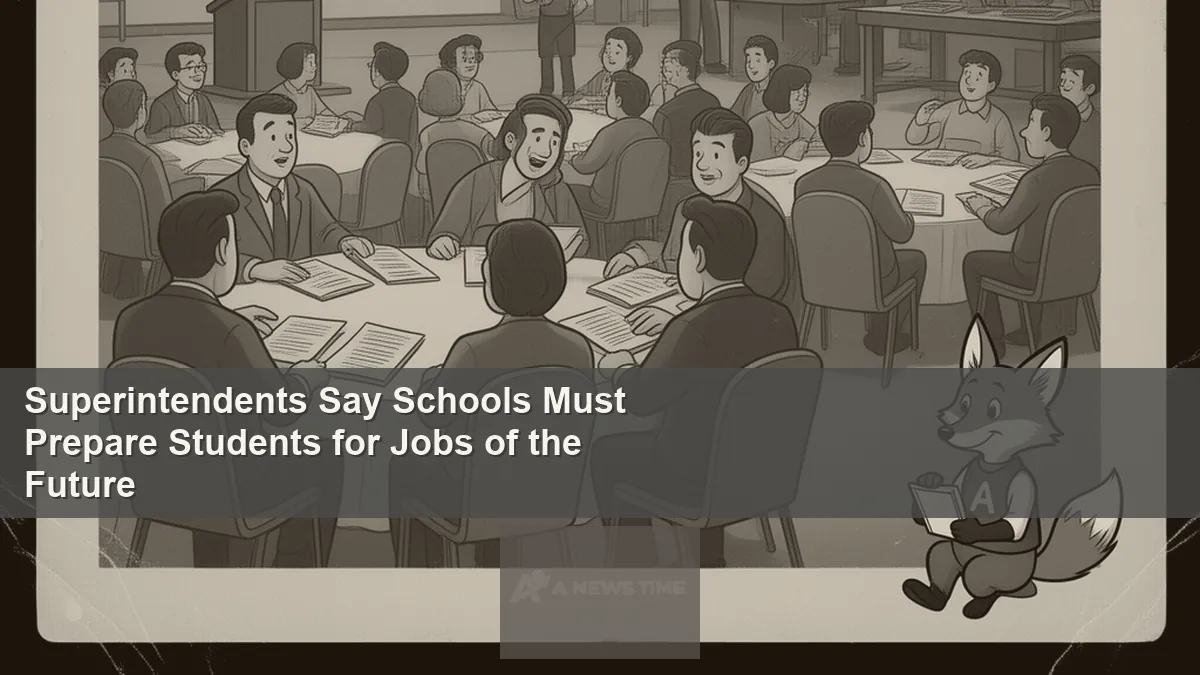
District leaders from across the United States convened in Nashville, Tennessee in for the annual National Conference on Education hosted by AASA, the School Superintendents Association, with one question dominating the agenda: how do schools prepare students for jobs that may look fundamentally different by the time those students enter the workforce?
The conference theme, "the future is ready," signaled a shift in how superintendent organizations are framing the challenge. Rather than treating career readiness as a supplement to academic preparation, the sessions presented employer partnerships, CTE credentials, and work-based learning as core components of what a high school education should deliver in 2026.
"It's really about making sure that all students have a pathway. It's not only about learning the best research, but seeing districts that put it into practice."
Kristine Gilmore, Chief Leadership and Learning Officer, AASA, and former superintendent
The gathering drew district leaders who are running what Gilmore described as a growing national experiment: aligning K-12 programming to the specific industries and employers that anchor local economies, rather than offering generic college-prep tracks that leave many students without either a credential or a career connection at graduation.
Career-Connected Learning Moves to the Center
For years, career and technical education occupied the margins of high school curriculum design, viewed by many administrators as a track for students who were not headed to four-year colleges. That framing has shifted materially since 2023. The combination of employer complaints about entry-level readiness, a tighter labor market for skilled positions, and data showing that students in structured CTE programs have lower dropout rates has pushed career-connected learning into mainstream district strategy discussions.
Nick Polyak, superintendent of the 3,500-student Leyden Community High School District north of Chicago, has built his district's entire program model around this approach. Students select coursework that aligns with a menu of career pathways and earn professional credentials before graduation, giving them both a resume item and a skills verification that employers in the region recognize.
"We live in one of the most advanced manufacturing hubs in the country, and kids can go earn six figures if they want right out of high school. The program we are running here makes perfect sense, but it might not make sense in the next district over."
Nick Polyak, Superintendent, Leyden Community High School District, Illinois
The local specificity point matters. Polyak's district has tailored its pathways to the skilled manufacturing sector that dominates the region north of Chicago. A district in a finance-heavy metro or a healthcare corridor would need a fundamentally different menu. What transfers across contexts, Polyak argues, is the structural principle: connect students to what the local economy actually needs, not to a generic notion of what employers want.
The conference sessions reflected that variety. Leaders from Sheridan, Wyoming teamed up with a coalition of districts and a community college to allow students to earn English language arts credits through work-based learning experiences, a credit structure that expands who can participate without requiring schools to add new elective slots. Administrators from Talladega County, Alabama presented a career pathway specifically for students interested in cybersecurity careers. Leaders from Delavan-Darien, Wisconsin described a partnership with local contractors where students interested in the trades remodeled a farmhouse as a school project.
The Engagement Case for Career Pathways
Beyond workforce preparation, district leaders at the conference pointed to an engagement dividend that career-connected learning produces for students who have historically disengaged from traditional academic tracks. When students can see how coursework connects to a specific occupational outcome, the motivational structure of school changes in ways that attendance data reflects.
Polyak described the dynamic directly. "We all know that for kids, they need that hook to what they are passionate about," he said. The credential-plus-pathway model his district runs gives students something to work toward that exists outside the abstract college-admissions framework that dominates most high school programming.
This is not a new observation, but the conference framed it with new urgency. Public schools are operating in a competitive landscape that includes charter networks, private options, and homeschooling arrangements that are all drawing students and their associated funding. A school system that can demonstrate to families that students leave with marketable credentials alongside academic preparation has a distinct value proposition that generic academic tracks cannot match. That competitive dimension appeared repeatedly in how superintendents framed the case for career-connected investment to their school boards and communities.
The conference also addressed how rapidly entry-level job market conditions have shifted for new graduates, with several sessions examining what employers mean when they say they want "work-ready" candidates and how that differs from what students currently understand about workplace expectations.
AASA's Public Education Promise Framework
The Leyden superintendent leads a cohort that has been working within AASA's Public Education Promise initiative, a structured program that includes working groups focused on student-centered learning, business and community partnerships, measuring success, and staff recruitment and retention. The career-connected learning cohort spent months developing action plans, self-assessments, and flexible frameworks that districts with very different resource levels and labor market contexts can adapt.
Gilmore said the goal is to move quickly from conference learning to practical implementation. "We hope that people leave with pieces they can put into action immediately. It's really about identifying who is doing great work and making sure we can scale that work across the country."
Working groups from the initiative had already started sharing resources with AASA's member districts before the conference. More would follow in the weeks after Nashville, according to the organization. The framework is designed to be modular: a district that cannot immediately launch a full credential-bearing CTE pathway can start with employer advisory relationships or work-based learning credit structures and build from there.
The emphasis on scalable, flexible frameworks reflects a pragmatic read of the resource landscape facing most U.S. districts in 2026. Federal education funding is under pressure, and districts in rural areas or those serving high-poverty populations face particular constraints on building new program infrastructure. The conference sessions highlighted models that have worked at different resource levels, from large suburban districts with established industry partnerships to smaller rural systems building their first connections with regional employers.
What Employers Are Actually Asking For
A recurring theme across sessions was the gap between what district leaders believe employers want and what employer advisory boards actually say when asked directly. The two are not always the same. Employers in high-skill manufacturing, healthcare, and technology sectors consistently identify soft skills and workplace habits (punctuality, communication, the ability to receive feedback) alongside technical knowledge as the primary differentiator between candidates who succeed and those who wash out of their first role.
This aligns with national data. A 2026 survey conducted by NACE, the National Association of Colleges and Employers, found that employers rate professionalism and work ethic as the most important attributes they screen for in early-career hiring, ahead of major-specific technical knowledge in most industries. The implication for K-12 programming is that work-based learning experiences, which give students direct exposure to professional norms before graduation, may be as valuable as the specific credential earned.
Polyak acknowledged the tension this creates. "The program we are running here makes perfect sense" in his region's manufacturing context. But the broader lesson, he argued, is less about specific sectors and more about the process: engaging employer advisory boards, using their input to design curriculum and credential requirements, and creating structured experiences where students can test and demonstrate professional readiness before they are competing for paid positions.
This connects to trends covered in recent research on the AI skills gap: technical preparation is increasingly table stakes, while the distinguishing factor in hiring is often the demonstrated ability to work effectively in a professional environment, something that classroom instruction alone rarely produces at scale.
Technology and AI in Career Preparation
Several sessions at the Nashville conference addressed how artificial intelligence is reshaping the skills landscape that career preparation programs need to target. The challenge is specific and practical: many of the occupational categories that CTE programs have built pathways around are experiencing AI-driven task automation at the entry level, which means the job descriptions students are training for in 2026 may look different by the time they are seeking employment in 2028 or 2029.
The response most districts are landing on is not to rebuild their entire CTE catalog around AI-specific programming, though some are doing that as well. The more widespread adjustment involves adding AI literacy and tool-use components to existing pathways. A student in a healthcare pathway learns how AI-assisted diagnostic tools work. A student in a business pathway learns how to audit AI-generated outputs rather than simply accepting them. The goal is workers who understand where AI sits in their occupational workflow, not just workers who can describe what AI is.
This mirrors the direction of federal workforce policy discussions. The Bipartisan Policy Center released a major report in calling for a unified national talent strategy specifically designed to address AI-fueled labor market disruption, with K-12 education identified as a critical but underutilized component of that strategy. The AASA conference covered that terrain from the practitioner side: what do district leaders actually do, given the constraints of existing curriculum structures, assessment requirements, and staff capacity?
According to Gilmore, the answer emerging from the most successful districts is to treat career-connected learning not as an add-on to the existing curriculum but as an organizing frame for it. When the local labor market becomes the reference point for what students are learning and why, the AI integration challenge becomes a specific, addressable question rather than an abstract disruption to manage.
What Comes Next for Districts
The National Conference on Education in Nashville was explicitly designed to move from aspiration to implementation. Gilmore said the organization would continue sharing resources from the conference's working groups with member districts in the months following the event. The career-connected learning cohort Polyak leads will continue developing its framework, with additional districts joining in subsequent cohort cycles.
For district leaders who attended, the immediate takeaways were practical: identify the two or three employers in your area who are consistently underserved by current graduate preparation, engage them in curriculum design conversations, and find at least one existing course where work-based learning credit can be piloted without requiring new legislative authority. Start there, measure it, and scale what works.
The broader question the conference surfaced is one that will persist well beyond Nashville. Global projections estimate that hundreds of millions of workers will need significant skills updates before 2027, and the K-12 pipeline is one of the few places where workforce preparation can be embedded before people enter the labor market rather than trying to reskill them afterward. Whether the district-level momentum visible at the AASA conference translates into systemic change depends substantially on whether the federal and state policy environment evolves to support it or continues to lag the pace of labor market change.
Frequently Asked Questions
What is career and technical education (CTE)?
Career and technical education refers to organized programs that provide students with academic and technical knowledge and skills needed to prepare for further education and careers. CTE programs cover a wide range of industry sectors, from manufacturing and healthcare to information technology and finance. Modern CTE programs typically include work-based learning components such as internships, apprenticeships, or employer-sponsored projects alongside classroom instruction.
What is AASA and what does it do?
AASA, the School Superintendents Association, is a national professional organization representing school system leaders across the United States. It provides professional development, advocacy, and networking for superintendents and other district leaders. Its annual National Conference on Education is one of the largest gatherings of K-12 district administrators in the country, drawing several thousand attendees each year.
How do districts build employer partnerships for career-connected learning?
Districts typically start by forming employer advisory boards composed of local business and industry representatives who provide input on curriculum design, credential requirements, and work-based learning opportunities. Some districts formalize these relationships through memoranda of understanding that outline specific commitments from both the district and the employer, including providing site visits, job shadowing, or paid internship placements for students.
Can students earn professional credentials before graduation?
Yes. Many CTE programs are designed to allow students to earn industry-recognized credentials, certifications, or licenses while still in high school. Examples include CompTIA IT certifications, OSHA safety credentials, Microsoft Office Specialist certifications, and healthcare credentials like nursing assistant licenses. These credentials are recognized by employers and, in many cases, articulate to community college programs, allowing students to avoid repeating coursework after graduation.
Sources
- Schools Must Prepare for Jobs of the Future, Superintendents Say - Education Week
- National Conference on Education 2026 - AASA, the School Superintendents Association
- How Career and Technical Education Is Evolving - Education Week
- NACE Research: Class of 2026 Hiring Outlook - National Association of Colleges and Employers