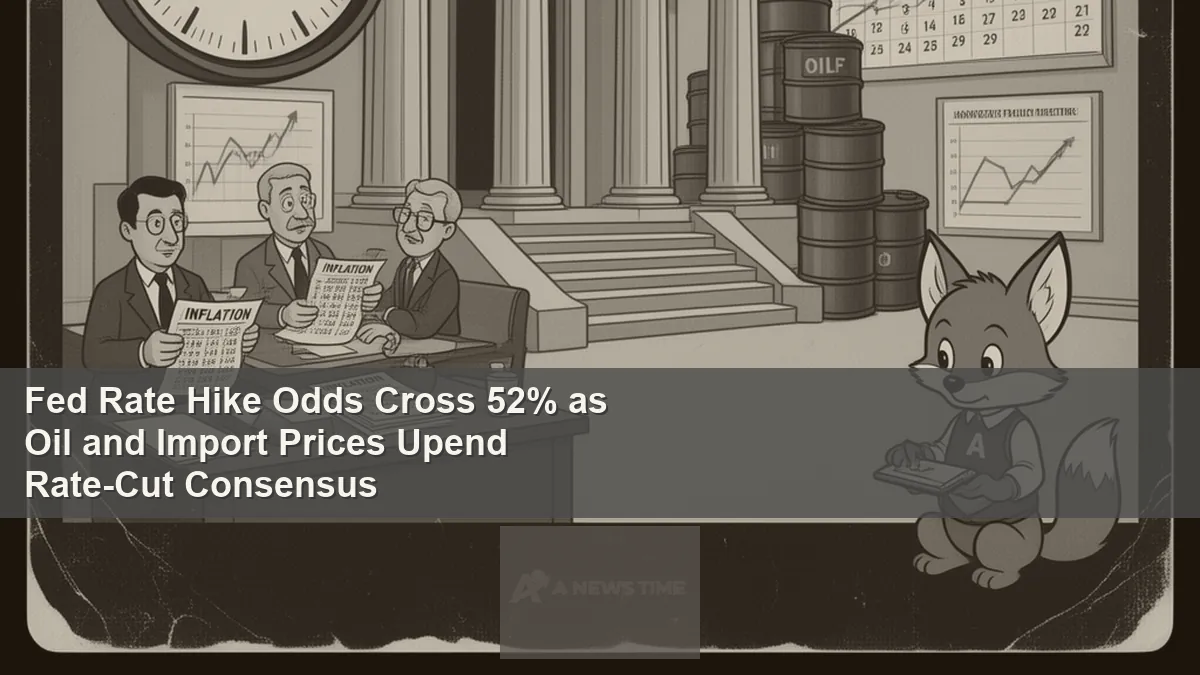
The probability of a Federal Reserve rate hike before the end of 2026 crossed 50% for the first time on , according to the CME FedWatch tool, which tracks federal funds futures contracts traded by institutional investors. The reading of 52% represents a market consensus that had seemed unthinkable at the start of the year, when traders were pricing in multiple rate cuts and economists debated only the timing and pace of easing. What changed was oil, import prices, and a sequence of inflation data points that collectively shattered the assumptions underlying the Fed's own March projections.
The Federal Open Market Committee (FOMC), at its March meeting, reached a consensus that one rate cut remained the most likely outcome for 2026. Markets have now moved decisively past that projection. CME data shows a 0% probability of any cut at the April 28-29 meeting and a 0% probability for any cut this year. The question on the table has shifted from "how many cuts?" to "is the next move a hike?"
What Drove the 180-Degree Turn
Three data releases in quick succession reset market expectations. The first was Brent crude, which topped $110 per barrel in the week of March 24-28, a level that feeds directly into transportation costs, food production, and the headline inflation figures that shape Fed deliberations. The Iran conflict, which began February 28, has removed a meaningful share of Persian Gulf export capacity from global oil markets, and the disruption has proven more persistent than futures markets initially priced.
The second data point was the Bureau of Labor Statistics report on import and export prices. Import prices jumped 1.3% in February, the largest monthly increase since March 2022. Export prices rose 1.5%, the biggest single-month gain since May 2022. Both figures arrived well above economist forecasts and pointed to inflation entering the domestic pipeline from multiple directions simultaneously: energy coming in through import costs, and U.S.-produced goods being sold abroad at accelerating prices that signal underlying cost pressures across the supply chain.
The third was the OECD's revised U.S. inflation forecast. The organization raised its 2026 projection to 4.2%, far above the Fed's own estimate of 2.7% published at the March meeting and more than double the Fed's stated 2% target. The OECD forecast, if it proves correct, would represent the highest annual inflation since 2022 and would occur at a moment when the Fed is holding rates at 3.50%-3.75%, well below the levels it maintained during the 2022-2023 tightening cycle.
The Fed's Own Signals: Confidence With an Asterisk
FOMC Vice Chair Philip Jefferson addressed the economic situation in a speech on , and his language illustrated the bind the central bank finds itself in. Jefferson acknowledged directly that the Iran war "complicates, at least in the short term, the picture on both sides of our dual mandate of maximum employment and price stability," adding that the conflict carries "downside risk to the labor market and upside risk to inflation." That formulation, acknowledging simultaneous pressure in both directions, is the textbook definition of the stagflation dilemma that makes monetary policy setting exceptionally difficult.
Jefferson nonetheless concluded that "our current policy stance is well positioned to respond to a range of outcomes," a statement of institutional confidence in the existing rate level of 3.50%-3.75%. The careful wording is notable: he did not argue that the current policy stance is appropriate forever, nor that no adjustment is coming. He argued it is positioned to respond, a phrase that accommodates movement in either direction.
"The Iran war and oil prices complicates, at least in the short term, the picture on both sides of our dual mandate of maximum employment and price stability, adding downside risk to the labor market and upside risk to inflation. I am confident that our current policy stance is well positioned to respond to a range of outcomes." — Philip Jefferson, Vice Chair, Federal Reserve
The FOMC's April 28-29 meeting carries only a 6.2% probability of a hike, according to CME data. That means markets do not expect the Fed to move next month. What has shifted is the longer horizon: traders now believe that by the time 2026 ends, the Fed will have raised rates, and the 52% reading reflects the balance of probabilities for moves at the June, July, September, or November meetings that follow April.
Market Probability Timeline: How Expectations Shifted
| Date | Market Expectation for 2026 | Cuts Priced In | Hike Probability |
|---|---|---|---|
| January 2026 | Multiple cuts, easing cycle underway | 2-3 cuts | Near 0% |
| February 28, 2026 (Iran war begins) | Cuts delayed, inflation risk rising | 1-2 cuts | Below 10% |
| Early March 2026 (FOMC meeting) | One cut consensus, late-year timing | 1 cut | Below 20% |
| Mid-March 2026 (oil at $105+) | Cuts pushed to December or beyond | 0-1 cuts | 30-35% |
| No cuts expected; hike now more likely than not | 0 cuts | 52% |
The Inflation Picture in Detail
The OECD's 4.2% forecast for U.S. inflation in 2026 sits significantly above the Fed's own projection of 2.7%. That gap matters because monetary policy is calibrated against the Fed's internal models, not the OECD's. If the OECD is closer to correct, the Fed's current policy stance is, in real terms, accommodative rather than restrictive, a fundamentally different starting point that argues strongly for tightening rather than easing. The last time the Fed was described as "behind the curve" in a meaningful way was 2021-2022, when the transitory inflation narrative delayed aggressive rate hikes and allowed prices to become entrenched at 40-year highs.
The February import price data provides the most concrete near-term read. A 1.3% single-month jump in import prices, the largest since early 2022, reflects oil costs flowing directly through the price of shipped goods. When energy prices rise, every freight shipment, every flight, every trucking route becomes more expensive, and those costs are ultimately passed to consumers. The 1.5% export price gain adds a second layer: U.S. producers are raising prices on goods sold abroad, which signals that cost pressure is not purely an energy import story but reflects broader inflationary conditions across U.S. manufacturing and agriculture.
The transmission to consumer prices is not instantaneous. Typical lags between import price moves and consumer price index readings run four to eight weeks, which means the February import price data will show up in April and May CPI reports. Those are the readings that will be on the table when the Fed meets in late April and again in June, and they are likely to come in above the Fed's forecasts.
The OECD's forecast also comes in the context of already-elevated baseline inflation. The PCE price index, the Fed's preferred gauge, showed core inflation running at 3.1% as of the Q4 2025 data, according to the Bureau of Economic Analysis. That is already above the Fed's 2% target before oil has fully passed through. Adding energy-driven inflation on top of a core rate that has not yet converged to target creates a compounding problem: two separate inflation sources hitting simultaneously, with different lead times and different degrees of stickiness.
What the Recession Probabilities Say
The rate-hike probability does not exist in isolation. It competes directly with a parallel shift in recession expectations that complicates any simple narrative about the Fed's likely course of action. Moody's Analytics has placed recession probability at nearly 50%. Goldman Sachs has raised its estimate to 30%, up from 15% earlier this year, as detailed in reporting on Goldman's recession forecast revision. EY-Parthenon and Wilmington Trust have both arrived at estimates above 40%.
These recession probabilities reflect the other side of the Fed's dual mandate. If the economy contracts, the Fed's mandate to maintain maximum employment would argue for rate cuts or at minimum rate holds, directly countering the inflation mandate that argues for hikes. The term for this situation is stagflation, a portmanteau of stagnation and inflation that became the defining economic problem of the 1970s. The Fed has relatively few tools for solving stagflation, and the tools it does have tend to address one side of the problem at the expense of the other.
The key numbers to watch are employment and wages. If the labor market remains relatively tight, the Fed can credibly argue that rate hikes address inflation without causing undue employment damage. If employment begins deteriorating sharply, as Q4 GDP data revised down to -0.7% had already begun to suggest, the case for hikes weakens even as inflation data argues for them.
- Moody's Analytics: ~50% recession probability
- Goldman Sachs: 30% recession probability (raised from 15%)
- EY-Parthenon: 40%+ recession probability
- Wilmington Trust: 40%+ recession probability
- CME FedWatch (hike probability by year-end): 52%
The near-term market stress is also visible in equities. As covered in five consecutive weeks of S&P 500 losses through March 2026, equity markets have been pricing in exactly this deteriorating macro backdrop. That market signal reinforces the recession-probability estimates and puts the Fed in the position of potentially hiking into a weakening economy, precisely the error critics said it made in 2022 but in the opposite direction.
The Dual Mandate in Conflict
The Federal Reserve's statutory mandate, set by Congress, requires it to pursue "maximum employment, stable prices, and moderate long-term interest rates." In practice this is interpreted as a dual mandate: full employment and price stability (defined operationally as 2% inflation on the PCE index). When inflation is high, the Fed raises rates to cool demand. When unemployment rises, it cuts rates to stimulate growth. The policy is relatively straightforward when the two objectives point in the same direction.
When they diverge, as Jefferson explicitly acknowledged in his March 26 speech, the Fed must make a judgment call about which mandate is under greater threat and act accordingly. The 2021-2022 experience showed the cost of prioritizing employment (or deeming inflation transitory) over price stability: the Fed had to raise rates 525 basis points in 12 months, triggering a housing market shock and nearly a dozen bank failures. The current configuration suggests the Fed is trying not to repeat that mistake, but it faces a labor market that is showing genuine weakness alongside inflation data that is genuinely alarming.
The difficulty is compounded by the fact that oil-driven inflation is, in an important technical sense, a supply shock rather than a demand shock. Raising interest rates reduces demand. It does not increase oil supply or reopen the Strait of Hormuz. Rate hikes address oil-driven inflation only indirectly, by dampening consumer spending enough to offset the price increases. That is a blunt instrument for a precise problem, and it carries real costs in terms of jobs, housing activity, and business investment. The OECD's assessment that the Iran war erases the global growth upgrade underscores just how significant those costs have already become globally, before any additional rate action.
What Borrowers and Markets Face
For consumers and businesses, the 52% hike probability translates directly into borrowing cost expectations. Mortgage rates, which had been declining through early 2026, have already reversed course. Credit card rates, auto loan rates, and business credit lines are all priced off the federal funds rate or the 10-year Treasury yield, both of which respond to Fed policy expectations. As detailed in coverage of mortgage rates jumping following the Iran war's impact on housing, the reversal in rate expectations has already shown up meaningfully in home financing costs.
For equity markets, a rate-hike scenario carries a double negative: it compresses the valuation multiples that justify equity prices (higher discount rates reduce the present value of future earnings) while simultaneously signaling deteriorating economic conditions that reduce those future earnings. The combination is what drives the correlation between rising rate-hike odds and falling stock indices, as seen in this year's equity performance.
For savers, counterintuitively, a hike cycle that keeps rates elevated or pushes them higher is relatively favorable. High-yield savings accounts and money market funds would benefit from sustained rate levels, and the case for holding cash at 4%-plus yields remains intact if the Fed abandons its cut timeline. As covered in reporting on high-yield savings accounts in March 2026, depositors who locked into competitive rates earlier this year stand to benefit if cuts are postponed or reversed entirely.
The April 28-29 Meeting: What to Watch
The FOMC's April meeting carries only a 6.2% probability of a hike at the meeting itself. That means the April decision is, barring a major data surprise in the next four weeks, almost certainly a hold. What matters about April is the statement language, the Summary of Economic Projections if one is released, and the press conference tone from Chair Jerome Powell.
If the Fed drops or softens its reference to "one cut expected this year," which was the March consensus, markets will interpret that as a signal that the tightening bias is firming. If the statement introduces explicit language about "monitoring upside inflation risks" or "prepared to adjust policy if inflation proves persistent," that is a clear signal to traders that the hike scenario is being prepared. Conversely, if the statement emphasizes labor market risks and downside growth risk, markets may read that as the Fed tilting back toward easing, which would likely push back against the 52% hike probability.
Beyond April, the key data releases that will determine the Fed's course are the April and May CPI reports, the March and April jobs numbers, and any further moves in oil prices. If Brent crude stabilizes or retreats from $110 as the conflict dynamics shift, the inflation pressure may ease before it fully transmits to consumer prices. If oil pushes higher, toward the $115-$120 range that some commodity strategists have projected in extended conflict scenarios, the case for a hike hardens further, and the 52% probability could move well past 60%.
The Fed's next move will not be determined in any single meeting. It will be determined by the cumulative weight of employment data, inflation readings, and oil prices over the next three to four months. What the 52% probability tells us is that for the first time in this cycle, markets have concluded that the path of least policy error runs through higher rates, not lower ones, a judgment that would have seemed implausible at the start of 2026.
Sources
- CNBC: Fed rate hike odds cross 50% threshold on CME FedWatch, March 27, 2026
- Bureau of Labor Statistics: U.S. Import and Export Price Indexes, February 2026
- OECD: Economic Outlook Interim Report, March 2026: U.S. inflation revised to 4.2%
- Federal Reserve: Speech by Vice Chair Philip Jefferson, March 26, 2026