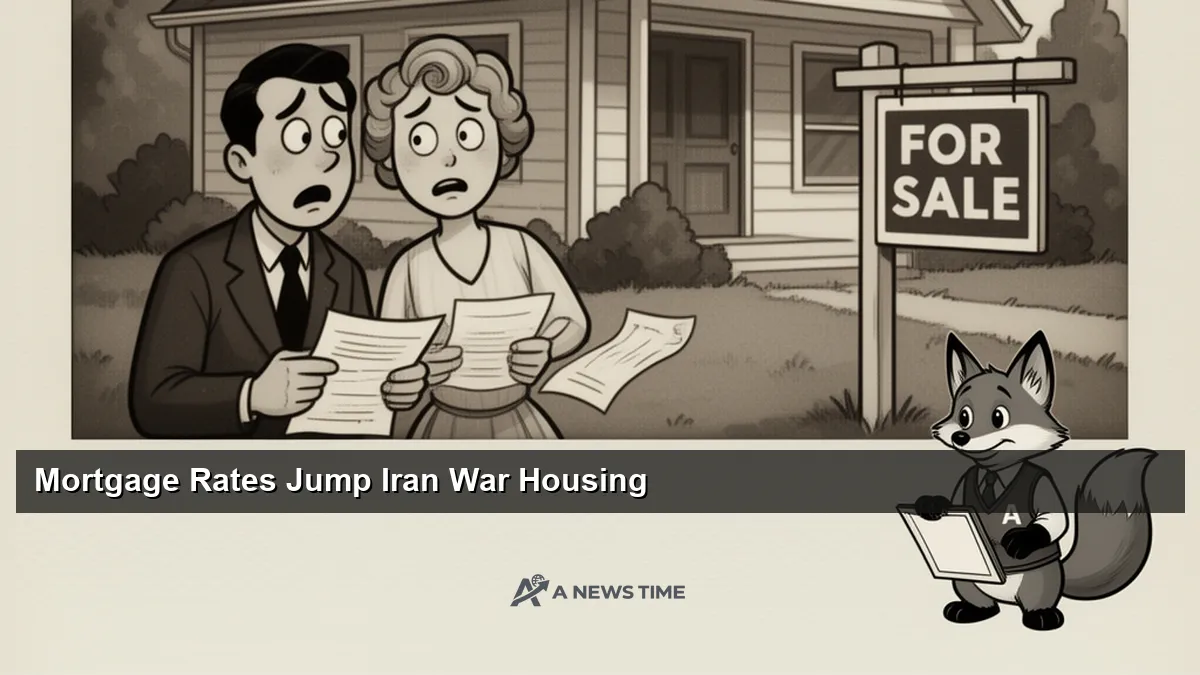
The average rate on a 30-year fixed-rate mortgage climbed to 6.38% this week, its highest level since October 2025 and the fourth increase since the U.S.-Iran military conflict began reshaping financial markets in late January. The rate, reported by Freddie Mac's Primary Mortgage Market Survey, represents a 47-basis-point increase from the 5.91% recorded in the first week of January, before the conflict's economic effects began rippling through bond markets, inflation expectations, and the Federal Reserve's policy calculus. For a homebuyer purchasing a $400,000 property with a 20% down payment ($320,000 mortgage), the rate increase translates to approximately $98 more per month in mortgage payments, or roughly $35,280 in additional interest costs over the life of a 30-year loan.
The connection between a military conflict in the Persian Gulf and the monthly mortgage payment on a house in suburban Ohio may not be immediately obvious, but the financial plumbing that links them is straightforward. Mortgage rates are primarily determined by the yield on 10-year U.S. Treasury bonds, which in turn reflect investor expectations for inflation and Federal Reserve interest rate policy. The Iran conflict has pushed oil prices above $109 per barrel, feeding into inflation expectations. Higher inflation expectations have pushed Treasury yields higher. Higher Treasury yields have pushed mortgage rates higher. The transmission takes a few weeks, but it is mechanical and reliable.
How We Got From 5.91% to 6.38%
Tracking the four rate increases since January reveals how the conflict's escalation has been progressively priced into the mortgage market.
The first increase came in the week ending February 7, when the average 30-year rate rose from 5.91% to 6.04%. This followed the initial U.S. military strikes against Iranian nuclear facilities in late January and the first significant jump in oil prices (Brent crude rose from $78 to $86 per barrel). The mortgage market's response was modest, reflecting the prevailing expectation that the conflict would be limited in scope and brief in duration.
The second increase arrived in the week ending February 28, pushing the rate to 6.18%. The catalyst was the naval engagement near the Strait of Hormuz, which raised the possibility of sustained disruptions to global oil shipping. Oil jumped to $95 per barrel. The 10-year Treasury yield, which had been hovering around 4.30%, rose to 4.42%. Mortgage lenders, who add a spread of approximately 170 to 200 basis points above the 10-year yield to determine their offered rates, adjusted accordingly.
The third increase, in the week ending March 14, brought the rate to 6.28%. The OPEC meeting's failure to agree on production increases and the diplomatic back-channel talks between Washington and Tehran drove this move. Oil pushed through $100 per barrel for the first time since 2022, and the 10-year yield climbed to 4.50%.
The fourth increase, reported this week, brought the rate to 6.38% following the collapse of diplomatic negotiations, an Iranian missile test, and a Goldman Sachs research note that raised U.S. recession odds to 30%. The 10-year Treasury yield closed the week at 4.58%. The New York Times reported that the trajectory of rate increases has effectively erased the improvements that had been made in the second half of 2025, when the market had been pricing in Fed rate cuts that now appear unlikely.
The Affordability Math
Mortgage affordability is a function of three variables: the home price, the interest rate, and the buyer's income. Two of those three variables have moved against buyers in 2026. Home prices, while growing more slowly than during the pandemic frenzy of 2020-2022, are still rising at a national rate of approximately 3.8% year over year, according to the S&P CoreLogic Case-Shiller index. And mortgage rates have increased by 47 basis points since January. Only incomes have provided some relief, with average hourly earnings growing at approximately 4.1% year over year, though that figure is partially offset by inflation.
To illustrate the affordability squeeze: consider a household earning the national median income of approximately $78,000, looking to purchase a home at the national median price of approximately $390,000 with a 20% down payment. At the January rate of 5.91%, the monthly principal and interest payment on a $312,000 mortgage would have been approximately $1,856. At the current rate of 6.38%, the same mortgage carries a monthly payment of approximately $1,950, an increase of $94 per month.
That $94 per month difference, while not enormous in isolation, matters at the margin. Mortgage lenders typically require that a borrower's total housing costs (including property taxes and insurance) not exceed 28% to 31% of gross income. For a household at the median income, the rate increase effectively reduces their maximum affordable home price by approximately $15,000 to $18,000, all else being equal. In practical terms, the house they could have afforded in January is now slightly out of reach, or requires a larger down payment, or necessitates making an offer on a smaller or less desirable property.
"Every quarter-point increase in the mortgage rate prices approximately 1.3 million households out of the market for a median-priced home. The cumulative effect of the increases since January has narrowed the pool of qualified buyers by a meaningful margin."
Lawrence Yun, Chief Economist, National Association of Realtors
The Lock-In Effect Intensifies
The rise in mortgage rates does not only affect prospective buyers. It deepens the "lock-in effect" that has constrained the housing market since rates first surged in 2022. Approximately 60% of outstanding U.S. mortgages carry rates below 4%, and roughly 85% carry rates below 6%, according to Freddie Mac data. Homeowners with these below-market mortgages face a powerful financial disincentive to sell: doing so would require them to give up a low-rate mortgage and take on a new one at 6.38% (or higher, depending on timing and credit profile), dramatically increasing their monthly housing costs even if they purchase a comparably priced home.
The lock-in effect suppresses housing inventory because the potential sellers who would normally list their homes (to move for job opportunities, family changes, or lifestyle preferences) choose to stay put rather than accept the rate penalty. The National Association of Realtors reports that existing home sales in February 2026 ran at a seasonally adjusted annual rate of 3.95 million units, near the lowest level in over a decade and approximately 25% below the pre-pandemic average of 5.2 million. New listings remain roughly 20% below their 2019 levels.
The inventory shortage, driven by the lock-in effect, is why home prices have remained relatively resilient despite the affordability challenges. In a normal housing cycle, rising rates would reduce demand, which would increase the time homes spend on the market, which would put downward pressure on prices. But when supply is constrained even more severely than demand, prices can remain stable or even rise even as sales volumes decline. It is a market that is functionally frozen: too expensive for many buyers, too costly (in terms of rate sacrifice) for many sellers.
Regional Variation
The national average rate of 6.38% masks meaningful regional variation in both rates and their impact. Mortgage rates are not identical across markets; they vary based on local lending competition, state regulations, property tax levels, and borrower profiles. Markets with higher average credit scores and lower default rates tend to see slightly lower offered rates, while markets with higher risk profiles may see rates 10 to 25 basis points above the national average.
The impact of rate increases also varies dramatically by market. In high-cost metropolitan areas like San Francisco (median home price approximately $1.2 million), Los Angeles ($830,000), and New York ($650,000 for the broader metro area), a 47-basis-point rate increase translates to monthly payment increases of $250 to $400, a more substantial burden than in lower-cost markets where median prices are $250,000 to $350,000. These high-cost markets, which were already stretching affordability limits, are seeing the sharpest declines in buyer activity and the most pronounced slowdown in pending home sales.
Conversely, markets in the Midwest and South with lower median prices and higher relative incomes, places like Indianapolis, Columbus, Nashville, and Raleigh, have been more resilient. These markets were already more affordable at pre-conflict rates, and the additional monthly cost of the rate increase is small enough that it does not push a significant number of qualified buyers out of the market. The divergence between high-cost and moderate-cost markets is expected to widen further if rates continue to rise.
The Refinancing Window Has Closed
For homeowners who purchased or refinanced during the brief rate dip in late 2025 (when 30-year rates briefly touched 5.65%), the current rate environment has eliminated the refinancing opportunity that many were waiting for. Refinancing typically makes financial sense when the new rate is at least 50 to 75 basis points below the existing rate, after accounting for closing costs. With rates at 6.38% and rising, refinancing is now economically rational only for the small number of homeowners who still hold rates above 7%, primarily those who purchased during the peak rate period of October to December 2023.
The Mortgage Bankers Association's weekly refinancing index has fallen to its lowest level since October 2000, reflecting the near-total absence of refinancing activity. For mortgage lenders, whose revenue depends on both purchase originations and refinancing volume, the collapse in refinancing has been a significant drag on profitability. Several non-bank mortgage lenders have announced layoffs in Q1 2026, and the consolidation trend that has been reshaping the mortgage industry since 2022 is expected to accelerate.
New Construction: A Partial Relief Valve
New home construction has provided some relief to the supply-constrained market, though not enough to fundamentally alter the supply-demand imbalance. Housing starts in February 2026 ran at a seasonally adjusted annual rate of 1.38 million units, roughly flat compared to a year earlier. Single-family starts were approximately 975,000 units annualized, while multifamily starts (apartments, condos) accounted for the balance.
Builders have responded to the lock-in effect on existing homes by capturing a larger share of total home sales. New homes now account for approximately 16% of all home sales, up from the historical average of 10 to 12%. National builders like D.R. Horton, Lennar, and PulteGroup have used their scale and financial resources to offer buyer incentives, including mortgage rate buydowns (where the builder pays upfront to reduce the buyer's rate for the first one to three years), closing cost credits, and upgrades. These incentives effectively reduce the net cost of a new home and have helped sustain new home sales volumes even as existing home sales have slumped.
The challenge for builders is that the same factors pushing mortgage rates higher, elevated Treasury yields, persistent inflation, geopolitical uncertainty, also increase construction costs. Lumber prices have risen approximately 8% since February on supply chain concerns, and labor costs continue to grow at 4 to 5% annually in the construction sector. Builder confidence, measured by the NAHB/Wells Fargo Housing Market Index, fell to 39 in March from 44 in January, below the 50 threshold that separates optimism from pessimism among builders.
The Rental Market Spillover
When potential homebuyers are priced out of the purchase market, they remain in the rental market, adding to demand and supporting rent levels. This dynamic has been playing out since 2022, and the latest rate increase reinforces it. National median asking rents have risen to approximately $1,980 per month, according to Zillow data, an increase of approximately 3.4% year over year. In high-demand metropolitan areas, the increases are larger: rents in New York, Miami, and Boston have risen 5 to 7% over the same period.
The rental market's strength is a double-edged sword for the economy. For landlords and multifamily real estate investors, it supports property values and rental income. For tenants, it represents an additional cost pressure on household budgets that are already being squeezed by higher energy prices and general inflation. For the Federal Reserve, persistent rent increases feed directly into the shelter component of the CPI and PCE inflation indexes, making it harder to bring measured inflation back to the 2% target. The shelter component of CPI, which accounts for roughly one-third of the index, rose 5.2% year over year in the most recent data, the single largest contributor to above-target inflation.
The connection between mortgage rates, homeownership affordability, rental demand, and measured inflation creates a feedback loop that the Fed cannot easily break with interest rate policy alone. Higher rates push would-be buyers into the rental market, which pushes rents higher, which pushes measured inflation higher, which keeps rates higher. Breaking the loop requires either a significant increase in housing supply (which takes years) or a reduction in demand (which typically occurs through job losses during a recession, a cure that is worse than the disease).
What Comes Next
The direction of mortgage rates from here depends primarily on two factors: the trajectory of the Iran conflict and the Federal Reserve's response to the economic data it generates. If the conflict is resolved or de-escalated, oil prices would likely fall, inflation expectations would moderate, Treasury yields would decline, and mortgage rates would follow. A return to the 5.65% to 5.90% range that prevailed in late 2025 is plausible in a scenario where the conflict ends and the Fed resumes its rate-cutting path.
If the conflict persists or escalates, the opposite is more likely. Goldman Sachs projects Brent crude at $115 in April, and if that forecast is realized, the resulting inflation pressure could push 10-year Treasury yields to 4.70% or higher, translating to 30-year mortgage rates in the 6.50% to 6.75% range. At 6.75%, the monthly payment on a $320,000 mortgage would be approximately $2,076, an increase of $220 per month compared to January, enough to materially reduce the pool of qualified buyers and further depress home sales volume.
The Mortgage Bankers Association's March forecast, updated after the latest rate data, projects that 30-year rates will average 6.20% for the full year 2026, reflecting an assumption that rates will decline modestly in the second half as the conflict's effects moderate and the Fed begins cutting rates. That forecast contains significant uncertainty bands: the MBA's "adverse scenario" envisions rates averaging 6.60% and their "favorable scenario" sees rates averaging 5.80%. The range itself tells the story. The housing market, like the rest of the economy, is being held hostage by events in the Persian Gulf, and the monthly payment that determines who can and cannot afford to buy a home in America is being set, in part, by the trajectory of a missile test in the Strait of Hormuz.