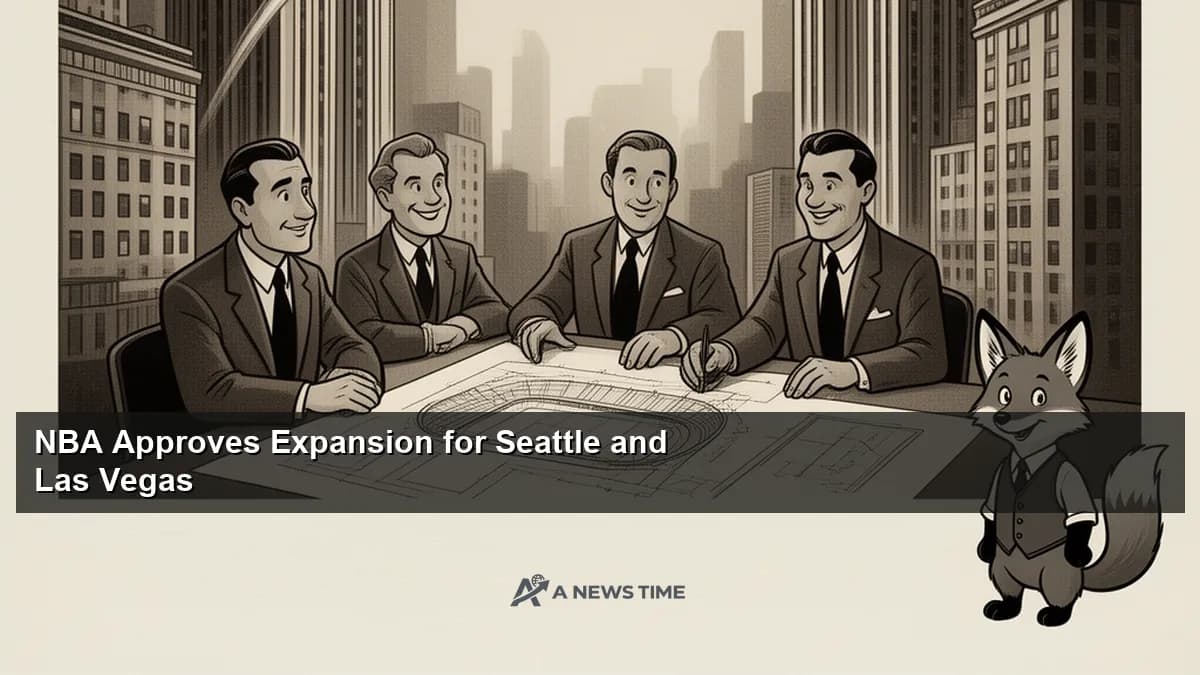
The NBA Board of Governors has voted to formally explore expansion into Seattle and Las Vegas, a decision that brings the league closer to its first new franchises since the Charlotte Bobcats joined in 2004. Commissioner Adam Silver confirmed the vote in , stating that the decision "reflects our Board's interest" in growing the league's footprint. The league has hired PJT Partners as its strategic adviser to evaluate the financial, logistical, and competitive implications of adding two teams, with an expansion fee expected to exceed $6 billion per franchise.
What the Board of Governors Actually Approved
Precision matters here, and it is important to distinguish between what was approved and what was not. The Board of Governors did not approve expansion itself. They approved formal exploration of expansion, which is a procedural step that authorizes the league office to conduct detailed due diligence, engage with potential ownership groups, and commission the financial analysis necessary to set an expansion fee and timeline. It is a significant step, the most concrete action the NBA has taken toward expansion in over two decades, but it is not a final decision.
"Today's vote reflects our Board's interest in the potential of expansion and the vibrancy of these two markets. We have engaged PJT Partners to help us evaluate every aspect of this opportunity. No final decisions have been made, but this process will give us the information we need to make an informed choice."
Adam Silver, NBA Commissioner
The choice of PJT Partners as strategic adviser is notable. The firm has extensive experience in sports franchise valuations and previously advised on the sale of the Phoenix Suns, which set a then-record price of $4 billion in 2023. Their involvement signals that the NBA is treating this process with the financial rigor it demands. The expansion fee alone represents one of the largest single transactions in sports history, and the downstream effects on revenue sharing, draft logistics, and competitive balance require careful modeling.
Silver indicated that the earliest realistic timeline for new teams taking the court would be the 2028-29 season, though he cautioned that the process could take longer depending on the complexity of the issues that emerge during due diligence. That timeline would give the league approximately two years to complete ownership vetting, arena planning, and the logistical framework for an expansion draft.
The $6 Billion Question: Why the Fee Is So High
The projected expansion fee of $6 billion or more per franchise reflects the extraordinary growth in NBA franchise values over the past decade. When the Charlotte Bobcats paid $300 million to enter the league in 2004, the average NBA franchise was worth approximately $350 million. Today, the average franchise value exceeds $4.5 billion, per Forbes' most recent valuations, and several teams are worth north of $7 billion.
The expansion fee is calculated, in simplified terms, as the price a new ownership group must pay to receive an equal share of the league's collective assets: national media rights, revenue sharing, league-wide sponsorships, and the intellectual property of the NBA brand itself. The current 11-year, $76 billion media rights deal with Disney, NBC, and Amazon, which began in 2025, is the primary driver of the fee's size. Each of the current 30 teams receives approximately $230 million annually from that deal alone. Adding two teams dilutes each existing team's share unless the expansion fee is large enough to compensate, which is exactly what the $6 billion figure is designed to do.
For context, $6 billion per franchise would make these the most expensive expansion teams in the history of North American professional sports, surpassing the NHL's $650 million fee for the Seattle Kraken in 2021 and the NFL's theoretical expansion fee (which is estimated at $8 to $10 billion but remains hypothetical, as the NFL has not expanded since 2002). The scale of the investment underscores a fundamental truth about the modern sports business: owning a team in a major professional league is no longer merely a passion project for the ultra-wealthy. It is a financial instrument with predictable cash flows, significant appreciation potential, and a scarcity premium that increases with every passing year. The same dynamics driving massive venture capital investments in high-growth sectors are at work in the sports ownership market.
Seattle: A City That Never Stopped Wanting Its Team Back
The Seattle SuperSonics left for Oklahoma City in 2008, a departure that remains one of the most contentious franchise relocations in American sports history. The Sonics' 41-year run in Seattle (1967 to 2008) included one NBA championship (1979), three Finals appearances, and a fan base that was deeply connected to the team's identity. The relocation, driven by a dispute over arena funding, left a wound in Seattle's sports culture that has never fully healed.
In the 18 years since the SuperSonics' departure, Seattle has become an even more attractive market. The city's population has grown by over 25 percent, fueled by the tech industry boom that has made the Pacific Northwest one of the wealthiest metropolitan areas in the country. Average household income in the Seattle metro area now exceeds $120,000, and the city's demographics (young, affluent, diverse) align perfectly with the NBA's target audience.
The arena question, which was the central obstacle to retaining the SuperSonics in 2008, has been addressed. Climate Pledge Arena, which opened in 2021 as the home of the NHL's Seattle Kraken, is a state-of-the-art facility that can accommodate NBA basketball with relatively minor modifications. The arena's capacity of approximately 17,100 for basketball events is in line with NBA averages, and its premium seating inventory (suites, club seats, and courtside options) is among the best in any North American sports venue.
"This has been a long time coming. Seattle is a basketball city. It always has been. The fans here never gave up hope, and now it looks like that hope might actually become reality."
Paolo Banchero, NBA All-Star and Seattle native
Banchero's comments reflect a sentiment shared across the basketball community. Multiple current and former NBA players with ties to Seattle, including Jamal Crawford, Nate Robinson, and Brandon Roy, have been vocal advocates for the league's return to the city. The grassroots campaign to bring back the Sonics has been sustained and organized, with fan groups maintaining active social media presences, hosting watch parties, and lobbying local and league officials for nearly two decades. That level of sustained fan engagement is itself evidence of market viability.
Potential ownership groups for a Seattle franchise have already been identified, though the league has not publicly confirmed any candidates. The city's concentration of tech billionaires, including several with known interest in sports ownership, provides a deep pool of potential investors. The ownership vetting process will be one of the most scrutinized aspects of the expansion exploration, as the league seeks to ensure that new owners have both the financial resources and the long-term commitment to sustain a franchise in the market.
Las Vegas: The Sports Capital America Never Expected
If Seattle's case for expansion rests on nostalgia, market growth, and unfinished business, Las Vegas's case rests on momentum. The city has transformed itself from a sports afterthought into one of the most dynamic sports markets in North America over the past eight years, adding major professional teams at a pace that would have seemed impossible a decade ago.
The NFL's Las Vegas Raiders relocated from Oakland in 2020 and play in Allegiant Stadium, a $1.9 billion venue that has hosted Super Bowls and major events. The NHL's Vegas Golden Knights, who entered the league as an expansion team in 2017, won the Stanley Cup in their sixth season and have consistently ranked among the league's top teams in attendance and merchandise sales. The WNBA's Las Vegas Aces have become one of the premier franchises in women's professional sports, winning back-to-back championships in 2022 and 2023 and drawing some of the largest crowds in WNBA history.
The success of these franchises has answered the skeptics who questioned whether Las Vegas could support professional sports. The city's unique dynamics, including a tourism-driven economy, a growing permanent population, and a corporate hospitality market that has few parallels in the country, have proven to be assets rather than liabilities for sports franchises.
"Those fans deserve it. Las Vegas has shown, with the Raiders, the Golden Knights, and the Aces, that it is a world-class sports city. An NBA team there would be incredibly exciting for the league and for basketball fans everywhere."
Steve Kerr, NBA Head Coach
The arena situation in Las Vegas is still being finalized. Unlike Seattle, which has Climate Pledge Arena ready to host NBA games, Las Vegas does not currently have an NBA-ready arena. However, multiple proposals are in various stages of development, and the expansion timeline (2028-29 at the earliest) provides a window for construction or renovation. The most prominent proposal involves a new arena on the Las Vegas Strip, which would give the franchise the kind of location advantage that no other NBA team enjoys. Just as cutting-edge venues are redefining entertainment experiences, a Strip-adjacent arena could set a new standard for the NBA fan experience.
Competitive Implications: How Expansion Affects the League
Adding two teams would bring the NBA from 30 to 32 franchises, matching the NFL's current count and creating natural symmetry for scheduling and playoff formatting. The league is expected to reorganize into four eight-team divisions (or maintain the current six-division structure with adjusted alignment), and the playoff format may be revisited to accommodate the additional teams.
The expansion draft is where the competitive implications become most concrete. Historically, NBA expansion drafts have allowed existing teams to protect eight players, leaving the remainder of their rosters eligible for selection by the new franchises. Each existing team can lose at most one player. The result is typically a new team built from veteran role players, second-tier starters, and young players whose development timelines did not fit their original teams' competitive windows.
The track record of NBA expansion teams is mixed. The 1995 Toronto Raptors needed six seasons to make the playoffs. The 2004 Charlotte Bobcats needed six seasons to post a winning record. However, the modern NBA's salary cap structure, combined with the availability of high draft picks (expansion teams are typically guaranteed a top-five pick in their first draft), provides a faster path to competitiveness than was available in previous expansion eras. If managed well, a new franchise in 2028 could be competitive within three to four seasons.
The dilution effect on talent is the most commonly cited concern about expansion. Adding two teams means adding approximately 30 roster spots, which could theoretically reduce the average quality of play across the league. However, the NBA's global talent pipeline has expanded significantly in recent years. International players now constitute over 25 percent of NBA rosters, and the development infrastructure (G League Ignite, international academies, and improved college programs) is producing more NBA-ready players than at any point in history. The talent supply may well be sufficient to absorb two additional teams without a meaningful decline in quality.
The Economic Ripple Effects
Beyond the expansion fees, two new NBA franchises would generate significant economic activity in their respective markets. Construction or renovation of arenas, creation of team operations and front office jobs, game-day employment, and the secondary economic effects of hosting 41 home games per season (plus potential playoff games) all contribute to local economies.
The media rights implications are also significant. The NBA's current media deal was negotiated based on a 30-team league. Adding two teams, particularly in attractive markets like Seattle and Las Vegas, increases the total inventory of games and the geographic reach of the league's broadcast footprint. That expanded footprint could be leveraged in the next round of media rights negotiations, potentially increasing the per-team payout despite the dilution from additional franchises.
Merchandise and licensing revenue would also benefit. New teams bring new fans, new jerseys, new merchandise, and new narrative possibilities. The entertainment industry's model of expanding content to grow subscriptions offers a parallel: more teams mean more stories, more rivalries, and more reasons for fans to engage with the league's content ecosystem.
For the existing 30 ownership groups, the calculus is straightforward. If the expansion fees are high enough to compensate for revenue dilution (and at $6 billion per franchise, they almost certainly are), then expansion is a net positive. Each existing owner receives a share of the $12 billion in total expansion fees while retaining ownership of a franchise whose value continues to appreciate. It is, by almost any financial measure, a good deal for everyone involved.
What Comes Next
The formal exploration process is expected to take 12 to 18 months, during which PJT Partners will conduct financial modeling, the league office will evaluate ownership candidates, and the competition committee will develop proposals for the expansion draft, scheduling, and playoff formatting. Public updates will be infrequent, as the NBA prefers to control the narrative around major structural decisions. But the direction of travel is clear.
Seattle and Las Vegas represent two different visions of what an NBA market can be. Seattle offers history, loyalty, and a fan base that has waited 18 years for this moment. Las Vegas offers newness, ambition, and a market that has proven, against all expectations, that it can sustain professional sports at the highest level. Together, they would give the NBA a 32-team footprint that spans the continent and captures two of the most compelling sports stories in America.
The wait is not over. But for fans in Seattle and Las Vegas, the Board of Governors' vote represents something that has been missing for years: formal, institutional momentum toward a reality that once seemed impossibly far away. The NBA is not just interested in expansion. It is actively, formally, and financially exploring it. That is new, and that matters.
Byline: Aisha Mbeki, Senior Sports Reporter